By Ian Duggan, Te Aka Mātuatua – School of Science, The University of Waikato
The tree tomato (Solanum betaceum Cav.) is native to South America. However, in New Zealand it has long been popular in gardens, and Aotearoa is the primary commercial grower of the fruit outside of its native range. Further, like ‘kiwifruit’, New Zealand has been responsible for the ‘tamarillo’ moniker, which has become the standard commercial designation for the versatile fruit.
Early introductions and experiments
The first known record of the tree tomato in New Zealand has been widely attributed to the nursery of D. Hay and Son, near Parnell, Auckland, where it was advertised in their 1891-92 catalogue. They declare they obtained seed in 1891 from a gentleman who had it sent from the hill district of India, where the plant was growing almost wild.[i] However, thanks to the power of Papers Past, we can push the first known mention of the tree tomato in New Zealand back to an independent importation by George Mason of Claudelands Nursery, Hamilton. In May 1890, the Waikato Times reported, Mason had
…a novelty in his nursery in the shape of what is called a tree tomato. This has been raised from seed imported from Ceylon [now Sri Lanka], and has been grown under glass. The plant is now about a foot in height. It bears a fruit which somewhat resembles a tomato in appearance, but the flavour is said to equal that of an apricot. Mr Mason has also about fifty young plants, and these will soon be ready for disposal.[ii]
Advertisements for the fruit trees increased rapidly from this time, particularly in the North Island.
In June 1893 Murray Aston, a correspondent for the Otago Witness visiting Auckland, observed that in the northern city the usual commodities of life ranged pretty much the same in value as in Dunedin, with the important exception of fruit,
…which in comparison with the cost in Otago makes one conjecture that the public here [in Otago] are not being so fairly treated as they deserve. A most delicious fruit is the green fig”, he stated, “which seems quite plentiful up north, and are sold in the shops at 4d per lb… Another, to me novel and at the same time appetising, delicacy in the fruit line (also sold retail at 4d per lb) was the “tree tomato.” In flavour it was not unlike the passion fruit ; in shape it resembled an egg of the common fowl, and its colour was that of a bright, glass-grown, ordinary tomato. I have never seen any of these in Dunedin, and I feel sure they could be imported to yield a good profit to some of our enterprising fruiterers.[iii]
In November 1894 the Dunstan Times, from Central Otago, reported that a quantity of the fruit had been sold the previous season by fruiterers in Wellington, under the name of the ‘Queensland tomato’, which
…quite took the fancy of buyers”. “Although the fruit is said to be delicious, there is a great diversity of opinion as to its flavor [sic], some people thinking it tastes like tomato and guava, others like tomato and melon, and gooseberry. It is said to make excellent tarts and jam”.[iv]
No mention of the name ‘Queensland tomato’ can be found in print beyond this article, however.
Throughout these early years, only yellow- and purple-coloured strains were apparently available in New Zealand, with the red varieties that came to dominate being used only from around the end of World War One. A Mr Bridge, of Mangare, Auckland, is reported to have grown the first red strain in New Zealand at this time, though other strains of that colour were introduced soon after, including from the United States.[v]
Despite recipes galore appearing in newspapers, and its wide availability from nurseries in the decades before, the popularity of the fruit seemingly did not take hold until the 1940s, when the Sub-Tropical Fruits Association began to distribute pamphlets containing recipes within the containers of the fruit. In June 1947, A. B. Congdon, President of the New Zealand Fruitgrowers’ Association stated in an address to a party of fruit growers at Otumoetai that “In my opinion the Sub-Tropical Fruitgrowers’ Association started out on the right foot when they printed recipes on the treatment of tree tomatoes, to pack with the fruit”. He said that if that had not been done, possibly many people would have tried them raw, disliked them, and not bothered to have ordered any more.[vi],[vii]
A well-laden tree tomato branch. Sparrow Industrial Pictures Ltd. photo. New Zealand Journal of Agriculture 75: 280, 15 September 1947
In late 1947, the tree tomato was reported to be becoming increasingly popular in New Zealand. Because of an increased demand, the area under commercial cultivation underwent rapid expansion. It was estimated in 1947 that there were 136 acres under cultivation, with most of this comprising numerous small plantings of up to an acre in extent, with much of this small adjuncts to citrus culture on small holdings. The number of larger plantings was, however, also increasing. Plantings weren’t distributed evenly across the country, however. Being a sub-tropical shrub “and considerably more frost tender than the lemon”, its commercial culture was largely confined to the frost-free areas of the Auckland Province. By this time the red variety had become the most popular on the market and was thus planted in greater proportion.[viii]
An export industry
Export became a priority in the 1960s. It was reported in 1961 that, prompted by Government exhortations to get out and sell, a group of New Zealand tree-tomato growers had shipped sample packs of fruit to Melbourne, Hong Kong and Italy. Nevertheless, concerns had arisen at this time regarding the name of the fruit.
One of the snags to marketing the fruit in Australia, where it is almost unknown, is the prosaic name. Experienced businessmen in the Australian fruit trade thought it was some variety of tomato. Hopes centre on selling it overseas under its botanical name Solanum.[ix]
These sentiments were echoed in 1962, when exploring trade of fruit to Sydney:
Another fruit which is not yet well known is the tree tomato… exports would be increased if the Australian public realised that this fruit is not just another form of the familiar tomato.[x]
Cover of ‘Tree Tomato Growing’ by William Arthur Fletcher. NZ Dept. of Agriculture, 1965.
What’s in a name?
In response to these naming concerns, a new name was proposed – but it wasn’t ‘Solanum’. ‘Tamarillo’ was suggested by Mr W. Thomson of Kerikeri, the chairman of the Tree Tomato Advertising and Promotion Committee, and this was approved by grower associations and trade interests in February 1966.[xi] But where did the name Tamarillo come from? Was it a native South American name for the fruit? No! Thomson explained that:
The new name is the result of many months of extensive research… It is a composite name, the first section of which is associated with New Zealand and the second with South America, the countries of adoption and origin respectively.[xii]
…the first section of the composite name, Tama, had been chosen as a compliment to New Zealand, the country of adoption. It also had historical significance, Tama being the commander of one of the early migratory canoes which brought the Maoris (sic) to New Zealand from Polynesia. The Maori people sometimes used the names of people of rank when naming articles of value, including agricultural products. Tama blended well with the South American section of the name and had the advantage that it was easy to pronounce by people not used to the Maori language.
Mr Thomson stated the tree tomato was a native of Brazil and Peru: “In these two countries the fruit is known as Paolo de tomate and tomale de arbol, which, translated literally, means tree tomato”, he said. “Little help is gained, therefore, from the South American names, and likewise from the botanical name, Cyphomandra betacea Sendt [now Solanum betaceum].” “However, in the countries of origin there is a close relative of this family, the tomatillo, meaning a small tomato. “We are endeavouring to get away from the association with the word tomato, but as a compliment to the countries of origin the final portion of this word has been retained as Tillo. The letter T was replaced in Tillo to make it easier to pronounce.” The name Tamarillo was registered with the Patents Office and it was reported that it could be used for the coming season’s export crop.[xiii]
A date of January 31, 1967, was declared as when the tree tomato would be officially rebranded as the tamarillo, with the name applying to the fruit sold on the New Zealand market as well as for export.[xiv] A rebranding ceremony was held at Waitangi in April, attended by about 80 representatives of the Tamarillo Growing Association from Kerikeri, Te Puke and Auckland, where the first tamarillo harvesting season was declared open.[xv]
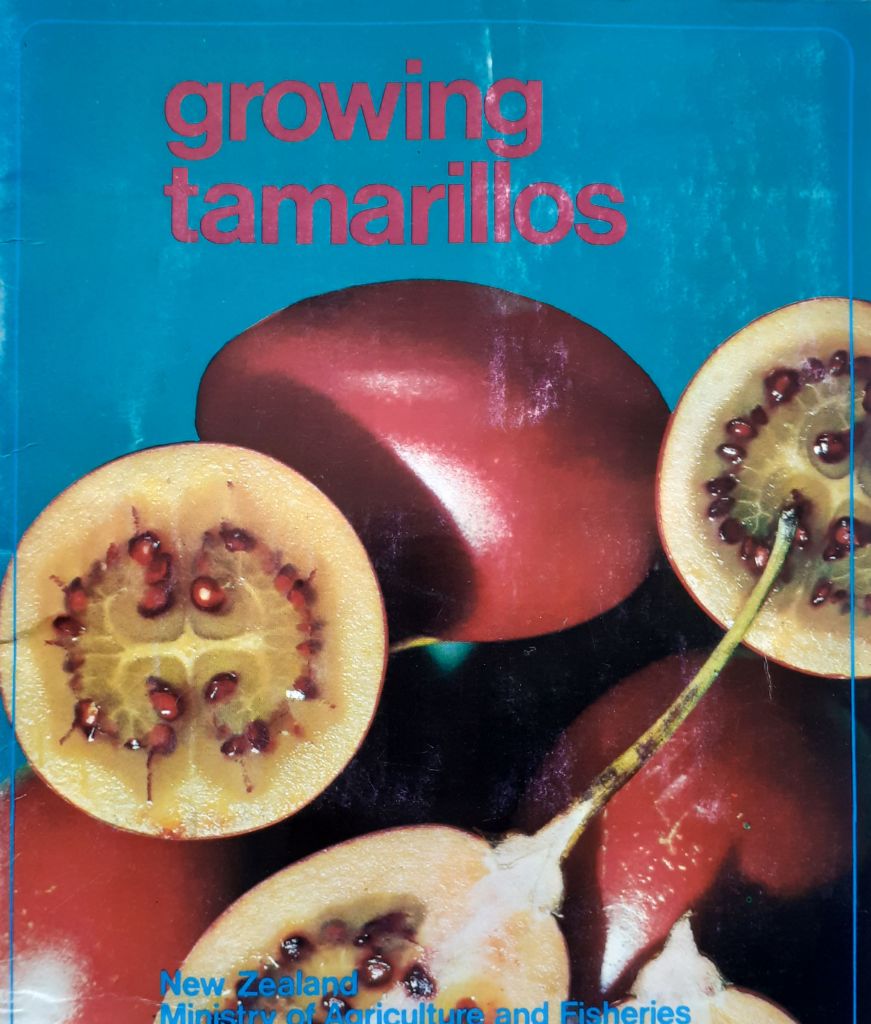
An update: the cover of ‘Growing Tamarillos’ by William Arthur Fletcher. NZ Dept. of Agriculture, 1975.
Not everything went to plan with the renaming, however. On 15 January 1970, for example, the name “tamarillo” printed on the label of cans was declared to be not adequate for the New South Wales Department of Health, with the department ruling that cans of the fruit imported from New Zealand must also carry the words “tree tomatoes.” Here, their Department of Health claimed that “tree tomato” was the commonly accepted English name for the fruit. In response, New Zealand trade officers stated that one reason why “tamarillo” was now preferred and used in New Zealand was that United States officials had objected to “tree tomato” as misleading:
“We changed it to get acceptance on the American market, but now find New South Wales doesn’t like the new term. You can’t win.”[xvi]
In 1977, a display of tamarillos and other fruits at department store Haywrights in Christchurch by the Kerikeri Citrus Growers’ Association. Mr D. Anning, one of the organisers of the display, stated that:
Tamarillos are one of the most underrated fruits. They can be eaten raw, sliced up for fruit salads and green salads, or added to chutneys, relish, and casseroles. They can also be stewed like other fruit and made into pies. How many people know that tamarillos have a great tenderising effect on meat?” said Mr Anning. He has been amazed during the week that many people are still unsure what tamarillos are. “They used to be called tree tomatoes,” Mr Anning said. “Many people are still confusing them with kiwi fruit, which changed their name from “Chinese gooseberries.”[xvii]
Nowadays, many of us still enjoy tamarillo, but I bet few of us know the origins of the name.
Advertisement, Press, 20 November 1982, P3
References
[i] Fletcher, WA. 1975. Growing Tamarillos. New Zealand Ministry of Agriculture and Fisheries, Bulletin. 306.
[ii] The Claudelands Nursery. Waikato Times, 17 May 1890, P2
[iii] A few noted on Auckland. Otago Witness, 1 June 1893, P35
[iv] Local and general. Dunstan Times, 2 November 1894, P2
[v] Fletcher, WA. 1975. Growing Tamarillos. New Zealand Ministry of Agriculture and Fisheries, Bulletin. 306.
[vi] Out and About. Bay of Plenty Times, 25 June 1947, P2
[vii] First General Meeting. Bay of Plenty Times, 2 July 1947, P2
[viii] Free Tomato Increasingly Popular Sub-tropical Fruit In Dominion. Bay of Plenty Times, 22 November 1947, P4
[ix] Tree Tomato Exports. Press, 17 October 1961, P12
“In Sri Lanka, there grows to this day, a tree, the oldest historical tree in the world.” – H.G. Wells
In late 2015, our family made a pilgrimage to the ancient city of Anuradhapura in Sri Lanka. The World Heritage site illustrates millennia of Sri Lanka’s cultural history and remains a lively contemporary religious and regional centre. Our visit coincided with the Ill Full Moon Poya day public holiday that draws crowds to the Thuparamaya – the most ancient of Sri Lanka’s stupas and the origin of Sri Lanka’s Buddhism, and to the ancient Jaya Sri Maha Bodhi – the oldest cultivated tree in the world with a documented written history. The veneration accorded this particular tree, especially by devotees of the Theravada Buddhist tradition, reflects the direct connection to the living Buddha.
The Jaya Siri Maha Bodhi was established from the southern branch of the peepal (or esathu) tree (Ficus religiosa) in whose shade the Buddha achieved enlightenment. This branch was brought to Sri Lanka from India in 236 BC by the Buddhist nun Sanghamitta Maha Theri, through the patronage of King Ashoka, a convert and powerful supporter of Buddhism – she is often referred to as his daughter, and accordingly, as a princess. So, the Jaya Sri Maha Bodhi is around 2,250 years old and from that origin has been steadfastly curated and protected by Buddhist monks and adherents. Such devotion to a tree deserves contemplation – certainly the tree is approached with piety for its connection with the Buddha but the tree is singular, and an individual in its own right. The achievement in protecting the tree demonstrates what good people can do.
Buddha’s enlightenment dates from around the 5th century BC and took place near the river Neranjana at Bodh Gaya in the Bihar State in northern India. The peepal tree was already a place of devotion, and after the Buddha’s enlightenment became identified as the Bodhi tree and consequently a pilgrimage site during His lifetime. Sanghamitta’s arboricultural endeavours turned out to be timely as subsequent arboricidal events show. King Ashoka’s second wife, Tisayaraksita, jealous of her husband’s love for the Bodhi (or perhaps the nymphs she believed it harboured), had the tree pierced by poisonous mandu thorns.[i] Although the tree regenerated, Ashoka subsequently built a three meter high stone wall (- elephants particularly like them). But within half a century the tree was destroyed by King Pushyamitra Shunga during his persecution of Buddhism. The tree planted to replace the Bodhi, possibly at that stage a scion from the original, was destroyed at the beginning of the 7th century AD – this time by King Sassanka. Thus there is considerable doubt as to whether the present tree at Bodh Gaya is even a scion of the original Bodhi. Indeed, the present tree planted by Alexander Cunningham, a British archaeologist in 1881 most likely represents the successor of a long line of substitutions. Such doubts over the provenance of the Bodhi tree at Bodh Gaya see the Jaya Sri Maha Bodhi at Anuradhapura viewed as the closest authentic link to the living Buddha and, consequently, as the preferred for scion wood for establishing the Bodhi trees that are now central to many Buddhist temples in Asia.
While the Bodhi tree is important to Buddhists, the tree that the Buddha chose to sit under was already a sacred tree in Hindu doctrine. In the Bhagavad Gita the Lord Krishna declares that, ‘Of all the trees I am the peepal tree’ and the peepal is mentioned as one of the names of Lord Vishnu in the Vishnu Sahasramana. In India sadhus choose them for meditation and many Hindus still practice pradakshina including circumambulation (meditative pacing) around peepal trees with an accompanying chant of ‘vriksha rajayanamah’ (‘salutation to the king of trees’). So while the Buddha chose the peepal tree, perhaps the peepal tree might also have chosen the Buddha.
Sacred trees aren’t isolated to Hinduism and Buddhism in human history. The earliest written chronicles including the Epic of Gilgamesh and the Bible record both the destruction and the planting of sacred groves. Hiking in the Simien Mountains of Ethiopia the only stands of trees still remaining are such sacred groves, including the ‘church forests’ associated with Ethiopian Orthodox Tewahedo churches and monasteries. In earlier times these sacred groves were revered by Agao pagans whose religious gatherings, sacrifices and burials were associated with the groves. These groves were apparently adopted by early Christian, and later, Islamic converts. The traditions associated with such groves are disappearing globally alongside the global destruction of forests and the globalisation of culture yet a profound truth in these relationships remains relevant. Reuters journalist Dean Yates outlined his experiences following the development of Post Traumatic Stress Disorder as a war correspondent. While professional help has been critical to his recovery, Yates witnesses the solace provided by the ancient trees of the Tasmanian wilderness. Trees play a critical role in food, water and climate security, but they also play a critical role in our spiritual wellbeing. Our future depends on them.
[i] Prof. B.M.P. Singhakumara, University of Sri Jayewardenepura observes that the madu thorn is found on the leaf bases of the cycad, Cycas circinalis, also known as Queen sago palm. However, the nature of the mandu thorn is still obscure.
The rise of civilisation could be seen as a series of transformations when populations started to see the world through a different lens, leading to profound and permanent change. They are the transformations that have shaped the modern world such as: the Reformation, Enlightenment, Romantic Period or the spread of the major religions. Each of these transformations was reflected in a different form of garden and these are the existing and proposed gardens in the Hamilton Gardens collection. In our next talk, Peter Sergel will explain this concept in more detail.
A copy of the book will be raffled at this talk and light refreshments served afterwards.
By Ian Duggan, Te Aka Mātuatua – School of Science, The University of Waikato
The hand push mower was invented in 1830, as a superior alternative to the labour-intensive scythe, and it was almost 100 years before the invention of the rotary motor mower. Through this time, mowers were typically propelled by a human, but occasionally other forms of horse-power have been utilised. This was the case at the Devonport Naval Base in Auckland in the early 1930s, from where various images appeared in the newspapers of their donkey driven lawn mower.
“Only a few wild animals are now required at the Devonport naval base to constitute a menagerie”, reported the Auckland Star in February 1931, “for at present there are a donkey and a number of sheep in the yard, and a dog and some cats on the [H.M.S.] Philomel”[i]
The Navy Gives a Party. A snapshot secured at the Devonport naval base yesterday, when the men of H.M.S. Philomel entertained children visitors. NZ Herald, 27 August 1931, P8 [via Papers Past].
The H.M.S. Philomel, it must be noted – as she maintains a central role in this story – was a steam powered naval “Pearl Class cruiser”, commissioned in 1890 by the Royal Navy. In 1914, already aged and largely obsolete, she was loaned to New Zealand. By this stage, seven of the only eight other Pearl-Class cruisers ever constructed had already been sold for scrap. Despite this, during World War One, the Philomel became New Zealand’s first warship, performing convoy escort duties around the Pacific, and carried out operations in the Mediterranean against the Ottoman Turkish forces. In 1921 she was transferred to the Devonport Naval Base for service, with engines removed, serving as a stationary training ship.[ii]
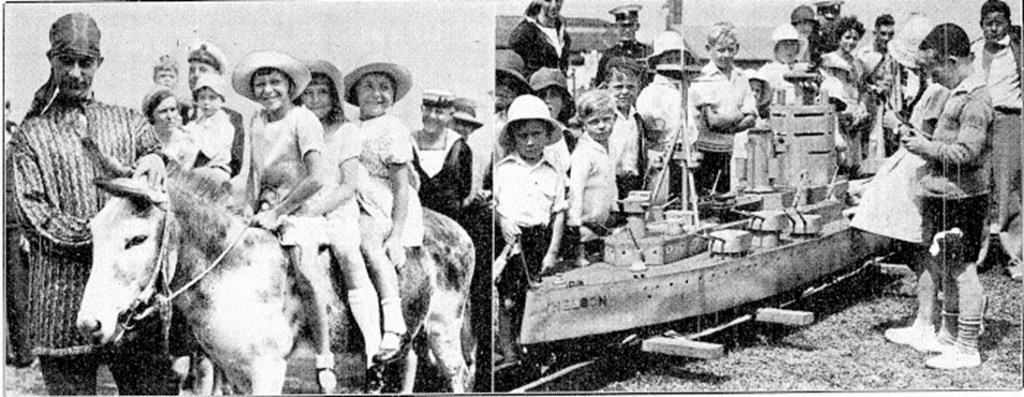
The donkey was a regular feature at naval base social events. For example, a “delightful party” was held in August 1931, when Commander E. L. Berthon and the officers of H.M.S. Philomel entertained about 100 children. “Donkey rides, a merry-go-round, games and many other amusements were provided by the ship’s crew for the entertainment of the little guests.”[iii] At an event later in the month, the Herald suggests there may have been more than one donkey on the base: “outside two donkeys moved in treadmill fashion all the afternoon, taking tiny excursionists on sightseeing trips about the base”.[iv] Nevertheless, at least one of these may have been a temporary visitor, as other contemporary reports seemingly relate to only a single donkey. Nevertheless, the use of a donkey was reported at similar events over several years. For example, in February 1932, around 1000 visitors attended a children’s party on the base, where Marine Miles was in charge of the donkey rides.[v] Similar rides were noted at events in 1933[vi] and 1934, also.[vii]
Children enjoying a donkey ride. NZ Herald, 18 January 1934, P6 [via Papers Past]
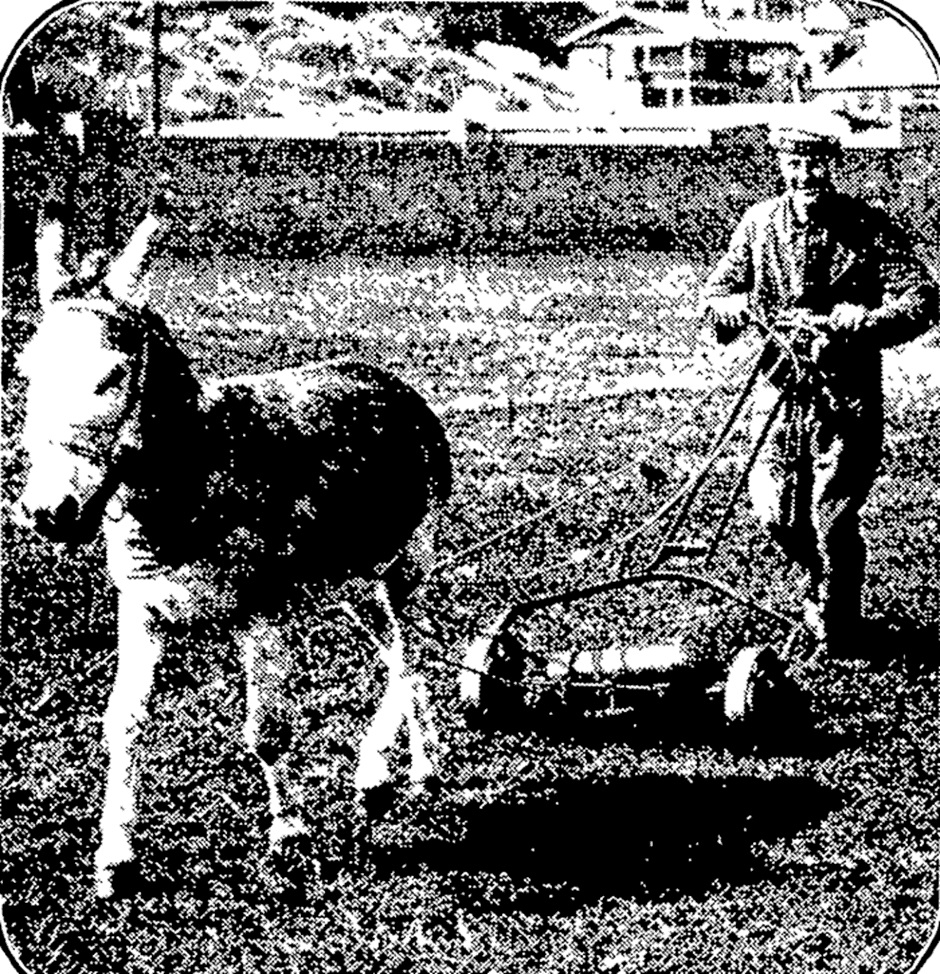
But our interest here isn’t on children’s entertainment, but on the contribution of the Devonport donkey to garden history. In November 1931, among the “News of the Day”, the Auckland Star reported under the heading, “Donkey Does His Bit”:
“Donkeys were common enough about Auckland some years ago, but to-day their braying is seldom heard. There is at Devonport, however, one donkey that not only interests young folk, but also earns his carrots. He is one of the mascots attached to the naval base, and this morning he might have been seen pulling the lawnmower which cuts the playing area on which the men of the squadron play their games. The donkey was acquired by an officer on H.M.S. Philomel, who has now returned to England, so it appears likely that the animal will spend the rest of its life at the navy yard”.[viii]
In February 1932, a photograph appeared in the New Zealand Herald under the title, “The Navy Solves a Problem”, where “One of the trainees at the Devonport Naval Base calls in the services of a donkey to assist in cutting the lawn which forms part of the reserve”.[ix] The remaining livestock quartered at the Naval Base at Devonport were soon after seriously depleted, with the entire naval flock of sheep, numbering three head, having disappeared due to not presenting a payable proposition – the flock were deemed “neither useful nor ornamental”. It was subsequently noted that “a somewhat temperamental donkey now grazes in solitary state on the playing fields at the base. The sheep, on the other hand, “were transported… to an unknown destination”, though it was stated that “it is understood that several needy families at Devonport were provided with enough fresh mutton for several meals”.[x]
‘The Navy Solves a Problem’. NZ Herald, 27 February 1932, P8 [via Papers Past]
Further images followed. In September the same year, another came with the caption “Novel Motive Power for the Lawnmower at the Naval Base: A sailor mowing the lawn at the Devonport Naval Base yesterday with the aid the navy’s pet donkey”.[xi]
‘Novel Motive Power for the Lawnmower at the Naval Base’. NZ Herald, 24 September 1932, P8 [via Papers Past]
A third image was published in March 1933, under the heading ‘A Naval Assistant’, with the byline: “The donkey at the Naval Base is a well-known figure and assists in keeping the lawns in perfect order”. It added an extra detail, “Note the shell used as a weight on the mower”.[xii]
A Naval Assistant (note the shell used as a weight on the mower). Auckland Star, 17 March 1933, P5
That the donkey was temperamental was echoed in a report on another Naval Base party in January 1934. While for the children that day was reported as “Joy Unbounded”, for the animal the Auckland Star noted: “The donkey, which usually draws the lawnmower on the recreation grounds, was used as a riding horse. The animal did not enjoy itself as much as the delighted children whom it carried. Still, it did not often refuse to go.”[xiii] Covering the same event, the New Zealand Herald noted the variety of events on the day: “The youngsters were invited to throw tennis balls at the head of an able seaman clown in an endeavour to remove his hat. Further on the same youngsters were handed bricks which they were permitted to hurl at shelves of crockery… There were hoop-las and skittle alleys and a miniature rifle range for older boys”. The donkey was noted in this report also: “The division’s donkey, which occasionally provides the motive power for the lawnmower on the recreation grounds, was also pressed into service and donkey rides were a popular feature”.[xiv] Following these three years of interest, however, the lawnmowing donkey apparently slipped into obscurity, presumably not ending up on the plates of the needy Devonport locals.
Interestingly, this donkey was not the first equine employed to mow the grass at the naval base. A decade earlier, in 1923, it was reported that the:
H.M.S. Philomel is probably the only ship in the Royal Navy that has a horse for a pet. If she went to sea there might be some difficulty about the horse, although there was a destroyer in the Mediterranean that carried a donkey. This animal, however, was signed on when it was a foal and it grew up on board, developing a fine set of sea legs and an astonishing capacity for rum. It could go down the gangway with the leave men and take its place in the picket boat as nimbly as the goat and some sailors aver that it could pull an oar. That however is another story.
The Philomel’s horse was won by a member of the crew in a half-crown raffle, and in the comfortable surroundings of the dockyard and football ground it has flourished exceedingly. A number of the men can now ride far better than any sailor should. The other day it was necessary to cut the grass on the football ground and the sailors thought their horse might lend a hand. Out of rope and canvas, something that resembled a set of harness was made and the animal was hitched to the mower. The rope reins, according to one sailor, were thick enough to moor a battleship. Three men undertook the mowing job. One held the mower handle and the reins, another had a whip and a third was on hand to give advice. Since joining the navy the horse has been given to understand that everything must be done “at the double,” so when the driver shouted “full steam ahead” and the others made encouraging sounds, he plunged into a gallop. “Hard astern,” or words to that effect came from the man giving advice, and the outfit was heaved to.
At this moment the ship’s goat, which sometimes is seen abroad with leave men, wearing a sailor’s jacket, took an interest in the proceedings. Possibly he made some sarcastic remarks to which the horse objected. At any rate the horse shied at the goat and it seemed that some grass would be cut very rapidly, but the driver pulled hard aport and once more saved the situation. The goat having been ordered off the parade in disgrace another attempt was made to mow the grass, but the horse refused to have anything more to do with the job. He would not move.
“I know what’s the matter,” said the driver, … “he’s out of his stride. He’s always galloped from his paddock and this time he was led. We’ll take him back, gallop him up and then see.” This was done and the horse was again hitched to the mower and he worked as pleasantly as possible. The driver’s reputation as a horseman is now high.[xv]
References
[i] A Floating Aviary. Auckland Star, 12 February 1931, P8
Hamilton Talk: ‘The Soldiers and the Olive Tree: An ANZAC Story’
Annette Bainbridge
21 March 2024, Chartwell Room, Hamilton Gardens
Talk begins at 5:15pm, $5 entry
Abstract:
This presentation covers the untold story of the New Zealand soldiers of World War Two and their emotional connection with the olive trees of the Mediterranean. Throughout the Syrian, Greek and Cretan campaigns, the New Zealand soldiers were exposed to a landscape covered with olive trees and groves. These trees provided shelter and cover from enemy fire as well as linking the ordinary soldiers with the symbolic role that the trees had played throughout history: from being a biblical sign of peace to representing victory for the soldiers of classical Greece and Rome. The New Zealanders established a deep attachment to this tree which would go on to see the olive grow in popularity as a nursery plant for New Zealand gardens in the post-war period and take its place in numerous war memorial gardens dedicated to the fallen of World War Two.
Biography:
Annette Bainbridge is an environmental and garden historian who has presented here in New Zealand, and overseas in Australia and the United Kingdom on 19th and 20th century history. She has contributed articles to the New Zealand Journal of History and the Australian Garden History Society’s regular journal. She holds a Masters in garden history from the University of Waikato, and is currently completing a PhD on the role of colonial women in New Zealand’s environmental history through Victoria University of Wellington. She is a member of the Garden History Research Foundation based at the Hamilton Gardens.
by Mike Lloyd, Victoria University of Wellington (mike.lloyd@vuw.ac.nz)
In the usual process of landscaping, buildings come first and then trees, shrubs and lawns are planted afterwards to beautify a site. Given enough time the two elements appear as a natural unity. That is, traces of both the construction of a building and the design and planting of a garden may disappear, and the two look as if they have always been together. That said, trees can be removed or pruned as they grow too large (or for other reasons), and change can also occur on the building side of the equation. Buildings can be extended, fall into disrepair or be removed, raising the question of the fate of the trees that were formerly in unity with the building. Bowring has called trees which survive disaster ‘survivor trees’[i], arguing that the ‘sticky affect’ of such trees is because of a significantly changed context: terrorist attacks, earthquakes, bombs, war, and tsunamis dramatically alter whole landscapes, meaning that a tree that survives such calamities can become very notable. There are well-known examples of survivor trees, but here I wish to adapt this logic and consider more prosaic, mundane cases of survivorship. In researching Phoenix palms in New Zealand, I have become aware of interesting cases of palms that remain when the buildings they were first associated with have been removed. By using visual resources we can get a feel for these trees, thinking about their place in the landscape and the meanings they invoke.
At the back of an old building
Figure 1.
Figure 1 shows before and after details of a Phoenix palm in the Cuba Street precinct of Wellington. Panel 1 shows the heritage listed Toomath’s Building on Ghuznee Street just before the intersection with Wellington’s famous Cuba St. Over 100 years old, it had been empty since 2019, due to designation as a quake-prone building. As the Google Map view of Panel 2 shows, at the back of the building was a Phoenix palm growing up against the property’s boundary. Its location right on the boundary suggested it may not have been a planned planting; overall it seemed ‘punky’, both because it had a certain rude good health, and because of the derelict and graffitied building right next to it. The palm could be clearly seen from the small Cuba Street carpark at the back of the building, adding to its public visibility. Unlike Auckland[ii], Wellington has an absence of Phoenix palms in the central city area, with the nearest palms being one on the Terrace, and two at Government House[iii]. Consequently, even though relatively young – about 25 years from its size – the palm had a certain presence in the Cuba St precinct. As panels 5 and 6 show, however, this presence did not ensure survival. On October 15 2023 a fire broke out and gutted the building; demolition of the building began within days, and the clearance of the site was total.[iv] Even though the palm was in a place – the boundary of the section – where it could have been left to grow, the demolition of the building extended to the removal of the palm. This removal may have something to do with a desire to maximise building space, and the fact that it was a solo tree. Perhaps if it was an older, and bigger palm, more thought would have been given to preservation. That is, both size and the length of historical association with a site may have saved it.
Next to an old hotel
Figure 2.
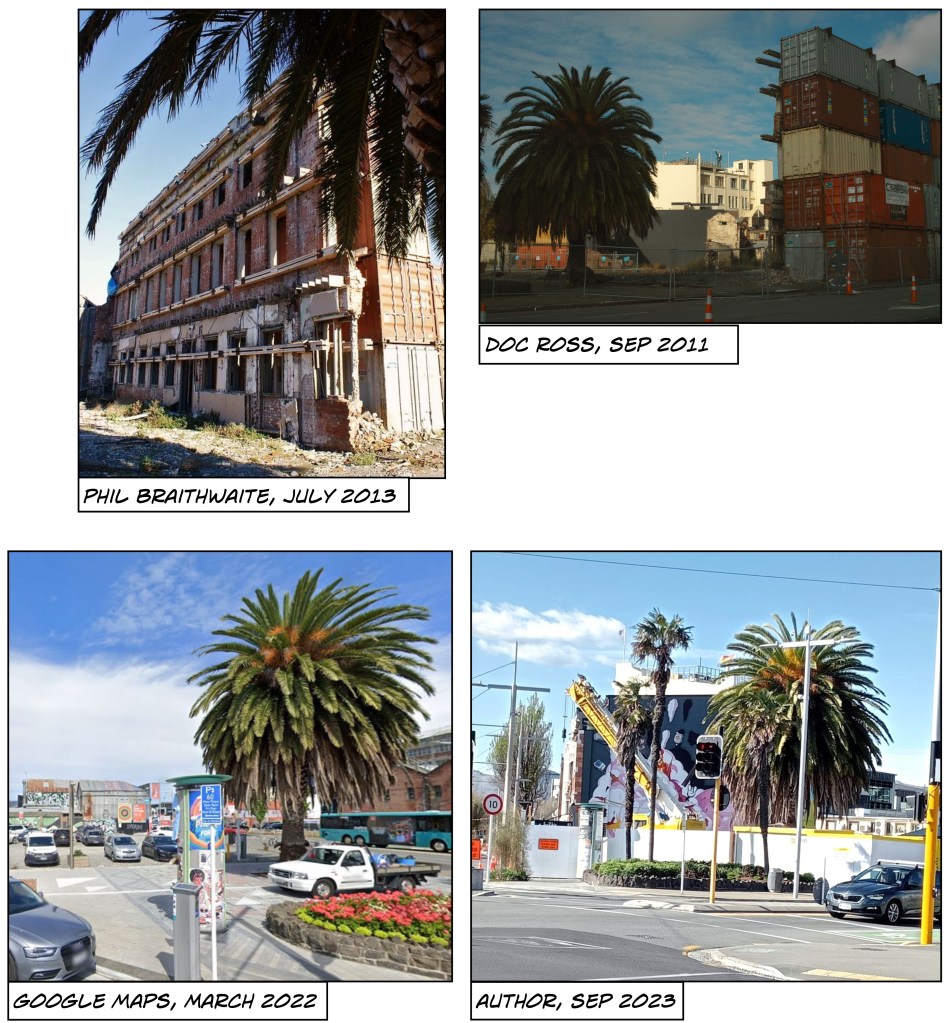
Similar to Wellington, there are very few Phoenix palms in central Christchurch, though this may have more to do with Christchurch’s hard winter frosts leading to an assumption that palms will not grow there. From its size, the single palm seen in Figure 2 was probably planted circa 1975, a long time after the building of the Excelsior Hotel in 1864[v], the façade of which can be seen in Panel 1. It was a listed heritage building, which is why attempts were made to save the façade after it sustained considerable earthquake damage. However, these proved unsuccessful and the remnants were finally demolished in April 2016, leaving the palm as the sole survivor on the Hotel site (it used to be beside an outdoor seating area). Indications are that as a new building goes up next to the palm, where the demolished Excelsior Hotel used to stand, the size and form of the palm will be appreciated. In contrast to the previous example then, this has become a survivor tree appreciated in itself, but also having the potential to act as a reminder of the demolished Excelsior Hotel (visual records[vi] exist which show both the building and the palm).
Bordering a funeral home and a petrol station
Figure 3.
As Figure 3 shows, this example takes us from solo palms to a larger cluster, which may favour preservation rather than removal. Panels 1 and 2 show a building known as ‘Libertyland’, an ‘unmissable landmark’ of Palmerston North during almost 70 years of operation as a clothing factory employing up to 80 staff.[vii] As the early aerial photo shows, it was originally an imposing art deco building on the outskirts of the city. As an estimate, the Phoenix palms were planted around the building about 1955, adding to an existing number of well-known clusters in Palmerston North.[viii] As the Bayleys Real Estate photo shows, as the palms grew in size they nicely complemented the lines of the art deco building.[ix] The palms were included in the Palmerston North District register of notable trees, indicating public appreciation, which also applied to the building, but in the latter case, due to the high cost of earthquake strengthening work, it was demolished in 2012.[x] After demolition and sale, the first replacement building was for Lychgate Funeral, followed by a Waitomo petrol station. Obviously, this has meant that the previous ‘natural affinity’ between the art deco Libertyland building and the palms has gone, but given there is no guarantee of even registered notable trees being retained, we should be grateful only one palm was lost in placing the new buildings on the site. Of course, when people fill their car with petrol or go to a funeral, they probably do not deeply reflect on the trees that surround them. Nevertheless, a cluster of 70 year old Phoenix palms does stand out as relatively significant. In response to this possible incongruity, the question may arise of what a cluster of Phoenix palms is doing beside a funeral home and a petrol station. This could easily be answered by the placing of an information board on the site, but if other examples are anything to go by, these tend to focus on buildings and material structures, being less inclined towards noting the associations between buildings and trees.
On the way to the (derelict) freezing works
Figure 4.
The 1949 aerial photo in Figure 4 shows the northern part of Tokomaru Bay, giving a good indication of the significant size of the freezing works, wharf, and Shipping Company building. It also shows that in terms of trees and vegetation the site was relatively bare at this time. However, this was all about to change. As reported in the Gisborne Herald, ‘Reporting to the August meeting of the Tokomaru Bay Harbour Board held recently at Te Puia, the harbourmaster, Captain P. W. C. McCallum, said that considerable progress had been made on the beautification scheme at Waima agreed to by the board. The ground between the harbourmaster’s residence and the freezing works, seaward of the main road was bulldozed and levelled, and a manuka shelter frame erected. The area, after cleaning was sown in grass, 12 Phoenix palms and other ornamental shrubs planted, and a strong fence erected the whole length of the road.’[xi] As we can see by the bottom two panels, the Phoenix palms’ trajectory from here on was literally upwards – at 75 years old they are now an impressive sight, providing a distinct tropical island landscape on the drive towards the wharf. The same cannot be said of the freezing works, which closed in July 1952. For about 40 years the works had been the central employer in Tokomaru Bay supporting both permanent staff and a seasonal workforce, to such an extent that the community fielded its own rugby team and supported a theatre.[xii] Only about 400 people now live in Tokomaru Bay, and the derelict freezing works has become a small tourist attraction for those that take the no-exit route off the main highway. Passing the Shipping Company building (to the right of the circled area in Panel 1), a Heritage Trails plaque gives details of the Freezing Works and its history; it is then a short drive past the twelve Phoenix palms to the derelict works and still functioning wharf. In this case, the incongruity noted above between a cluster of palms and a petrol station is not so apparent. Nonetheless, the palms receive no mention in the plaque, even though their planting to beautify the area was intimately connected with the main industry of the area. So, the palms are an interesting survival and historical marker. Whereas post-1950, Phoenix palms continued to be planted throughout New Zealand, the peak period for group-planting was in the prior 30 years; the Gisborne-East Coast meat-freezing industry was also about to undergo a significant decline about this time.[xiii] But buildings can deteriorate rapidly – see the aerial view of the freezing works – so this means that unless a tree or palm is chopped down, its continued growth can be consulted as an historical reminder of past activities. A cluster of Phoenix palms just seemed to go with the Libertyland art deco building; a cluster of palms similarly seemed to fill the need to beautify the Tokomaru Bay freezing works site. Other trees could have been chosen, but just then in the late 1940s to 1950s Phoenix palm clusters still had currency as a suitable plant to ‘go with’ buildings and activities of social significance.
Acknowledgements:
Thanks to: Doc Ross for permission to reproduce his 2011 image of the old Excelsior Hotel; to Phil Braithwaite for permission to use ‘Excelsior Façade’ photo; to Dudley Meadows of Tairawhiti Museum for the historic photo of the Tokomaru Bay Freezing Works.
References
[i] Bowring, J. 2019, ‘Survivor trees: Spectrality and stickiness’, Fabrications, 29(1): 21-36.
[vi] Searching DigitalNZ for ‘Excelsior Hotel’ will give over 100 results.
[vii] Tina White, ‘Behind the scenes of a fixture in the city landscape’, Manawatu Standard, April 7, 2018.
[viii] Most well known is the double avenue in the Esplanade, but there are also clusters in Fitzherbert Avenue, the CET Arena, and at Awapuni Racecourse (see New Zealand Tree Register entries).
[ix] It is not just art deco buildings that Phoenix palms go well with. There is a longstanding association between Spanish mission architecture and the palm – see the example of Stanford University (https://trees.stanford.edu/ENCYC/PHOca.htm), and in New Zealand the 106 year old palm in front of Auckland Grammar School main building (https://register.notabletrees.org.nz/tree/view/1946).
by Ian Duggan, Te Aka Mātuatua – School of Science, The University of Waikato
Much was written in the newspapers about the 1928 visit to New Zealand by Dr. Arthur William Hill, the Director of the Royal Botanic Gardens, Kew. As covered in Part 1 of this blog, there was an outcry in Dunedin at not being a destination in his initial travel itinerary, and further provincialism came to the fore in his push for a National Botanic Garden of New Zealand. In this blog, we look at how Hill’s opposition to a road on Rangitoto Island stirred up emotions in Auckland. Hill’s visit to Auckland was brief, spanning only the 5th and 6th of February 1928, and his visit to Rangitoto Island was even shorter – totalling an hour. But that hour led to much debate in New Zealand’s newspapers.
Image from The Sun (Auckland), 31 January 1928, P8 (via Papers Past)
A Road on Rangitoto
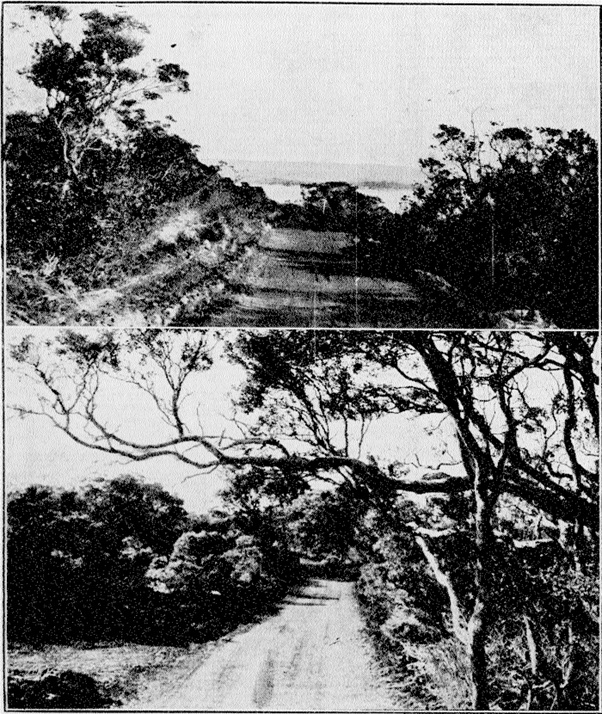
The construction of a road on Rangitoto was put forward at a meeting of the Devonport Borough Council in February 1925, when business of the Rangitoto Domain Board was discussed, three years prior to Hill’s visit. It was proposed that the construction of a road should encircle the base of Rangitoto, thereby opening up parts of the island that at the time were inaccessible[i]. Cost, however, was an immediate issue, though plans were made to circumvent this problem:
“Ample material is available on the island for road construction, and the principal cost would be the labour. Although the Domain Board has a substantial credit balance, it would not be sufficient to undertake the outlay. The Minister for Justice is to be communicated with asking that a prison camp be established on the island and prison labour used for constructing the road”.[ii]
Soon after, a visit was paid to the island by officials of the Prisons Department, including the Inspector-General of Prisons. The roadway was proposed to commence at the wharf and skirt the base of the island to beyond Rangitoto Beacon, from where a road would be continued up the side of the island to connect with an existing track leading to the summit. The Inspector-General stated that he was favourably impressed with the proposal and he would submit his recommendation to the Minister for Justice, Sir James Parr.[iii]
In June, “after long and careful consideration”, Parr agreed that the road could be made by employing a gang of short-sentence prisoners. “The proposed road,” said Sir James, “will be six miles in length, and will be suitable for both pedestrian and motor traffic. When completed it should prove of very great benefit to the citizens of Auckland, and to the community generally, as it will provide easy access to a vantage point from which a magnificent view of the Waitemata, the city and its environs, and a wonderful land and seascape eastward is obtainable”. Further, “the work would provide for relieving overcrowding in prisons in Auckland, and a means of most usefully employing well behaved prisoners, whose sentences were too short to warrant their being sent to one of the Prisons Department farms”. He continued, “The scheme is rendered particularly suitable for the employment of prisoners… by reason of the fact that owing to the isolated locality of the work, the men will be far removed from the public gaze… A gang of some twenty prisoners will be employed on the job, maintained… by the Prisons’ Department”.[iv]
Otago Witness, 31 August 1920, 34 (Supplement) (via Papers Past)
Questions were quickly raised about the scheme by the New Zealand Herald, however: “But are the board and the Minister quite certain that the building of a road to the top of Rangitoto is the best way of using the prison labour which the Minister proposes to supply? After the road has been made, how are the motors to reach it? …The great majority of people will regard the whole undertaking as a ridiculous extravagance. If more prison labour is available than can be usefully employed on tree-planting, sawmilling and land development, surely the department can find work for it more urgent and necessary than the roading of Rangitoto Island. There are hundreds of miles of national highways whose needs are clamant, and the employment of prison labour upon them… would be vastly more sensible than using it to provide an inaccessible highway for an entirely illusory motor traffic to the top of Rangitoto.”[v]
The Auckland Star presented similar views: “But to go to the trouble and expense of making a motor road on this island, which can be reached by motorists only after a long trip on a ferry steamer, is one of the wildest proposals we remember… The delights of the Waitakeres, for example, need better roads to make them accessible to Aucklanders, and those wonderful hills have the advantage over Rangitoto of being connected with the city by land”.[vi]
In a letter to the Auckland Star, an AJ Nagle agreed: “Many thanks for your leader protesting against a motor road to be constructed on Rangitoto. One half of the charm of that unique island is due to the fact that whilst there, one is out of sight and sound of the ubiquitous motor, and I think many people will fail to see how its attractions are to be increased by the introduction of these odorous juggernauts. The Minister concerned in the matter, naively remarked that the proposed road would be for the benefit of pedestrians as well as motorists. As the present track to the summit is some two miles in length, and the new road is to lie six miles long, it is obvious that the road is worthless to those who venture afoot”.[vii]
Others, however, were for the scheme: “I was glad to see in my “Star” to-day that the Government is going to build a fine road up to the summit of beautiful Rangitoto”, wrote Mr. JA Lee of Auckland East”.[viii]
The Minister for Justice, Sir James Parr, was surprised by criticisms of the scheme. “Really, I fail to see why anyone should wish to make fun of a road on Rangitoto… It is easy to say that the road will be of no use for motor-cars… but what about motor-buses running from Rangitoto Wharf to the summit? When there is a fine road six miles long, with perhaps a rest house and tea kiosk at the summit, there will be no better holiday resort near Auckland. Imagine a broad level road running round the shore from the wharf to the beacon, with pretty seaside cottages dotted along it… To say that the men could be better employed in improving roads in the Waitakare Ranges did not affect the question at all. The roads in the ranges were controlled by local authorities with rates at their disposal, and the Auckland City Council, which held large areas of land there, should be well able to contribute to the upkeep. Rangitoto was vested in a body which had almost no funds and the work would be entirely for the benefit of the public in general”. He felt sure that the people of Auckland would fully appreciate the value of the road when it was completed.[ix]
It was decided that fourteen prisoners – only short-sentence, good conduct men – would be employed, and they would be in the charge of a warder. Further, the usual prison clothing would be dispensed with. No material other than that which is available on the island would be required for the road construction, where “scoria boulders and the finest gravel is available in any quantity, and sand and shell for binding will be taken from the beach”.[x]
In November, the prisoners – nicknamed ‘the Handy Dozen’ – were on their way. They were, it was reported, “paradoxical as it may appear, a very decent-looking dozen. Giving them a casual glance, one would not dream that they were any but an ordinary working gang about ships, unless it was that they appeared to work with more than usual energy. But a Sherlock Holmes would have had his suspicions aroused by the sign of the broad arrow, stamped on the seat of one man’s trousers — the mark of the convict”. “These men were a selected dozen of the good conduct prisoners at Mount Eden… They had arrived at the wharf at an early hour in the morning, quietly and unostentatiously, in one of the covered-in conveyances provided by His Majesty for the transportation of his compulsory guests. Prisoners have feelings, as well as other humans more fortunate, and the gaol officials took every care that they should not be paraded in the public eye. True, the men were passed on the wharf by crowds from the ferry steamer, but they were hurrying crowds, and if some among them did cast a glance at the workers in dungarees and moleskins (not stamped with the broad arrow), it was doubtful if any guessed at their identity”. It was reported that “there is no fear on the part of the officials that the men will misbehave, but a definite scheme of signalling and communication has been arranged in case of sickness or insubordination, and should anything go wrong, assistance from the mainland will be available in a very short time.”[xi]
In January of 1926, the road “had not yet progressed 200 yds.” [~180 m], but “if a proposal to double the gang now at work is made effective, the road should be completed in well under two years”, reported the Herald. “It will have no grade exceeding one in twenty, so that motor-buses will be able to make the climb at a good pace”. Concerned about visitors to the island, “A notice warns picnic parties that the place is a prison reserve”. The prisoners were housed “in three neat wooden huts, each containing four bunks, with spring mattresses, also a table and two stools. The men work eight and a-half hours a day. They are given a special extra ration of tobacco, making two ounces a week instead of one. Several Devonport people have sent over books to form a small library for their use.”[xii]
Despite the men being selected as good conduct prisoners, two of them, 23-year-old 6ft Charles Wahle – serving two years for forgery and uttering – and 33-year-old Samuel Rattray, 5ft, 8in – undergoing one year’s reformative detention on charges of forgery – “bid a midnight escape, a bright moon assisting them in finding a 12 ft dinghy, which they fitted with a motor from a nearby boat.[xiii],[xiv]They were soon recaptured, however, on nearby Waiheke Island.[xv]
Auckland Star, 8 February 1926, P9
By September 1926, about twenty prisoners are employed on the island: “Great quantities of explosives have been used to break down the solid rock on the island. Most of this work occurred near the landing-stage, where the existing track was widened to form the promenade and from the effect of the explosions the tea kiosk did not escape undamaged”.[xvi] Further, August 1927, it was reported that two men were killed and a number injured in a premature blasting explosion.[xvii]
Enhancing the attraction of Rangitoto for Holiday-makers. The esplanade which has been constructed as the first section of the road leading to the summit. New Zealand herald, 27 September 1926, P11.
Hill’s Auckland and RangitotoVisit
Early in 1928, Arthur Hill visited Auckland, and his whirlwind tour included a trip to Rangitoto Island, Kauri bush in the Waitakere Ranges – which he was impressed by – and Chelsea.[xviii] It was in Auckland that he made his first acquaintance with Kauri in its natural surroundings: “It is a grand thing that these magnificent trees should be so close to your city”, he stated. “There is a kauri 40ft high growing under glass at Kew and some small specimens flourish out of doors in south-west England”.
It was with his visit to Rangitoto, however, where controversy reared its head. Hill certainly didn’t start the fire, as we saw above, but he did re-add petrol to the flames. In the course of his Rangitoto visit Hill displayed a special interest in the kidney ferns growing in places that were not especially well shaded. Overall, he thought the plant life as a whole was most interesting.[xix] Nevertheless, he paid particular attention to the road, which was said to displease him greatly. He remarked that Rangitoto was probably unique in the world because, “as a volcano fairly recently extinct it had been colonised by plants under most interesting conditions”. As such, he believed it should be preserved as a plant sanctuary with as little disturbance as possible. Of particular concern, he was of the opinion that if it were made into a holiday resort, “all kinds of weeds were bound to find their way in”. Dr. Hill was welcomed to the island by Mr. T Walsh, representing the Rangitoto Island Domain Board. Walsh noted that in recognising that the island was unique in its botany, the board was preserving as much of it as they could as a sanctuary for native plants and native birds. Further, he argued that the island was a public domain, and that the best way to preserve it was to make a road from which the public would not wish to deviate. Prominent New Zealand botanist, Dr. Leonard Cockayne, who accompanied Hill through his New Zealand tour, agreed, expressing the opinion that it was best for the board to make a good road and a play area for the public. If this were done, he proposed that the public would be less likely to get among the plants.[xx]
Map of Rangitoto Road. Sun (Auckland), 20 July 1928, P1
Hill’s opinions continued to be published over the following days. The Sun reported that Dr. Hill declared the road work on the island as “a desecration of nature’s handiwork”, rather than a benefit to the community. “A rest house at the foot, and a good track to the summit would be sufficient”, Hill thought.[xxi]
The New Zealand Hearld, who were the first to report disapproval several years earlier, noted that “when the proposal of a motor traffic road on Rangitoto was first mooted, some opposition was raised regarding the road being unnecessary and of its imperilling the unique character of the island, though this protest aroused little visible support”. They continued that Aucklanders “had permitted the volcanic cones of this neighbourhood to be terribly marred by commercial spoliation, and [had] been largely indifferent to unsightly treatment of the waterfront. The thought of injury [to] Rangitoto has apparently been given no serious heed”. Dr. Hill’s words, they reported, “should stab the city broad awake. What he saw on his visit to the island yesterday moved him to vigorous protest. Rangitoto, in his opinion, is probably unique… The New Zealand botanists sharing the visit to the island endorse his opinion. When so renowned an authority as the Director of Kew Gardens speaks so emphatically, it behoves all citizens to give heed. Motorists will suffer no serious disability if the pleasure of an easy drive to the summit of Rangitoto is denied them… If to open a motor-traffic road on Rangitoto is to destroy the characteristic interest of the island, as Dr. Hill so plainly states, then it certainly ought not to be done… Auckland citizens as a body should be wise enough and vigorous enough to put an end to the menace that has called forth Dr. Hill’s warning.”[xxii]
As with the earlier rounds of debate, Hill’s comments did draw opposition. In an article in Auckland’s Sun Newspaper, one writer stated: “As a scientist in principle and in profession Dr. Hill naturally found Rangitoto Island a realm of curious phenomena, attracting his professional interest. But his suggestions that it, too, should be reserved as a plant sanctuary will not meet with undivided support from the city. There are many arguments against the introduction of motor-cars to Rangitoto. Its mystery and remoteness might at first seem to be destroyed at once by such an invasion. But there are equally strong arguments the other way. Motors and a motor road would permit many elderly or infirm people to reach the summit and revel in the glorious panorama of the gulf, instead of staying below in fear of the laborious walk up the scoria track. It has yet to be shown that a road to the summit would in any way mar the symmetry of Rangitoto’s gentle slope. As for making the place a sanctuary—one island, Motuihi [sic], is already, closed to the public. And one is enough.”[xxiii]
Interestingly, many of the opposing comments seemed to go beyond what Hill had even suggested – inferring that he had called for Rangitoto to be free of humans altogether. Referencing Hill, Sir. E. Aldridge, chairman of the Rangitoto Island Domain Board, stated: “It is hardly a fair proposition for a man to spend an hour at Rangitoto and then advocate shutting it off from the public forever”. Aldridge had been unable to visit the island with Hill and the official accompanying party, but the board was represented by Mr. T. Walsh. Walsh reaffirmed that Dr. Hill was on the island barely an hour, and the whole of that time he was occupied in viewing and discussing botanical subjects. He went on to declare that “Dr. Hill was quite ignorant of local conditions. It is now too late to make Rangitoto a sanctuary, because it has been open for the past 80 years”. Walsh further added the island had always been open to boatmen and the Harbour Board worked a large quarry there. In addition, there was now a settlement and a school on the island, while twice within his memory the island had been swept by fire. Even if it were desirable to make Rangitoto a sanctuary, he was of opinion it would not be possible: “They would have to provide a large guard to prevent people landing there”. Another, unnamed, member of the board was equally as scathing, stating, “These were chance remarks made by a man who had not enough time to know the facts”. Yet another said he was quite sure that by building a road on the island they were opening it up for the great benefit for the people, not only of Auckland, but also of the whole of New Zealand, and overseas tourists. A Mr. J Brown declared that the area to be taken up by the road would only be “a drop in the ocean” compared with the area of the island. Other printed dissenting comments included, “We do not want to take notice of criticism such as this”, and, “The proportion of people interested in botany is very small”.[xxiv]
Following these criticisms, others came out in support of Hill. The Curator of the Auckland Museum, Mr. Gilbert Archey, was “in hearty accord” with the opinion expressed by Hill that Rangitoto should be kept as a reserve on account of the extreme importance of its flora: “He knows that once these plants are destroyed they can never be replaced”. “He does not look upon such an area from a social, or sports, point of view. He regards it purely in the light of its value to the world of learning. Personally, I think Dr. Hill is quite right”, he added.”[xxv]
In a letter titled Rangitoto Spoilation, JA James of Devonport wrote that Hill’s condemnation of the roading of Rangitoto “is only what may be expected from any man having… a regard of Nature’s marvellous handiwork”. He also acknowledged the Herald’s comments on the little support given to the opposition raised at the time the motor road was first mooted: “As one who then protested, I was amazed at the lack of interest in protecting this unique natural heritage from such vandalism. There certainly is no need for such a road, and the bare thought of motors on Rangitoto should be utterly repugnant to anyone in his right senses. I trust, now that this spoliation has been again brought under public notice, action will be immediately taken to stop the work. The portion of road already made will remain a ghastly monument to the crass ignorance of its originators. All we want on Rangitoto is a walking track to the summit. No vehicle of any description should be allowed. Wake up Auckland and save Rangitoto. Given a motor road, and the consequent vehicular ferry, and you have committed irreparable vandalism.[xxvi]
The result of four years of ‘‘hard labour”, the motor road round Rangitoto Island is expected to be finished by the end of this year. Sun (Auckland), 8 July 1930, P16
A few days later, Hill departed the country. In some parting statements, he defensively responded to the press reports. He noted that when he had “mildly suggested” that in view of the unique character of the island and its flora such a road was unwarranted he was “hauled over the coals” by the local Press, and told he should not have the temerity to criticise after an hour’s visit to the island: “A botanist could see, after a ten minutes visit, that such a road would inevitably mean the introduction to the island of a miscellaneous collection of weeds, and then gone would be the uniqueness of the island”. He maintained his opinion on this point. He reiterated that Rangitoto should be left to the pedestrian and to nature.[xxvii] “I still stick to my guns on this point: there are many other hills around Auckland much more suitable for a motor road: Rangitoto should be left to the pedestrian and Nature”.[xxviii]
The Road Post Hill’s Visit
Ultimately, the road construction was completed despite the furore. Some modifications needed to be made, however. In May 1928, Mr. Aldridge announced that it would not be possible to construct the motor road to the summit of the cone owing to the nature of the soil: “It will go, however, as far as the saddle.”[xxix] Aldridge added, “The ground is very soft, and the grade is so great that with wet weather or heavy traffic the road would slip badly. However, we can take the road up to the saddle without much difficulty, and there will not be a great climb from there.”[xxx]
In August 1928, it was optimistically stated that the completion of the road to the summit was expected to take another six months.[xxxi] Fast forward two years, and it was announced on 10 July 1930 that the new scenic route was to be opened the following Saturday. It was also noted that the road that should last, in the opinion of the authorities, “for all time”.[xxxii]This opening estimate, too, was still getting ahead of itself, as 12 July was actually the day the road was inspected by members of the Domain Board; the date of the opening of the road had not yet been decided.[xxxiii] The inspection party left the city by the ferry steamer Condor, and was conveyed over the new road in a fleet of nine “baby” cars. Islington Bay was reached “after a few minutes run over a fine scoria-surfaced carriageway, the distance from the wharf being about three miles”. The party then travelled over the crest of the mountain. Excellent work was said to have been done and it was hoped that it would be ready for public use by the end of the year.[xxxiv] By October 1930, arrangements had been made to start a bus service on the island, and the first vehicle to cater for visitors was shipped there by one of the vehicular ferries.[xxxv] The bus service started soon thereafter. Today, a tractor powered ‘road train’, the Rangitoto Island Volcanic Explorer, still uses the road.
Cars belonging to members of the official party who made an inspection of the newly-formed road round the island and over the crest of the mountain, negotiating the new route during the week-end. Rangitoto summit appears in the background. New Zealand Herald, 15 July 1930, P6.
It is difficult to pinpoint where and when the first Phoenix palm (Phoenix canariensis) was planted in New Zealand. There is a good chance though that it was in Auckland, planted in the early 1900s. D. Hay and Sons’ Montpelier nursery catalogue for 1891 has the palm for sale, but following international trends of the time it was initially sold as an indoor plant[1]. However, by 1899 the same nursery’s catalogue described them as ‘hardy to grow in the open air’[2]. Taking Auckland as the case in point, there seems to have been a rapid uptake in such ‘open air’ planting. As we will see below, there is a remarkable concentration of Phoenix palms in downtown central Auckland. By describing this concentration, part of the legacy of Phoenix palms in the New Zealand cityscape can be appreciated.
Figure 1. Map of sites
Figure one shows a map of the central Auckland area, where the ten green stars are the sites of the Phoenix palm plantings to be described. Beginning at the Queen Street star (next to Aotea Square), we move clockwise from site to site, thus finishing at Myers Park. All sites have a minimum of two palms, with larger clusters the norm. Most of the palms are planted pre-1940. However, there are a few which are later; these are included here to show that the appeal of the palms lasted beyond the 1900 to 1940 period when planting was at its peak.[3]
Figure 2. Queen St and Albert Park
Panel 1 of Figure 2 shows the Sir George Grey memorial in central Queen Street, just in front of the Auckland Town Hall. Clearly visible are two Phoenix palms on either side of the memorial statue. From other historical photographs of the site, an estimated date of planting of about 1916 can be made. This is the only case of an early centre-road planting I am aware of, but as both the statue and the palms ‘increasingly [became] a traffic hazard’ the statue was moved to a new site in 1922[4]. It is not known what happened to the palms. However, the interesting thing is that the new site the statue was removed to – Albert Park – already had two phoenix palms growing. As Panel 3 shows, by 2023 the palms dwarf the statue, and at some point after 1923 a new planting of Phoenix reclinata closer to the statue was introduced. Given the size of the palms in Panel 2, and from an historical source, it is possible to date the planting of these palms as 1905 to 1906. The historical source is an article in the New Zealand Herald detailing ‘Alterations in Albert Park’[5], including the planting of palms in the area between Bowen Avenue and the flagstaff, which is right next to where the George Grey statue was relocated. This is to presume that the ‘proposed work’ was carried out, but given the palms are there to this day, it seems reasonable to see their planting as part of this work, overall making them amongst the oldest in New Zealand.
Figure 3. Bowen Avenue
The same conclusion about age can be reached with the next site visited: a group of phoenix palms in Bowen Ave, just 50 metres north of the Grey statue. Figure 3 shows two historical photographs looking up Bowen Ave, and the 2023 photograph looking down in the other direction. A row of six Phoenix palms can be seen to the left margin of the 1918 photograph. The 1921 photograph shows the palms have grown to about 3 metres tall, and additionally there is what seems to be a slightly younger palm in the foreground on the other side of the avenue. It seems reasonable, given the current size of these palms, to also date their planting to about 1905 to 1906.
Figure 4. Freyberg Place
The move to the next site – Freyberg Place – is also short, but this time involves a much more recent planting of Phoenix palms. The age of the four palms seen here is unknown, but going by their size somewhere between 50 to 60 years looks likely. As can be seen, the four palms provide a columnar frontage to the Metropolis Tower apartment building (developed in 1999). The interesting thing about this site is that it was redeveloped from 2015, and the plans from Isthmus Architects included the possibility of removing the palms.[6] This may well reflect the fact that beginning as early as 2004 the Auckland Regional Council moved to classify Phoenix palms as a pest plant, undoubtedly contributing to a devaluation of the palms.[7] Ultimately, the palms were not removed partly because they sit on private land owned by the Metropolis apartments.[8] What can also be seen in Figure 4 is a strong presence of nikau palms. In current landscape architecture circles these are clearly much preferred to the imported Phoenix palm. Nevertheless, the four Phoenix palms remain in Freyberg Place offering a larger ‘monumental’ effect than the smaller nikau palm (which have a different visual appeal).
Figure 5. Emily Place
The next site – Emily Place – is a mere 300 metres north-east from Freyberg Place, but is a much older reserve. As can be seen in Panel 1 of Figure 5, the original planting featured pohutukawa trees across the top and fan palms down the side of the triangular shaped reserve. Panel 2 shows a circa 1945 photograph showing two Phoenix palms have been added in the central area that was previously just lawn. Their size in this photograph suggests an estimated planting date of 1930 – the two 2023 photographs show the height that we would expect of a 90 year old palm. The example of Emily Place shows that over time both the planting and layout of a reserve can change significantly: the fan palms to the left were removed at some stage and replaced with gingko trees, and obviously the two Phoenix palms were also added, making good use of their framing quality when used as a pair. This addition is also of course at a time – the 1930s – when Phoenix palms were still very popular.
Figure 6. Mahuku Reserve and Quay Park Centre
Moving again about another 300 metres north-east we have a significant precinct of Phoenix palms, albeit in 3 separate sites. The first two – Mahuhu ki te Rangi reserve and Quay Park Centre – are shown together in Figure 6. The dates of planting are not known for these sites, but a good estimate would be the early 1960s. The Mahuhu ki te Rangi reserve was redesigned in 1996, with Panel 2 showing how well Phoenix palms go with a monument or other structure. The other thing to note, particularly from the Quay Park Centre palms, is that they are all very well maintained. The trunks have been trimmed of dead and old fronds, maintenance that does incur some cost. This would suggest that these palms, even given their ‘pest plant’ status, are still relatively highly valued.
Figure 7. te Taou Reserve
Just across the road from the Quay Park Centre we then come to te Taou Reserve, shown in Figure 7. This carefully laid out area was originally the frontage to the main Auckland railway station (the big building visible in Panel 2), with the Station Hotel across the road (see Panel 1). A close inspection of Panel 1 shows in the foreground the presence of a young Phoenix palm, suggesting a circa 1930 planting date, which is consistent with the current size of the six palms (see Panel 3 and 4). The very formal geometric layout of the reserve is no longer in fashion in contemporary amenity landscaping. However, it still has strong visual appeal with the combination of Phoenix palms and pencil cypresses working particularly well. The six Phoenix palms in te Taou Reserve are registered on the Auckland Schedule of Notable Trees.
Figure 8. Anzac Avenue
From te Taou Reserve, if we travel back towards Queen St taking Anzac Avenue, just where it becomes Symonds Street, we find the pair of large Phoenix palms seen in Figure 8. As can be seen, they now appear on the northern frontage of the University of Auckland, but originally the palms were amongst a mix of native, Australian and European trees planted in Anzac Avenue as a ‘war memorial avenue’.[9] These can be accurately dated as 105 years old, being planted by a group of schoolchildren in a tree-planting ceremony on September 19, 1918, with ‘a very careful selection of trees’ having been made by Thomas Pearson, the city parks superintendent.[10] The latter information is significant as it has an important link to the final site we visit – Myers Park, seen in Figure 9.
Figure 9. Myers Park
Myers Park is a relatively long and narrow park in a gully to the west of upper Queen St, opened in 1915 mainly due to the actions of Arthur Myer, mayor of Auckland between 1905-1909.[11] It has the largest cluster – 25 – of Phoenix palms in our visited sites, including a double row to the south of the park as seen in Panel 4 of Figure 9. Thomas Pearson, who was Auckland Parks Superintendent between 1908 to 1930, designed the planting, it being noted that ‘the great Phoenix Palms are almost regarded as his trademark.’ [12] The historical photographs included in Figure 9 would suggest that the palms were planted circa 1915.
There are many more Phoenix palms to be found in Auckland’s public and private gardens[13], and Thomas Pearson’s keenness for them may well explain other large clusters in Auckland, including Cornwall Park, Ellerslie Racecourse, the Auckland Domain, and Mount Roskill. But the concentration we have seen in the central downtown area is not repeated elsewhere in Auckland, nor in any other New Zealand city.[14] As noted, the Albert Park and Bowen Avenue groups are probably amongst the oldest in the country, and the Myers Park group are not far behind. Despite this significant presence, amongst these palms only the six in te Taou reserve are included in the Auckland Schedule of Notable Trees. This may reflect the vagaries of the process whereby trees are entered on the schedule, or it may partly reflect the Phoenix palm’s ‘pest plant’ classification. Nonetheless, it seems surprising. It is worth noting that the effect of the pest plant classification is that sooner or later Auckland’s Phoenix palm legacy will disappear. Currently, with the death or removal of a Phoenix palm in Auckland there can be no legitimate replanting. Hence, it could be that 100 years from now the visual record presented above will remain, whereas many of the palms will not. Luckily, however, other towns and centres in New Zealand have not followed the Auckland precedent, and it may be that the centre of the exotic appeal of the Phoenix palm moves further south. The good news is that there are already significant collections of the palms in Waihi, Gisborne, Whanganui, Palmerston North, Napier, Nelson, and as far south as Timaru. In the meantime, any visitor to central Auckland with an interest in garden history could follow the above ‘tour’ and take the chance to appreciate the Phoenix palms while they still grow.
Acknowledgments
Thanks to John Adam, Bill Mckay, and Jenny Larking for useful information.
References
[1] In the 1890s the Phoenix palms was the tenth most popular indoor plant in Europe. See Spennerman, D. (2018) ‘Canary Island Date Palms Palm (Phoenix canariensis) in Australia: Introduction and early dispersal. Palms, 62(4): 185-201.
[2] Thanks to Louise Beaumont for access to the catalogues.
[3] See Zona, S. (2008) The horticultural history of the Canary Island Date Palm (Phoenix canariensis), Garden History, 36: 301-308.
[4] ‘A familiar Auckland landmark removed to a new site: Sir George Grey’s statue’, Auckland Weekly News, 14 September, 1922, p. 39.
[5] ‘Alterations in Albert Park’, New Zealand Herald, 22 June, 1905, p. 6.
[6] ‘Bill McKay: New design for Freyberg Place misses the mark’, New Zealand Herald, 15 September, 2015.
[13] See Wilcox’s 2012 botanical survey showing that Phoenix palms were the fifth most abundant tree in a sample of 1561 home gardens, p. 81 in Wilcox, M. 2012, Auckland’s Remarkable Urban Forest, Auckland: Auckland Botanical Society.
[14] Napier might be the city that gets closest to such a concentration.
An Old Blush rose grows behind a picket fence at the Ongaonga Museum in Central Hawkes Bay. The interesting story of its arrival to the museum was faithfully recorded in history notebooks kept by my grandfather Mr Edward (Ted) Bibby, MBE (1896-1991).
Old Blush rose. Photo C. Bibby.
Ted was a founding member of the Ongaonga museum, which was established in 1966. One of the museum’s objectives was to collect, record and preserve material to the history of Ongaonga District.[1] This included collecting plants sourced from early settler farms for the museum garden. Ted writes of getting a weak graft set on an apple tree of an historic apple and a true primrose from a stockade.[2]
One day a rose came into his care. It didn’t have a name, so he called it the Pioneer Rose.[3] He recorded in his notebook that the rose was brought to him by Juliet Holden of nearby Forest Gate Station, in about 1966.[4]
Forest Gate 1901. Russell Duncan collection.
“It was a rose bush that had very little life in a collect of dead stems,” he wrote. “I understood her to say it came from the old garden of an old house at Forest Gate. I assume it would be the first home burnt down.”[5]
This was verified to me by Juliet Holden many years later, who said the rose had been growing in a paddock on the site of the original cottage.
The first Forest Gate homestead burned down on March 4th, 1874.[6]After the fire the homestead was rebuilt in 1875 with more than 20 rooms on a site nearby.[7] This suggests that the rose was likely planted at the original homestead by the first owners, the Duncan family, or by the Herrick family who were living on the property at the time of the fire.[8]
The original Forest Gate homestead 1860. Russell Duncan collection.
Forest Gate was established in 1853 by Richard J. Duncan, formerly of Forest Gate, Essex.[9] He settled his son, J. Russell Duncan, and wife Elizabeth on the property. During their tenure, the Station was enlarged to 13,000 acres.[10]
In time, the Duncan’s went into partnership with Jasper L. Herrick. In 1870 Mr Herrick married J. Russell Duncan’s sister Emily and took on full responsibility for Forest Gate.[11]
Mr Herrick was well-known in the province having served in the Armed Constabulary following the escape of Te Kooti from the Chatham Islands and as chair of the Waipawa County Council and having been elected to the Hawkes Bay Provincial Council. [12][13]
It would be nice to think that the rose was planted by the Herricks, as Mr Herrick had close association with the school, opening it in 1876.[14]Furthermore, when the Ongaonga school museum was established in 1966, the sword presented to him by Queen Victoria, was placed on display.[15]
The rose grew happily in its garden at the Ongaonga museum. Ted Bibby wrote “It was planted with the other old-fashioned plants and slowly recovered. Its flowers are much admired, and cuttings were propagated.”[16]
Ongaonga Museum, 2022. Photo C. Bibby.
It wasn’t until 1971 that the rose was identified. Ted received a letter from Pieter Bruggeman of Masterton, who had been visiting him and his wife on their Ongaonga farm.[17]
Mr Bruggeman wrote “After I left you, I went to Ongaonga and stopped at the little museum where I soon spotted the rose we talked about. I just couldn’t resist the temptation and after a quick look over my left and right shoulder, I picked three pieces with the flowers on.”
Mr Bruggeman sent his cuttings to Mrs Nancy Steen, in Auckland, author of The Charm of Old Roses (1966) “…and here is her reply,” Mr Bruggerman wrote. “…which I forward to you as I thought you might like to read it and the name of the rose is Old Blush China.”
Ted Bibby wrote in his notebook that it was a horticultural find “…one of the earliest roses brought to New Zealand.”[18]
He seemed confident that the rose had been planted by Mr Duncan. However, he provided no evidence to support this.[19]
Mr Herrick died in tragic circumstances at the age of 58. On 19 December 1890, he was with a party of friends and his daughter, on a picnic to his newly purchased Oporae property, thirty miles out of Dannevirke.[20]
The group made an excursion to the Waihi falls. Whilst his daughter Hetty was sketching and his friends, Mr and Mrs Giblin were collecting ferns, Mr Herrick climbed the waterfall, estimated to be 80 feet high. He took his boots off and was on a ledge below the top of the falls, when, to the horror of the onlookers, he slipped and fell 50 feet into the pool below. He fractured his skull on rock and was pulled out of the water, dying an hour and twenty minutes later. The men in the group went for help, walking through five miles of bush and five miles of cleared land to the road where they were able to get a message taken by horse and rider to Dannevirke. They returned in darkness, using candles to find their way through the bush. The next day the group somehow managed to carry Mr Herrick’s body miles out to a place where horses and traps met them. He was buried in St Peter’s Anglican Church Cemetery at Waipawa.[21]
Waihi Falls. Jasper Herrick fell from a ledge on the northeast side of the falls, below the top. This would appear to be the right side of the falls in this image. Photo C. Bibby.
In an interview in 2018, descendant Robert Herrick said that his great grandfather was collecting a flower for his daughter Hetty when he fell.[22]
After her husband’s death, Mrs Herrick stayed on at Forest Gate with trustees managing her property. In 1901, Forest Gate was compulsory acquired by the Government and subdivided under legislation breaking up the great estates for closer settlement.[23] The homestead block was bought by the Mackie family.[24] Since 1934 it has been owned by the Holden family, who farm there today.[25]The magnificent Forest Gate homestead still stands and in 2025, will be 150 years old. Along with the dairy safe shed, woolshed, stables and coach house, it is listed with Heritage New Zealand.[26]
The Holdens have an excellent collection of historic photographs of Forest Gate. These were taken by Russell Duncan during his time on the farm, and at the time of its acquisition in 1901. The photographs include specimen trees, the garden and roses. However, it is not possible to discern the actual Old Blush rose.
The descendant of the original Forest Gate Old Blush lives on at the Ongaonga Museum and in the Bibby family. Each of Ted Bibby’s daughters, both in their nineties, have a treasured bush in their Central Hawke’s Bay gardens. My grandfather gave me a bush he had potted up and its descendants grow in my cottage garden and at the historic Halfway House garden at Glenside, north of Wellington.
Forest Gate, 2022. Photo C. Bibby.
The pink rose flowers intermittently from spring to late summer. The semi-double loose petals have a bright sheen to their edges. The stems have few thorns and can be trained as a bush or as a semi-climber against a post or wall. The rose can also be used as a low hedge or grown as a small garden feature.
The Helpmefind website informs us that Old China Blush is included in the World Federation of Rose Societies Old Rose Hall of Fame, which recognizes roses of historical or genealogical importance and those roses which have enjoyed continued popularity over a great many years.[27]
Acknowledgements
An earlier version of this blog was published in the Heritage Roses New Zealand Inc. Journal, Volume 48, Issue 2, in February 2023.
[1] Bibby, E.S. (1966). 1966 Aims of Old School Committee. Local History Book 1. (p.60).
[2] Bibby, E.S. (1966). 1971 Chairmans Report to OSM Committee. Local History Book I. (pp 155-156).
[3] Bibby, E.S. (1981). Pioneer Rose. History Notes Book 2. (p.22).
[20] Details of the incident are sourced from the Waipawa Mail and Bush Advocate. Where there is a discrepancy, the testimony of the witnesses at the Inquest as reported in the Bush Advocate prevails.
by Ian Duggan, Te Aka Mātuatua – School of Science, The University of Waikato
New Zealand had the occasional famous visitor in the mid-1920s. For Anna Pavlova, the famed Russian ballerina and dessert inspiration, several hundred newspaper articles were devoted to her visit to this country in 1926. Adventure novelist Zane Grey also visited in 1926, and in 1927 there was a Royal Visit by the Duke and Duchess of York (the future King George VI and Elizabeth). In 1928, however, a huge number of column inches were reserved for Dr Arthur William Hill, the Director of the Royal Botanic Gardens, Kew.
Arthur William Hill, 1875–1942. From: Obituary. Transactions and Proceedings of the Royal Society of New Zealand 72: 36-37 (via Papers Past)
Hill had joined Kew as Assistant Director under Sir David Prain in 1907, and eventually succeeded him as Director in 1922. His New Zealand visit was initiated five years later, in 1927, when the Empire Marketing Board ear-marked £4OOO of its revenue a year over five years to permit the Director of Kew, or his assistants, to travel to co-operate in development work in the Empire.[i] Hill stated that the idea of such travel arose out of a conversation with the secretary of the Empire Marketing Board, who, at a luncheon, had asked him to suggest some means whereby the Board could assist botany in the Empire. Hill thus suggested help could be provided through the provision of funds sufficient to send a man—himself, for instance—on tour to whatever countries required assistance with their problems. He also suggested that the fund would need to include provision for the appointment of an assistant director, who would carry on ‘at home’ in his absence.[ii] The first country visited under the new scheme was British Guiana, while another man had been sent to the Malay States to study banana disease, and yet another curator had been sent to Java, Ceylon and Singapore to study tropical vegetations under natural conditions.”[iii] New Zealand’s Auckland Star newspaper described the purpose of the visit:
“If the Gold Coast wants a suitable cocoa plant, if Fiji wants to know what disease is affecting the banana crop, if Australia wants to grow cricket bats, or if New Zealand should wish to start the beet sugar industry, Kew undertakes to supply the plants and to answer questions about them”.[iv]
Then it was Hill’s turn to visit New Zealand, taking advantage of an existing invitation to visit Australia.[v]
Botanist Leonard Cockayne, one of New Zealand’s most influential scientists, played a major role in organising this visit, and with E. Phillips Turner, Secretary of Forestry, he accompanied Hill through his New Zealand tour.[vi] In letters to Cockayne prior to his visit, Hill suggested he would spend a fortnight in New Zealand, and asked for suggestions on where to visit: “All too short a time, I fear… there is nothing I should enjoy more than seeing the New Zealand botanists and something of the vegetation of the country”, Hill wrote. Cockayne concurred: “It was both exciting and most pleasant news to learn that you propose to visit this country next January. But a fortnight is far too short a time. Possibly in a well directed month you could see a good deal of New Zealand vegetation and also the economic botany (forestry, agriculture, horticulture)”. Among Cockayne’s major contributions to botany were in his theories of hybridisation[vii], and with an element of self-interest he responded: “Above all, I want you to see some of our hybrid swarms”.[viii]
Years later, Hill reflected on his experience of travelling with Cockayne, at a time when the New Zealand scientist was 73: “No matter whether we were in a crowded train or wedged in the back seat of a motor car, he would discuss abstruse botanical matters or bring forward knotty points as to hybrids, or what was meant by such and such a species. Then his son Alfred would join in with a totally opposite point of view and a fierce altercation, proving quite harmless, would ensue – an outsider might have thought blows would follow! – and all would end happily”.[ix]
Image from The Sun (Auckland), 31 January 1928, P8 (via Papers Past)
The New Zealand Tour
Before the tour even started, controversy arose. In early January 1928, the itinerary for his three-week visit to New Zealand was mapped out and announced. Hill was to make:
“Visits to the kauri forest, or Rangitoto Island, and the Domain, Auckland; to the forestry plantations and native forests at Rotorua; to Taupo and National Park; and to the flax swamps and pastoral lands of the Manawatu. While in Wellington Dr. Hill will hold consultations with the Department of Scientific and Industrial Research, visit Wainui-o-mata in company with the director of parks and reserves, and be the guest of honour at a reception to be tendered by the New Zealand Institute of Horticulture in the Concert Chamber of the Town Hall, where a special display of New Zealand flowers will be given. In the South Island Dr. Hill is to visit Christchurch, and will inspect the forest services at Hanmer and the plantations of the Hon. Sir R. Heaton Rhodes. Other visits include calls at Arthur’s Pass, Hokitika, and Nelson. A walk from Arthur’s Pass to Otira is contemplated”.
Ominously, reports on the itinerary ended with the note: “It is doubtful whether time will permit of a visit to Dunedin”.[x]
On 7 January, the Otago Daily Times – clearly stung by the snub of the city – ran a piece titled “No Time for Dunedin”. “And where,” it asked, “does Dunedin come in? It is a pertinent inquiry, and the answer is unfortunately discouraging. Apparently Dunedin is not to come in at all. In the words of the message from Wellington, in which Dr Hill’s movements in the Dominion between his arrival on January 20 and departure on February 13 are circumstantially indicated: “It is doubtful whether time will permit of a visit to Dunedin.” About the phrase there is a touch of ingenuousness. The manner of it is perhaps suggestive of a certain delicate concession to the susceptibilities of the South. There is an implication of official sympathy and of regret that we are to be disappointed. For what is perhaps to be interpreted as really quite a friendly gesture we should possibly be grateful. For, after all, upon this occasion there is at least definite recognition of the existence of Dunedin, and as often as not even that is entirely lacking in intimations of tours arranged for visitors to this country from overseas. The programmes are prepared in Wellington, and more often than not the South Island is apparently not regarded as of sufficient economic importance to warrant the recommendation on the part of officialdom that tourists or missioners from other countries should occupy any part of their time in visiting it. Consequently, to have mention made of Dunedin in connection with Dr Hill’s itinerary should perhaps be soothing to this community, though its effect in that way may be a little difficult to detect.”[xi]
Things escalated. Within days, a meeting of interested bodies was held to protest against the omission of Otago and Southland, chaired by Mr Thomas Sidey, Liberal M.P. for Dunedin South, and including members of their City Council, the local branch of New Zealand Institute of Horticulture, the Chamber of Commerce, the Expansion League, the Otago A&P Society, the Dunedin Horticultural Society, Nurserymen’s Association, and the Amenities and Town Planning Society. Among them was Kew-trained horticulturist David Tannock, and superintendent of Dunedin’s city reserves, who felt it “a conspiracy”. He believed that there was not the slightest doubt that Dr Hill would be asked by the Government to report on the desirability of a national botanic garden, and he considered that Dunedin was especially suited for such a purpose. “I consider that Dr Hill has been deliberately prevented from visiting Dunedin”, Tannock stated, “so that he cannot see what Is being done. Botanical work is negligible elsewhere—it is nil in Auckland and practically nothing in Wellington. There is a more complete collection of healthy plants in private gardens in Dunedin than anywhere else in New Zealand, and we have organised a system of collecting, establishing, and exchanging plants, and we have tried to maintain a system of exchange with other parts of the world”.
The group framed a resolution of protest. Among their arguments were “That the inclusion of Dunedin is especially important, seeing that it is the only city in the dominion that has in its botanical gardens, a very large and representative collection of New Zealand’s alpine vegetation and many plants from the Auckland, Campbell, Antipodes, and Chatham Islands”. “That the Dunedin Botanical Gardens are making a systematic effort to carry out the function of a true botanic garden—namely, by maintaining a system of exchange of plants and seeds with botanical gardens and cultivators in other parts of the world, and by establishing as complete a collection of the vegetation of all parts of the world as possible, and adopting a simple system of botanical and geographical classification by training young men and women in gardening and forestry.”[xii]
Ultimately, the protestations worked. Hill’s itinerary was revised, and it was announced he would spend one and a half days in Dunedin after leaving Christchurch.[xiii] Nevertheless, fate intervened in Dunedin’s favour regardless, when his steamer, Manuka, was diverted due to a sick fireman”. Hill had left Melbourne bound for Milford Sound and Wellington, intending to start his journey through New Zealand with an inspection of Nelson and Westland. With the steamer heading for Milford, one of the firemen became seriously ill. Luckily for the fireman, one of the passengers included a Dr Gordon, who operated surgically at 12 o’clock that night, and the vessel’s course was changed, being put at her fastest pace on the way to the Bluff. At Bluff some New Zealand friends of Dr Hill suggested that he should alter his itinerary and step ashore at Bluff. As such, his first night was spent in Invercargill, and he went to Dunedin by the express train the next morning”.[xiv]
Postcard of early Dunedin Botanic Garden. ICD collection.
Placating Dunedin, Hill had many nice things to say about the city, stating that he did not think there was a much more beautifully situated town, with its wealth of greenery, that it was splendidly laid out, and that the reserves in the heart of the city were quite unique. “The pioneers had shown a wonderful foresight in laying out the city, with its reserves and fine areas of native bush”. Dr Hill added that he had been very favourably impressed with the general tidiness and cleanliness of the city and its surroundings, showing that the citizens respected their property. This was especially apparent, as nobody knew he was to make a visit that morning, so that there could be no general tidying-up because he was visiting. He generally praised Dunedin’s gardens, where he thought there was a wonderful collection of native trees and shrubs, with the collection in some ways far more interesting than that seen in any gardens he had visited in the southern hemisphere. Dr Hill went on to refer to the great value of the native trees and shrubs, and said that the real object of botanical gardens was to educate the public – a point he commonly made clear during the trip. He did not think it likely that there was any collection of native trees in New Zealand to compare with those in the Dunedin Gardens. The only criticism was that he thought it was a pity that telegraph poles were allowed to remain in the gardens, being unsightly, and out of place in that setting. He was also surprised to see what Mr Tannock had accomplished with the small staff at his disposal, and he considered he should have a larger number of men, because he was developing gardens that were of very great importance to the Dominion.[xv]
Although Hill visited a number of other areas in the country, the remainder of this blog will concentrate on a single theme where friction was developed during, and following, the tour – the development of a National Botanic Garden. Needless to say, he was generally on a charm offensive as he travelled. For example, he declared Oamaru Gardens to be among the most beautiful he had seen on his overseas travels, where he was especially pleased with the Peter Pan statue and its setting.[xvi] On visiting Otari Reserve/Willton’s Bush, in Wellington, he stated he considered it an ideal place for an open-air plant museum.[xvii] More general praise followed: “To see the orderliness and tidiness of the people in New Zealand has been the greatest pleasure to me” he said, speaking at the Auckland University Hall. “Here in the City of Auckland I find gardens planted right to the edge of the footpath, with no fear of people taking anything. It will be very nice to hold you up as an object lesson to the people at home. Our public is not as well-behaved as the New Zealand public.”[xviii] He built on this elsewhere, stating: “What astonishes me is the neatness of everything. One wonders where all the old newspapers and orange peel go to. I shall certainly tell people about it when I get back to England.”[xix]
A National Botanic Garden
In Wellington, the first mention of a National Botanic Garden was mooted by Dr. James Allen Thomson, which became a theme throughout Hill’s tour. Thomson stated that he hoped that the establishment of such a garden would follow Dr Hill’s visit. However, Hill immediately noted that the word “National” raised some difficulties and would lead to potential jealousies, and likened it to a situation in South Africa where rival gardens had been established by two cities. Nevertheless, Hill proposed that a southern garden might be developed in Dunedin and a northern garden in Auckland, for in Dunedin things could be grown that would be impossible in Auckland, and vice versa. He felt there might be a scientific head or director linking the two together as a national institution, joined by two curators, one in each city.[xx] In doing so, local jealousies might be overcome.[xxi]
In Auckland, he even suggested a possible location for the northern garden: “Exactly where it should be established is a local matter, and not one in which I should interfere. I did, however, see a very nice place, this afternoon in Cornwall Park, where it should be possible to develop good botanic gardens”. Still aware of the local parochialism, he noted: “I will warn you on one point because I have heard mention of a ‘national’ botanic garden for Auckland. If you carry on with that idea you are not only likely to get into hot water with other centres in New Zealand but you will be taking a wrong course from a scientific point of view. It is impossible for you to grow here in the North some of the things that grow in the South, just as down there they cannot grow some of the plants that you grow here.” Again, he reiterated that if there was to be a National Botanic Garden, it would be best to divide it into two parts, one in the North and one in the South.[xxii]
Auckland newspaper The Sun quickly pointed out why Cornwall Park would not be a good option, however: “The public could not be allowed to picnic beneath valuable specimen trees, nor, small boys permitted to climb their leafy heights in search of birds’ nests. Therefore, though the visitor [Hill] saw in Cornwall Park an ideal location for the type of institution he recommends, his choice is hardly likely to be endorsed by the citizens of Auckland. Cornwall Park was presented to the city in 1901, by Sir John Logan Campbell, and its 230 acres form an unsurpassed area of park land. The donor’s specific stipulation set the land apart for the people of the city, and the establishment of a botanic reserve would therefore introduce inevitable conflict with the people’s rights.”[xxiii]
Postcard of John Logan Campbell statue, Cornwall Park. ICD collection.
Following Hill’s departure from the country, a summary report to government provided in April crystallised his thoughts. This provided some detail that contrasted with his public statements. In it he criticised New Zealand’s existing Botanic Gardens: “Botanic Gardens do not exist in New Zealand except in title and by Act of Parliament”, he stated. “The present gardens are really public pleasure gardens, with a good horticultural display, which is in no sense a botanical arrangement.” Here, he reiterated that New Zealand was in need of a National Botanic Garden, but owing to the differences with regard to climate between the North and the South Islands, there was not any one spot could be chosen adequately to represent the flora of New Zealand to full advantage. Further, he noted the difficulty in that each of the four main centres naturally regards its own botanic garden as a place of considerable importance, and he feared that, were any one of the botanic gardens now in existence chosen as the seat of the National Botanic Garden, considerable jealousy and friction might be aroused. Again he proposed a National Botanic Garden in two parts, with one centred in Dunedin, where the high Alpine plants could be grown, while he proposed the northern garden be situated in either Wellington or Auckland. Again he noted that the leaving out of any of the four main centres may lead to difficulties that would prevent what he regarded as an ideal scheme from being a workable proposition. With that being the case, he felt that it may be better to select Wellington as the headquarters of the Dominion Botanic Garden, and consider the gardens of Dunedin, Christchurch, and Auckland as branches of the Dominion garden.[xxiv]
The current gardens came under some criticism, being not what Hill considered to be ‘real’ botanic gardens: “The nearest approach to a botanic garden is the one at Dunedin, but that fulfils the proper functions of a botanic garden only to a small extent. At Wellington, Christchurch, and Dunedin there is a fairly representative display of the native flora, but the native plants are not displayed in any botanical or biological manner so as to be of real educational value, nor are they properly labelled. The present gardens are really public pleasure gardens, with a good horticultural display, which is in no sense a botanical arrangement. At Dunedin, some efforts have been made in the right direction, but labelling everywhere is poor. To be of real use, the scientific and English or Maori names of plants should be given as well as their natural families, and their country of origin”. His greatest criticisms were directed towards what he called “a sad waste of money” in some centres in the erection of costly structures called “winter gardens” – these “housing a very poor collection of plants of no botanical interest, and of very little horticultural value”. Nevertheless, he believed they might be made of interest under the care of a scientific man.”[xxv]
A full report of Hill’s visit was printed in booklet form by the Government in June, which led to widespread resentment and negative reaction. Christchurch’s The Star reported on the “Severe criticism of the Cuningham Winter Gardens in the Christchurch Botanic Gardens”, as well as those in Auckland, where Hill was “strongly critical of the winter gardens that have been erected in these cities”. “What I have said about the present gardens being really public pleasure gardens is well illustrated by the Christchurch Botanic Gardens and by the Domain Gardens at Auckland”. “In both there has been a sad waste of money in the erection of winter gardens—costly structures, housing a very poor collection of plants of no botanical interest and of very little horticultural value. The plants displayed could have been grown in any small greenhouse, as the ugly and large structures contain only a senseless repetition of a few comparatively uninteresting plants”. Hill’s criticisms were stated to be “strongly resented” by Mr James Young, Curator of the Christchurch Botanic Gardens, who stated that it was quite uncalled for and was absolutely unjustifiable from a man of Dr Hill’s standing. “I do not think Dr Hill was brought to New Zealand to indulge in that kind of criticism”, Mr Young added. “He was brought here, I understand, to report on matters of scientific interest, not to try and scandalise what is being done in Auckland and Christchurch… The Cuningham Winter Gardens have increased the popularity of the gardens fifty-fold, and, moreover, they are a gift to the city and have not cost the Domain Board a penny.” He continued, “I don’t happen to be a Kew-ite but I come from Edinburgh and Glasgow, which are just as good places. It is absolute nonsense to say that the plants in the Winter Gardens could be grown in any greenhouse. Winter gardens are generally two stories high, and the one in the Christchurch Gardens follows practically the same design as the Winter Gardens in Glasgow. It contains some slashing good stuff in spite of all Dr Hill has to say”. Mr G. Harper, chairman of the Domains Board, was also invited to comment on Dr Hill’s criticism. He said that the board looked at the matter from a different point of view from Dr Hill, regarding the Winter Gardens as the greatest attraction to the Gardens. “Dr Hill was a scientific man and he looked upon these matters from the scientific point of view.”[xxvi] Mr H. J. Duigan, Dominion president of the New Zealand Real Estate Institute, and a Fellow of the Royal Horticultural Society of England, felt that the criticism levelled by Dr Hill was wrong both in purpose and intent. He stated that while Dr Hill was a very eminent man, he had looked at the park from the point of view of its being a botanical or horticultural laboratory, and had overlooked the fact that it was laid out primarily with the object of giving pleasure to thousands of people.[xxvii]
Postcard of Christchurch Botanic Gardens, showing Cuningham House. ICD collection.
A month later, the negative responses to the reports continued. From a seemingly fiery meeting of the Association of Parks and Gardens Superintendents of New Zealand, members viewed with disfavour some of the statements contained in the report. “Dr. Hill had characterised as a sad waste of money the erection of costly winter gardens, both at Christchurch and Auckland”. The chairman, Mr D. Tannock of Dunedin, who had earlier been upset by Dunedin’s omission, believed that a garden devoted entirely to botanical species would be of little interest to the general public. “This report of Dr. Hill leads us nowhere”, said Mr McPherson, of Invercargill: “Dr. Hill has overlooked the fact that conditions in New Zealand are vastly different those prevailing in other countries. Our public gardens serve a dual purpose — although essentially gardens they are also recreation grounds. The public wants a bright display, and it is our duty to fulfil requirements in this respect; at the same time educating the public on the scientific side”. “The remarks of Dr. Hill in regard to the labelling of plants are a distinct reflection on the superintendents”, continued Mr McPherson. “I, for one, am anxious to do this, but where is the money to come from? Dr. Hill does not enlighten us in this connexion — he has taken too much for granted. As to Dr. Hill’s suggestion that the Botanic Gardens should be controlled from Wellington, I doubt very much whether such a scheme is feasible in New Zealand, where the gardens are controlled by the municipalities”. Mr J. Young of Christchurch, who had visited the gardens at Kew, Edinburgh, Glasgow, and Dublin, declared he thought that the gardens of New Zealand were equal to the best in the world, which was met by applause from the group. Further reported comments came from Mr J. E. Mackenzie, of Wellington, who stated “I’ve often wondered, why Dr. Hill ever came to New Zealand”, while Mr McPherson declared that Dr. Hill’s visit had been badly arranged from start to finish. MacPherson believed “It was a great pity that he was not given a better opportunity of meeting the men responsible for bringing the gardens of the Dominion to their present high standard of efficiency”. The chairman, Mr D. Tannock, concurred, stating: “That’s what he should have done instead of gadding over mountains and being taken about in motor-cars, wasting valuable time. Dr. Hill could have seen all the alpine plants in our Botanic Gardens.”[xxviii],[xxix]
Postcard of Auckland Winter Gardens. ICD Collection.
But was this reporting accurate? Soon after, MacKenzie, at least, was quickly backpedalling, blaming the newspaper for mis-representing the conference. To the Editor of the Evening Post, he wrote: “Your criticism in connection of the New Zealand Association of Gardens, Parks, and Reserves Superintendents in connection with the above proposal has been called to my attention. Your information, I presume, is based on a report… copied out in ‘The Post’, which gives quite a wrong impression of what was in the minds of the speakers at this conference.” “Your inference that the conference wished to disparage Dr. Hill is quite contrary to fact…”. “When the itinerary of Dr. Hill’s visit to this country was drawn up, the main feature was not to visit the Botanical Gardens, but to let the distinguished visitor see as much of the natural beauty of the country as possible. The main reason of the visit, I have been advised, was Dr. Hill’s desire to study the native hybrids of this country, and to meet Dr. L. Cockayne, F.R.S., whose research work in this connection is of world value and interest.”[xxx]
Nevertheless, the negative feedback reached Hill. On hearing this criticism, Hill responded at length in January 1929: “I am very sorry to learn that some parts of my report relating to ‘Botanic Gardens’ have been misunderstood and have thus given rise to a good deal of adverse criticism. I was very much impressed by the beauty of the gardens which I visited, and I saw those at Nelson and Palmerston North in addition to the six mentioned in my report. As I also visited some nurseries, experiment stations, the forestry plantations both in the North and South Islands, and the Cawthron Institute, I think it was hardly fair of one of the horticulturists, whom I had the pleasure of meeting, to say that I wasted my time in ‘gadding over’ mountains and being taken about in motor-cars. I doubt if any botanist has ever been given so splendid an opportunity of seeing the various aspects of the vegetation of New Zealand as I was, and of thus being put in a position to assist botanical enterprise in the Dominion whenever called upon to do so. With regard to my remarks about a National Botanic Garden, the garden superintendents have quite misunderstood the purpose of my remarks. I very much admired the various gardens I visited, but the point of my remarks about the establishment of a National Botanic Garden was, firstly, to consider the proposals for such a Botanic Garden which had already been made in the Dominion, and, secondly, to put forward my own suggestions how such a desirable project might be best brought about. I beg to submit that it was essential to discuss how far any of the existing gardens in the principal cities of the Dominion could be considered, either as fully ‘national’ or wholly ‘Botanic’ in their aims and functions. That a botanic garden should make a fine horticultural display is both very necessary and perfectly legitimate, but this should not be done at the expense of botanical functions. In order that a garden should be a real botanic garden, a large part of its area must be devoted to a collection of plants, systematically arranged and well labelled, so that it can be of the greatest educational value. With a flora of so much interest as is that of New Zealand, a fine collection of the native plants, together with related plants from adjacent countries is, I consider, a highly desirable object… My critics, who ought to know, seem to forget that the Royal Botanic Gardens at Kew and Edinburgh and the Glasnevin Gardens, Dublin, serve a dual purpose; since they are pleasure grounds for the enjoyment of the public as well as scientific institutions, and l was anxious to see more attention paid to the latter function in the New Zealand botanic gardens. As the chief critics of my remarks appear earnestly to desire to have a national botanic garden, established, I must confess, I rather fail to understand some of their adverse criticisms”.
Interestingly, he added a note that his report was never intended for widespread consumption: “In conclusion I should add that I was under the impression my report was in the nature of a private and confidential document, and therefore it was not written with a view to publication… I do not, however, feel on rereading my report that I have reflected unfavourably on any of the beautiful gardens in the Dominion when it is remembered that my reference throughout was to a botanic garden in the real meaning of the term”.[xxxi]
Ultimately, New Zealand never did get its National Botanic Gardens.
[i] Empire Marketing Board. Activities in Research. New Zealand Herald, 4 April 1927, P 7
[ii] The New Gardens. Waikato Times, 9 February 1928, P 5
[vi] A. D. Thomson (1980), Annotated summaries of letters to colleagues by the New Zealand botanist Leonard Cockayne. New Zealand Journal of Botany, 18: 405-432, DOI: 10.1080/0028825X.1980.10427256
[viii] Thomson A.D. (1980), Annotated summaries of letters to colleagues by the New Zealand botanist Leonard Cockayne. New Zealand Journal of Botany, 18: 405-432, DOI: 10.1080/0028825X.1980.10427256
[ix] Hill AW (1935), Leonard Cockayne 1855–1934. Obituary Notices of the Royal Society of London 4: 443–457.
[x] Economic Rotary [sic], Poverty Bay Herald, 7 January 1928, P 7