
James Beattie, Te Herenga Waka—Victoria University of Wellington
I recently spent a day at Royal Botanic Gardens, Kew, where I was hosted by post-doctoral researcher, Dr Diego Molina. Diego works on South American-European plant exchanges, and has just published a book on this topic, with our very own Routledge series, Planting a City in the Tropical Andes: Plants and People in Bogotá, 1880 to 1920.
For someone studying plant exchanges, there is probably nowhere better than Kew. Kew is well-known to historians for its role as a global “sorting house” for plants from around the world. In the nineteenth century, Kew was indisputably at the centre of a global network of botanists and collectors. It received everything from samples of woods, dried specimens, descriptions and, of course, living species. Kew’s role was to investigate species new to European science, improve them, and then send them to the colonies.[1]
The improvement of nature formed a key part of Kew’s aim, which was then known as economic botany. To this end, Kew’s Economic Botany Collection originated as The Museum of Economic Botany, which formed “a ‘library’ of useful plants for manufacturers and a popular attraction for visitors to the Gardens.”[2]
Diego took me to visit the Economic Botany Collection, which today contains “90,000 plant raw materials and artefacts representing all aspects of craft and daily life worldwide”.[3] The breadth of its collection includes everything from dyestuffs and wooden spears to samples of handicrafts and clothing made from plant fibre—all of which are arranged taxonomically, by wood type not by object or use! It still collects over 800 specimens per year.

Displayed prominently at the Economic Botany Collection was a wonderful example of the Wardian Case. Both the Wardian case—effectively a mini-glasshouse whose use took off after the repeal of the Glass Tax in 1845—and the steamship facilitated the successful transportation of live plants, making possible the importance of places like Kew. Until the widespread use of Wardian cases, losses of plants moving between continents were remarkably high.[4]

East India Company surgeon and plant collector John Livingstone (1770–1838?), writing in 1819, gloomily listed all that could (and very often did) go wrong in transporting live plants from China: from lack of adequate preparation to saltwater poisoning, neglect, and the sinking of vessels. He estimated “that one thousand plants have been lost, for one, which survived the voyage to England.” Given the high failure rate, he reckoned that “every plant [from China] now in England must have been introduced at the enormous expense of upwards of ₤300.”[5]
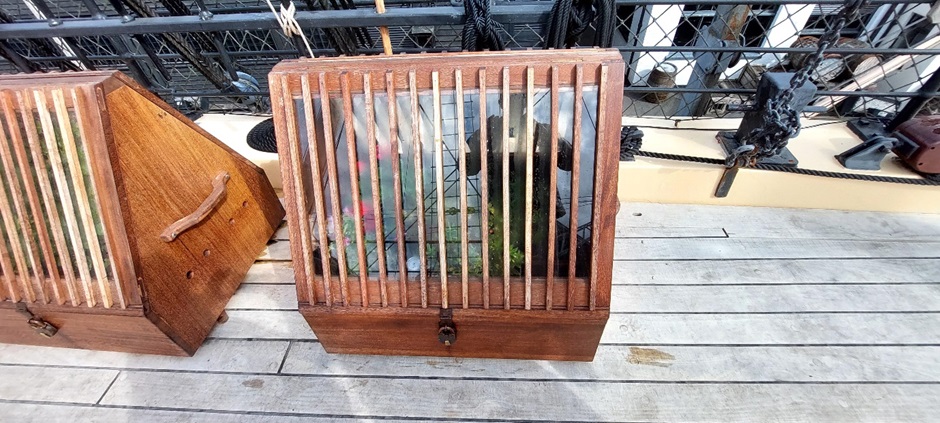
An excellent illustration of how these cases which shaped our modern world travelled was in evidence on the upper deck of the SS Great Britain, now moored in dry dock as a museum ship in Bristol. The Great Britain was the first ship to be built of iron and equipped with a screw propellor in an ocean-going vessel. It cut the voyage from Britain to the US down to 14 days.

The end of my day’s research involved meeting with other humanities and science researchers at Kew. This included historical geographer Professor Felix Driver, University College London. Felix was a Principal Investigator of Mobile Museum, a major research project on the mobility of biocultural collections, in collaboration with the Royal Botanic Gardens, Kew. With Caroline Cornish, Humanities Research Coordinator at Kew, he is now leading a project on plant humanities.[6]
These projects bring together humanities and science scholars to work together to examine historical plant collections. What can these collections reveal about past environmental injustices and present environmental issues? How can these plant collections aid in reconstructing past environments and climates, and the drivers of those changes?
We could well take a leaf out of these inspiring projects in the UK to return museums and botanical gardens to the central place they once had in research in Aotearoa New Zealand. Another important role is by showcasing the centrality of humanities scholarship on the natural world and humans. Thanks to these new research projects, institutions like Kew are once again at the forefront of interdisciplinary research, by asking questions about our future and the future of our planet.
Thanks.
I would like to thank Diego Molina, Felix Driver, Caroline Cornish and the staff of Royal Botanic Gardens, Kew, for hosting me. All photographs are mine.
Notes
[1] For an excellent introduction, see: Richard Harry Drayton, Nature’s Government: Science, Imperial Britain, and the ‘Improvement’ of the World (New Haven: Yale University Press, 2000).
[2] https://www.kew.org/science/collections-and-resources/collections/economic-botany-collection
[3] https://ecbot.science.kew.org/
[4] For more information, see Luke Keogh, The Wardian Case: How a Simple Box Moved Plants and Changed the World (Chicago: Chicago University Press, 2020). On New Zealand and the Wardian case, see James Beattie, ‘Thomas McDonnell’s Opium: Circulating, Plants, Patronage, and Power in Britain, China and New Zealand, 1830s-1850s’, in Sarah Burke Cahalan and Yota Basaki, eds., The Botany of Empire in the Long Eighteenth Century (Washington, D.C.: Dumbarton Oaks/Harvard University Press, 2017), 163-188.
[5] J. Livingstone, ‘Observations on the Difficulties which have existed in the Transportation of Plants from China to England, and suggestions for obviating them’, Transactions of the Horticultural Society of London, Vol. III, (1819), p. 427.
[6] For more information, see also: The Plant Humanities Lab, Dumbarton Oaks Research Library and Collection.
 The Garden History Research Foundation