
Mike Lloyd
Recently I spent a week’s summer holiday in Taranaki, and after driving back to Wellington found myself thinking ‘there are so many big Phoenix palms in the North Island’. I’d seen quite old palms in Oakura, Opunake, Eltham, Palmerston North, Levin, Otaki, and Paraparaumu. Despite now being a sociologist, I was able to identify them1 from my earlier horticultural training. That training was in Christchurch, where the palms are much rarer, which no doubt contributed to my noticing of so many specimens in the lower North Island. Based on this observation, reinforced by my sociological and horticultural training, I resolved to begin a new investigation into Phoenix palms in New Zealand. There is an academic context to draw upon as environmental sociology has been around for at least 50 years, and more recently there has been much interest in so-called ‘plant studies’2. However, the aim here is not to engage in theorising. Instead, I wish to describe the way my research has begun by searching for Phoenix palms using Google Maps, which also leads to a broader point to do with scale of inquiry. There is a reasonable impression that sociology is an over-generalising discipline, so by presenting a case study I hope to show that a sociological approach to people-plant connections need not jump immediately to a generalising ‘wider’ scale. It is worth asking, ‘what qualifies as a wider level inquiry, for example, could consideration of plants within a two-kilometre radius qualify?’ My answer is yes, and how I arrived at this is communicated via a strong grounding in visual material. The case is about Foxton, which raises the first question ‘why Foxton?’
After discussing some preliminary research with a colleague, the idea arose that ‘Phoenix towns’ could be identified. For example, Levin has several large ‘solo’ palms, a main road with a significant group planting, an area of historic significance with another cluster3, and other large groups of the palms. These factors could qualify Levin as a ‘Phoenix town’. My colleague, Michael Brown, suggested moving the search further north by considering Foxton, Fielding and so on. I agreed this would be useful, but delayed a trip from Wellington, sticking with my initial procedure of using Google Maps: I opened Google Maps, located Foxton at a distant scale, and then began focusing down trying to locate any palms. Previous experience of this technique had shown that parks were a good place to begin, which proved to be the case with Foxton, as I quickly made a ‘hit’ at the Foxton Reservoir Park, as shown in Figure 1.

The plan view shows how easy it is to spot Phoenix palms from above. The ‘street view’ function is an essential supplement though, as it both confirms they are Phoenix palms and shows variation not visible from above: in the second screensnip we see a mature female and male palm (about 50 years old), and a smaller female to the left of the larger palms. Of course, Google Maps does not provide information on planting history, but from this we have at least located a notable trio of the palms, prompting a search slightly wider in Foxton. The results of a continued search are seen in Figure 2.
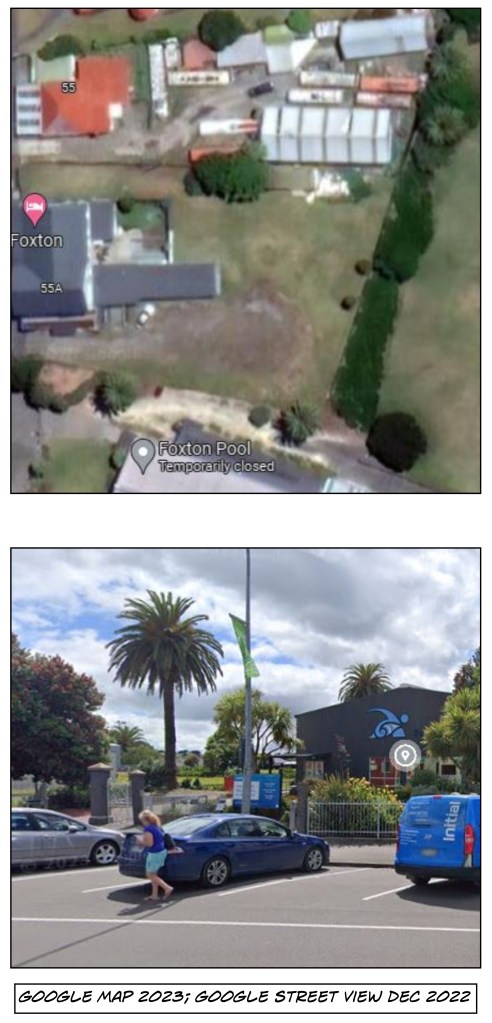
The location in the plan view is 700 metres from the Reservoir Park. We see next to the Foxton Pool the crown view of two palms, and then another pair in the tree border of Easton Park. This location is very close to Foxton’s well-known tourist attraction, the Dutch windmill. The street view shows that the large size of the palms gives them a visible presence in the skyline. In terms of New Zealand’s arboreal heritage, another tree that equally dominates the skyline is the Norfolk Island Pine, and in many coastal sites the two are often planted together for a strong exotic effect (e.g., Pilot Bay Beach, Mount Maunganui). A field visit to Foxton would fill out this observation about skyline presence. Nevertheless, by moving just slightly-wider on Google Maps, we can learn further interesting things. Consider Figure 3.
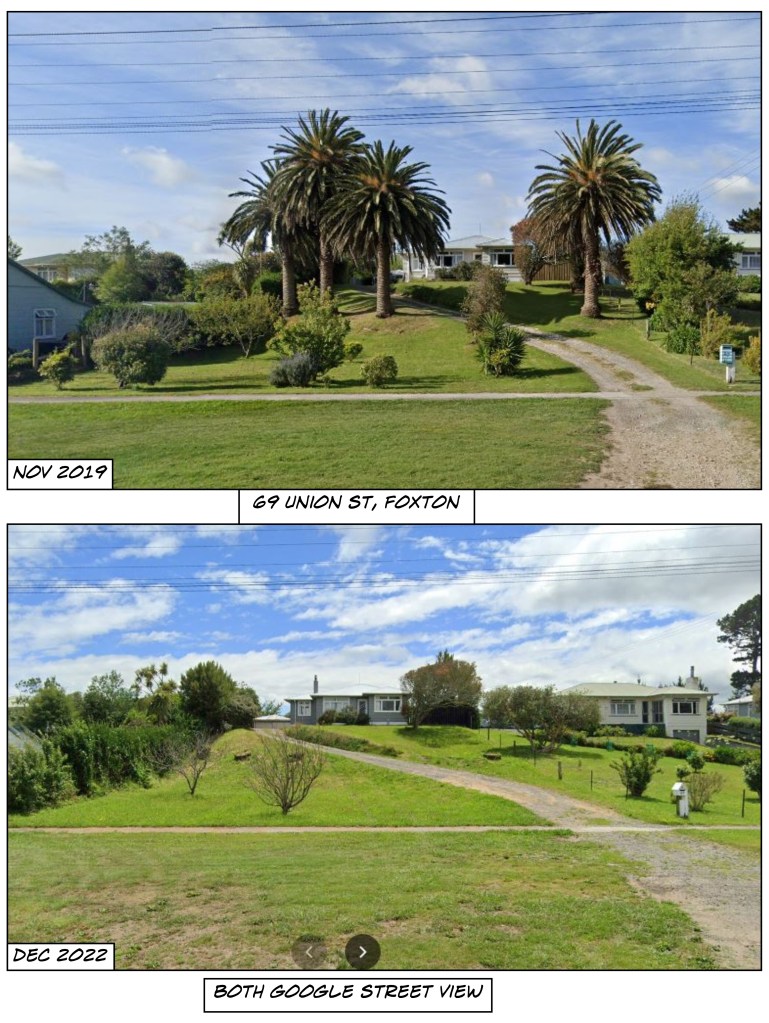
Sixty-nine Union Street is 700 metres eastwards from the previous location. The Phoenix palms that were here were found on the map view (not shown), indicating large specimens. However, once I switched to streetview, as seen in the two screensnips taken just over two years apart, I realised that the palms had recently been removed – they are what could be called ‘Google ghosts’, visible until the next update of Google Maps is made. As can be seen from the view when the palms did exist, they also had significant skyline presence, partly due to the group planting on a raised section. Their removal emphasises a key point: the continued existence of any tree, despite what might seem to be obvious aesthetic appeal, is far from guaranteed. Cutting them down was a conscious choice, something about which Google Maps tells us nothing, clearly necessitating other types of research. In the meantime though we can learn something from one last look about in the close vicinity.

Figure 4 shows 39 Purcell Street, just 600 metres from 69 Union Street. Here the plan view alerts us to the presence of a group of 10 Phoenix palms spread out on a larger property. In contrast to the homeowner of 69 Union Street, we can infer that the homeowner here was very keen on the landscape effect of a group of Phoenix palms. The bottom two screensnips cover a ten-year span, graphically showing the growth rate of the palm. This suggests that even 20 years provides sufficient time to develop a significant landscape effect from Phoenix palms, particularly when planted in a group.
There are more Phoenix palms to be found in Foxton, but our move slightly wider from the first sighting is sufficient to establish some key points. First, as the case of removal exemplifies, not everyone highly values Phoenix palms, despite their undoubted visual presence. Second, this suggests that abstractions like ‘Phoenix town’, whilst appealing, need careful thinking through. By classifying Foxton – or any other town – as such, we cannot thereby assume any individual plantings will be highly valued, safe from the threat of the chainsaw.4 Currently within New Zealand, particularly in the North Island, Phoenix palms are relatively common and many large specimens can be seen, but this does not assure their easy passage into middle age (at about 100 years old). My future research aims to detail the complexities of this situation. Google Maps is a great place to start, but other research techniques are needed to gain a good understanding of people-plant connections. A key focus of the ongoing inquiry is the contrast and connection between valuing and disvaluing the palms: I want to provide detail on instances where Phoenix palms are highly regarded, contrasted with cases where assent is given to their removal.5 Sadly, the number of cases of removal is growing. This is not fully surprising, for as Elkin powerfully states, ‘[Humans] plant trees to stimulate meaning, expression, and awareness, provoking poetry, art, and belief. We plant trees by necessity, to secure food, shelter, comfort, and fuel. But there is more to this. Humans also plant trees because we are very good at taking them down’.6 By travelling little more than a few kilometres, using the wonderful resource of Google Maps, we have glimpsed part of this ongoing process.
Acknowledgment
Many thanks to Michael Brown for fruitful conversations, and accompaniment on bike trips spotting Phoenix palms.
References
1 Phoenix canariensis is the botanical name. Identification is relatively easy, partly because there are very few other species of the Phoenix genus, including the true date palm – Phoenix dactlylifera – in the country.
2 See for example Ergas, C. & York, R. (2023) ‘A plant by any other name: … Foundations for materialist sociological plant studies’, Journal of Sociology, 59(1): 3-19.
3 Actually just south of Levin in the old ‘Kimberley Centre’. See Lloyd, M. (2023) MWR/G1887 New Zealand Tree Register entry for Speldhurst Country Estate, available at: https://register.notabletrees.org.nz/tree/view/1887
4 This accords with Steve Braunias’ impression from Auckland in his recent article, ‘The rise and fall of the Phoenix palm’, New Zealand Herald, 15 April, 2023.
5 Beginning work from early 2023, I have built a record of removals of well-established Phoenix palms (pairs and larger clusters) which includes cases in: Matamata, Hamilton, Mount Maunganui township, Wairoa, Patea School, Taradale School, Dannevirke School, Hawera RSA, Waikanae, and Blenheim riverside. There are bound to be more examples, and readers are invited to contact me to help update my records (email: mike.lloyd@vuw.ac.nz).
6 Elkin, R.S. (2022) Plant Life: The Entangled Politics of Afforestation. Minneapolis: University of Minnesota Press, p. 1.

 The Garden History Research Foundation
2 thoughts on “Phoenix palms: beginning a sociological inquiry”