Pania Mu, Research Associate, Institute of East Asian Art History, Heidelberg University
30 November 2026, Tui Room @ Hamilton Gardens (suggested donation: $10 waged; $5 unwaged)
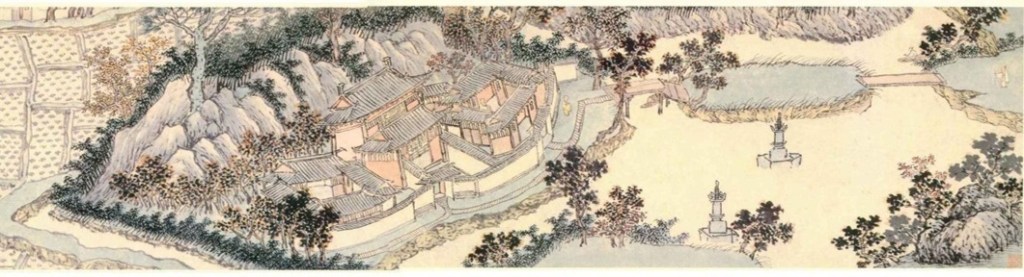
Image source: Shen Zhou, Painting of Thatched Cloister (Cao an tu juan), 1497, handscroll, ink, and colour on paper, 29.5×155 cm. Shanghai: Shanghai Museum.
This talk introduces how gardens, temples, and landscapes were represented in Chinese paintings from the Yuan to Qing periods (12th–19th centuries). Guiding a general audience with no prior background, the talk offers a way to read classical Chinese paintings as spatial worlds through paintings from Shen Zhou, Xu Ben, Wen Zhengming, Wang Hui.
Drawing on research from my published book, the talk invites audiences to reflect on how telling details in paintings, such as the mounds, pavilions, and water edges, reflect social and environmental transformations. The lecture further shows how architectural modelling and site archaeology help connect historical paintings to current gardens on site.
Dr Pania Mu is an art and architectural historian based in Berlin, Germany. Her book From Temples to Garden Estates and Academies, published by Routledge Press in 2025, investigates the socio-hydraulic transformation of Suzhou gardens in late imperial China. Her recent research examines Dunhuang Buddhist architecture in Medieval China and the transition of Silk Roads reconfiguration.
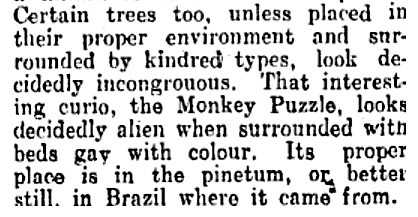
The first blogpost on the monkey puzzle tree in New Zealand finished with a view of a good specimen in Queen Mary Hospital, Hanmer. It was planted about 1930, very likely as part of Alfred Buxton’s commissioned work at this site. Given that Buxton & Company planted quite a few monkey puzzles in their highly regarded garden designs, it is reasonable to infer that this helped maintain their popularity in New Zealand. However, by 1930 signs of resistance to the tree had also developed. Here is one example from the Hawke’s Bay Tribune, January 8, 1930:1
The article is sub-titled ‘An Expert’s Views.’ Of course, the expert is entitled to characterise the monkey puzzle as an ‘interesting curio’, but in saying its proper place is in ‘Brazil where it came from’, some doubts can be cast on his or her ‘expert’ opinions. Whereas Brazil is close to Chile and Argentina, the monkey puzzle is not endemic to Brazil.
Not long after the expert’s views were expressed, this time in the Southland Times, a writer expresses a nonchalant indifference towards the monkey puzzle. In a column on ‘The Garden’, the view is expressed that ‘An elegant green foliage shrub to take the place of an old araucaria is Cupressus bermudiana.’2 By ‘old araucaria’ the writer probably does mean the monkey puzzle tree, rather than other Araucaria species like the Norfolk Island pine, or bunya bunya, as the latter two species were not commonly planted in the far south. However, the monkey puzzle seems to have been very popular in Otago and Southland, and by 1935 there were indeed old specimens to be found in the far south. Southland is as good a place as any to begin the discussion here, which helps to show that the monkey puzzle tree was more than an interesting curio in New Zealand. After considering examples in Southland we move to one particularly well-known example in central Canterbury, then move to Hawera in the North Island.
Some Southland Monkey Puzzles
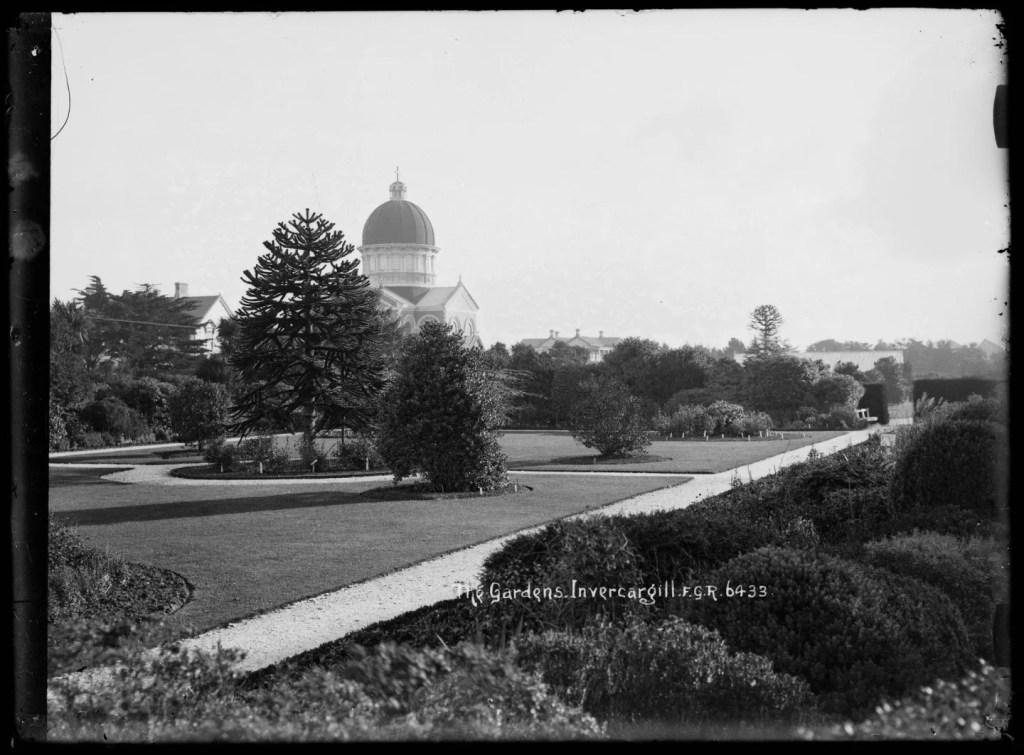
Invercargill is the main city in Southland and as early as 1856 land was set aside for a central park. However, it was not until 1873 that planting began in Otepuni Gardens (sometimes simply known as ‘Town Gardens’).3 Monkey puzzle trees were planted early in the Gardens’ history, and in prime locations as this early photograph shows:
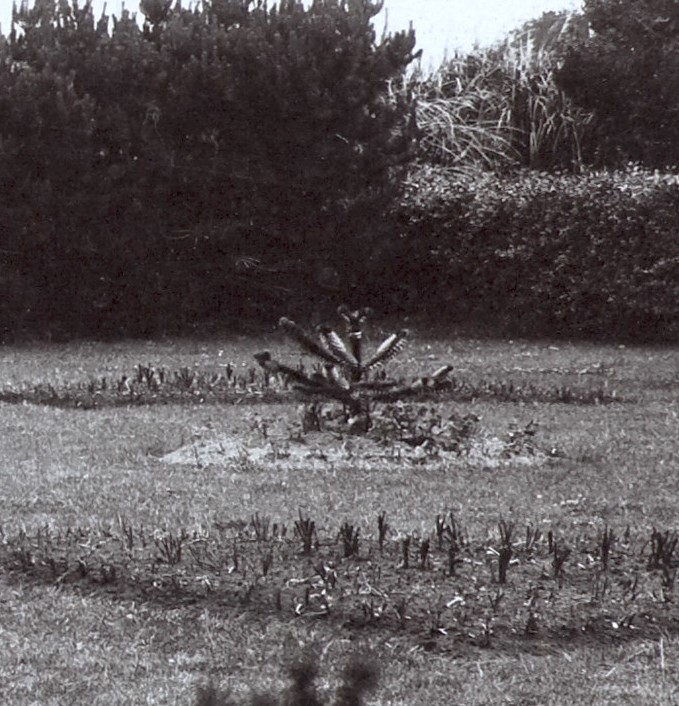
Just as the St Mary’s Roman Catholic Basilica stands out on the skyline, so too does the sturdy specimen growing in a feature circle. Further in the distance a second monkey puzzle can be seen rising above other plantings. Both look to be about 15 years old, thus having been planted circa 1890.4
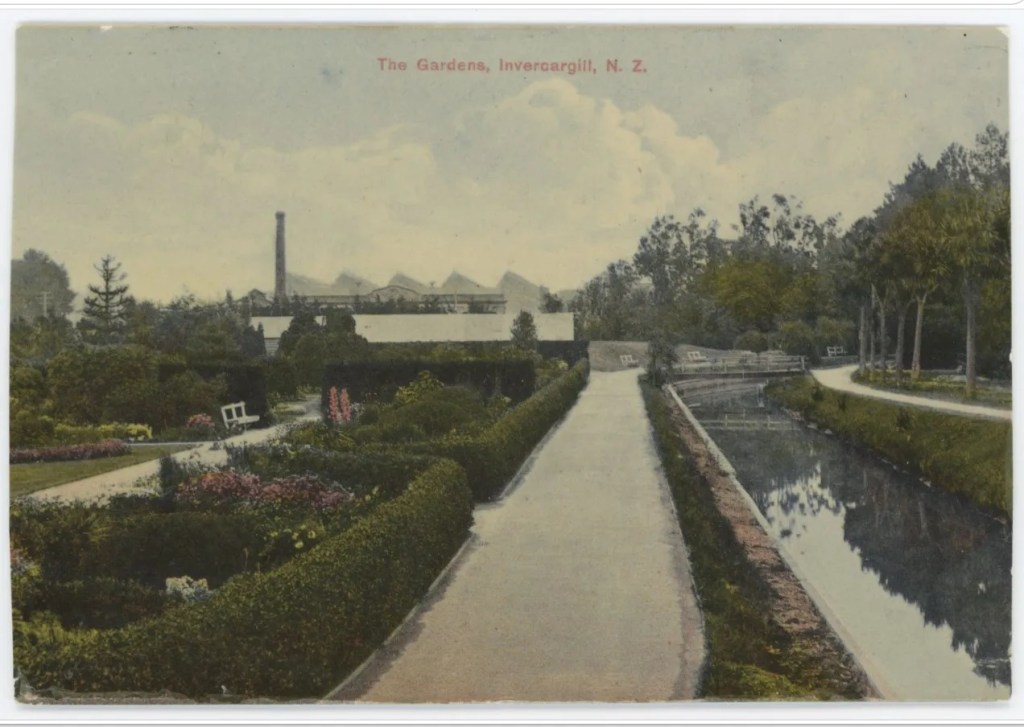
Otepuni Gardens were the premier gardens of Invercargill at the time, and on a visit many people would have viewed the monkey puzzle trees. If they wished they could also send their friends and relatives a postcard featuring a colourised view not that different from the photo above:
Source: ‘The Gardens, Invercargill, N.Z.’ ca 1909, Fergusson Ltd Postcard, Invercargill City Council Archives A0637_S27880015
There is no way of knowing whether the impressive pair at Otepuni Gardens stimulated other plantings, but nurseries did have stock for sale, and there certainly were many other plantings in Southland about this time. We can consider four examples not far from Invercargill, all in a northwards direction (distance given in brackets): at Edendale (34 kms), Brydone (37 kms), Otamita (60 kms), and Waikaka Valley (75 kms):
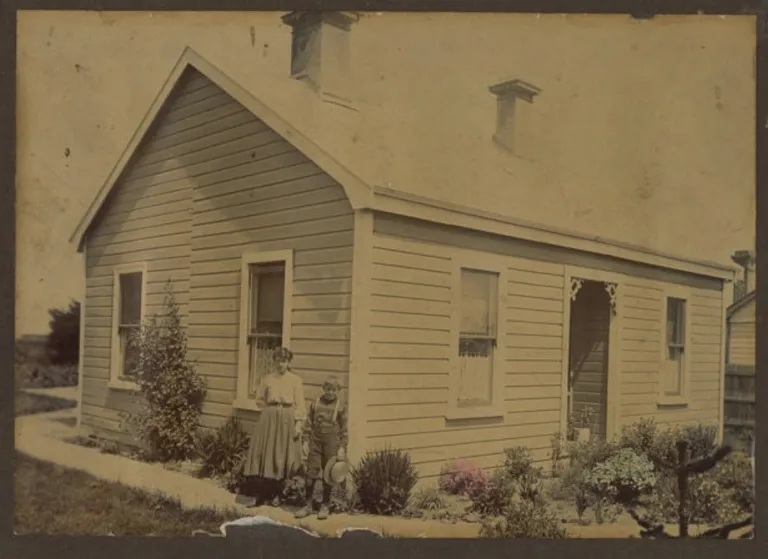
Granny Brown’s Cottageat Edendale1890-95
Source: Granny Brown’s House, Wyndham & District Historical Museum, WY-0000-.577
The notes for this photo give the location as 18 Brydone Street, giving the names of the woman and boy, also stating, ‘Note the monkey puzzle tree in the foreground’. It would appear to have been planted within a year or two of the photo, at what is clearly a modest cottage, where nonetheless ‘Granny Brown’ took care over her garden.
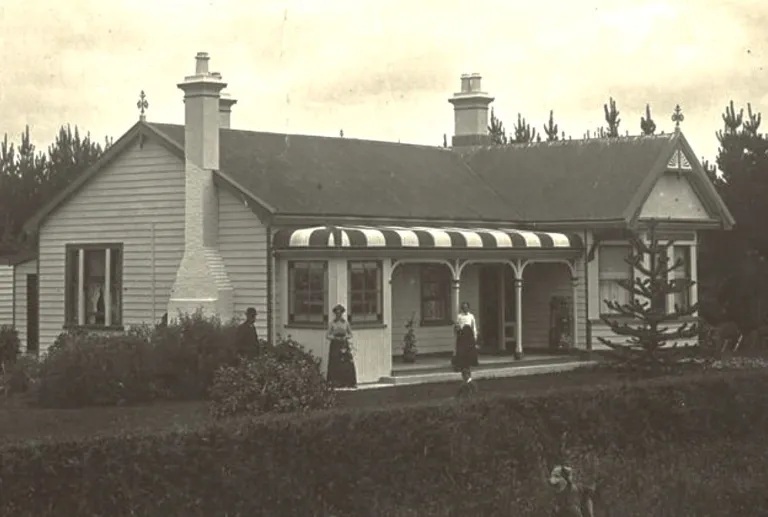
Brydone 1890-1900
Source: Photograph, house with three adults …, Wyndham & District Historical Museum, WY.2009.09.10
This time the house is much larger, probably fitting the classification ‘middle class’, but similar to the Edendale cottage the monkey puzzle tree is planted close to the house. Clearly, both the Edendale and Brydone examples show that in the 1890s small-town Southland properties featured monkey puzzles in conspicuous sites. The same applies to rural farmhouses, as we can see in the next two examples.
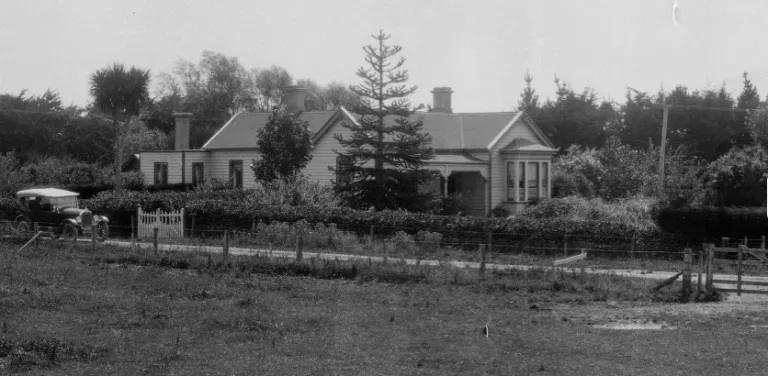
Farmhouse at Otamita, 1923-28
Source: R P Moore Collection, Alexander Turnbull Library, 1923-28, Pan-0408-F
The full panoramic photo shows a very isolated farmhouse, but there again in pride of place in front of the house is a significant monkey puzzle tree. This looks to have been planted about 1900 to 1910.
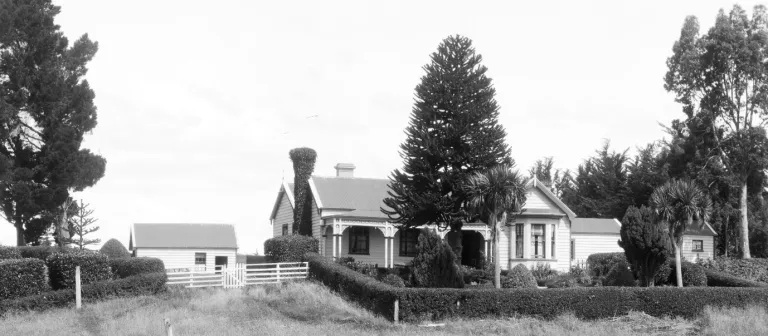
Farmhouse on hill, Waikaka Valley, 1923
Source: R P Moore Collection, Alexander Turnbull Library, 1923, Pan-0108-F
Just as with the last example, the farmhouse is isolated, this time sitting atop a small hillock. It has well-trimmed hedges and right in front of the house a perhaps 25 to 30-year-old monkey puzzle, nicely framed by two cabbage trees. Careful attention to the left of the photo, next to the small shed, shows a second monkey puzzle, in the order of 4-years-old. The planting of two specimens clearly suggests the farmer was very taken with the tree.
Awaiting fhe fall?
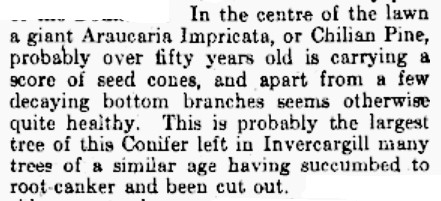
Undoubtedly many more monkey puzzle trees were planted in Southland from the late 1800s into the early 1900s. The examples above are sufficient though to show a liking for the tree across situations: from small town cottage-gardens, to middle-class town houses, to isolated farmhouses. An obvious question is, ‘what happened to these trees?’ In some cases further information can be found, but in general it is impossible to accurately track down their fate. This makes difficult a simple repetition of a ‘rise-and-fall’ narrative, however, there is also another factor that bears examination. Hints of this are seen in an extract from the Southland Times, 1921:5
This is an extract from a lengthy report on a ‘garden club’ visit to ‘Lennel’, a well-known residence in the Invercargill suburb of Gladstone. The writer suggests the currently healthy tree was planted in the 1870s, it being one of few that age surviving in Invercargill due to ‘root-canker’. ‘Canker’ can be a fairly general term for tree ailments, but regardless of how good a descriptor it is of what ailed monkey puzzle trees the identification of this loss of trees is significant.6 Again it suggests that social things like fads and fashions may not be the best explanation of the fall in popularity of the monkey puzzle tree. Instead, they may have fallen out of the public eye due to disease, and not mainly any change in opinion about the merits of a healthy tree in the garden. We will return to this factor in considering the Hawera example, but first we can move to the case of the monkey puzzle at Lincoln College, Canterbury.
Lincoln Collegeloses an old friend (but forgets its history)
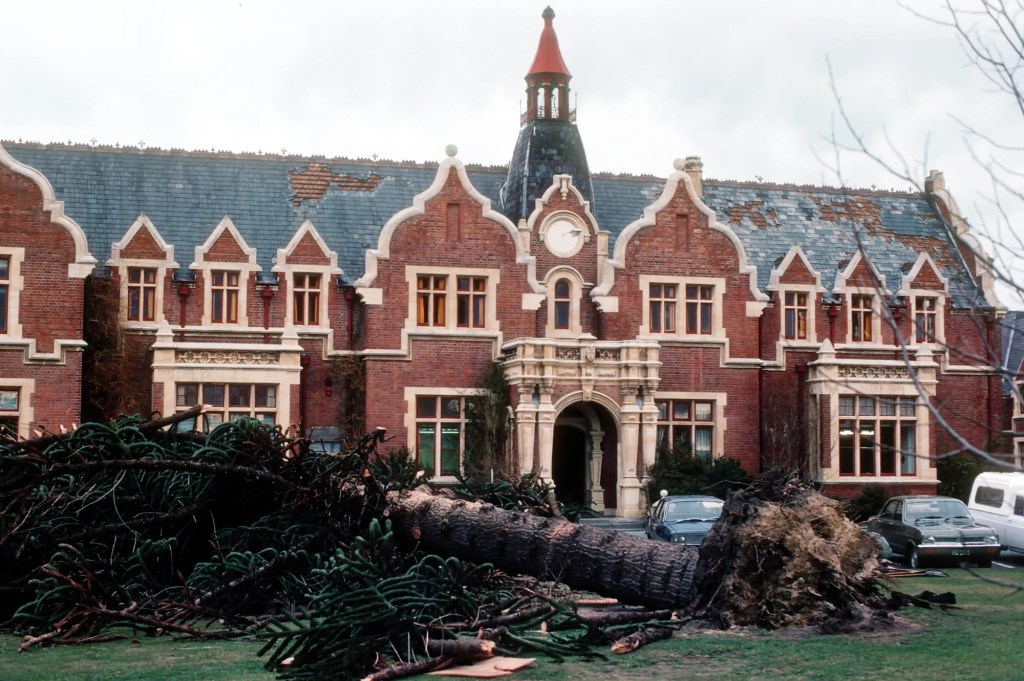
On August 1, 1975, there was a severe wind-storm in Canterbury. One result is shown in this photo taken by a horticultural lecturer at the College:
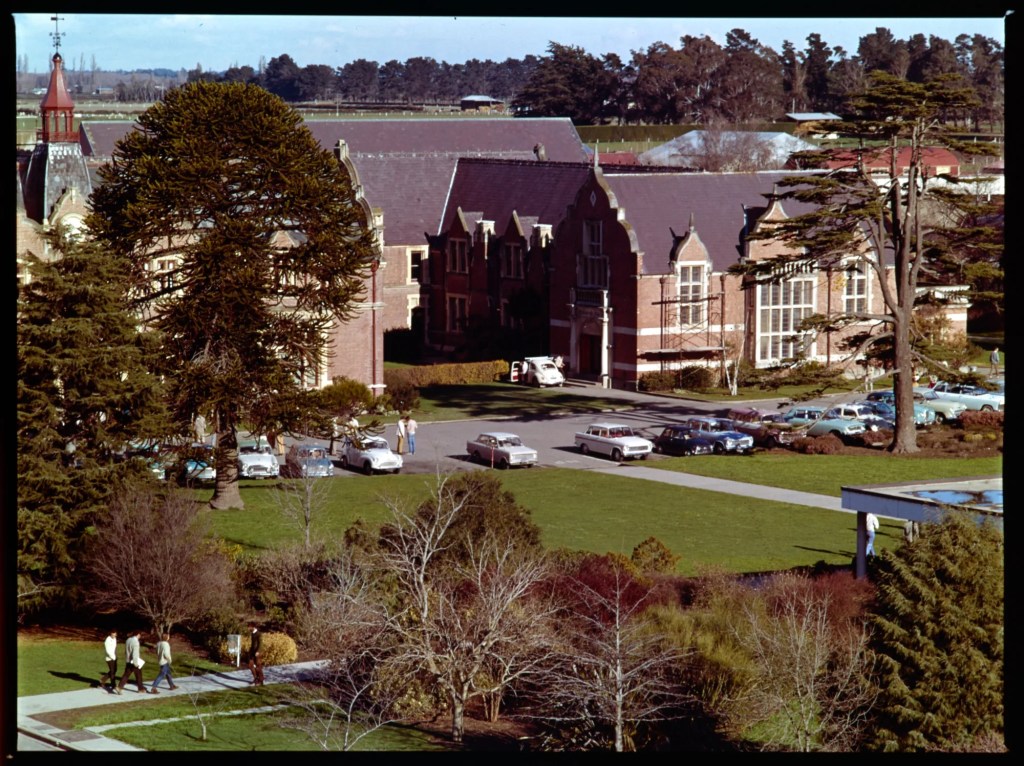
The photo shows a toppled monkey puzzle tree in front of Lincoln College’s iconic Ivey Hall. What the tree looked like when upright, commanding a significant site, is shown by another photo:
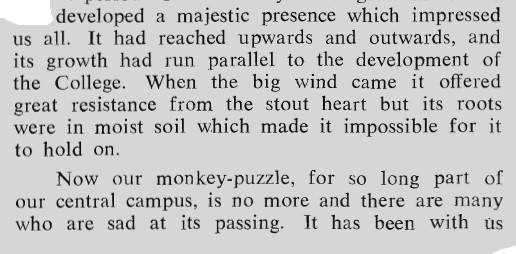
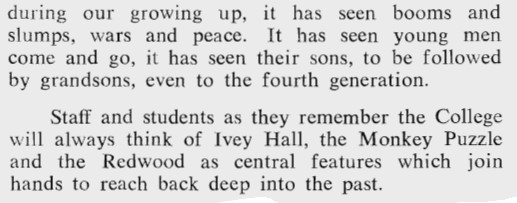
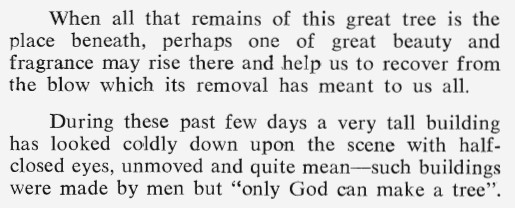
The tree was clearly of significant size and in very good health. Not long after its toppling, reports mourning the loss of the tree appeared. On August 13 The Press carried an article titled ‘In memory of a monkey puzzle’ (p. 5). Starting with the byline ‘Lincoln College lost an old friend in the great gale of August’, the article notes that the tree had developed a majestic presence as it grew over about 80 years, then quotes G B McLeod from a college newsletter. If we go to that source, we first learn that a count of the tree rings dated the tree as 91 years old, thus it was planted in 1884. McLeod’s tribute is worth quoting at some length. He says the tree
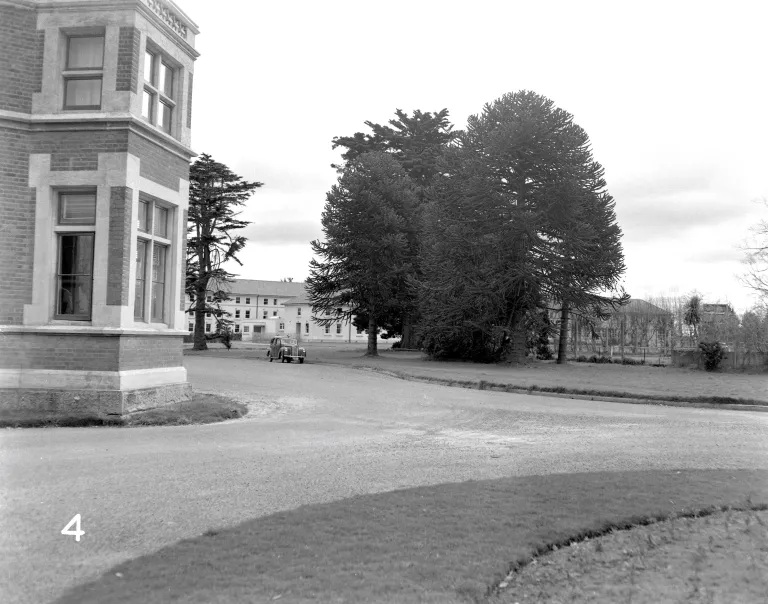
There is little reason to doubt that the monkey puzzle tree was centrally placed within the culture and history of Lincoln College. The sentiment is heartwarming, and even a non-believer can connect with the powerful finish: ‘only God can make a tree’. However, while McLeod alludes to the ‘very tall building’ looking ‘coldly down upon the scene’ he does not look beyond his own lyricism. The fact is, up until 1958, there were three monkey puzzle trees planted in front of Ivey Hall, as this photo shows:
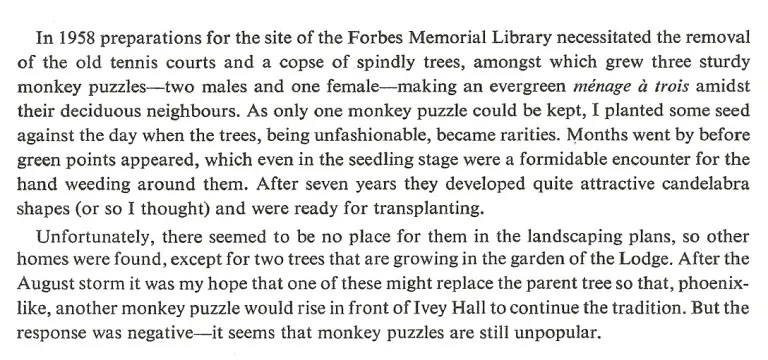
Ruth, an American, was the wife of Malcolm Burns, whom she had met and married while he was on a fellowship at Cornell University. Beginning as a lecturer in soil science at the then Canterbury Agricultural College, Malcom went on to become director of the college in 1952, and then principal in 1962 when it became Lincoln College7. Ruth notes in ‘Some Trees’ that they lived on the college grounds for 33 years, and in the first part of that document lists a number of trees that she planted, sometimes growing these from seed. It is clear that Ruth is knowledgeable about trees and gardening, being impressed by the monkey puzzle trees. It is in the ‘Pictorial Comment’ that this is made most clear. The tree that was toppled in the storm is described as Lincoln’s ‘most distinctive tree’, though at the time of writing she admitted that ‘fashions have changed and young monkey puzzles are seldom seen now’. Most interesting is the comment that she ‘grew eight seedlings 20 years ago’, detailing why and what happened to them:
Though the document from which this is quoted is dated 1977, it needs to be realised that Malcolm Burns retired as principal of Lincoln College in 1974. Thus, in 1975 when the tree was toppled, Ruth had moved to Christchurch with Malcolm to retire, meaning that she no longer had the ability to have trees she had grown from seed planted in the Lincoln College grounds. This probably helps explain why the offer of a replacement monkey puzzle for the toppled 91-year-old was turned down.8
The ‘Some Trees’ document, dated 1964, explains that one of the monkey puzzle trees planted by the Lodge died, and the second was moved to the horticultural research area. Inquiries indicate no trace there of a monkey puzzle tree. So, in the space of 90 years Lincoln College went from having five monkey puzzle trees to none.
A new group of buildings at Lincoln College named the Burns Wing, in recognition of the contribution of Malcolm and Ruth to the College, was opened in 1976. Extrapolating from her clear love of trees and gardening, Ruth may have been happier if one of her seedling monkey puzzles had been replanted in front of Ivey Hall, rather than having a building named after her husband and her. If ‘only God can make a tree’, it is clear that once made humans do highly variable things to them.
The Hawera Triangle
Finally, we move north to Hawera, in South Taranaki, with an example that also involves three monkey puzzle trees. They are in Hawera’s King Edward Park, but to set the scene for their planting it is useful to view a full Robert Percy Moore panorama, taken in Hawera sometime between 1923-28:
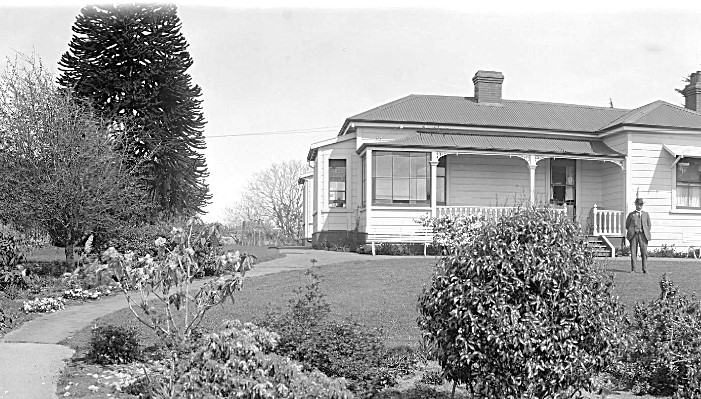
Though it looks like a small park, this is a homestead named ‘Ti-Maru’ (R P Moore Collection, pan-2471-F, Alexander Turnbull Library). If we magnify the area close to the house we can see the owner, Charles Goodson, as well as a significant tree:
The impressively healthy monkey puzzle is well over six metres tall and must have been planted pre-1900. Available information on Charles Goodson describes his gardening interests and helps to contextualise what we will see at King Edward Park.
Goodson was born in Wanganui in 1866, and when a young man he farmed with his father at ‘Waihi Downs’ near Hawera. When his father died in 1888 Charles extended his farm to 700 acres, becoming an active stockbreeder. He was elected to the Hawera Borough Council in 1904 and was appointed chairman of the parks and reserves committee, a role he retained until 1918. Under his direction King Edward Park was planned and laid out, with an emphasis on trees, shrubs and plants suitable to Hawera’s climate. At his Ti-maru residence in Cameron Street, Hawera, Charles’ garden included rhododendrons and daffodils which he hybridised and bred. He was a self-taught horticulturalist, but nonetheless had great success in plant-breeding, and was also recognised as the person who introduced Luculia species to New Zealand.9
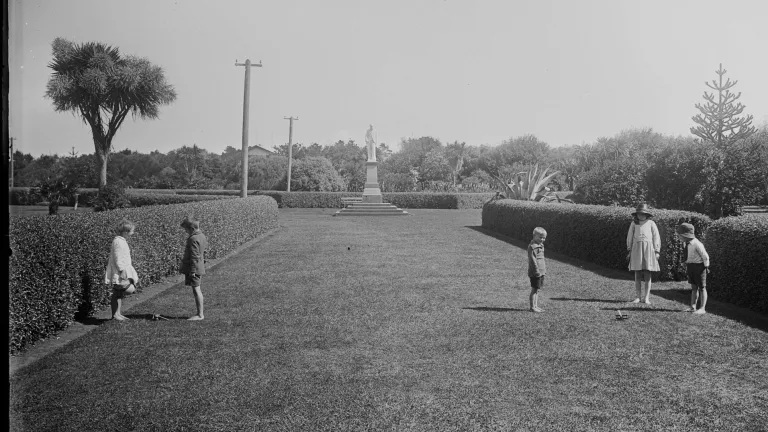
It is not likely that Charles planted the monkey puzzle at Ti-maru, but given its robustness and his admitted desire to plant trees and shrubs which grew well in the local environment, it is no surprise to find monkey puzzles as an early planting at King Edward Park, as this 1920 photo shows:
Source: ‘King Edward Park, 1920’, E Bradbury, Auckland Libraries Heritage Collections 1784-132
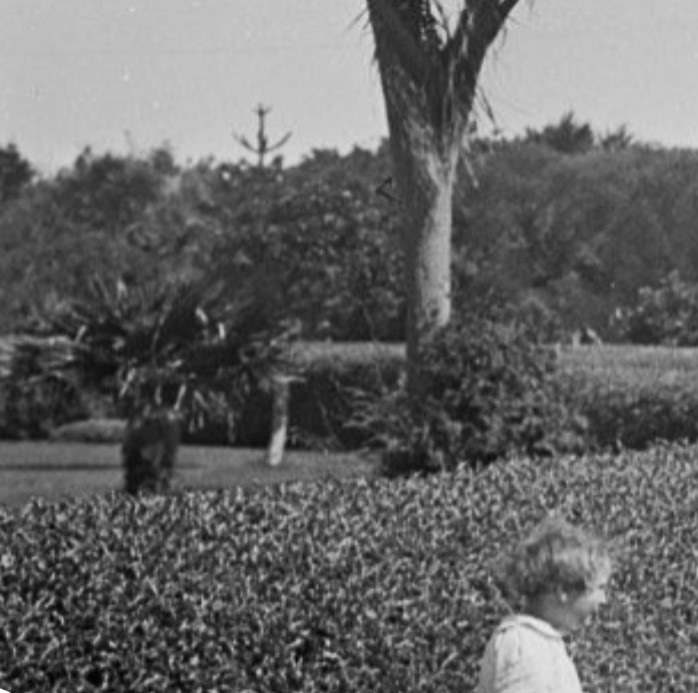
A good-sized specimen can be seen above the children on the right of the photo, but if we magnify the left side we can see a second specimen between the cabbage tree and young palm:
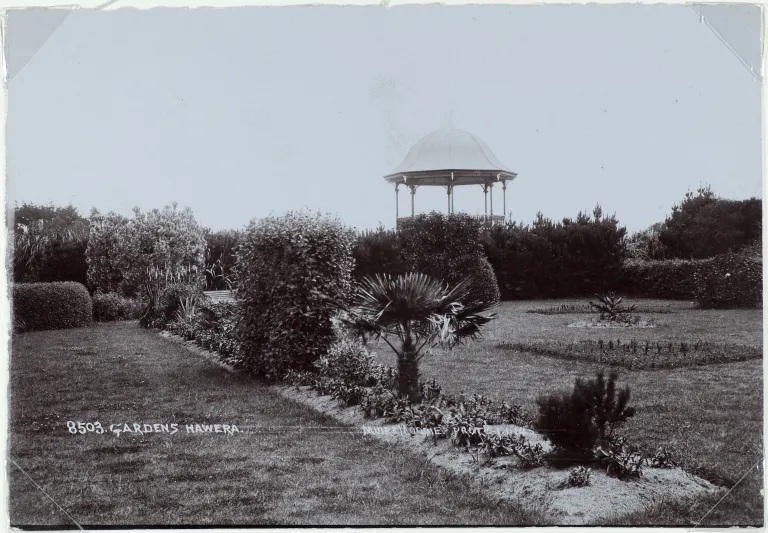
In his history of King Edward Park, David Bruce10 dates the planting of the monkey puzzle to the right as Arbor Day, 1907. However, the newspaper article11 that he refers to in suggesting this date does not specify particular plant names. Bruce does not mention there being two monkey puzzles in the site seen above, nor does he seem aware of a third planting, just visible in this 1914 photo:
Source: Gardens, Hawera, January 1914, Muir & Moodie. Te Papa (O.001879)
A magnification suggests the monkey puzzle is freshly planted:
The band rotunda is some distance away from the area seen in the first photo, so it does very much look like there were three monkey puzzles planted in King Edward Park. Given the size of the two seen in the 1920 photo, it seems likely that 1913-14 was the planting date for all three.
The point of going into so much detail here is to emphasise how little of this historic planting has been remembered, despite three being a significant number of monkey puzzle trees to plant. David Bruce’s history of the park does feature a 1958 Whites aerial12 photo of King Edward Park, which does show the specimen to the right of the three children, at 44 years old. But there is no mention of the fate of the other two trees, and no mention of the trees is found In Papers Past searches. What we are left with is this:
Some specimens have also succumbed to natural causes. Planted in that long ago Arbor Day in 1907, the Chilean “monkey puzzle” pine, which for more than a century stood alongside the Fantham statue, succumbed to the fungal disease armillaria blight in early 2011. (Bruce, p. 46)
Whether it was 104 years old from a 1907 planting, or 98 years old from a 1913 planting, the tree would have had a massive presence. The site did not have the constant public traffic that the Lincoln College tree did, nonetheless, it grew in the premier park in Hawera. Four years after Charles Goodson’s death, in recognition of his contribution to horticulture in Hawera, a Charles Goodson Memorial Garden was established in King Edward Park (see Bruce, p.30). There are no monkey puzzle trees in the Memorial Garden.
The same goes for Ti-maru, the garden that Goodson stood proudly surveying in the 1920 photo above. In 1933, at the age of 67, Charles put his large property up for sale13, moving to a smaller section within it. Searches of aerial photos of the site show no sign of a very large monkey puzzle tree, just a lot more houses added. There is a little good news however: the area around the pond, which had fallen into ‘wrack and ruin’, has been restored and preserved as a small public garden called the ‘Goodson Dell‘.
Coda
There is no doubt that the monkey puzzle tree was very popular in New Zealand at least into the 1930s. But owing to factors like root canker, ill winds, fungal blight, and property development, the trees are now hard to find. There is a more recent part of the story of the monkey puzzle tree in New Zealand to be told. Likewise, it is not good news, but here rather than burden the reader with yet more talk of demise, interested readers can check The Local Arboretum blogposts where this extra information will be included along with a gallery of images of monkey puzzle trees. The latter will provide further evidence of how striking they appeared in New Zealand gardens, an effect that as we have seen brings no guarantee of a long-life.
References
On page 3, titled ‘The flower garden . Advice on designing’ ↩︎
‘The Garden’, Southland Times, 31 July 1935, p. 16. ↩︎
A 1892 article ‘By the Corporation Gardener’ (ie.Thomas Waugh) on ‘Trees in the Invercargill Reserves’ includes ‘Arancaria imbricata’ (sic) in the list, and notes that ‘most of the plants in Invercargill have been brought from London in Wardian cases’. Thus, 1890 looks to be a good estimate for planting date. Southland Times, 9 July 1892, p 1 (supplement). ↩︎
The Garden Club, Southland Times, 9 November 1921, p. 2; note that impricata, actually imbricata, was the first (now replaced) botanical species name for the monkey puzzle tree. ↩︎
Note too that whereas there is no mention in the Southland Times newspaper, photographic evidence shows that by the mid-1920s the two monkey puzzles in Otepuni Gardens were no longer there. Roger Percy Moore has a good photo of the formal garden area, sans monkey puzzles: ‘Invercargill Gardens, New Zealand’, 1923-28, Pan-1234-F. ↩︎
Just how long the two seedling trees planted in front of the Lodge had been in the ground in 1975 is unknown. They may have still been relatively young, thus Ruth’s ‘replacement’ suggestion may have assumed that the tree can be easily transplanted, which may not be the case. ↩︎
Details from ‘Life-long service to horticulture record of late Mr C. Goodson’, Hawera Star, 7 December 1949, p. 4. ↩︎
The PīwakawakaRoom @ Hamilton Gardens (suggested donation: $10 waged; $5 unwaged)
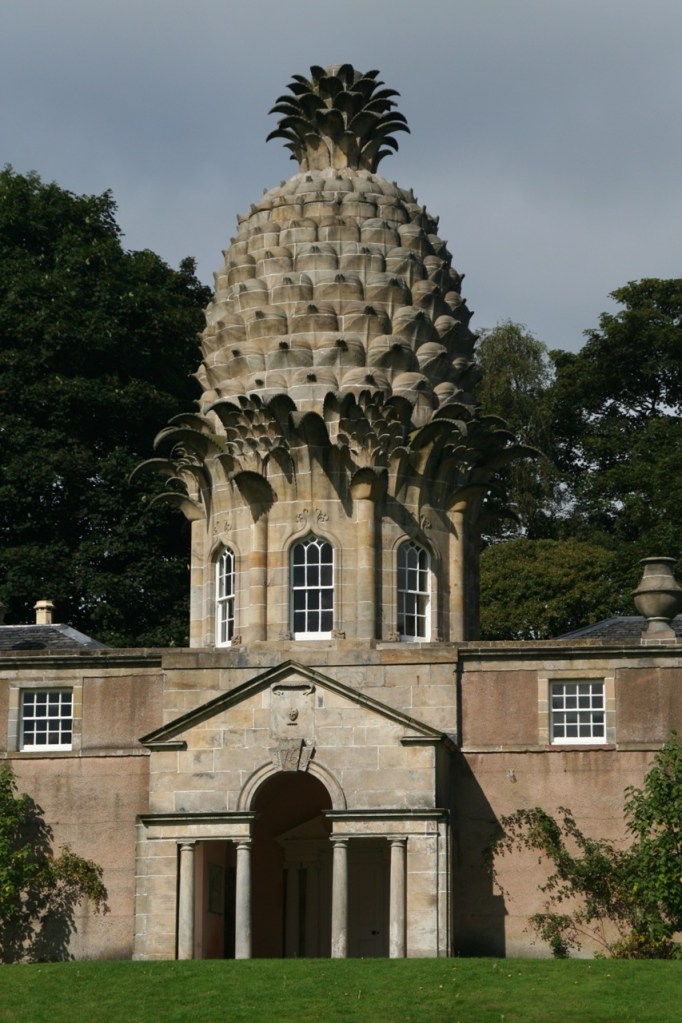
From the seventeenth century, pineapples were a sought-after status symbol in Europe. Imported from the tropics, a single specimen was worth more than a thousand pounds, while less affluent customers rented them by the night as decorations. With its golden spiky crown and unique aroma, the pineapple was a rare and exotic novelty.
The Dunmore Pineapple in Falkirk, Stirlingshire, Scotland (Klaus Hermsen, CC BY-SA 2.0.)
Initial attempts to grow the new fruit in temperate climates were not successful because pineapples require very warm temperatures to thrive and do not tolerate frost. Gardeners raced to recreate this environment and claim the prestige of being the first to propagate them in Europe. A pineapple growing mania followed, making hothouses and specialist gardeners the ultimate markers of conspicuous consumption.
Join us for a history of pineapples, hothouses, and the cultivation of luxury in the early modern garden.
Dr Garritt (Chip) Van Dyk is a senior lecturer in history at the University of Waikato. His research interests include botanical imperialism, food history, and patterns of consumption in early modern Europe. He is a recipient of the Sophie Coe Prize for writing in food history, and the author of Commerce, Food, and Identity in Seventeenth-Century England and France: Across the Channel. He is a regular contributor to The Conversation.
One of Wellington’s very few monkey puzzle trees. Source: Author, August 2026
Stories of trees falling in and out of fashion are common. Beamish,1 for example, has written on the ‘rise and fall of the Lombardy poplar’, a tree frequently seen in New Zealand landscapes. But perhaps the tree that most readily comes to mind in terms of worldwide ‘rise and fall’ stories would be the monkey puzzle tree (Araucaria araucana). William Noble2 describes how the tree was introduced to the British Isles in 1795 by Archibald Menzies, who supposedly procured nuts in Santiago. These germinated on the return trip to England and seedlings were given to Sir Joseph Banks and to Kew Gardens. Thereafter the monkey puzzle became the ‘ultimate fashion accessory’ of Victorian landowners who collected trees with competitive zest. A second wave of collection occurred in 1826, but most important was a collection in 1840 by William Lobb, who was associated with James Veitch, an Exeter nurseryman. Lobb collected over 2,000 seeds, which when germinated were sold for large sums from the Veitch nursery.
Noble is careful to add more than just ‘fad and fashion’ to his account. He notes that the monkey puzzle was a ‘star tree, partly because it is so different from any other conifer and therefore easily recognizable, but also because a mature specimen, especially when clothed to the ground, is a very striking sight and might be used as the centre of a formal display’ (p. 157). Some large estate owners were so taken with the tree that they planted lines or double avenues, but the tree also became heavily planted in smaller suburban villa gardens from the mid-1800s. By 1850 the use in smaller gardens drew criticism from Loudon, who argued the tree was not actually suited to such smaller gardens.3 Thus began the fall of the monkey puzzle tree.
By 1915, Herbert Maxwell roundly condemned the use of the monkey puzzle in suburban gardens. Noble quotes him as follows:
there is no tree which has suffered so much from injudicious planting among inappropriate surroundings … and I know of no more dismal object in the world of plants than an araucaria stuck down in front of a suburban villa, stifled with smokey deposit, retaining a despairing grip on life, whereof the only visible sign is the green tips of its poor blackened branches. It is treatment such as this which has caused the araucaria to lose favour with British planters. (p. 159)
Others shared this view, and while this did not result in the cessation of monkey puzzle planting in the British Isles, Noble effectively marks this as the end of its once spectacular popularity.
In New Zealand
About the same time that Loudon was denouncing the planting of monkey puzzle trees in small British gardens, they were first planted in New Zealand. The strong likelihood is that the first monkey puzzle tree was planted here in 1859 at Mount Peel Station (see NZTR entry CR/1478 (Cadwallader 2015). Interestingly, it was procured by Barton Acland from Veitch’s nursery in Exeter, and according to Strongman ‘At Mount Peel this symbol of the Victorian Gothic was given great status’.4 It is reasonable to assume that word about the tree would have spread quickly in the local region, and it was soon available from local nurseries for those who wanted to plant one. Without attempting a comprehensive tracking, there is little doubt that thereafter the tree underwent a ‘rise’ phase. Given the time of introduction was later than that in the British Isles, we could not expect a mirroring of the beginning of decline at about 1915. Furthermore, there are local factors which complicate any replication of the British rise and fall pattern. To see this we can turn to some interesting aspects of the history of Alfred Buxton, New Zealand’s premier colonial landscape gardener.5
Buxton: Well Familiar with Araucaria
The scholarship on Buxton by Tipples and Gleeson has some comment on the planting of monkey puzzle trees, including several photos of Buxton gardens where they were clearly identifiable. However, given monkey puzzles are not a substantial focus of either author, further inquiry was called for. In brief, this shows that even if there is no explicit comment by Buxton on his use of the tree, he was certainly well familiar with it and used it in his landscape designs. We can show this by starting at 1896 when Buxton began a nursery apprenticeship, his entry into a highly successful career as a landscape designer.
Pride of Place
In 1886, when Alfred Buxton was fourteen years old, he was apprenticed to Thomas Abbott, Canterbury’s then leading nurseryman. Abbott had a homestead in his Papanui Road nursery (named Exeter after ‘home connections’6 ). Luckily, photos are available of the homestead and its environs a few years apart:
Source: Abbott’s nursery, Papanui, ca. 1880. Canterbury Museum (2000.198.58)
Source: S. Challenger, ‘Studies of pioneer Canterbury nurserymen (2). Wilson’s major competitors’, RNZIH annual journal 1979, 7: 5-38.
Whereas Challenger has the bottom photo labelled ‘date unknown’, Rupert Tipples dates a photo (see p. 23) looking in the opposite direction, where the monkey puzzle tree is about the same height, as from 1891. 7 So clearly, just before, or just after, Buxton started his apprenticeship a monkey puzzle tree was planted in a very significant site in the large nursery. Thomas Abbott was known as a keen horticulturalist who was ‘always importing new and rare plants’,8 so the planting of a monkey puzzle tree in such a choice site obviously reflected it having high status in the horticultural world.
The first major design work: Leslie Hills
Buxton finished his apprenticeship with Thomas Abbott and in 1896 started his own nursery in St Albans, and by 1898 was promoting a landscape business. As Tipples, Strongman and Gleeson all concur, Buxton was a ‘go-getter’ and by 1900 he had secured his earliest commission at a large Canterbury station owned by Eva and Duncan Rutherford. The contract was for a new garden surrounding a new homestead. The existing garden was not insignificant, and interestingly contained a tree that Buxton was very familiar with. In the photo, dated 1896, behind the standing girl, we can see the unmistakable form of a young monkey puzzle tree:
Source: T. Strongman, 1984, p. 103
If we assume that between 1896 and 1900 the tree continued growing, and by consulting another historic photo, we can make a first important characterisation about Alfred Buxton and the monkey puzzle tree. Consider, the photo below, looking up to the new house at Leslie Hills:
Source: J. Holm, Nothing But Grass and Wind: The Rutherfords of Canterbury, Hazard Press, 1992, p. 216
Almost cropped out of this 1910 photo, nonetheless identifiable, is a second monkey puzzle tree, by its size planted during Buxton’s design work from 1900. This shows that Buxton used the tree right from the beginning of his landscape design career. We will see below that this use continued, but first it is important to note that even at this early stage Buxton’s work was accomplished by teams of men. Some members were very important in the design work, including Edgar Taylor who joined Buxton’s company in 1905. Taylor was to work for Buxton for 20 years, being key in the role of draughting landscape plans, and also in expanding the business to the lower North Island (he was based in Masterton from 1916-1921).
Edgar Taylor was born in Britain in 1886, emigrating to New Zealand with his family when he was three. As Tipples puts it, ‘The young Edgar Taylor grew up in the [Christchurcn] Botanic Gardens and was employed there from an early age under the direction and tutelage of his father’ (p. 40). As curator of the Botanic Gardens from 1889 to 1907 Ambrose Taylor was provided a house in the Gardens, seen in the photo below:
Source: The Park, Christchurch. Burton brothers album 2. Ref: PA1-o-081-06. Alexander Turnbull Library.
The photo, dated 1880s, shows the house, but the key thing of interest is the 2-metre tall monkey puzzle tree growing perhaps 50 metres away. Several had been planted in the Gardens since as early as 1870, but the one seen here was probably planted about 1878.9 So, similar to Alfred Buxton’s experience at Exeter Nursery, Edgar Taylor’s early everyday life had the monkey puzzle as a visible and growing presence. This does not mean either Buxton or Taylor had to like the tree, but as we follow the landscape work of Buxton and Company it is easy to think that they did.
A Significant Job in Christchurch
In 1906 Buxton and his team began a significant job in Upper Riccarton, Christchurch. Called Baron’s Court, the work was for the very wealthy Kincaid family. Given the contextual details above, it is perhaps no surprise to find that the design included a monkey puzzle tree in a feature circle in front of the house:
Source: Tipples, 1989, p. 52
This photo was probably taken in the early 1930s when Buxton created an extensive system of ponds, bridges and a cascade for a later owner, however Tipples notes that the monkey puzzle was a part of the first planting in the original 1906 contract. This photo also featured in full page ads that were carried in the first two volumes of New Zealand Gardening in 1931 and 1932 (see further discussion below). The ads included the information that the photos showed good examples of Buxton & Co’s landscape design work.
A Good Tree to Use?
As noted in a previous blogpost on Buxton and his liking for the Chinese fan palm (A Buxton Favourite in the Deep South) there is a wonderful resource for researching Buxton gardens. This is Clare Gleeson’s work (A Directory of Alfred Buxton Gardens) which has a link to a website where a comprehensive list of Buxton Gardens can be searched. It was too large a task to begin with this directory and then search DigitalNZ for images of these gardens to find monkey puzzle trees, however, a less time-consuming and fruitful search was provided by utilisation of the National Library’s digitisation of Robert Percy Moore (RPM) panoramic photos. As both Tipples and Gleeson note, many of Buxton’s landscape designs were photographed by Moore, hence a search of this resource seemed useful. The results are summarised in the following table:
Buxton Gardens with Monkey Puzzle Trees
Name/Place
Year of Photo
Estimated planting date
Comments
Leslie Hills, North Canterbury
No RPM, but see Strongman above
1900
second tree on property
Baron’s Court, Riccarton, Christchurch
No RPM, but see Tipples pp 51-52
1906
planted in feature circle in front of house
Downlands, Waimate
1925
1915
4m tall, in driveway centre circle
Ngaiana, Wairarapa
none
unknown
from Gleeson information
Netherlea, Greendale
1926
1924
3 trees, 2m tall
Holton homestead, Eyreton
1925
1920
mistakenly called Norfolk pine in photo description
Kaituna, North Canterbury
1924 (not digitised RPM)
1915
4m tall, in front of house; Gleeson information
Parorangi, Kimbolton
1923-28
1918
3m tall, in drive entrance not far from house
Homewood, Karori
no RPM
1930
Photos from DigitalNZ
Garvan, Lovells Flat, Otago
1923-28
1925
Gleeson information; RPM photo too distant
St Patrick’s Convent, Oamaru
no RPM
1922
Gleeson book, information
Ben Lomond House, Napier
1921 (DigitalNZ not RPM)
1915
4-5m tall, visible in background of several photos
Fitzroy, Christchurch
1923-28
1918
3m tall in large lawn
Queen Mary Hospital, Hanmer Springs
1923-28
1928
not visible in RPM, see text below
Readers can enter the name of the garden where there is an RPM photo in the National Library collection and view the original photos. Magnification is often needed to find the monkey puzzle trees, but they are there.
From this we at least know there are 14 Buxton Gardens that contain monkey puzzle trees. However, the point to make here does not centre on quantification. There are too many unknowns to venture arguments dependent upon frequency: the full number of Buxton Gardens is unknown; not all are available in the RPM digital resource; even for those that are, not all possibly planted monkey puzzle trees will be visible, and so on. Nonetheless, should we be tempted to connect with the theme of ‘the rise and fall’ of the monkey puzzle tree, and the variant of that, Buxton following or resisting a tree fad or fashion?
It is not necessary to do either. What is most useful is to pay attention to the tree itself, and to draw on some comments of Alfred Buxton made in the early 1930s. The latter were made in seven articles commissioned for the new magazine New Zealand Gardener on ‘The garden beautiful and landscape architecture’. Buxton generally writes about the landscaping of larger estates, but also includes comments relevant to quarter/half-acre sections. He suggests that one should ‘always plant a few trees about the main lawn leaving plenty of good open space however’, and he emphasises the ‘appreciation of the fact that few trees or shrubs look anything by themselves’.10 Other comments show a liking for a tree with a formal appearance, including the following containing an interesting turn of phrase:
In planting a garden it is desirable to so place your trees that they may produce a pleasing contrast, not merely in their colouring, but also in their foliage and form … it is essential that they should have sufficient room to make their natural growth and to show their uninjured forms clear against the sky.11
Upon viewing any photo of a monkey puzzle tree it is clear that their foliage and form are inescapable, moreover as they grow they very much show their ‘uninjured forms clear against the sky’. Generally, the trees seen in the RPM resource are young, nevertheless a few examples nicely show the natural affinity between the tree and Buxton’s landscape aesthetic. The following examples involve magnification from the Robert Percy Moore original, but readers can return via the link to see the broader panorama:
This monkey puzzle tree appears to be about 10 years old, and has clearly been planted in a central location, much like the centre-circle of the early Baron’s Court design. Next is ‘Netherlea’ in Greendale, mid-Canterbury:
The interesting thing about this garden is the planting of three monkey puzzle trees in the landscaped area close to the house. Obviously, in the photo the trees are young, but as they grew they must have formed a significant sight. Next is the ‘Holton’ homestead in Eyreton, North Canterbury:
In this case the house looks relatively modest, but the photo strikingly shows, both in the tree and its shadow, the distinctive form of the monkey puzzle tree. This effect is similarly seen in the last example, at ‘Parorangi’, Kimbolton:
Parorangi, Kimbolton, RPM between 1923-28 Pan-0101-F
The notes that go with the photo say, ‘Shows the Japanese lantern in the sharp end of the tear-drop drive, a feature often used by landscape architect Trevor Buxton who designed the garden.’12 The monkey puzzle tree seen directly above the Japanese lantern clearly complements this oriental ornament. Moore’s Parorangi photo is a perfect example of the ability of a monkey puzzle tree to reliably offer an ‘uninjured form clear against the sky’.
Perhaps, similar to the British Isles, eventually they were over-used in New Zealand gardens, but at what date this occurred is unclear. Through the example of the popularity of the tree for Alfred Buxton, Trevor Buxton or Edgar Taylor, we have seen its popularity here extended from the early 1900s into the 1930s.
This is not to say this form guaranteed the survival of any planted monkey puzzle trees, but in a final example we can see one case where a tree probably specified by Alfred Buxton has survived and grown tall. Although the exact date of Buxton’s work at Queen Mary Hospital, Hanmer, is not known, about 1930 he is believed to have been the major landscape designer at the site. Further, this took Buxton back to Eva and Duncan Rutherford his first client at Leslie Hills, for whose garden he included a monkey puzzle tree. As Gleeson notes, ‘[they] were no doubt responsible for Buxton’s commission to landscape the grounds’,13 hence forming a connection to his first use of a monkey puzzle tree in a landscape design. Here is a photo of the tree as it appeared in 2022:
Source: Photo courtesy of Brad Cadwallader, taken 2022. See NZTR entry CR/1860
The photo shows that as monkey puzzle trees mature they lose the conical symmetricity of their youth, nevertheless they still remain a readily identifiable tree. The argument above has been that it is this recognisability that we should look to in understanding why the tree was so popular, rather than the more purely sociological forces captured by the phrases ‘fad and fashion’ or ‘rise and fall in popularity’. In part 2 of this blogpost we will have a close look at some monkey puzzle trees in New Zealand not associated with Buxton & Co landscape designs.
Acknowledgements
Many thanks to Clare Gleeson for sharing information, and to Brad Cadwallader for permission to use his photograph of the Hanmer tree.
Anne Beamish, 2022, ‘A much-abused tree: The rise and fall of the Lombardy poplar’, Studies in the History of Gardens & Designed Landscapes, 42(2): 120-137. ↩︎
William C. Noble, 2009, ‘Chilean trees and shrubs: A history of introduction to the British Isles’, Garden History, 37(2): 151-173. ↩︎
Thelma Strongman, 1984, The Gardens of Canterbury, A.H. & A.W. Reed, Wellington, 1984. ↩︎
Key work on Buxton is R.Tipples 1989, Colonial Landscape Gardener: Alfred Buxton of Christchurch, New Zealand, 18, 72-1950, Dept of Horticulture and Landscape, Lincoln College, and C. Gleeson, 2024, The Fairer Side of Buxton: Alfred Buxton’s gardens and the women who loved them, The Cuba Press. ↩︎
Tipples notes (p. 21) that Abbott was possibly trained at Veitch’s nursery at Exeter, an important site for the distribution of the monkey puzzle tree in England. ↩︎
Gleeson also reproduces the photo (p. 16), colourised, also dated 1891. ↩︎
New Zealand Gardener, November 2, 1931, pp 6-7. ↩︎
Note: it is highly unlikely that Trevor Buxton designed this garden as he was born in 1901 and some work on it was complete in 1914. The description with the RPM photo is probably mistaken, though it is a Buxton & Co. designed garden. Thanks to Clare Gleeson for pointing this out. ↩︎
[This article is reproduced from Australian Garden History with the permission of the Australian Garden History Society. The Society produces four journals a year which cover New Zealand as well as Australian garden history topics and welcomes New Zealand members www.gardenhistorysociety.org.au.]
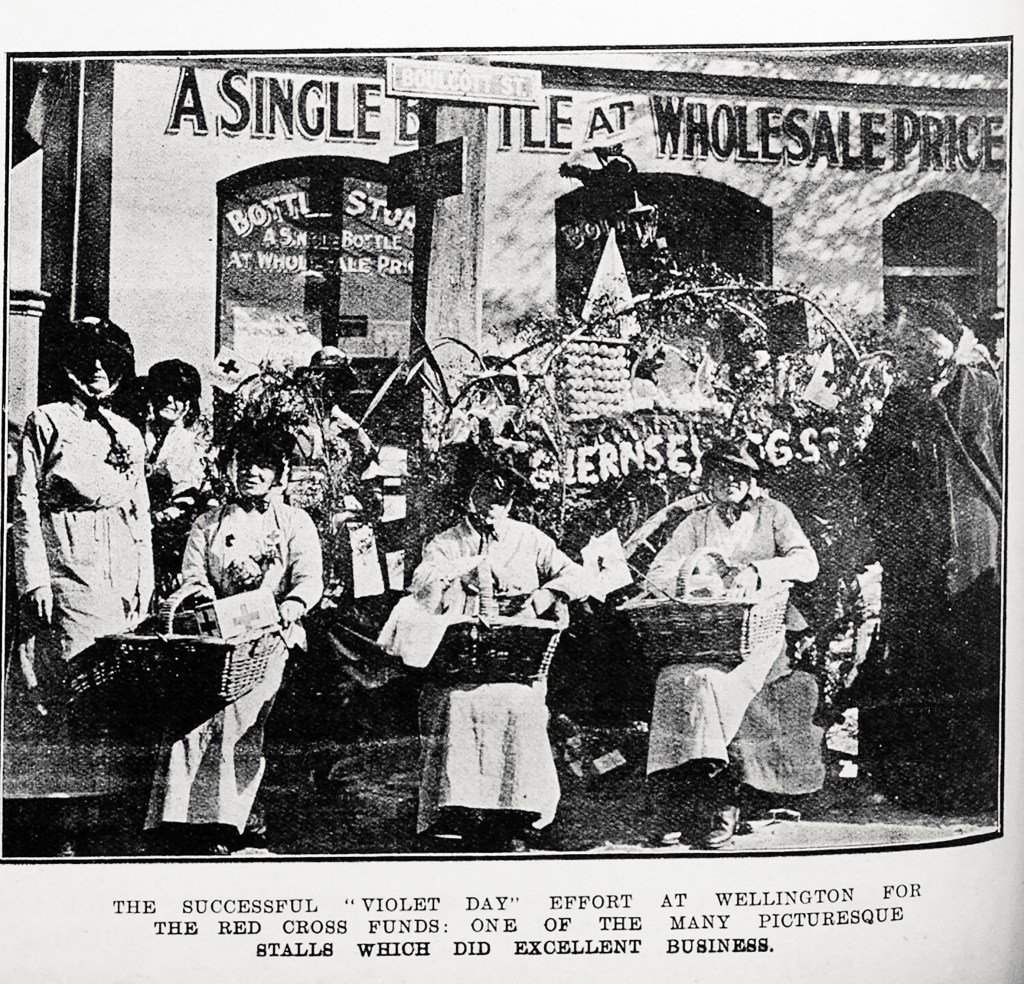
Image 1: The successful ‘Violet Day’ effort at Wellington for the Red Cross funds: one of the many picturesque stalls which did excellent business’. Auckland Weekly News, 16 August 1917.
During the First World War a floral initiative was introduced in Australia and New Zealand to raise money for organisations associated with the war effort. Violet Days took place in towns and cities with different charities benefitting from the money donated.
Why the violet? The small, fragrant flower was extremely popular at the time, widely grown and relatively inexpensive. Its rich ‘regal’ colour, heady perfume and ability to be easily tied into a saleable bunch made it ideal as a fundraiser.
In July 1915, during the lead up to Adelaide’s first Violet Day, the city’s Daily Herald wrote that
…it is fitting that there should be some public sign of sorrow and honor. The fragrant violet will put us in mind of what Socrates described as “the perfume of heroic deeds.[1]
First World War
The first Violet Day was held in August 1914 in New Zealand when Christchurch’s efforts raised £500 for Belgium Relief Fund.[2]. Violet Days were eagerly embraced and quickly became widespread. Shortly after the Christchurch event a more modest day was held in the small farming town of Marton in the Manawatu. As the jingoistic patriotism of the early days of the war took hold, enthusiasm increased. On 4 September 1914, Christchurch witnessed what was described as a ‘purple invasion’. One hundred flower girls armed with baskets or trays of violets marched in procession to Cashel Street where they were dispatched to various ‘beats’. The cause was the Food for Belgium and Britain Fund, so each seller wore the Belgian colours along with the red, white and blue of Great Britain. As the flowers were sold, the girls returned to fill their baskets and trays from the huge mound of violets that kept pouring into the city. The local paper reported that everyone in Christchurch was wearing a violet buttonhole, carried a bunch of violets, had one pinned on their muff or blouse or tucked into their belt that day. Cars and taxis flaunted violets and nearly every shop window ‘had a tinge of purple about it’.
It was after the disastrous campaign at Gallipoli that the focus of Violet Days changed with fundraising carried out in aid of returned soldiers. Over the Tasman, Melbourne’s Argus reported that successful Violet Day sales in June 1915 had raised money for the Australian Wounded Soldiers’ Fund. The Violet Day held in Sydney on 13 August 1915 in aid of the Soldiers’ Club made over £1,000.[3]. Violet Days were also held in Queensland.
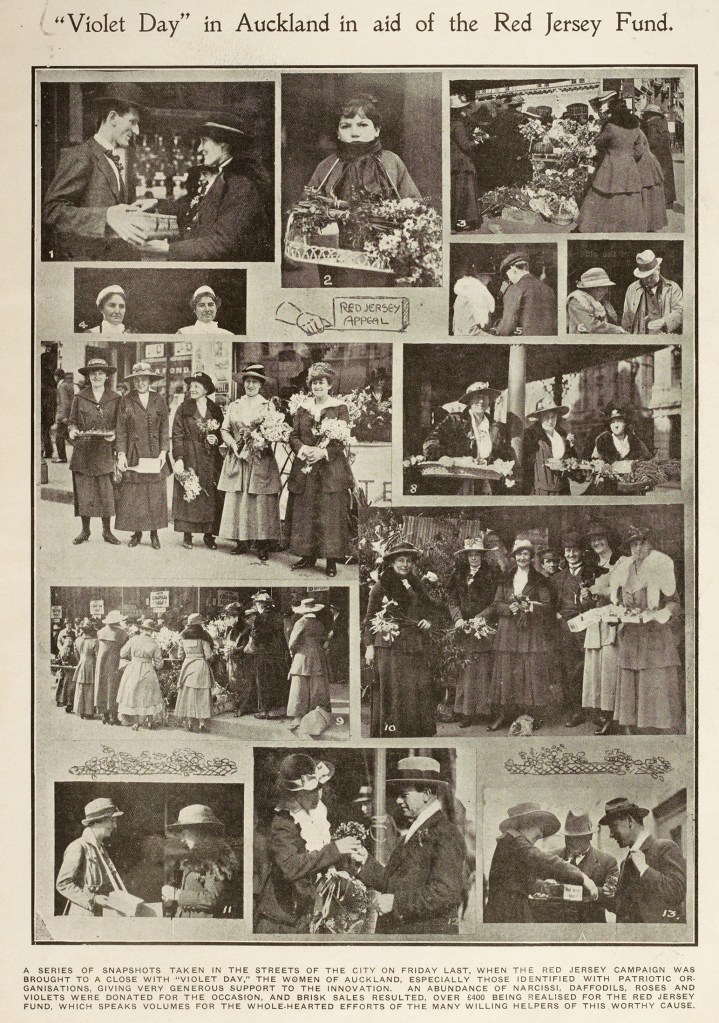
Image 2: Violet Day in Auckland in aid of the Red Jersey Fund, New Zealand Illustrated Sporting & Dramatic Review, 8 August 1918
However, it was South Australia that really embraced Violet Days. These were centred around the Cheer-Up Society founded by Alexandrine Seager and William Sowden, of the Register newspaper, to provide for the needs of soldiers on the move. The Society, staffed largely by women volunteers, offered refreshments and recreation in a large tent north of the Adelaide Railway Station from 1915. The tent was replaced by the Cheer-Up Hut, which opened on 4 November 1915.
At the Cheer-Up Hut, soldiers could eat a meal and relax in a place deemed morally safer than hotels. Facilities included a rest room, billiard room, dining hall and lounge area. By the end of 1915 volunteers were serving 10,000 meals a month. The hut closed on 24 December 1919, after the bulk of the servicemen had returned.
The Cheer-Up Society’s first Violet Day was held in Adelaide on 2 July 1915. On that day around 100 women dressed in white sold bunches of violets to raise money to support returned soldiers or the Cheer-Up Society. Also on sale were ribbons with the words ‘In Memoriam’, to be worn with the violets, and violet posies tied with purple ribbon printed with ‘In Memory’ and the Christian cross. The statue at the city’s South African War memorial was draped in purple and white ribbons, memorial wreaths were laid, the Governor spoke and the police band played. More than £700.00 was raised.
In both countries the major cities’ Violet Days were huge events. At Wellington’s Violet Day in 1917, thousands of bunches were sold, each in memory of a ‘New Zealand hero’. The day was described as a purple pageant with violet backgrounds in shop windows, violet stalls and their sellers dressed in violet. There was even a violet geisha being pulled around in a floral rickshaw. Seventy thousand violets sent from nearby Ōtaki were just part of the number donated and over £1,600 was raised.
Many Violet Days were much more modest but just as important to their community and all raised money for the returned soldiers. On 14 September 1916 the Red Cross ‘ladies’ of Methven in Canterbury held a Violet Day that raised £30. ‘There were very few in Methven yesterday who were not wearing violets’ wrote the Ashburton Guardian.[4]
In South Australia from 1916 onwards, badges, or commemorative buttons, were sold along with fresh violets and at least one South Australian town, Burra, produced its own Violet Day badge. The production and sale of badges does not seem to have occurred in New Zealand or elsewhere in Australia.
The Auckland Museum holds a large collection of Violet Day badges. Many have the word ‘Remembrance’ as well as ‘Violet Day’ on them and several are dated. It seems for some years badges were issued in multiple colours. The badges often feature an image of violets, or a Christian cross. One has a crown and another flags. There are several from Burra including one that shows a young woman wearing violets and the words ‘Burra Violet Day 1919’. In addition to the colourful badges there are also two metal pins with a violet head, which are undated. There are no badges dated after 1919; production may have ceased that year.
There does not seem to have been a specific date for Violet Day in either country, although clearly it had to be within the flowering time of violets. The emphasis on Violet Days, apart from honouring the dead, was fundraising for practical support for soldiers, especially the wounded and items other than violets were also sold on the day. In South Australia in 1917 and 1918, volumes of poetry were sold. In 1918 combined efforts saw South Australians raise over £4000 with the funds going towards the work of the Cheer-Up Hut.
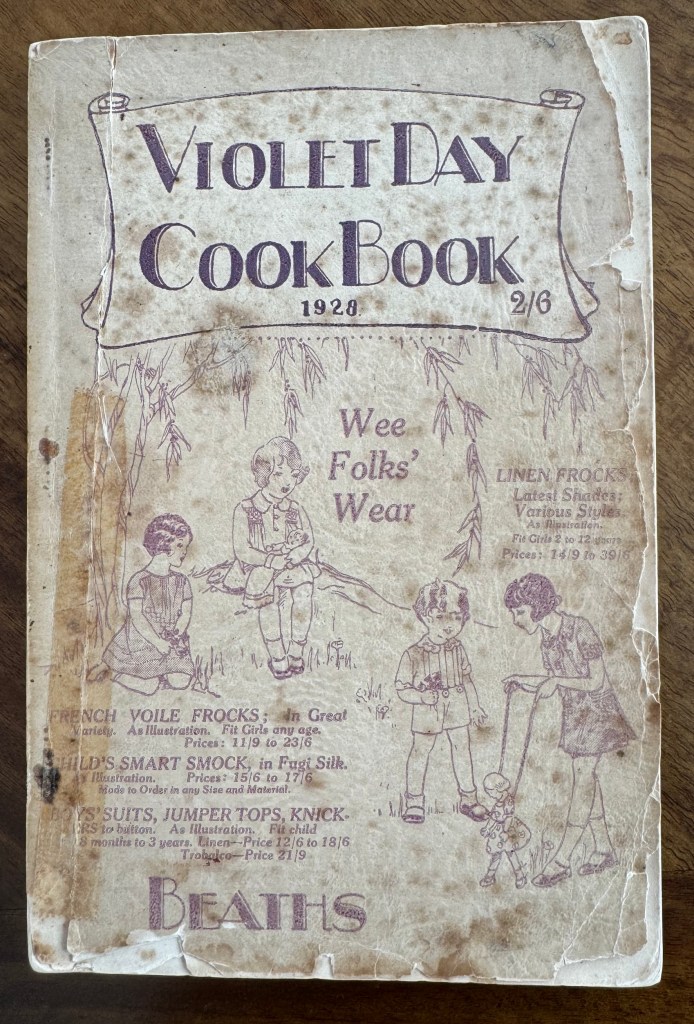
Image 3: Violet Day Cookbook cover. Author’s collection.
Post First World War
Between the wars fundraising from South Australia’s Violet Days went towards things such as the upkeep of the ‘Soldiers’ Cemetery’ at West Terrace and the name changed from ‘Violet Day’ to ‘Violet Memory Day.’[5] From 1924 Violet Memory Day was observed on the first Sunday in August. In 1927 the memorial service was shifted to the Adelaide Town Hall, which was decorated with violets and other floral tributes.
On Violet Memory Days during the Second World War, violets were laid at the South African and National War Memorials, and at the Cross of Sacrifice in the Garden of Memory, West Terrace. Funds raised continued to be donated towards the upkeep of the Australian Imperial Forces graves in the West Terrace Cemetery. Following the Second World War the commemorations incorporated the fallen soldiers of both conflicts. The last Violet Day in South Australia took place on 2 August 1970.
Violet Days in New Zealand had died out long before this. By 1925, Violet Day in Christchurch had nothing to do with the aftermath of war but was in aid of the Plunket Society, who in 1928 published the Violet Day Cookbook.[6]. Wellington’s Violet Days of 1922 and 1928 had a military association as they were in aid of the Women’s National Reserve Residential Nursery, but violets seem to have played only a small part in them.[7]The Women’s National Reserve had formed clubs for the wives and widows of men who had gone overseas during the First World War. In 1920 it established a nursery to look after children whose mothers were in hospital.
There is no mention of a Violet Day in New Zealand after 1928.
References
[1] ‘Violet Day’, The Daily Herald, 2 July 1915, 4.
[2] ‘What Has Been Done for Belgium by Canterbury’, Sun (Christchurch), 17 April 1915, P11.
The Dunedin Botanic Garden is dissected by the Lindsay Creek, dividing the garden into two distinct areas; the more formal, level Lower Garden and the steeper Upper Garden. The Water of the Leith / Ōwheo provides a boundary along the south side of the Lower Garden. This gives the Botanic Garden the luxury of a wide range of landscape areas in which to display the plant and bird collections. The creek itself offers a lot to the garden, both in landscape possibilities and wildlife habitat.
Connecting the Upper and Lower Garden for visitors has always been a challenge. To cross the creek there has been a range of bridges constructed, both practical and ornamental.
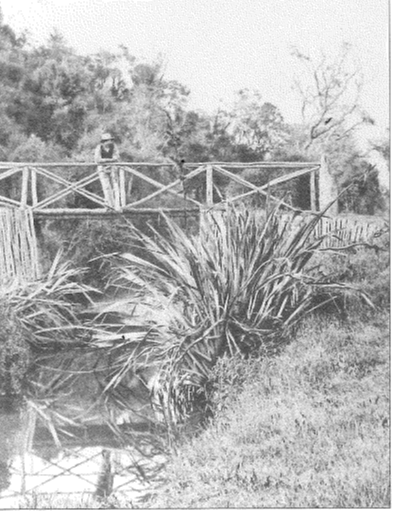
The Dunedin Botanic Garden was relocated from its original site of the corner of Castle and Albany streets (the present site of the University of Otago in Dunedin) to its current site in 1869, after the first garden was destroyed by flooding. This site had been occupied by the Otago Acclimatisation Society since 1864. The Acclimatisation Society manager CP Clifford made one of the first bridges across the Lindsay. Clifford’s bridge was a simple structure with what looks like abutments made from branches. The plantings of flax would have been very good at helping to control erosion and flood damage.
CP Clifford, Acclimatisation Manager, on a bridge he built across the Lindsay Creek. Hocken Collections – Uare Taoka o Hākena, University of Otago.
The early bridges were rustic structures made of timber, often very ornamental in their arts and crafts style. Rough sawn timber crisscrossed for strength made attractive patterns. Mānuka or Kānuka was often used. Basically, whatever was at hand was put to use.
These initial bridges were only able to take foot traffic, which limited the amount of access for maintenance vehicles. These were originally horse and cart and later small tractors. Anything large or heavy would have to take the public road around the botanic garden. Or, in some cases, they never crossed the creek.
Clifford’s bridge was replaced by this sturdier structure around 1886. Hocken Collections – Uare Taoka o Hākena, University of Otago.
This bridge, not as ornate as some of the others, looked strong enough and wide enough to take a small cart.
In March 1870 the Water of the Leith was widened and a new channel cut to prevent flooding of the new garden and nursery. The banks were lined sloping stone walls. A new central bridge across Lindsay creek was able to take a small dray.
Rustic bridge across Lindsay Creek. 1908 Dunedin Botanic Garden collection
Lower Garden north foot bridge before straightening of Lindsay Creek An attractive rustic bridge. C 1920 Dunedin Botanic Garden collection.
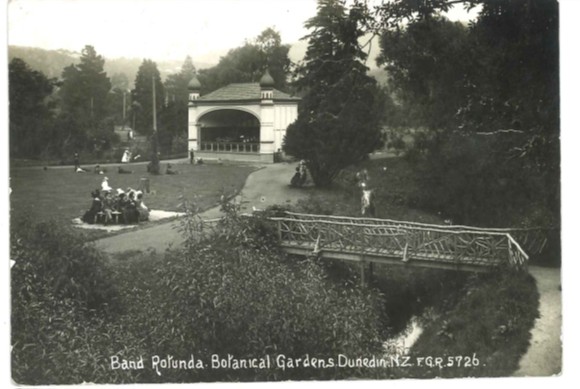
Lindsay Creek has undergone several changes, such as being straightened in the late 1920s to accommodate the tram and road changes. Before the straightening of Lindsay Creek there was an extremely attractive rustic bridge leading to the bandstand. There was more digging out and retaining in the 1930s, with the bridges rebuilt each time.
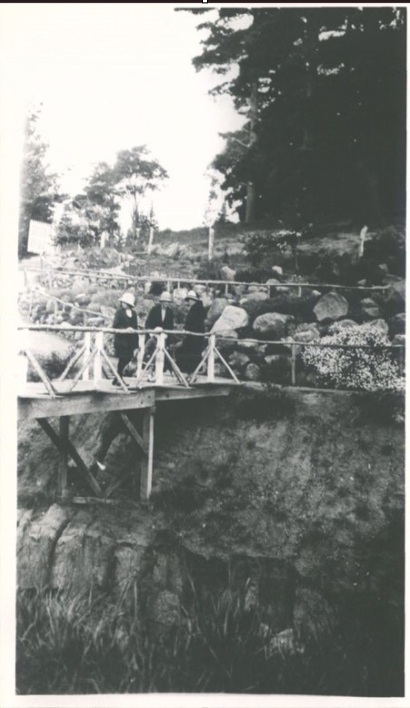
North foot bridge with new rock garden developments behind. The top railing of the bridge matches the fences put in to keep people of the new made rock garden. The stone walls of the creek were yet to be made. C 1925. Hocken Collections – Uare Taoka o Hākena, University of Otago.
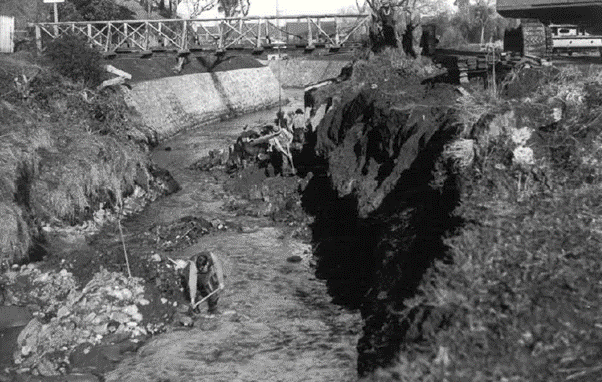
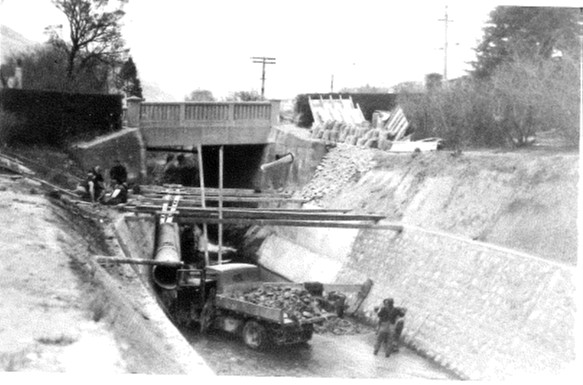
In 1936/37 Lindsay creek was widened and deepened again and two new bridges were constructed with braced steel beams, completed in 1938. Excavated out and retained with stone walls, David Tannock, the Botanic Garden Curator, hoped to alleviate the severely formal appearance of the walls by planting rambler roses, which would hang down over the stone walls. Even now in heavy rain, water can lap the bottom of the bridges.
Widening and deepening of Lindsay Creek 1936/37. Central bridge in background. DBG collection.
Widening deepening Lindsay creek with the Opoho Road concrete bridge in Background DBG collection 1938. DGB collection
Central bridge in background. C 1980 DBG Collection
By the 1960s, the Lindsay Creek bridges were replaced with far less attractive timber and hurricane wire constructions and painted an unsympathetic white. These bridges were mainly for foot traffic, but if you approached it at the right angle, you could just squeeze a small tractor and trailer across. Get it slightly wrong, however, and the trailer would get stuck, which would necessitate unhitching the trailer and turning it on its side to carry off the bridge. Very embarrassing.
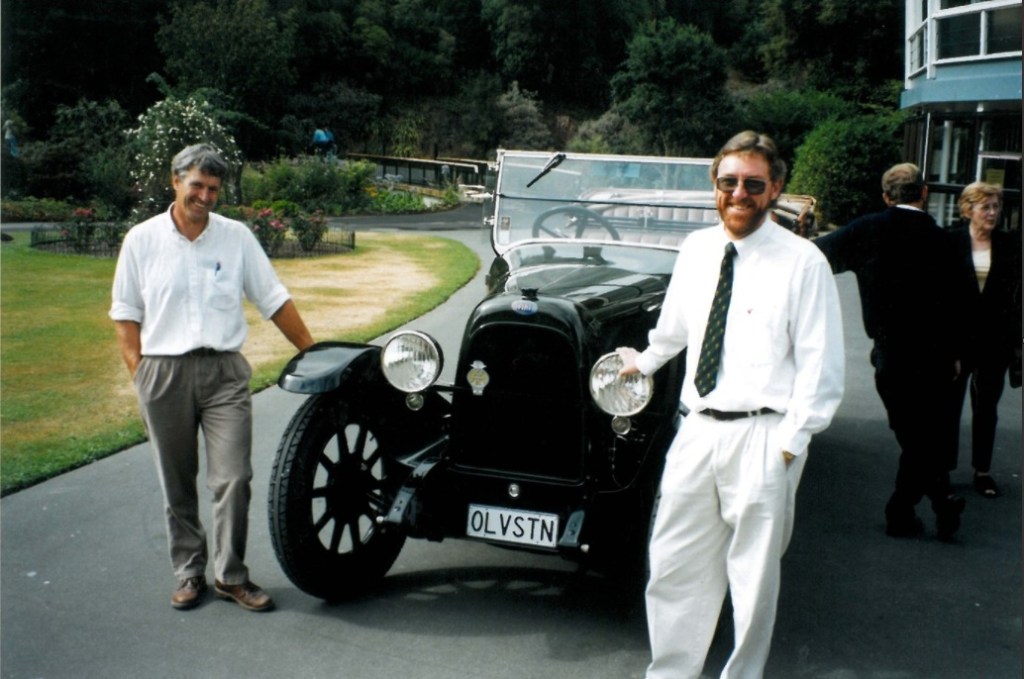
Opening of the Edward Theomin Bridge. 1998. Botanic Garden manager Alan Matchett and Botanic Garden Curator Mick Reece withthe Theomin’s 1921 Fiat Tipo (type) 510, the first vehicle to use the new bridge.
There are now three bridges connecting the Lower Garden to the Upper Garden. The central one replaced in 1998 was designed to be more in keeping with the garden and can carry the Botanic Garden maintenance vehicles. The bridge with its heritage style railings was possible by a $24,000 grant from the Edward Theomin Trust and is greatly appreciated by staff and visitors.
Robert Percy Moore is regarded as New Zealand’s greatest panoramic photographer.1 Particularly during the 1920s, Moore’s photos included many large urban houses of the upper class and rural homesteads of wealthy runholders. Here is an example of the former:
Source: Smith, George John, 1862-1946. Riverlaw, a very large three-storeyed house in Aynsley Terrace, St Martins, Christchurch. Moore, Robert Percy, 1881-1948 :Panoramic photographs of New Zealand. Ref: Pan-0928-F. Alexander Turnbull Library, Wellington, New Zealand. /records/32050477
The St Martins house, owned by Colonel Smith, had an extensive garden designed by Alfred Buxton, who in terms of landscape design shares with Moore the appellation ‘New Zealand’s greatest’ (at least during the early 1900s). If we enlarge the photo to show the entrance to the house, we can see the central interest of this blogpost:
The relatively formal design has two palms framing the entrance steps leading to the front of the house. The magnification does not give enough detail to precisely identify the palms, but as Gleeson2 notes Buxton liked Chinese and European fan palms. The former, in particular, were heavily used in his garden designs, and so it is likely the palms are either Livistona chinensis or Trachycarpus fortunei, both of which can go by the common name ‘Chinese fan palm’, though the latter is also known as the Chusan or Chinese windmill palm.3
As Tipples notes in his 1989 book Colonial Landscape Gardener,4 Buxton’s Christchurch nursery had a large heated greenhouse for the production of palms, both for sale and for use in planting out his landscape designs, so it is quite possible that the two palms seen above were grown in Buxton’s nursery. Though the pair above function as an entrance frame, another reason Buxton favoured the palm was a rising popularity in the 1920s for Japanese gardens. Either the Chusan or Chinese fan palm went well with bamboos, Japanese maples, camellias and so on to give a Japanese look to parts of a garden.
Both palms are amongst the most cold-hardy of palm species, hence their further appeal to Buxton who designed many large gardens in the South Island. As Tipples notes, Buxton hired Robert Percy Moore to photograph many of his major landscape works, as early as 1910, and certainly up to 1926 when Buxton’s landscape business went into voluntary liquidation. A good number of Moore’s panoramic photos are available from DigitalNZ as a result of a National Library digitisation project, but the coverage does not allow the identification of the southern-most Buxton-inspired planting of fan palms. The remainder of the post does, however, focus on two, that being in the deep south – Clyde – are a strong candidate for that category.
Earnscleugh Station’s Fan Palm Pair
Source: Spain, Stephen Thomas, 1862-1940. Earnscleugh Station homestead. Moore, Robert Percy, 1881-1948 :Panoramic photographs of New Zealand. Ref: Pan-1859-F. Alexander Turnbull Library, Wellington, New Zealand. /records/33821129
This photo is one among many of the Moore collection in the National Library that is dated 1923-1928, which turns out to be useful because if we magnify the front-of-the-house portion of the photo we can see something of interest:
Visible as a lawn planting in the front of the house is a young palm, perhaps planted within a year or two of the photo date, meaning that circa 1925 is a reasonable planting date. That this is a palm is confirmed by a photo taken in 1948:
Two palms can actually be seen in front of the homestead,5 but again a magnification is needed to clearly see this:
Whereas I have not actually visited Earnscleugh Castle, as it is now called, I have been given access6 to several photos that wonderfully update both what the palms and the refurbished castle currently look like. Views from an aerial view, and both inside and outside the castle, are useful:
The following photo clearly shows the palms have retained the thatch on the trunk, thus strongly suggesting they are T. fortunei rather than Buxton’s other favourite fan palm, L. chinensis.
Finally some photos at ground level help give a contextual feel for the appearance of the palms alongside the now restored castle:
In this case, the pair of palms certainly don’t contribute to a Japanese themed section of the garden. Nonetheless, now at just over 100 years old and still very healthy, there is little doubt that they make a notable contribution to the overall landscape of Earnscleugh Castle. As we saw in the first photo above, Buxton was certainly very keen on the effect of a pair of palms in front of a large house, thus perhaps risking over-use, but this far south in New Zealand his landscape choice is far from hackneyed, providing a striking and key element to the now impressive garden.
Notes:
See Natalie Marshall’s The Long View which along with examples of his photographs has a fascinating description of how the National Library has gone about digitising over 2,000 of Moore’s photos. ↩︎
Obviously it is hard to distinguish the two palms from photos alone, however a useful difference is that T. fortunei tends to retain the thatch on the trunk, whereas L. chinensis tends to have a ‘naked’ trunk, something common to most palms. If a close view can be obtained the latter also has thorns on its petioles, which T. fortunei does not. ↩︎
The full title is Colonial Landscape Gardener: Alfred Buxton of Christchurch 1872-1950, Department of Horticulture and Landscape, Lincoln College, 1989. ↩︎
The homestead is incomplete in this 1948 photo. Stephen Spain – the original owner – had to close his rabbit canning factory in 1924 and the homestead was unfinished at the time of the photo. See the website of Earnscleugh Castle for details of this story and a description of the recent refurbishment and completion of the building. ↩︎
Many thanks to Marco Creemers for taking some recent photos and allowing my use of photos from the Earnscleugh Castle website gallery. ↩︎
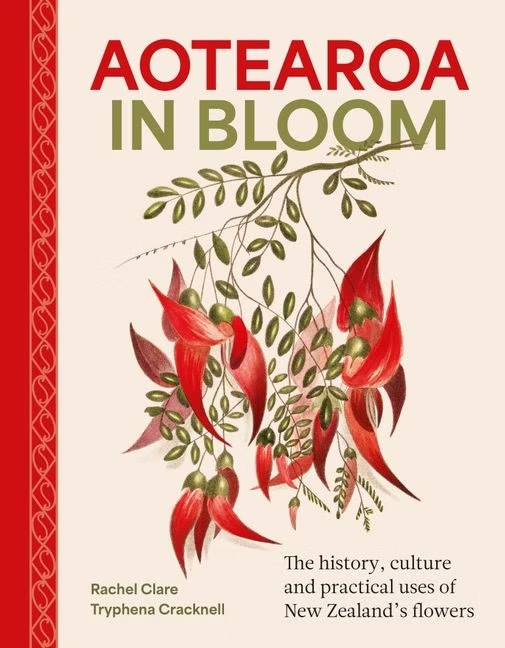
As part of Hamilton Book Month, we are hosting authors Rachel Clare and Tryphena Cracknell, who will provide a talk on their book “Aotearoa in Bloom: The History, Culture and Practical Uses of New Zealand’s Flowers“.
This lushly illustrated book, combining photographs and historic botanical drawings, explores the history of a range of flowering plants, including their significance in te ao Māori. Subjects range from the beloved blooms of kōwhai and pōhutukawa to the lesser-known native forget-me-nots, fragrant toropapa and our many orchid species. Books will be available for sale and signing.
Thursday 13 August, 6:30 – 8:00pm, Central Court, Hamilton Gardens Pavilion, 6:30-8:00pm
$10 cash, no registration required
For further information, refer to the Aotearoa in Bloom page on the Hamilton Book Month website.
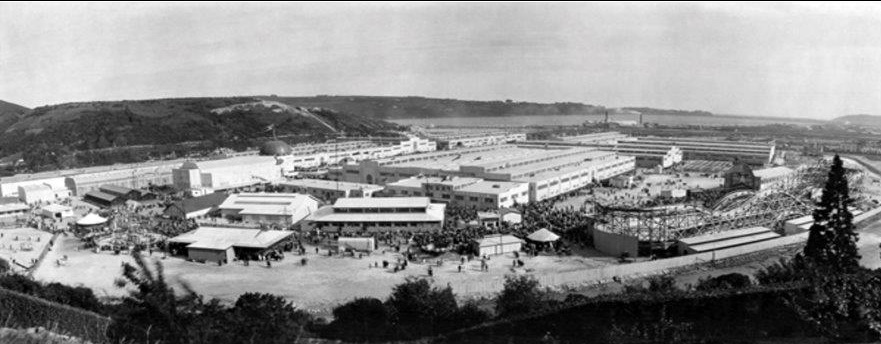
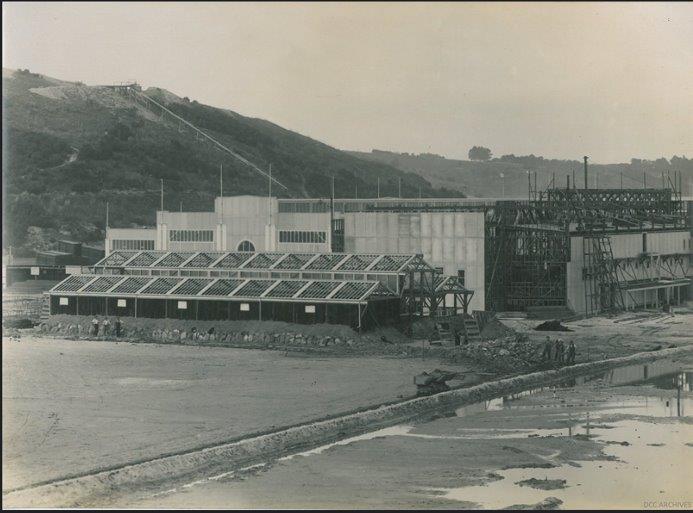
The New Zealand and South Seas International Exhibition was a major World’s Fair held in Dunedin, New Zealand, from 17 November 1925 to 1 May 1926, a total of 24 weeks.
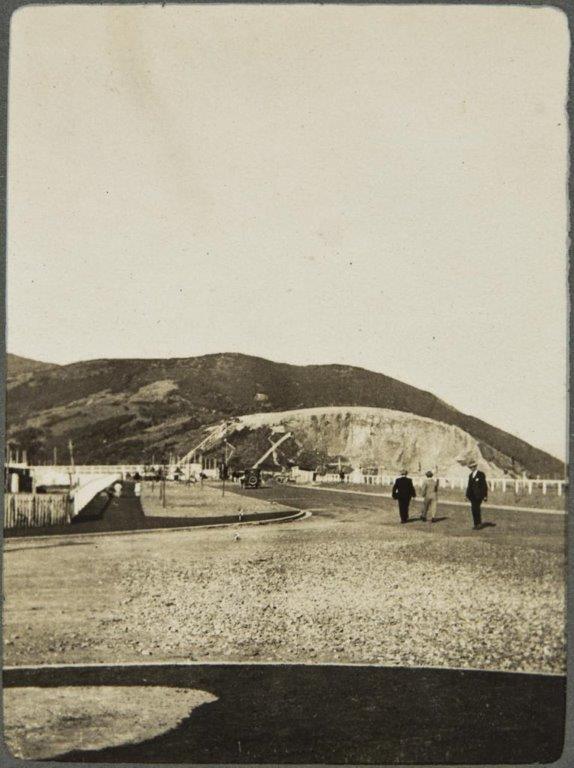
It was a massive event that drew over three million visitors, which was more than double the country’s population at the time. The event was held on 16 acres (6.5 hectares) of reclaimed land at Logan Park, near the University of Otago, and promoted by the Otago Expansion League to boost economic and population growth in the region. The exhibition featured seven main pavilions, with industrial and government displays from Great Britain, Canada, Australia, Fiji and New Zealand, while Otago had several displays, There was the Festival Hall, a Grand Dome, an art gallery, a fernery, an aquarium, sports grounds, and a popular amusement area.
Panorama of completed site. Dunedin City Council Archives.
Along with agricultural, horticultural, educational and tourism displays, there were experimental plots from the Department of Agriculture.
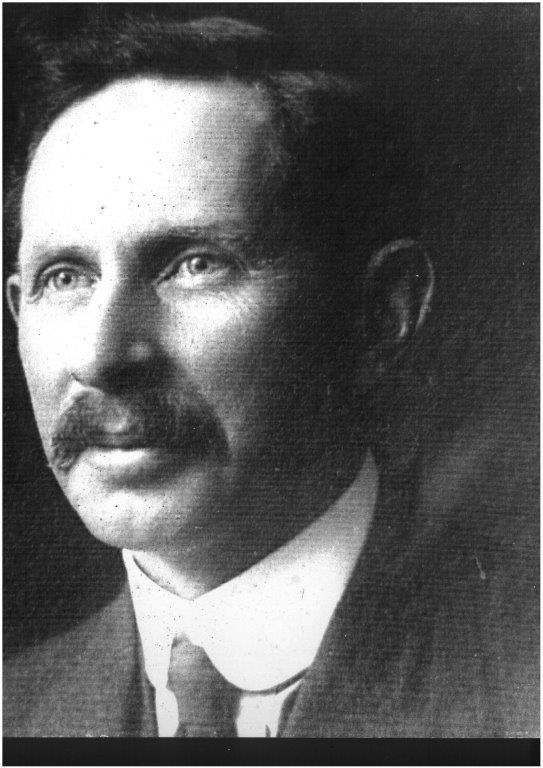
The task of the laying out the gardens and organising displays was massive. This work was undertaken and overseen by David Tannock (1873-1952), the Superintendent of Reserves at the Dunedin City Council. This role also included being in charge of the Dunedin Botanic Garden.
David Tannock, Dunedin City Council Archives.
David Tannock, Superintendent of Reserves and Botanic Garden Curator 1903-1940: contribution to the exhibition.
David Tannock was chairman of the New Zealand and South Seas Exhibition Horticultural Committee and the Horticultural Week Committee.
Tannock originally proposed that the exhibition should be sited at the Dunedin Botanic Garden. His proposal suggested using the lower garden and the six-acre piece of land on the other side of Great King Street:
‘This would provide an ‘extensive, ample, and convenient site. The art gallery could be put on the big lawn near the Great King Street entrance. The hillside would do well for entertainments and the playing fields at Opoho for sports. The Gardens were already connected to sewerage, electric light, and water. It would save the Exhibition Company money as the gardens were already laid out. That there was a good band rotunda and viewing from the hillside.
To get visitors up the hill it was hoped to have the Opoho tram running and there was already a motor road with ample parking. Visitors could be taken up the hill by the hundred with travelling stairs or lift. A simple matter he claimed. (we still don’t have any such thing)
The gardens could stay open during construction and only be closed to the general public during the exhibition. That the Glasgow exhibition was held at Kelvi Grove park and the Auckland exhibition at the Domain. (DCC Archives)
Given the numbers that attended the exhibition, maybe it was not such a bad idea to not accept this proposal. This obviously didn’t put Tannock off as he, the Dunedin City Council and Dunedin Botanic Garden, contributed a huge amount to the exhibition.
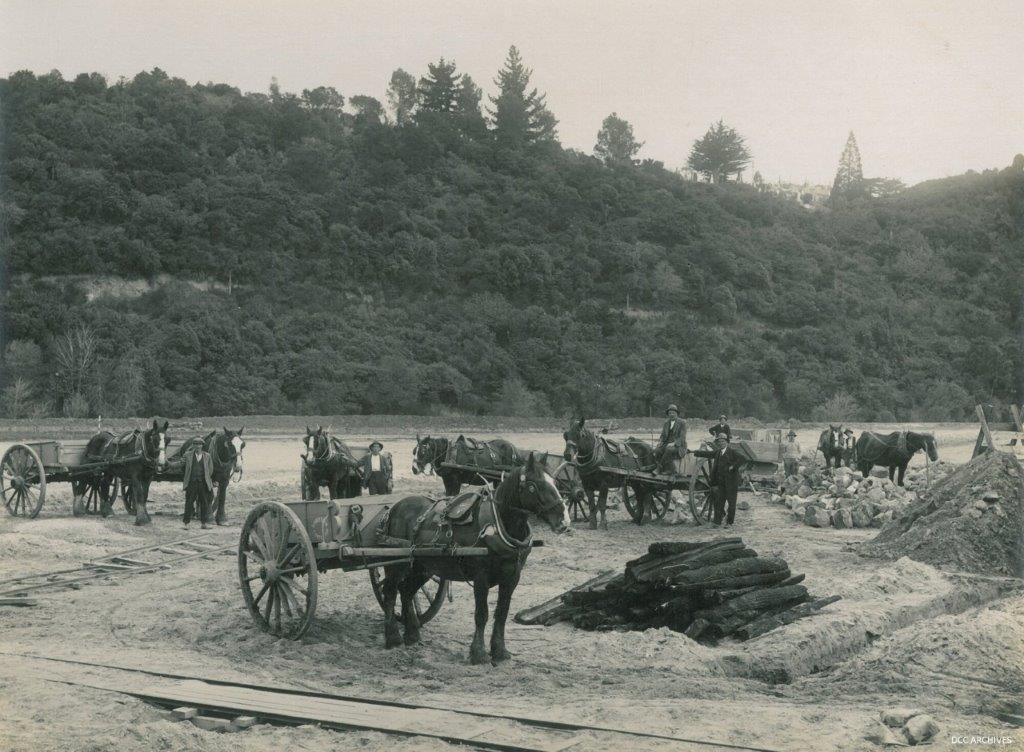
Preparing the Site, Dunedin City Council Archives
Growing the plants for the exhibition.
By late 1924 the exhibition directors had approved the Botanic Garden raising most of the plants required for the gardening decorations. Approximately 80,000 annual and herbaceous plants and 2,350 shrubs and trees were grown at the Dunedin Botanic Garden for the exhibition.
With the added production of plants for the exhibition, two new propagating houses were built and the potting shed expanded. An unseen advantage was that David Tannock took the opportunity of employing women to help with extra workload. Mary Watt, an experienced gardener from the UK, was taken especially for the propagation of plants for the exhibition.
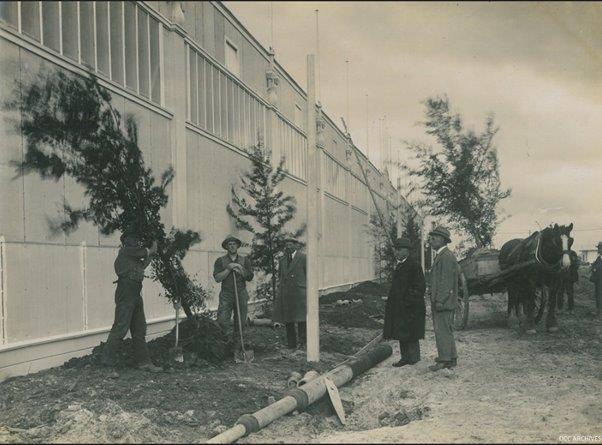
Exhibition tree planting, with David Tannock. Dunedin City Council Archives.
As they had no way of employing women, Tannock took her on as an apprentice on the 3rd year scale. Miss Watt had contacted David Tannock late in 1924 asking for work. She was offered an apprentice to help.
As well as landscaping there was a fernery with 50 different native ferns and alpine plants. An expedition to the Garvie mountains by Tannock and others brought back over 120 species of native alpine plants for a display at the exhibition. This showed Tannock’s enthusiasm for native plants and the development of a significant native plant collection. Indeed, Tannock later wrote a book on how to make rock gardens in New Zealand using native plants.
In reports to the Exhibition committee in the middle of 1925, Tannock reported ‘That the planting of specimen trees was well under way and a large number of flowers are to be planted and that the display would be a very fine one and there would be a display of flowers at opening and right though’. (DCC Archives)
Tannock also proposed that special tree planting day should be arranged, on Arbor Day. The trees could be sourced from the city and planted in positions where they would be permanent.
Avenue tree planting. Dunedin City Council Archives.
Horticultural Week
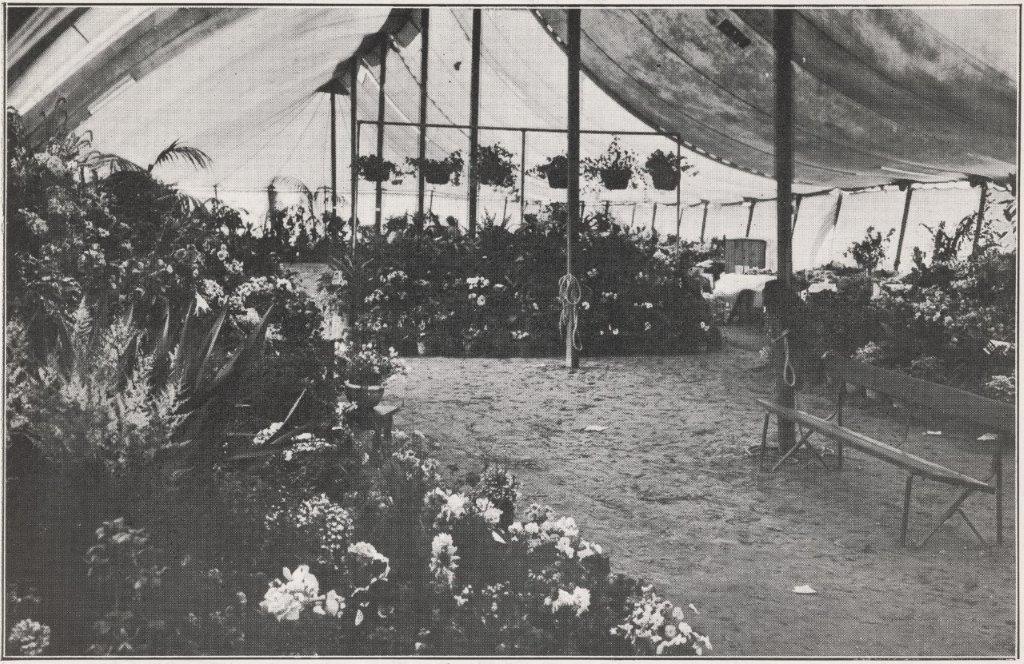
With The Dunedin Horticultural Society, David Tannock proposed that a horticulture week be held in association with exhibition. The week consisted of the conferences for three horticultural groups, the Royal New Zealand Institute of Horticulture, the Nurserymen’s association, and parks curators. A series of lectures and a three-day flower show followed.
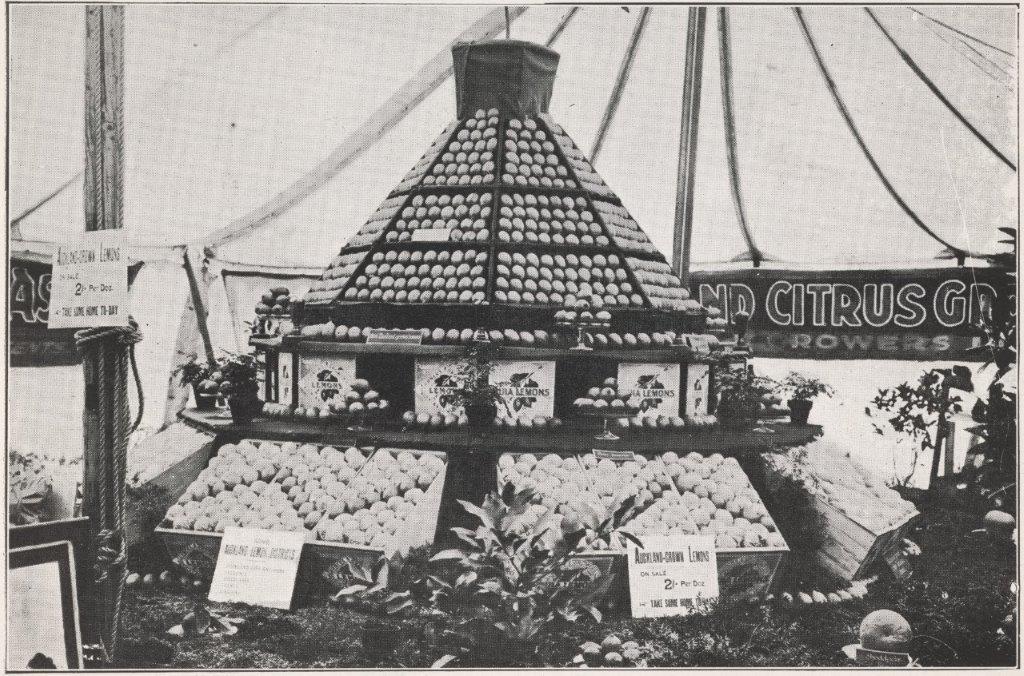
Three large tents were on the site of the sports ground and attracted exhibitors from both the North and South islands. There were displays from Auckland citrus growers and Otago Fruit growers.
At the end of the exhibition the area was given over to developing sports grounds and the art gallery. Avenues of trees were planted on the drive made to the art gallery.
Auckland citrus fruit display. Hocken Collections – Uare Taoka o Hākena University of Otago.
Horticulture week flower exhibition. Hocken Collections – Uare Taoka o Hākena, University of Otago.
Botanic Garden Legacy from the Exhibition.
With the pressure put on the Dunedin Botanic Garden to produce the plants, Tannock used this to have some of the features from the Exhibition allocated to the Garden.
To this day there are still a few features at the Dunedin Botanic Garden inherited from the Exhibition.
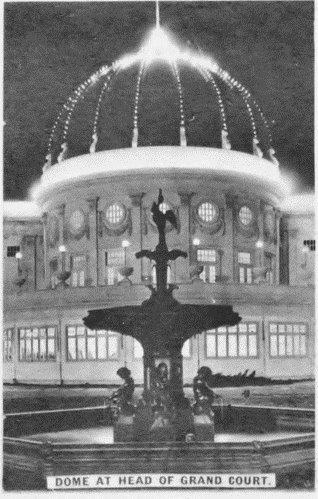
The Central Court at night with fountain. Dunedin City Council Archives.
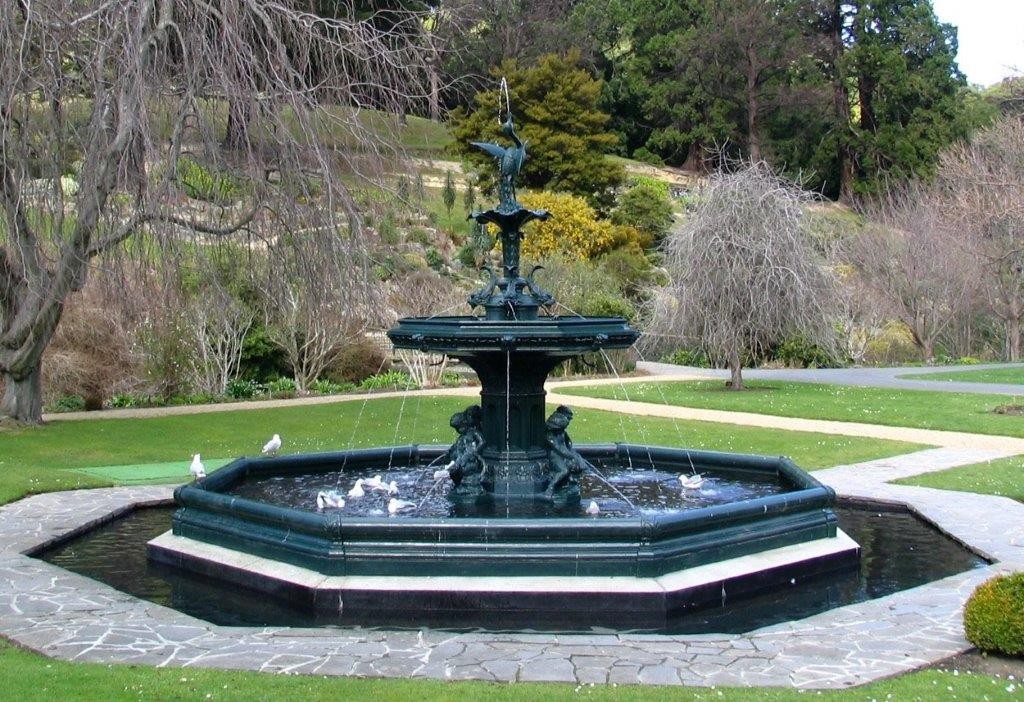
The main feature was the Woolf Harris Fountain, the ornate Victorian-style fountain in the Lower Garden near the Herbaceous borders. The fountain, donated by Woolf Harris, was originally sited at Queens Gardens, but was removed to make way for the cenotaph. After a few years in storage, it was used as a centre piece for the main pavilion of the Exhibition before coming to the Garden.
Wolf Harris Fountain at the Botanic Garden. Dunedin Botanic Garden collection.
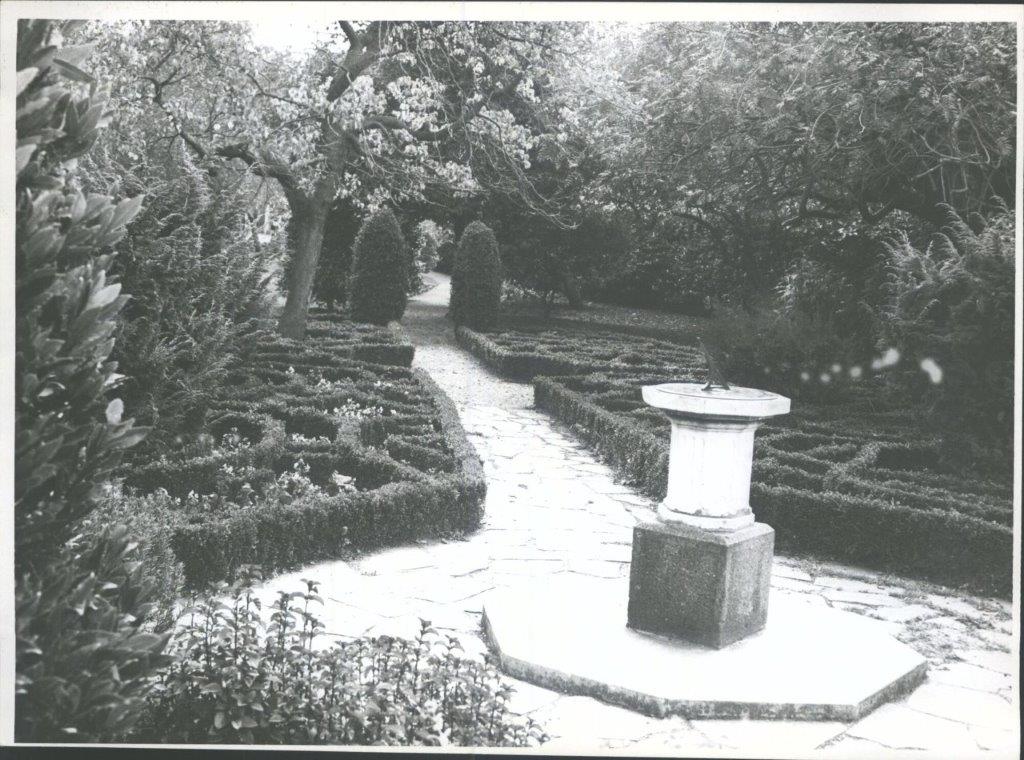
The James Stewart sundial in the same area by the Knot Garden also came from the exhibition, along with 160 seats that were placed above the rock garden.
In addition, James Stewart had a display in the Southland Court which later in the Exhibition got moved to the Education Court (where a sundial made by Arthur Beverley for the 1865 Exhibition was also on display, on loan from the Early Settlers’ Museum, now Toitū Settlers Museum).
James Stewart sundial at Dunedin Botanic Garden, 1935. Dunedin City Council Archives.
Legacy of the Exhibition in Dunedin Botanic Garden
There were several other buildings and features that are no longer here but were part of the garden for a long time.
The first restroom was organised by the Women’s Restroom and Creche Committee for the 1925-26 New Zealand & South Seas Exhibition, held in Dunedin. The restroom was placed near the fun park section and provided a welcome space for women and children while visiting the Exhibition. When the Exhibition was dismantled in 1926, the Women’s Committee donated the restroom to the city and it was placed in the Botanic Gardens.
All these services were paid for and run by the Women’s Restroom Committee, which also paid attendants wages, supplied uniforms for them and provided all the furniture in them. Dunedin City Council funded them annually and assisted in securing sites. (Alison Breese.)
A 1930 report outlined the services they provided.
The building from the exhibition was moved to the lower garden near the entrance way.
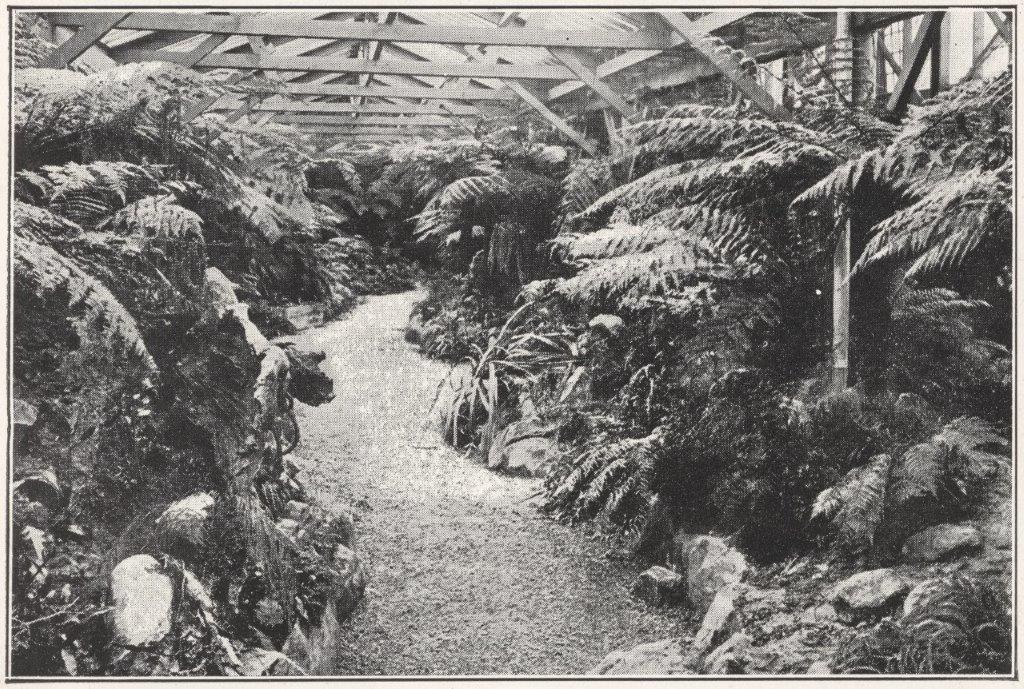
The Fernery at the exhibition recreated a New Zealand bush gully and included a stream and waterfall. It contained about 50 species of New Zealand ferns from the Dunedin area and many New Zealand alpines. It was about 100 ft x 60 ft in 3 spans.
Fernery under construction. Dunedin City Council Archives.
After the exhibition the Fernery was re-erected at the back of the Dunedin Botanic Garden’s winter garden. This came with fish tanks and glazed lights from the Aquarium building. By securing the fernery from the exhibition, Tannock was able to change the current fernery into a greenhouse.
The fernery from the exhibition was damaged by a snowstorm in 1939, the Oregon (framing and beams) had deteriorated, and the fernery was rebuilt using macrocarpa and turned into a single span.
Fernery walkway. Hocken Collections – Uare Taoka o Hākena, University of Otago
That, in turn, was replaced in 1962 with a building made of fiberglass, concrete and laminated wooden trusses. This building was demolished in 1989.
Playground equipment from the Exhibition was distributed around the city, with some coming to the Dunedin Botanic Garden. The playground was by the pond, then moved to behind the old aviary, and finally to its current site in late 1980s.
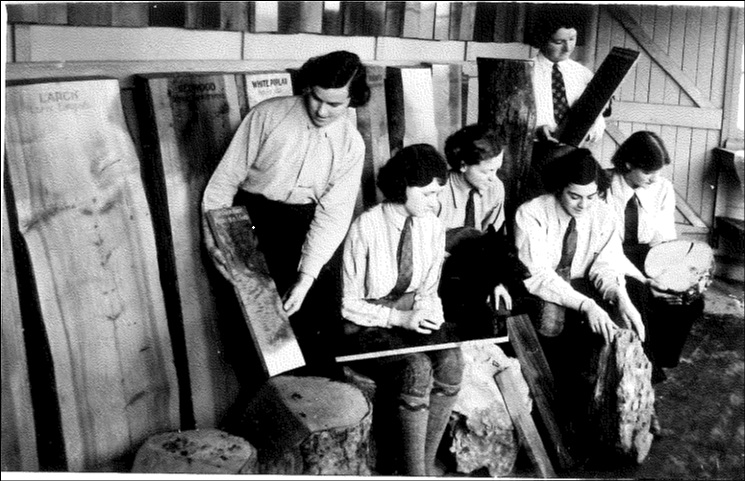
What became known as the Wood Museum at Dunedin Botanic Garden came from the Otago Court of the Exhibition. Slabs of timber were obtained locally to show the wide range of species that could be grown here. These samples became a teaching aid and were originally in the shed of the school garden, now the Azalea Garden, and then moved to another building in the 1930s.
Dunedin Botanic Garden trainees with wood samples from the Exhibition, 1935. Dunedin City Council Archives.
Biography
Alice has worked in horticulture most of her life and became interested in garden history while working at Government House grounds in Epsom in the 1980s. She moved to Dunedin in 1990 and started work at the Dunedin Botanic Garden soon after. She has worked in several areas of the Dunedin Botanic Garden and has been in charge of the nursery and propagation since 2001.
Sources
Hocken Collections – Uare Taoka o Hākena, University of Otago
Dunedin City Archives
The Story of the Dunedin Botanic Garden – Eric Dunlop
Southern Gardening – Louise Shaw.
Dunedin Botanic Garden Archives.
Alison Breese-How Convenient are our Conveniences? The demise of the underground facilities in Dunedin 1910-1980s.
Despite the danger of rhubarb leaves being known for over one hundred years, their consumption remains one of the most highly reported causes of poisoning by plants in New Zealand. Based on data from the New Zealand National Poisons Centre collected between 2003 and 2010, for example, rhubarb was ranked as the eighth most reported cause of poisoning by plants to its phone centre, representing 121 phone calls, of which 76% was from consumption by children.[i]
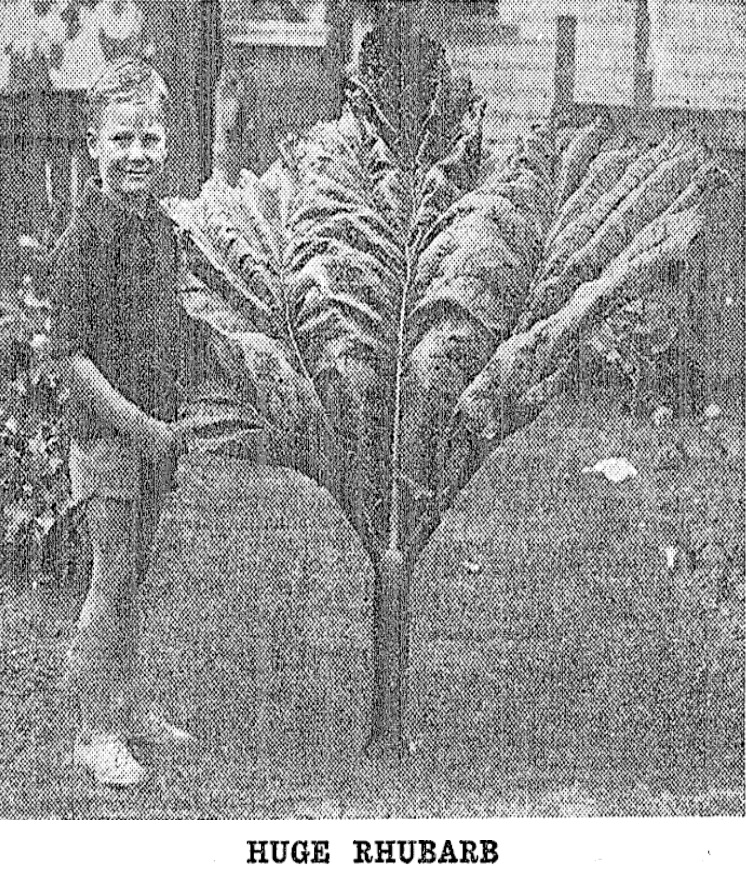
Fig. 1. “This leaf is from a huge rhubarb grown by Mr F. Alexander, 36 Normanby road, St. Kilda. It is 50 inches across and is nearly eight inches around the stalk”. Otago Daily Times, 8 February 1936, P20
The widespread use and popularity of rhubarb in Great Britain began in the early 19th Century,[ii] and its import to New Zealand likely occurred not long after. Indeed, newspaper advertisements for rhubarb in New Zealand can be found as early as 1840.[iii]
The first reports in New Zealand newspapers of death by the ingestion of rhubarb leaves came from a curious case in England in 1917. At this time, during World War I, rhubarb leaves were being recommended in Great Britain a substitute for green vegetables due to wartime shortages.[iv]
Here, it was reported that a Presbyterian minister, a Rev. W. R. Colville, had died in Enfield Cottage Hospital, north of London, five days after he had consumed rhubarb leaves that were “cooked as cabbage”. It was noted, contrary to previous advice, that “the public would be well advised to refrain from indulging in rhubarb leaves as a substitute for spinach or cabbage”. Poisoning by oxalic acid was suggested by the British Medical Journal as the explanation of cases of poisoning from eating rhubarb leaves.[v],[vi]
News continued to filter through to New Zealand on this case. At the inquest, it was reported, expert opinion on the dangers of using rhubarb leaves as a food was provided by Mr J. Webster, a pathological chemist and assistant analyst to the Home Office, who presented an analysis of the rhubarb leaves taken from the same ground as those from which the deceased ate, which showed that oxalic acid was present. Dr Spilsbury, who made the post-mortem, found fatty degeneration of the heart and liver, apparently due to poison. Death was thus concluded to be due to poisoning from the oxalic acid contained in the leaves. The coroner, a Mr Forbes, said the case was important, because people economising on food were using food substitutes: “If using rhubarb leaves involved risk, the public should know it, and the present inquiry should be given the fullest publicity. Considerable harm had been caused by advising the people to eat rhubarb leaves”. However, “Nothing need prevent the use of stalks as fruit”.[vii]
Overall, this report was among the first to provide an appreciation of the dangers of eating rhubarb leaves in Great Britain, and among the colonies. Nevertheless, prior to this, a number of illnesses and deaths had been reported in New Zealand relating to consumption of rhubarb, some of which may ultimately have been the result of oxalic acid via consumption of the foliage. In particular, a series of 1885 articles concerned a boy “who had died at Oamaru from poisoning resulting from eating green rhubarb tops”.[viii]
Here, it was reported that a “boy, aged eight years, died suddenly on Sunday morning. An inquest was held today, at which the medical evidence gave the cause of death as poisoning. It appears that the boy had eaten green rhubarb tops on Saturday last, and on Saturday night and Sunday morning was taken ill with vomiting and purging. The post mortem examination revealed the fact that the irritation caused by eating the rhubarb had brought about congestion of the brain”.[ix] At this time, the effects were thought to be because the “rhubarb tops… had been lying on a galvanised iron roof for some time, and were slightly decayed”[x]
Regular stories of rhubarb poisoning in New Zealand continued from there, though not always linked to consumption of leaves. Often, illness was put down to improper preservation. In 1872, for example, it was reported that “A family in Greytown had a narrow escape from poisoning from eating preserved rhubarb. Severe symptoms for a time existed, but ultimately they recovered under the care of Dr Welch”. The newspaper noted, “It is remarkable how people will persist in eating imported preserves of any kind, when, by a trifling expenditure of money and labor [sic], they can produce a much superior article. Extreme care should always be taken that the part next the tin be not eaten. The acid of preserves dissolves the tin, producing in some cases a deadly poison”.[xi]
A similar story emerged in 1878: “A singular case of fruit poisoning came under our notice a few days ago!”, exclaimed the Thames Advertiser. “A family were enjoying a pie made of rhubarb which had been preserved in tins, when they commenced to feel very sick, and afterwards vomiting ensued. An inquiry into the cause of the sickness resulted in one of the members of the family taking up the tin and finding that some of it was crusted over with rust, the acid having eaten away the tin, which was in solution, causing the sickness. The attack was a very severe one, and continued for the space of an hour, not ceasing until, by the aid of emetics, the poisoned fruit had been removed”.[xii]
In 1898, a serious case of poisoning was reported, affecting six Auckland residents. There, “an elderly couple named Mr and Mrs Colvin, their son Thomas Colvin, aged 20 years, a married daughter named Mrs Page, and two grandchildren, were all taken so seriously ill that Dr. Lewis was sent for”. It was determined that the family were suffering from “ptomaine poisoning” [xiii] – a now obsolete term relating to food poisoning caused by bacteria or their toxins. An investigation by a Dr Lewis indicated that the illness was due to a rhubarb pie that had been kept in a ‘close safe’ near the fireplace, which had fermented.[xiv] Thankfully, all of the family completely recovered.[xv]
While other similar stories exist, a large amount of coverage and correspondence was given to a major food poisoning case in Christchurch following the consumption of rhubarb in 1968, which suggested that some of the previous cases of food poisoning may have actually been the result of consuming oxalic acid from the leaves.
There, the Health Department reported 126 cases of food poisoning in one week, with rhubarb blamed for most of them: “…120 adults at an institution suffered from food poisoning in which the food eaten in common was rhubarb”. Symptoms including nausea, vomiting and diarrhoea. A Mr Snoad, the supervising district inspector of health, noted that the “green leaves and any green portions of the stalks of rhubarb normally contain oxalic acid which is toxic and would cause these symptoms If consumed”, indicating he believed that he may have thought consumption of the foliage may have been the cause. However, he broadened the possibility by stating, “Also it is thought by some people that ‘first-of-the-season’ rhubarb tends to be somewhat of an irritant of which too much should not be eaten”. The report was clear with caution, stating that, “When preparing rhubarb always discard the leaves and green portions of the stalks. The red portions of the stalks are quite safe to cook and eat in moderation.”[xvi]Indeed, following tests, Mr Snoad stated that although the result of the analysis of the only sample available was not as clear as he had hoped it would be, it pointed strongly to oxalic acid as the cause. He reiterated at this point that “people should not eat the green parts of rhubarb stalks, nor use the leaves as a substitute for spinach”.[xvii]
Being such a notable event, much correspondence followed in Christchurch newspaper, The Press.
An Isabella C. Brown wrote to say that she was “surprised to learn that many Christchurch people have been suffering from food poisoning after eating rhubarb”. She believed that most people would be aware that the veins and leaves of rhubarb contain oxalic acid, and she had thus never before heard of anyone being poisoned by eating them. Her main concern, however, appeared to have been of the danger of potatoes: “instead of being sold in paper bags or other safe containers all potatoes are now sold in transparent plastic bags, fully exposed to the light. I have no doubt that many other cases of food poisoning could be traced to eating green potatoes. The practice of storing them in plastic bags should be discontinued”. The Medical Officer of Health, Dr L. F. Jepson, however, responded that they did not “consider the packing of potatoes in plastic bags hazardous”.[xviii]
This was followed soon after by correspondence from someone using the moniker “Rhubarb”, concerned by the negative publicity from the recent press: “Because of the adverse publicity given rhubarb recently after cases of poisoning, our sales of spring rhubarb, on which we usually depend for our rates money, have been severely cut down. We would like to have it made clear that, provided rhubarb is cooked properly —without using any of the green leaf—it is quite safe and will incur no risk of poisoning.[xix]
Further correspondence followed, including a theory by “No Sago” that the poisoning had possibly been caused by the consumption of the combination of rhubarb and sago.[xx] E. D. P., in response, responded that “During World War I rhubarb leaves were freely used as spinach. However, there were some cases of poisoning and the public were warned not to use baking soda (sodium bicarbonate), as the addition made the leaves poisonous”. They pondered, “As far as rhubarb and sago are concerned, I often cook both together, as for apple sago, and it makes a pleasant dish. It has never upset any of us. Is it possible that “No Sago” could have confused soda with sago?”[xxi]
These continued communications worried some. “Not Indisposed” wrote, “As you may be aware considerable correspondence has ensued after the recent case of rhubarb poisoning. I have failed to note any replies or statements on the matter by more competent authorities and wonder if you could perhaps discuss this aspect in your column as it would undoubtedly make the position clearer to many of us, including myself, who grow or buy and consume it”.[xxii]
The Press reminded the readers at this point that, indeed, the “Christchurch Health Department issued a statement on the matter shortly after the incident occurred which I think should have quelled any misgivings about rhubarb”, adding, “Dr Connor, in his publication “Poisonous Plants in New Zealand,” states that “the leaf stalks of rhubarb are edible but care must be taken not to include the leaves”.[xxiii] And, with a sense of finality, followed with, “[This correspondence is now closed.—Ed., “The Press.”].” [xxiv]
References
[i] Slaughter, R.J., Michael, D., Beasley, G., Lambie, B.S., Wilkins, G.T. & Schep, L.J. (2012). Poisonous plants in New Zealand: a review of those that are most commonly enquired about to the National Poisons Centre. New Zealand Journal of Medicine 125: 87-118.
[ii] Foust, C.M. & Marshall, D.E. (1991). Culinary Rhubarb Production in North America: History and Recent Statistics. HortScience 26:1360-1363.
[iii] New Zealand Advertiser and Bay of Islands Gazette, 3 September 1840, P2