A Directory of Alfred Buxton Gardens

Clare Gleeson (author of The Fairer Side of Buxton: Alfred Buxton’s Gardens and the Women Who Loved Them, The Cuba Press)

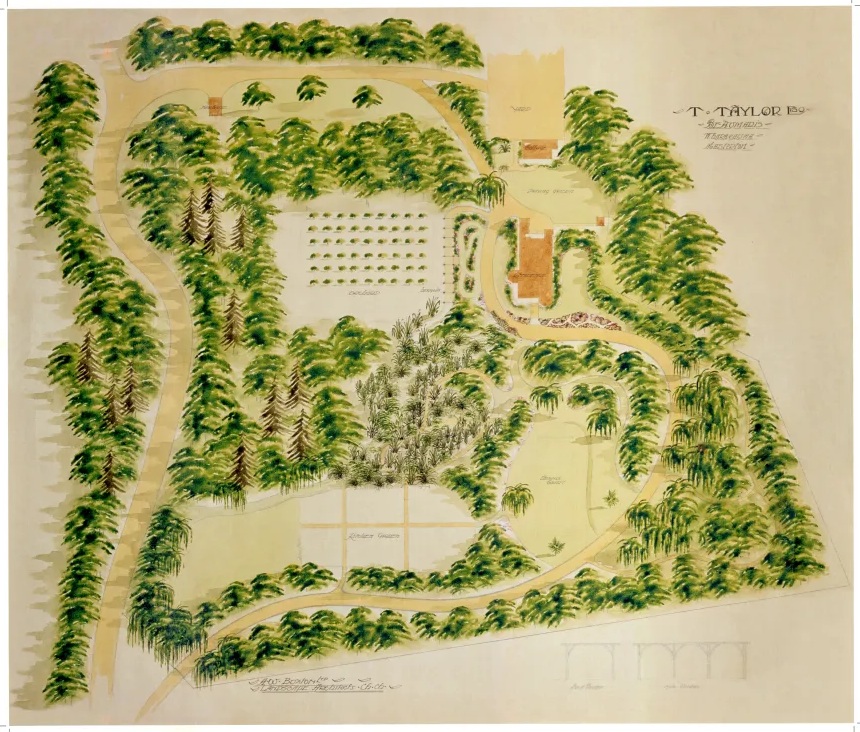
Alfred Buxton created gardens throughout much of New Zealand, as far south as Invercargill and as far north as the Waikato.  During my research for The Fairer Side of Buxton: Alfred Buxton’s Gardens and the Women who Loved Them, I compiled a spreadsheet of all the Buxton gardens I discovered and was staggered at the number involved.  With the earliest of these gardens created over 120 years ago, many no longer survive and those that do are generally significantly altered from their original design. 

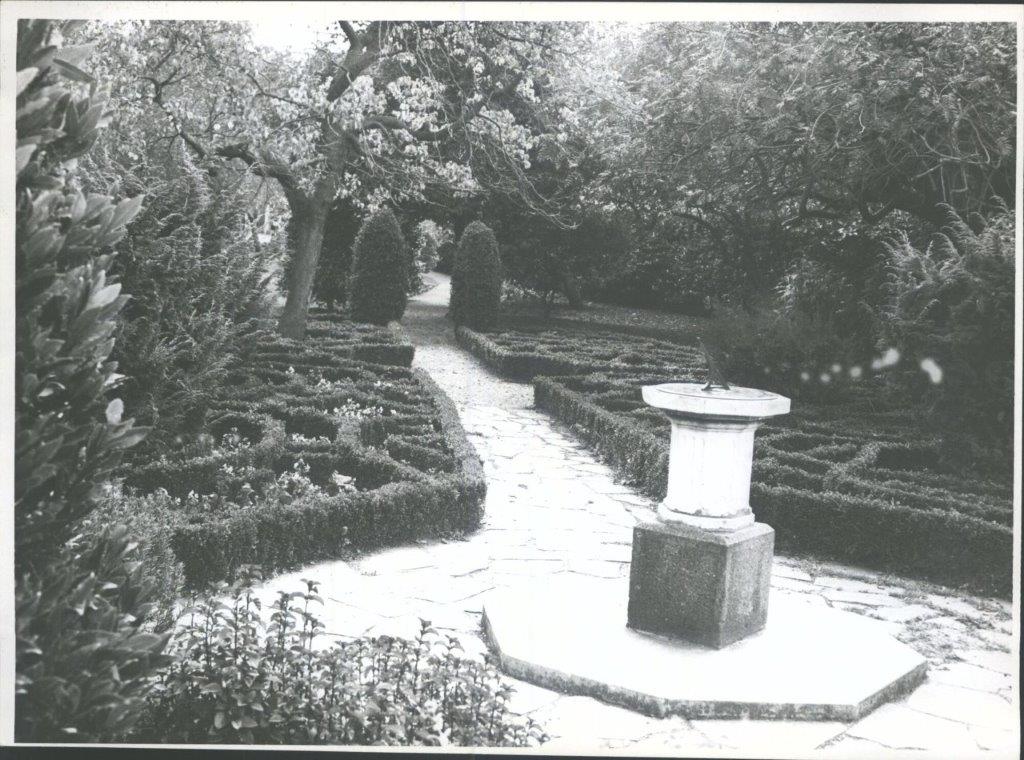
Buxton’s plan for Beaumaris, home of the Taylor family, Wairarapa. Credit: Taylor family

Since my book was published I have spoken to several garden clubs and horticultural societies and as a result have been made aware of additional Buxton gardens – some current owners or descendants of past owners even have the original plans!  Other people have asked me if a particular property had a Buxton garden, or if a forebear commissioned one. 

As I believe it is important that a complete register be kept of gardens created by such a significant figure in New Zealand’s horticultural history, I have built a publicly accessible directory of gardens created by Alfred Buxton at alfredbuxton.com.  Gardens are listed within geographical divisions by the name of property, or who owned it if the property did not have a name, its location, who commissioned the garden and the date.  The website has a search function so it’s easy to find the garden or person the user is looking for.  A comprehensive list of Buxton gardens is an important part of New Zealand’s garden history and for this reason I ask anyone noticing any errors or omissions to contact me so the directory can be as accurate as possible.  

Screenshot from the ‘Alfred Buxton’s Gardens’ website, April 2026

Welcome to Miramar, Wellington’s Pohutukawa Suburb

by Mike Lloyd

Republished from ‘The Local Arboretum: Noticeable Trees and their Stories
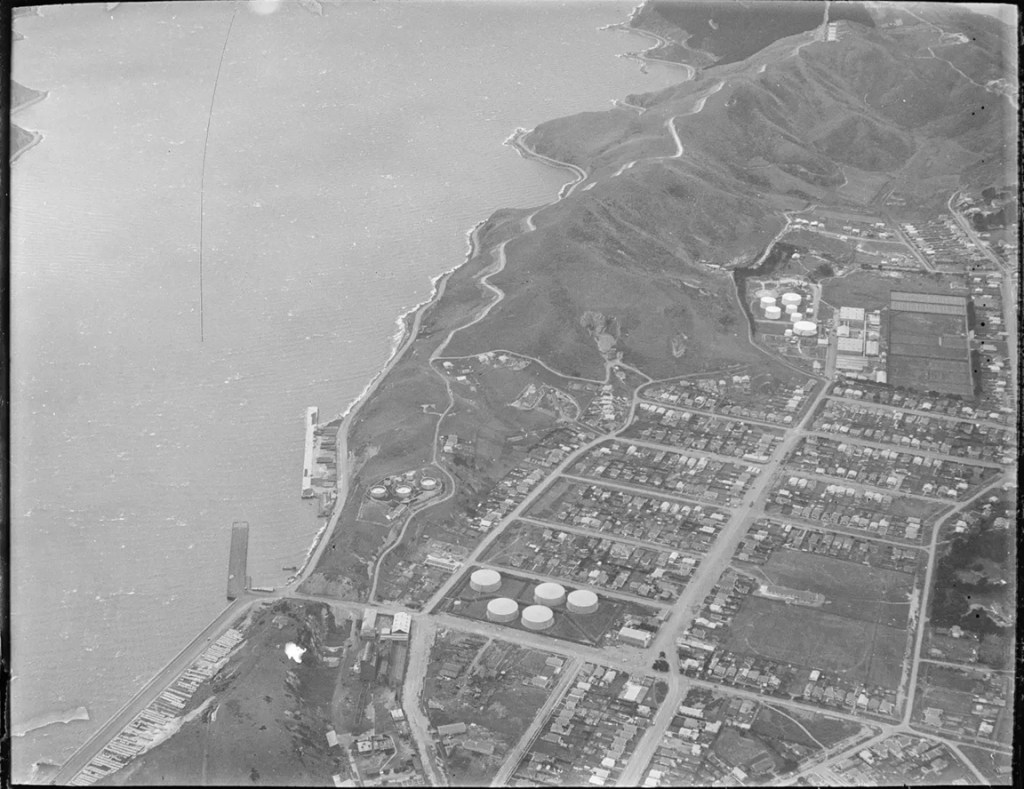
Source: ‘Wellington from the air, 1930‘, F. Douglas Mill Collection, Auckland Libraries Heritage Collections FDM-0570-G

The photo above shows part of the Miramar Peninsula, Wellington. If you fly into Wellington when a southerly is blowing, you’ll be just above the strip of water with the land to your left.

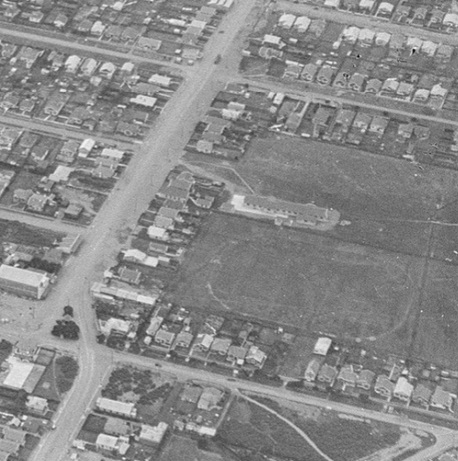
Struthers1 reports that the name ‘Miramar’ was adopted in 1870 by J. Crawford, a major European landholder, in reference to the Italian ‘mira mare’, meaning ‘behold (or wonder at) the sea’ and the supposed likeness of the area to the Gulf of Trieste where there was a ‘Castle of Miramar’. Clearly though, as the photo shows, in 1930 the Miramar Peninsula did not have the established tree life we would associate with an old castle on the Italian coast. However, this was about to change, particularly here in the area enlarged from the photo:

The very wide road running south to north is Park Rd, which is crossed by Miramar Ave. A branch of the Wellington tram system ran up Park Rd, past a main shopping area, including the Roxy Cinema (the large building to the left of the intersection).

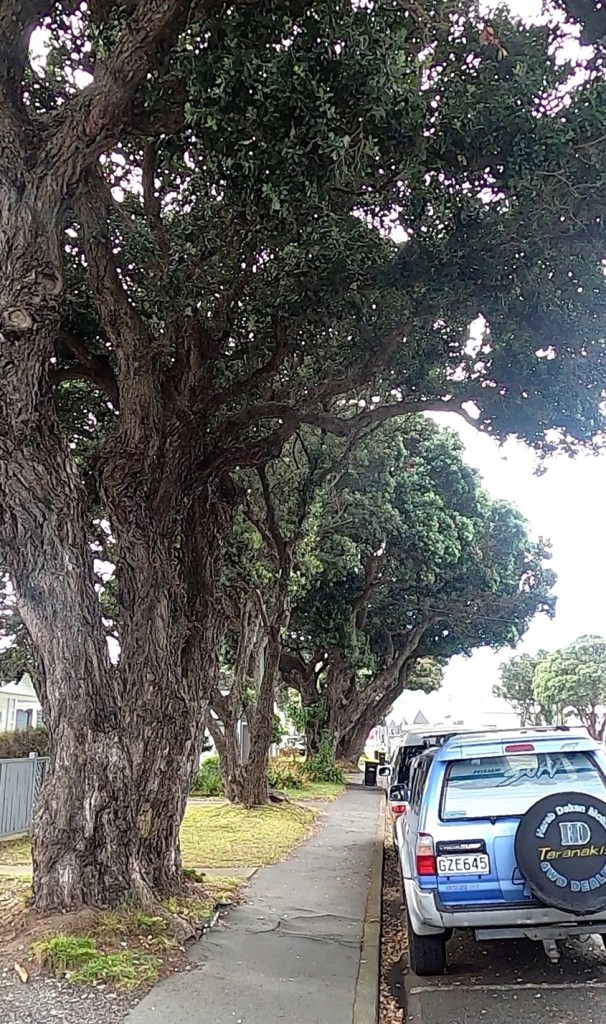
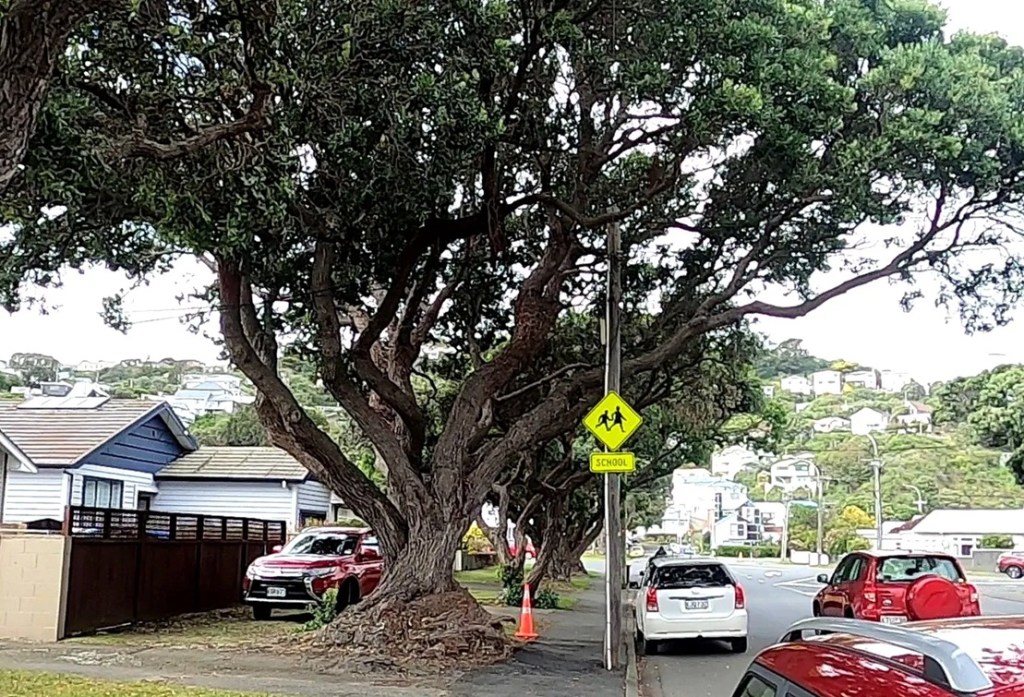
On the 16th of January, 1931, it was reported that in these streets of ‘noble width’ a start had been made in local beautification. Pohutukawa trees were planted, and these being a ‘fairly fast grower … these streets will gain considerably in picturesque aspect in a few years’.2 Indeed this proved to be the case, and the popularity of the pohutukawa as a street tree spread within a few years to nearby streets of less ‘noble width’. Within the area considered to be central Miramar, and not including planting in parks, Para St, Chelsea St, Brussels St, Rex St, Weka St, and Rotherham Tce all had pohutukawa planted as street trees. Miramar Avenue alone has a total of 67, and there is little doubt that the sum total planted would be well over 300. As I have written elsewhere Wellington is very much a ‘Pohutukawa Town’, even though the tree is not endemic to the area. They certainly flourish near the sea, which Wellington in surrounded by, and also seem able to tolerate Wellington’s notoriously strong winds. The numbers above clearly suggest that within Wellington, no other area can challenge Miramar as the leading ‘Pohutukawa Suburb’.

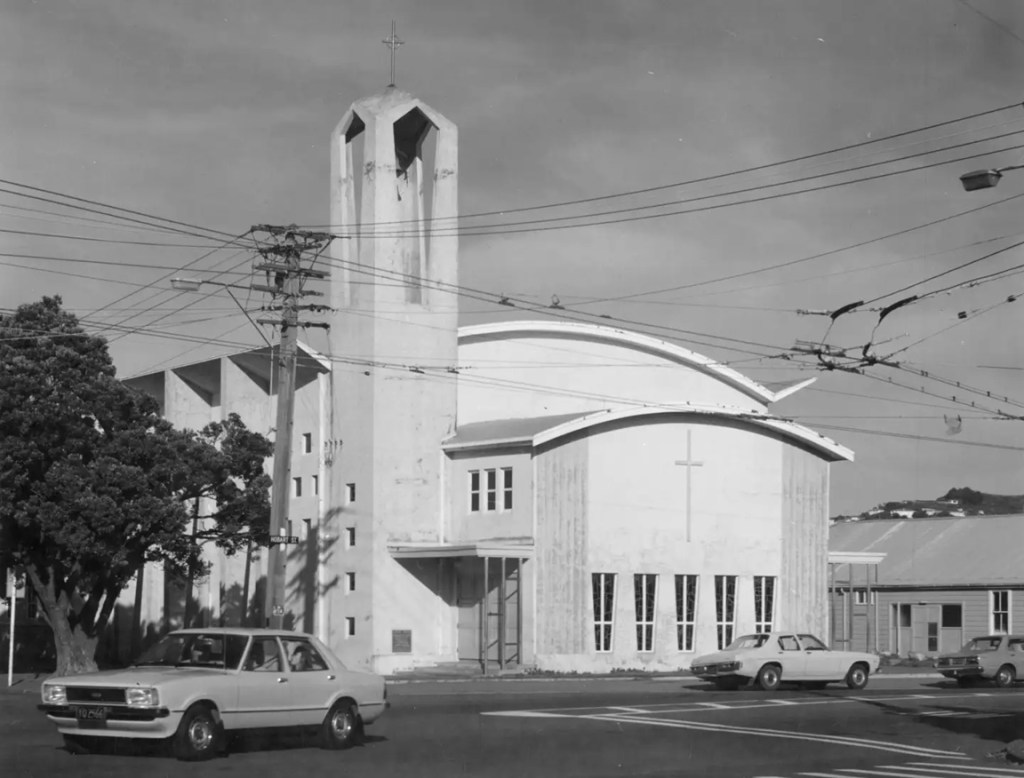
The Miramar Avenue pohutukawas are particularly noticeable because they are planted on both sides of the road, but it is useful to start with a single tree visible in an historic photo from 1978 as this provides a good point of comparison to realise the rate of growth. The photo shows the Church of the Holy Cross with an already decent-sized pohutukawa in front of it:

Source: Church of the Holy Cross, Hobart Street, Miramar, 1978. Charles Fearnley, Wellington City Recollect 1432

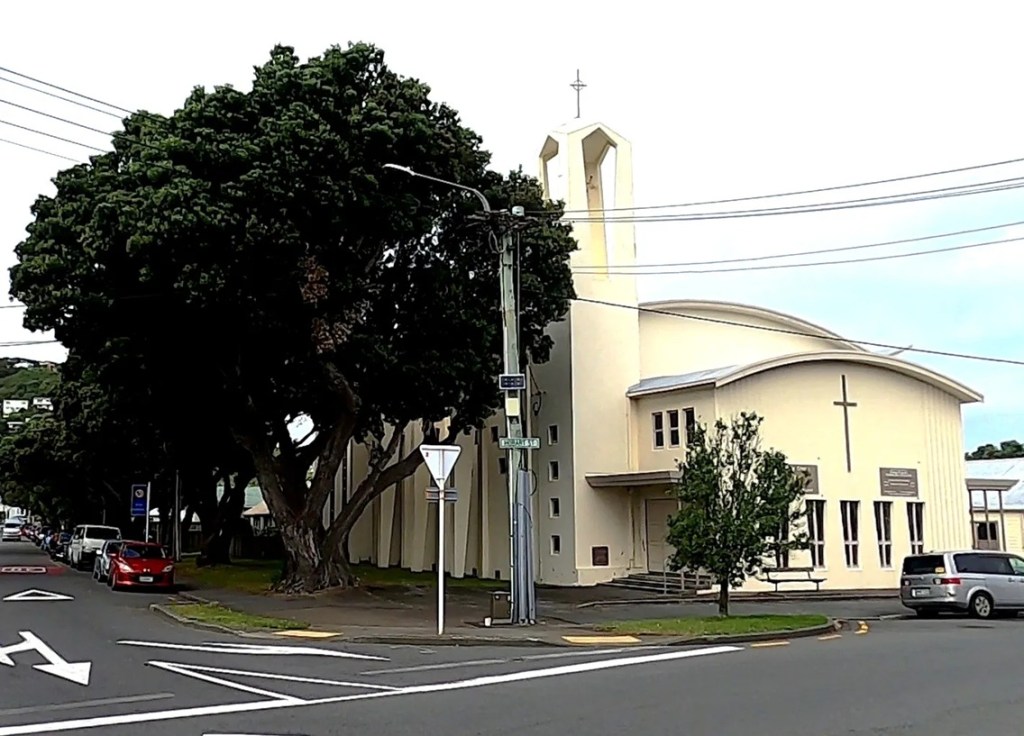
The church is not visible in the aerial photo above as it was not opened until September 1961, but it is located at the intersection where the tram route slightly curves from Hobart St into Park Rd. The overhead lines visible here are for electric trolley buses, as the Miramar electric tram route was discontinued in 1957.3 A photo from April 2026 shows us how much the pohutukawa has grown:

The useful internet resource Wellington Urban Tree Explorer measures the tree, in 2020, at 12.3 metres high and 9.03 in diameter. Sadly, the Holy Cross Church ceased being used in September 2024 due to earthquake damage and water-tightness issues, and its future is currently undecided.4

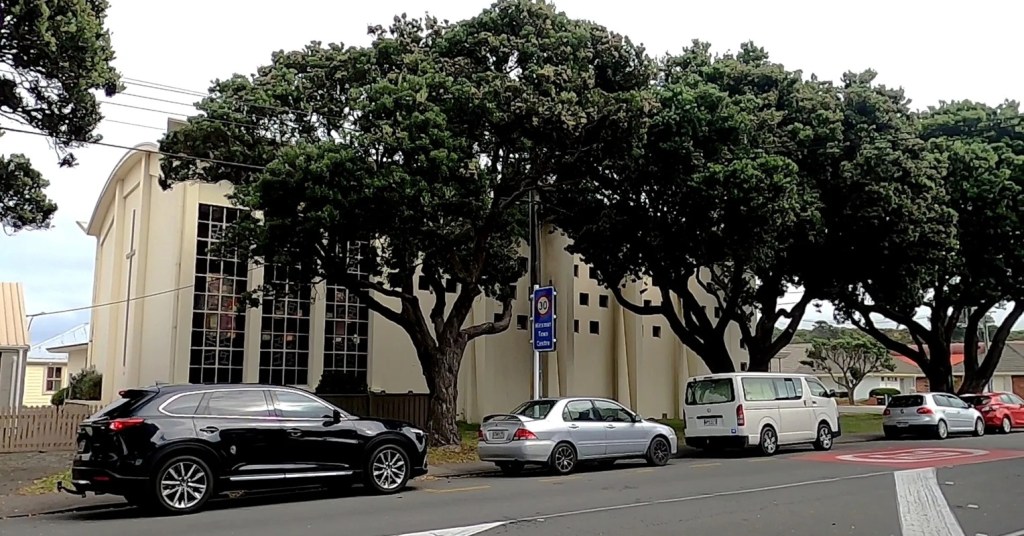
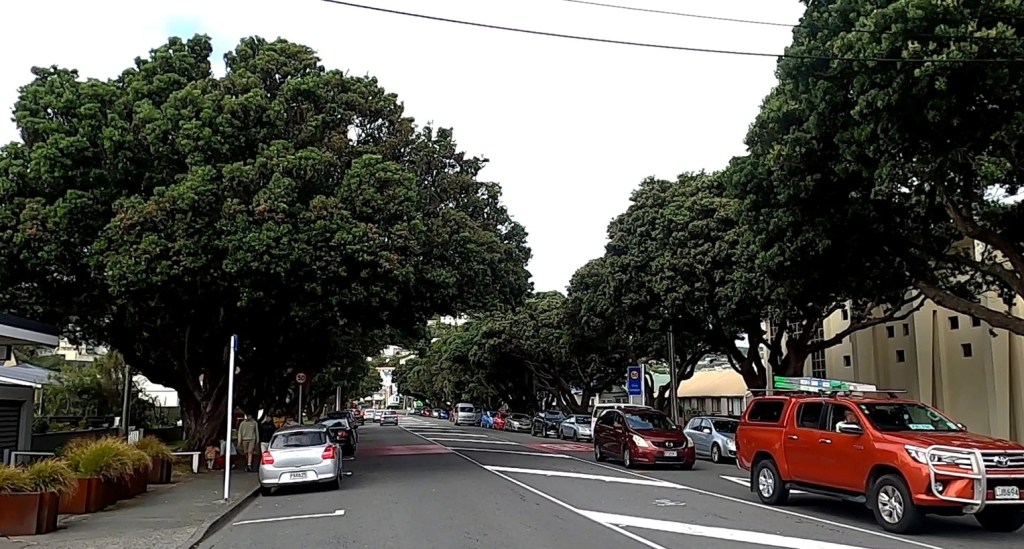
Proceeding eastward on Miramar Ave we can see there are many more pohutukawa of similar size:

The trees have the typical feature of often being wider than they are tall, and while the photos don’t do justice to the reality, there is very much an effect of travelling through a tunnel of pohutukawa. Unfortunately, the photos were not taken during flowering – usually December to January – when the visual impact is even more pronounced.

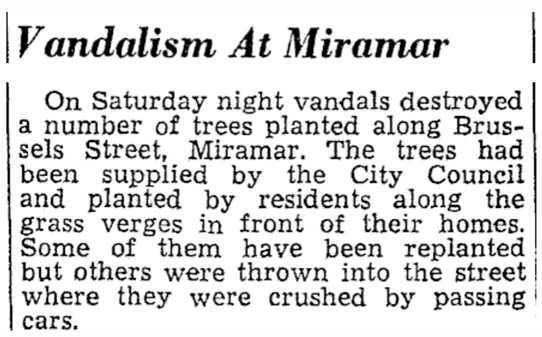
I don’t live in Miramar so have little idea of the range of local attitudes towards the trees, however, some visual and other evidence can be marshalled on this. As noted, pohutukawa have been planted in Brussels St, but interestingly a newspaper article suggests that by 1951 when they were planted, not everyone was thrilled with them:

Source: Evening Post, 4 September, 1951, p. 9

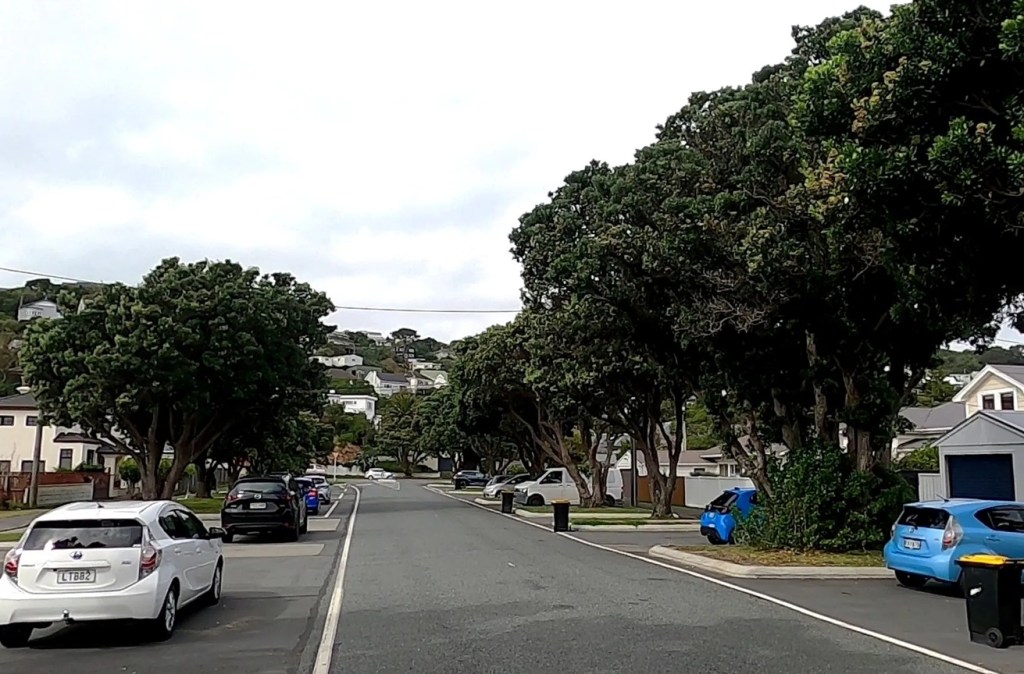
The article does not mention that the trees were pohutukawa, but recent photos establish that they were:

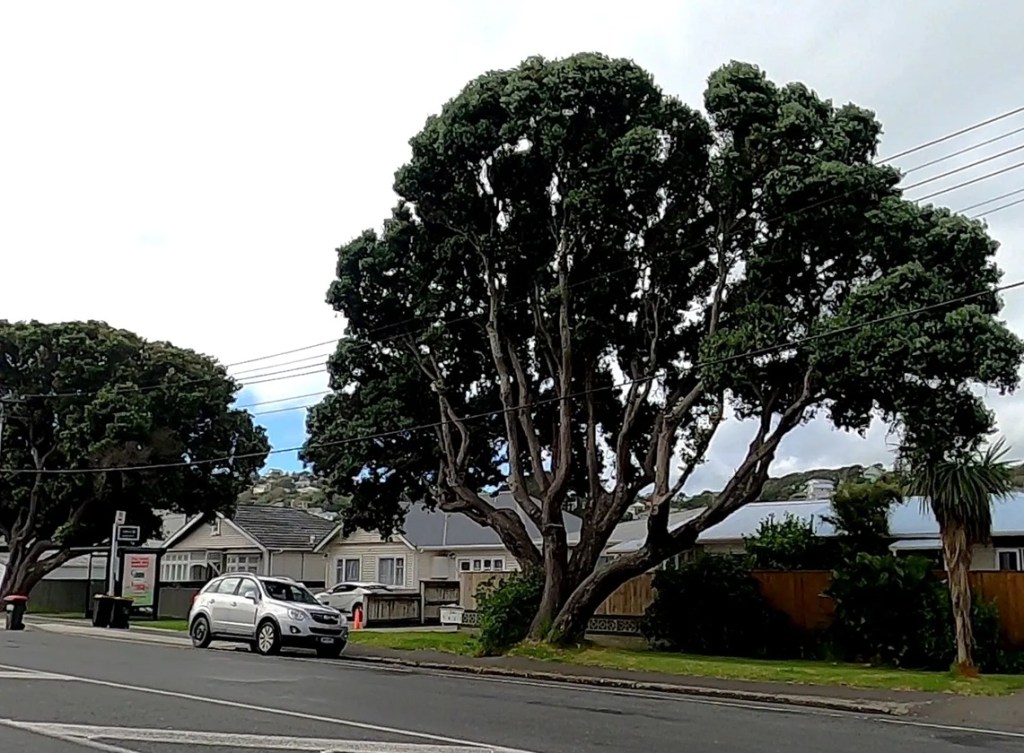
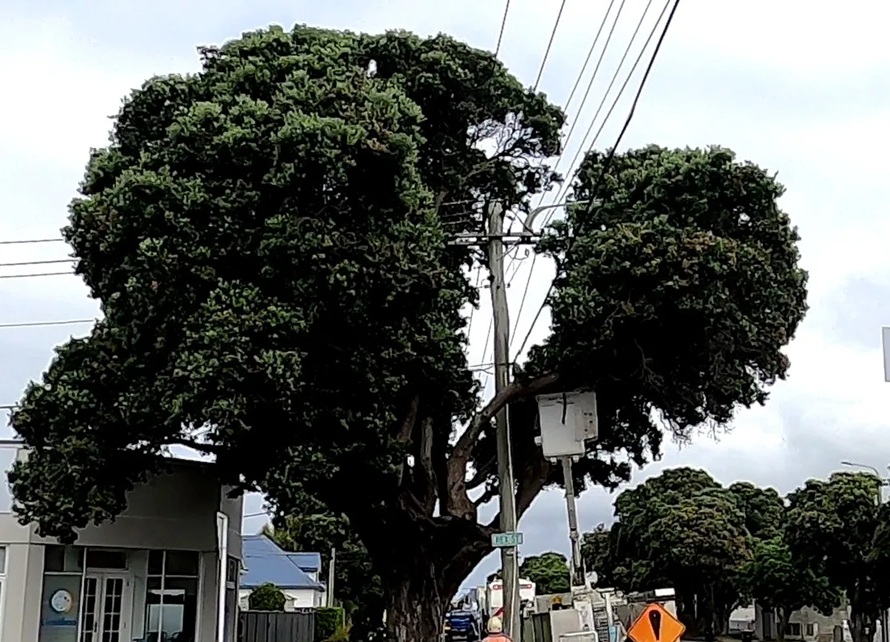
The layout of the road has probably changed since 1951. We can see here that recently the council has made considerable effort to accommodate both the trees and spaces for car parking. Pohutukawa seem well-suited to such street tree planting, and we can see a further advantage of them just around the corner in Park Rd, which is the very wide road where part of the original 1931 planting occurred:

The photo to the left shows how a pohutukawa can be pruned, effectively with a ‘flat half’, to avoid power lines without destroying its visual impact. Fortuitously, while I was photographing, I came across a lines company in the act of line maintenance, and the photo to the right again shows how the structural features of the tree allow space to be made for overhead lines. Not all trees would so readily admit such pruning, nor retain their aesthetic features afterwards.

Of course, sometimes the roots of the trees cause unevenness to foopaths, as these final two photos show:

Nevertheless, given that the trees we are looking at here are 95 years of age, surely such disruption is a small price to pay for the undoubted collective effect of the Miramar pohutukawas.

References:

  1. John Struthers, 1975, Miramar Peninsula: A historical and social study , (self published). ↩︎
  2. ‘Decorative streets. A start at Miramar’, The Dominion, 16 January, 1931, p. 3 ↩︎
  3. See E. Cox, 2018, ‘Electric Dreams of Wellington’s Tram History‘. ↩︎
  4. See ‘Cracks, climate change, safety, close church‘ CathNews New Zealand. ↩︎
Mistletoe: the Christmas Parasite in New Zealand

by Ian Duggan, Te Aka Mātuatua – School of Science, The University of Waikato

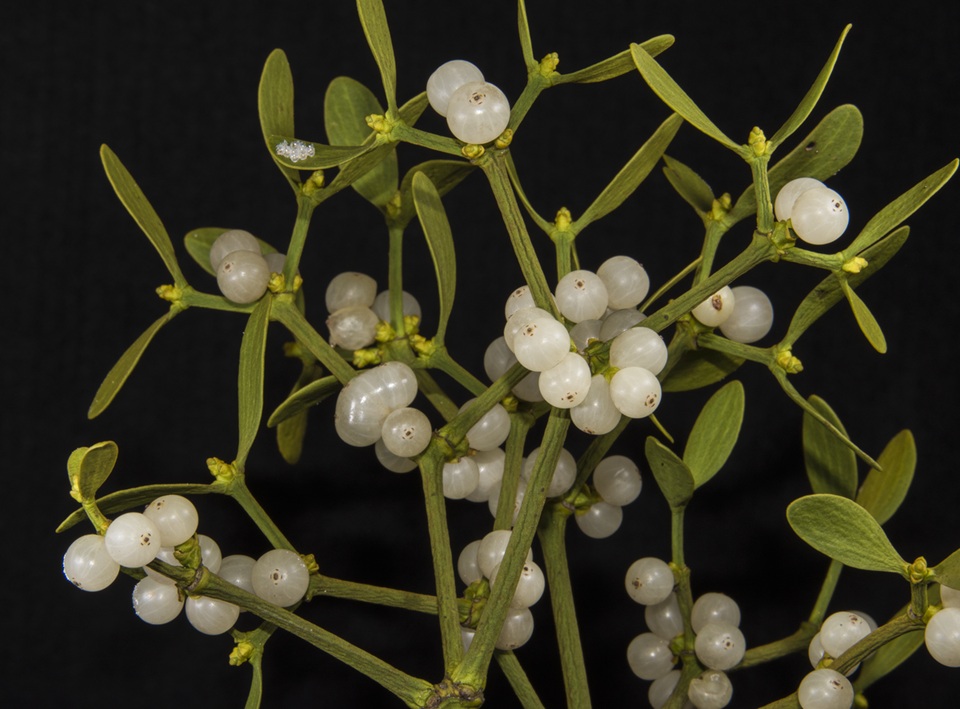
The mistletoe species most associated with Christmas globally is Viscum album – the so-called European mistletoe – which is native to Europe, but also to western and southern Asia. Being a hemiparasite, mistletoe grow attached to a host tree or shrub by a structure called the haustorium, through which they extract water and nutrients from the host plant, but not being entirely parasitic, they still need to obtain their own energy via photosynthesis. The most common host in Britain is the apple tree, followed by lime, hawthorn and poplar.[i]

European mistletoe, Viscum album, with berries, Photo by Florapic. Photo used under Creative Commons Attribution-Share Alike 4.0 International .

The term ‘mistletoe’, however, includes not just this one species, but many hemiparasitic plants with similar habits found in other parts of the world. This includes New Zealand, which compared to Britain is relatively high in mistletoe diversity. We have eight extant native species, compared to just one in the British Isles. All of our species are at threat from introduced mammals including Australian possums, land clearance, and declines in bird pollinators, and one of our native species has already succumbed to these pressures, presumed extinct.[ii] This blog will not concern itself greatly with the native mistletoes, however, which grow in our beech and lowland forests. We will focus instead primarily on New Zealand occurrences of the Christmas associated European mistletoe, which has either not survived following its introduction, or is now only observed very sporadically.

While the European mistletoe became associated with Christmas elsewhere as a decoration under which lovers are expected to kiss, the tradition never caught on in New Zealand, despite our native mistletoe diversity. For example, as far back as 1898, the Auckland Star declared: “With us in New Zealand the mistletoe does not enter into our Christmas rejoicings”.[iii] Nevertheless, we were certainly aware of the tradition: “Although English Mistletoe may not have been seen by New Zealanders hanging from lamps and ceilings during the festive season, few have not heard about it”, declared the same newspaper in 1938. [iv] Journalist and naturalist James Drummond elaborated with some possible reasons why the tradition never caught on in the early 1930s: “kissing under the mistletoe at this season is not in vogue in New Zealand. Native mistletoes are not grown in cultivation, and it would be troublesome to gather their flowers from forest trees on which they live parasitically. It may be considered not worthwhile, or there may be sufficient kissing all the year round without encouraging it under the mistletoe at Christmas time”.[v]

It is not well appreciated that European mistletoe has been used and grown in New Zealand. In 1914, for example, it was found growing in Christchurch on its preferred host, an apple tree, providing confidence that it wasn’t being confused with one of its native cousins:  

“In a florist’s shop in High Street [Christchurch] may be seen a fine piece of the genuine English mistletoe, and its freshness was a sure proof that it had been grown in the Dominion. As it is a rarity in New Zealand, a “Press” reporter made a few inquiries about it, and found that it had been grown at [Christchurch suburb] Papanui, the grower having got out some apple trees from England with the mistletoe growing on them. A well-known nurseryman of the town told the Pressman that repeated efforts had been made to grow the mistletoe from seed placed in the bark of trees, but the efforts had, not been successful”. [vi]

In 1942, another report was made of the plant in Christchurch, again from an apple tree, which suggested European mistletoe had been grown in the city for some time:

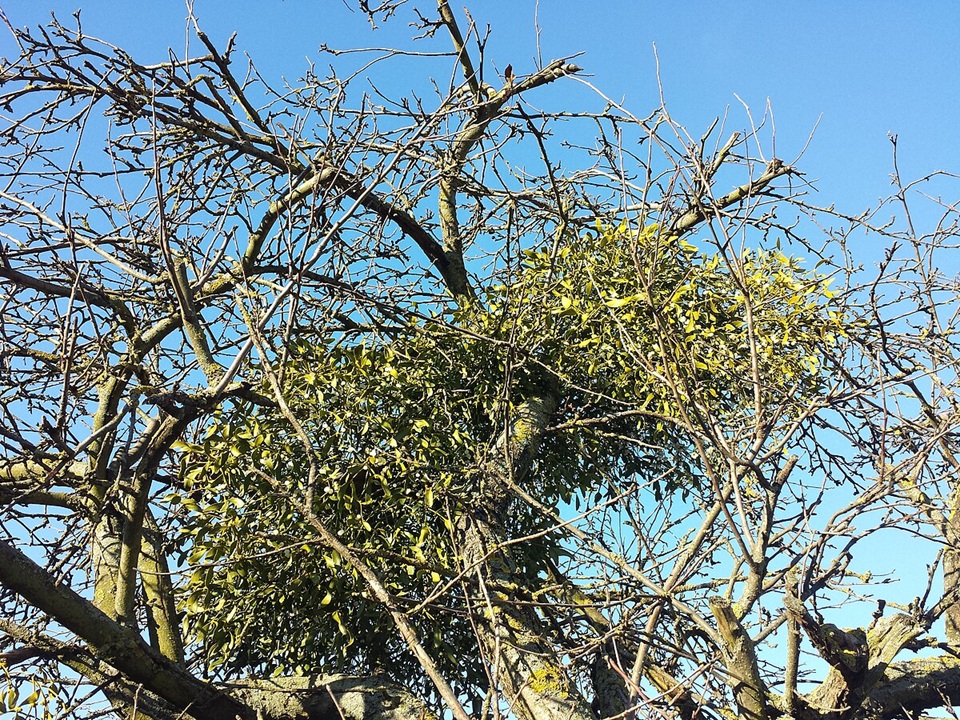
 “A large bunch of mistletoe plant, rare to New Zealand, is at present growing on an apple tree in an Avonside garden, Christchurch. The mistletoe, a small parasitical shrub, takes root abundantly on apple trees in Europe and England, and there are several stories and legends about it. The Druids regarded the mistletoe as sacred, and whenever a plant was found a ceremony was held and two white bulls were slaughtered as a sacrificial offering to the gods. A Scandinavian legend tells how Hoder the Blind God, slew Baldur, the Sun God, with an arrow fashioned from a mistletoe branch. In England the plant is traditionally associated with Christmas, when many [what might now be considered “problematic”] pranks are played by youths, who greet girls at parties by kissing them in doorways under a sprig of mistletoe. The European mistletoe bears small white berries and flowers, but the Christchurch plant has never displayed flowers in its fifty years of growth”.[vii]

European mistletoe in an apple tree, Austria. Photo by Stefan.lefnaer. Photo used under Creative Commons Attribution-Share Alike 4.0 International license.

Nevertheless, some were reported to flower and fruit that same year:

“The hope was expressed recently that someone in the city would report that he had been successful in acclimatising a berrying English mistletoe in a Christchurch garden… We are pleased to be informed that in the garden of St. Winifred’s Convalescent Hospital there is a plant of it growing on a fruit tree. The plant produces berries regularly in due season.”[viii]

Beyond Christchurch, the European mistletoe was also recorded growing in the Hawke’s Bay in 1940:

“A parasitic growth on the branch of a wattle tree taken from a property at Kereru, Hawke’s Bay, has been identified as the British variety of mistletoe. Though there are many varieties of New Zealand mistletoe, the English species is not particularly common in New Zealand, and it is concluded the seed was propagated through a bird, which had been feeding on the berries of the mistletoe, wiping its beak on the bark of the wattle tree. The parasitic growth looks as if it had been skilfully grafted, with no sign of the graft remaining.[ix]

Beyond these early newspaper reports, the New Zealand Plant Conservation Network currently reports the New Zealand distribution of Viscum album as having been “present locally in the Wairarapa in the vicinity of Masterton & Greytown, but seems to have died out in the early 1970s”, indicating its historical presence elsewhere is not well appreciated.[x]

Despite many of our native mistletoes flowering around Christmas, the use of our native species has thankfully never caught on, though not without an effort by some people. Back in Christchurch, the sale of a consignment of native mistletoe in some Christchurch florist’s shops leading up to the Christmas of 1984 was said to have “concerned D.S.I.R. botanists”:

“The mistletoe, which arrived at the Christchurch flower market in the week before Christmas, was apparently consigned under the label “Elytranthe tetrapetala” (red mistletoe). But, according to D.S.I.R. sources, at least some, if not all, of the flowering sprays in the consignment were the less common scarlet mistletoe, Elytranthe colensoi. Scarlet mistletoe is the biggest and most attractive of the New Zealand mistletoe, but compared with others in the South Island it has a limited distribution and a restricted host range. Its numbers are believed to be decreasing, and it is being considered for inclusion in the D.S.I.R. list of rare or endangered native species”.

European mistletoe flowers (Viscum album). Photo by gailhampshire. Used under Creative Commons Attribution 2.0 Generic license.

Dr B. P. J. Molloy, of the D.S.I.R.’s Botany Division, noted at the time that there was no legal reason why they should not be picked for sale from plants growing on private land: “However, the practice of exploiting uncommon native plants is questionable… Most of the people who bought mistletoe from florists before Christmas would have been disappointed soon after by its bedraggled appearance… Unlike normal plants, mistletoe depends entirely on its host for its moisture supply, and once severed from the plant it wilts quickly. Plunging it in water does not help, because cut mistletoe is unable to take up water”.

This, apparently, was not the first sale of native scarlet mistletoe in Christchurch: “About five years ago [i.e., around 1980], after a consignment of mistletoe appeared on the Christchurch market at Christmas, Dr Molloy traced it to a tennis club in the Moutere area near Nelson — one of the few places where scarlet mistletoe is relatively abundant. On that occasion he had visited the club’s secretary, and had received an assurance that the venture would not be repeated… He was hopeful of meeting a similar response this time”.[xi]

One final positive note: The Department of Conservation released a Christmas media statement a few days ago, noting that the once widespread native scarlet, red and yellow mistletoes were on the increase in the Hope River Valley, in South Westland. The population numbers there have increased 57% there in the last 19 years due to intensive possum control.[xii]

References


[i] Briggs, J. 2021.  Mistletoe, Viscum album (Santalaceae), in Britain and Ireland: a discussion and review of current status and trends. British & Irish Botany 3(4): 419-454

[ii] Mistletoes. Department of Conservation website: https://www.doc.govt.nz/nature/native-plants/mistletoe/

[iii] The Mistletoe. Auckland Star, 24 Dec 1898, P1 (Supplement)

[iv] Auckland Star, 31 Dec 1938, P19

[v] Do People Kiss Under Mistletoe? Star (Christchurch), 24 Dec 1931, P8

[vi] The City. Ashburton Guardian, 3 Jul 1914, P2

[vii] European Plant in City. Pahiatua Herald, 29 Jun 1942, P 4

[viii] Local and General, Waikato Times, 18 Sep 1942, P2

[ix] English Mistletoe on Wattle. Central Hawke’s Bay Press, 1 Mar 1940, P5

[x] https://www.nzpcn.org.nz/flora/species/viscum-album/

[xi] Mistletoe sales worry botanists. By Derrick Rooney. Press, 9 Jan 1985, P7

[xii] https://www.doc.govt.nz/news/media-releases/2025-media-releases/native-mistletoe-on-the-increase-in-time-for-christmas/

Alice’s Looking Glass Garden

by Peter Sergel

The imaginary gardens described by Lewis Carroll include elements of old gardens, reflect the changing culture of the Enlightenment and, like all good art, they can perhaps challenge our perception of the world. 

I’ve always been intrigued by imaginary gardens and had the privilege of turning some of my own imaginary gardens into real ones at a place called Hamilton Gardens. But like many others I’ve always been intrigued by the evocative imaginary gardens described in books. This includes the books of famous authors like: Frances Hodgson Burnett, Kenneth Grahame, Arthur Ransome, Walter de la Mare, John Hadfield, Sidonic Gabrielle Colette, Beatrix Potter, Arthur Ransome, P.G. Woodhouse and Oscar Wilde. In some cases a safe idyllic garden provides the ideal setting for grisly discovery and you get the impression that Agatha Christie’s imaginary gardens are littered with dead bodies. 

But of all of those strange and fascinating imaginary gardens, probably the most famous and surreal is the garden described in the story called Through the Looking-Glass, and What Alice Found There, first published in 1871. It was written by Charles Dodgson (1832-1898) who often used the pen name of Lewis Carroll. 

In this book Alice enters a fantasy world by climbing through a large ‘looking-glass’ mirror into a room that she can see on the other side. In that reflected world things are reversed, including logic. After she’s left that room she starts running through a garden towards a hill, yet constantly finds herself arriving back to the house she’s just left. That description reflected a new garden fashion for winding, sinuous paths that often doubled back on themselves. This fashion was promoted in the early 19th century by the very influential garden writer, John Claudios Loudon. Loudon and his wife Jane told their readers that you shouldn’t follow fashions, yet for a while they more or less defined garden fashions throughout the British Empire. Another influence was the self-proclaimed expert on China, Sir William Temple. He’d never been to China but confidently told everyone that the Chinese never used straight lines and, since everything Chinese was fashionable, meandering, curved garden paths became a new fashion. 

Not everyone approved. Shirley Hibberd told his readers the curved paths were ‘enough to make the butcher’s boy dizzy’. Some other unnamed person apparently said “It’s easy to design a garden these days. You get your gardener very drunk, then get another chap to follow him with a field marker.” There was also a fashion for mazes, and some of these had curved forms. So Alice wasn’t alone in getting confused by curved paths that could direct you away from the feature you were heading towards. For her that feature was a hill, where she thought she might find a good view over the looking glass garden. 

The hill Alice is heading for was a regular feature in Tudor and Stuart gardens. They had been created in gardens since at least the 13th century to gain a view over walls and hedges and were generally called ‘mounts’. Another influential figure, Francis Bacon, wrote in his famous essay On Gardens in 1625 that “I would have a Mount on some Pretty Height … to looke abroad into the fields”. Apart from gaining a view, these mounts were often a way to get rid of material from newly dug moats, cellars or fishponds. They often had some form of underlying structure like the remains of a building or unwanted rubble. Henry VIII’s enormous mount at Hampton Court was made in 1532 from more than 250,000 bricks and topped by a three storied banqueting house. Of course his mount was bigger and grander than anyone else’s. 

As Alice heads for the garden mount, she comes across a large flower-bed with a border of daisies, with a willow tree growing in the middle. “O tiger-lily, I wish you could talk” says Alice. “We can talk” replies the tiger-lily “when there’s anyone worth talking to”. It was probably inevitable that it would be the tiger-lily that would take the lead ahead of the other rather rude talking flowers that included roses, daisies, violets and delphinium. Tiger-lilies had been introduced to Britain from China in 1811 and like everything else from China they held an exotic fascination. In the Victorian era there was another popular fashion for associating each flower with a symbolic meaning and so the tiger-lily was said to symbolise confidence, pride and a boastful attitude, which you can see reflected in its stroppy response to Alice. 

A book published in 2001 by Peter Thompson called The Looking Glass Garden has nothing to do with these looking glass plants. Instead it’s about plants and design from the Southern Hemisphere, including New Zealand, Australia, South Africa and Chile. The title is inspired by a question Alice asks herself as she’s falling (like Robert Kennedy Junior) down a very deep rabbit hole. 

“I wonder if I shall fall right through the earth!  How funny it’ll seem to come out among the people that walk with their heads downwards!  The antipathies I think…  but I shall have to ask them what the name of the country is, you know.  Please Ma’am, is this New Zealand?”

Rather more pleasingly, to fall through the centre of the world from our part of New Zealand might land us somewhere closer to Salvador Dali’s Surrealist Museum. Dali was directly inspired by Alice’s adventures because he saw them as a journey through the subconscious. The elephants that Alice sees drinking nectar from giant flowers could easily have inspired Dali’s paintings and sculpture of long legged elephants. He illustrated a book of Alice in Wonderland and in 1977, painted the white rabbit with one of his iconic melting pocket watches and created a bronze sculpture of Alice with roses blossoming from her head and hands. 

Carroll’s story is full of surrealist details and characters. Alice through the Looking Glass was a sequel to his Alice’s Adventures in Wonderland (1865), in which many of the characters are anthropomorphic playing cards. In the Looking Glass book the theme is chess. In my 1896 edition the author has added a note at the front to explain how the chess pieces and characters will play out ‘in accordance with the laws of the game’, which he explains with a diagram and a series of chess moves. Each character in the book is associated with a particular chess piece in this introduction.

The first chess piece that Alice meets in the Looking Glass Garden is the Red Queen. The queen gives Alice a sound piece of advice that many have found useful. “Curtsey while you’re thinking what to say. It saves time.” In response you’ll generally find that people will frown and ask you what you’re doing. After a brief discussion, the Red Queen and Alice walk to the top of the hill. From there Alice could look out in all directions and see that the surrounding garden was divided into squares just like a large chess board. The squares were divided by a number of little brooks running straight from side to side and the squares defined by a number of hedges that reached from brook to brook. The tradition of large-scale chess-like patterns in gardens were sometimes found in Renaissance and Baroque gardens with the formal layout of parterre or knot gardens incorporating checkerboard-like geometric patterns. There were references to chess board patterns in Tudor and Georgian gardens with black and white chequerboard paving or alternate squares in different coloured mulches, like white limechip, crushed red bricks or black coal. 

This certainly wasn’t the first garden to be set out like a chess board. The ancient Indian encyclopedia called the Brhat-Samhita mentions gardens being set out like an ashtapada, which is an eight by eight, sixty four square grid orientated to the four cardinal directions. Ashtapada was a board game that used this grid but there was another 64 square grid game that their ancient culture had invented called chaturanga. We now call that game chess. Both games were older than the 6th century encyclopedia description and were said to have been played by Siddhartha Gautama, the Buddha himself.

The Red Queen explains that the entire garden is laid out in squares, like a gigantic chessboard, and says that Alice, representing a pawn, could become a queen if she can advance all the way to the eighth rank on the board. Beyond the hill there’s a stream where Alice rows a boat for a sheep while collecting beautiful scented rushes that immediately begin to fade like melting snow. Later there’s a forest where she meets a very confused knight. Finally she crosses the final brook to reach “a lawn as soft as moss, with little flower-beds dotted about here and there”, which sounds as if she’s back in a garden setting. 

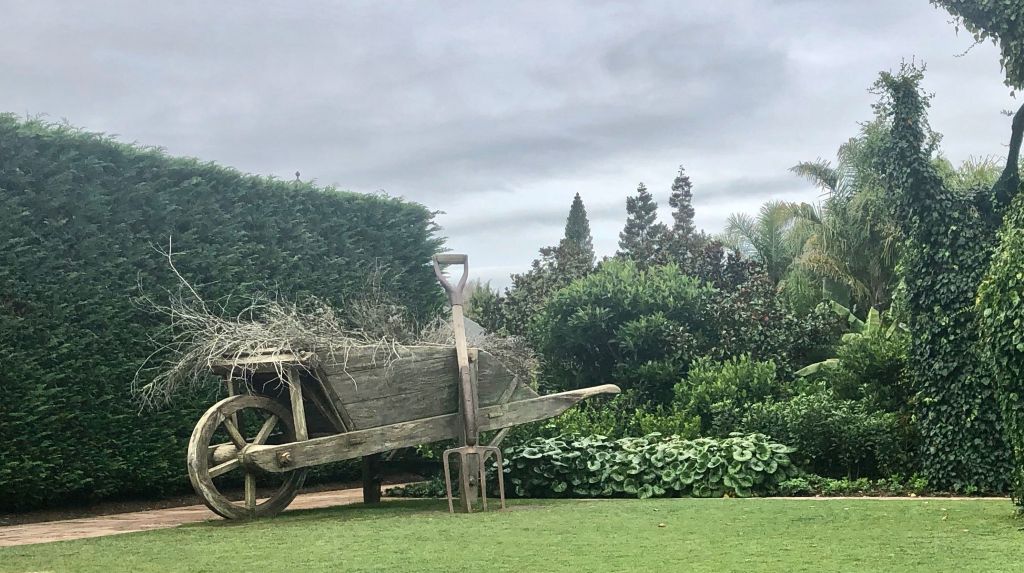
Since Tudor and Stuart times, gardens sometimes featured topiary figures representing chess pieces. A famous surviving example is Levens Hall in Cumbria, whose overgrown topiary figures partially inspired the Surrealist Garden at Hamilton Gardens. If you Google Looking Glass Garden you’ll come across references to this garden. The explanation, apparently written by AI, mentions that “this is because of its dreamlike, unsettling disorientating atmosphere, distortions of scale, biomorphic topiary and fantasy environment that visitors can walk through’. Proposed further development of this garden using AI to create a metaversal experience may make it far more surreal than Carroll’s Looking Glass Garden. AI’s regular reference to this particular garden is probably because of the number of people writing about their impression of shrinking. Objects in the Hamilton Surrealist Garden like: the wheelbarrow, garden gate, tap, flowers, spade and deckchair are ten times the normal size so a visitor can feel they’ve shrunk like Alice, who experiences a garden as a very small person. She leans against a buttercup to rest and fans herself with one of the leaves. Then she meets a large blue caterpillar sitting on top of a mushroom smoking a long hookah. 

Surrealist Garden, Hamilton Gardens. Photo by Johnragla. Used under Creative Commons Attribution-Share Alike 4.0 International license.

At this point in Alice in Wonderland films, like William Sterling’s 1972 and Tim Burton’s 2010 versions, the garden setting gets quite trippy. Mind altering drugs like opium and laudanum were freely available from places like Harrods at the time of Carroll’s writing, but there’s no evidence he used them. However, he did suffer from migraines and hallucinogenic experiences that have come to be formally referred to as AIWS, Alice in Wonderland Syndrome. But the Alice gardens are still weird places, the product of Lewis Carroll’s fantasies that could so easily be interpreted as horror stories. 

The Lewis Carroll characters in these books became quite popular garden sculptures through the early 19th century. The best known New Zealand examples used to be the fantastic old stone figures of the Duchess and Knave in the Larnach Castle garden, which had clearly been inspired by the original Tenniel drawings. The Alice stories were very much in fashion when the Larnach children were growing up. When the Barker family took over the Larnach estate they continued that theme with an Oamaru stone Cheshire Cat and the Queen of Hearts throne. There used to be a Looking Glass Garden in the Papamoa Hills near Te Puke that featured fairytale and whimsical detail. It’s apparently fallen into disrepair and the last Tripadvisor post says that ‘the toilet has been taken over by spiders’. That’s quite a Looking Glass feature, especially if the spider can talk. Some major gardens have featured Alice in Wonderland garden displays with Alice themed props, fantastical floral arrangements or have used garden features as storytelling devices, sometimes with interactive mobile phone apps. These include: the New York and Atlanta Botanic Gardens, the Hunter Valley Garden near Sydney and the Alice in Wonderland Garden in Bucharest. 

The Cheshire Cat up a tree at Larnach Castle. Photo by Ciell, used under Creative Commons Attribution-Share Alike 4.0 International license.

Mention has been made of Carroll’s significant influence on literature, garden design and popular culture by subverting Victorian-era expectations, symbolising childlike desire, and inspiring surrealist and whimsical themes. There have been imaginary gardens that have had a major influence on garden design such as: Genji Monogatari, Dream of the Red Chamber and The Decameron, but Lewis Carroll’s stories didn’t encourage a new type of garden. Instead I would argue that Carroll was reflecting changes that were occurring during the Romantic Period (1738-1850). Renaissance and Baroque gardens had been neat, formal and well mannered, with nature apparently well under control. You played by the rules, like the playing card characters who repainted the white roses red to avoid having their heads cut off. But then around the mid 18th century something bizarre started to happen. A new form of garden design became popular called the Picturesque and old garden traditions were turned on their head, a little like a Looking Glass Garden. Instead of neatly trimmed hedges and grass, naturalistic unpruned planting and long grass started to become fashionable. Flat neat paths were replaced with rough uneven ground like the ‘ridges and furrows’ on the Red Queen’s croquet lawn. Instead of gardens that projected complete control and order there were newly created overgrown gothic ruins, dangerous rustic bridges and cliffs. Instead of well mannered promenading along wide walks, there were caves where garden staff would sometimes be required to make the sound of tormented animals or a thunder noise or pretend to be a hermit living in a cave. ‘Now chaps, this afternoon we’ve got visitors so I want you all to stand at the back of the cave and make tormented animal noises.’ 

Most of the main transformations that have shaped the modern world were reflected in a new form of garden and for the Romantic Period that was the Picturesque. You really need to understand the Romantic Period to understand the Picturesque gardens, but the Picturesque gardens themselves are a very direct way of understanding the Romantic Period. These new forms of garden may have sometimes been strange but they were an indication of a new sensitivity that liberated most of the arts with a reaction against rationality and order. It was replaced with individual expression, risk taking and mysticism that challenged the old order and rules. Emphasis was placed on subjectivity, emotional response and imagination over rationality and reason. This was reflected in garden design and the arts and then, through Lewis Carroll, it was also reflected in children’s literature. 

Not everyone can visualise imaginary gardens but most people like having their imagination prompted, which you can see from the numbers who visit the Tolkien hobbit gardens at Hobbiton, near Matamata. With the help of AI, amazing gardens are now being created online where budgets, clients and planning regulations offer no restraint to the imagination. It’s likely they’ll substantially replace the imaginary gardens that have been described in literature, but I can’t help feeling something is missing. If you don’t need to use your own imagination, those imaginary gardens can never be as memorable or personal. Some writers, like the English novelist and playwright Susan Hill, say that their love of gardens started with the garden briefly described in Alice in Wonderland. She mentions that she can always “imagine every detail of that garden and could wander freely among its beds and borders, up and down the broad paths in the summer sunshine.” Yet the description in the book is very brief. 

“She knelt down and looked along the passage into the loveliest garden you ever saw. How she longed to get out of that dark hall and wander about among those beds of bright flowers and those cool fountains”. 

It seems that the lack of detail has engaged Hill’s imagination. It’s just a tantalising glimpse of a magical place of brightness, Victorian gardenesque spender and moving water beyond the gloomy inner room in which Alice is trapped, because of her size.

Perhaps the poor and destitute in Gaza can carry on by imagining the garden of Jannah, described in the Quran.  A charbagh garden filled with lush greenery, bountiful fruit and four rivers of water, milk, honey and wine. And that’s perhaps the value of imaginary gardens. They’re a place to escape to, as perfect or strange as you want them to be. Albert Einstein said that “Imagination is more important than knowledge because knowledge is limited. Logic will get you from A to B. Imagination will take you everywhere”. Through a looking glass into remarkable gardens or perhaps, through ignorance, down a rabbit hole. 

References 

Anita Brookner, Romanticism and its Discontents, Penguin Books, 2001

Jane Brown, The Pursuit of Paradise – A Social History of Gardens and Gardening, Harper Collins, 1999, 

Lewis Carroll, Alice’s Adventures in Wonderland and Through the Looking Glass,  Collins’ Clear Type Press, 1896

Jane Fearnley-Whittingstall, The Garden – An English Love Affair, Seven Dials Paperback, 2002

Susan Hill & Angela Barrett, Through the Garden Gate, Hamish Hamilton London, 1986

John Dixon Hunt, The Picturesque Garden in Europe, Thames & Hudson, 2002

Peter Sergel, Inspiration in the Garden, Penguin Viking, 2004

Charles Watkins & Ben Cowell, Uvedale Price – Decoding the Picturesque, Bydell Press, 2012

Ship Figureheads as Statuary in New Zealand Gardens, Part 3: the America, the Helen Denny, and others

Ian Duggan

A number of newspaper reports were published in the early 20th Century on the figureheads of ships featuring as items of statuary in New Zealand gardens. In previous blogs we examined the stories of the figureheads of the Hydrabad and HMS Wolverine. But there have been plenty of reports of others that have adorned our gardens besides these. Though not exhaustive, in this final contribution I examine the interesting stories of several more of these, including the figureheads of the America and the Helen Denny.

AMERICA

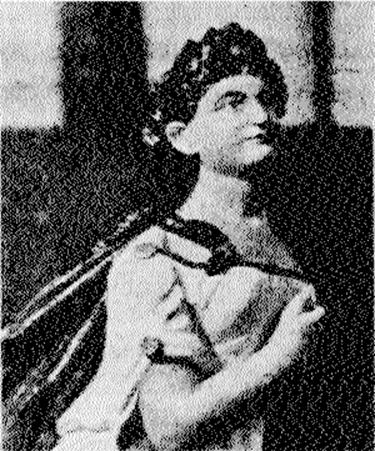
One of the most interesting remaining stories of ship figureheads appearing in New Zealand gardens is that of one that had lost its provenance. In March 1930, it was reported that an “exceptionally fine figurehead, true to nautical regulations in being one and a-half times life size, has lost her identity. For many years she reposed in the garden of Mr. J. J. Craig’s house, in Mountain Road [Epsom], but after 23-4 years no one remembers where she came from”.[i]

“This exceptionally fine figurehead, true to nautical regulations in being one and a-half times life size, has lost her identity”. Sun (Auckland), 22 March 1930, P 17

Soon after, this figure – like that of the Wolverine in our previous blog – made its way into the collection of ships’ figureheads at the naval headquarters in Devonport, Auckland. Despite the origin being unknown, it was noted to be “in an excellent state of preservation”. The figure was “that of a girl dressed in Grecian costume. The figure is a particularly fine one, and represents a very high degree of perfection in the art of wood-carving. The features are well-proportioned and the flowing garments have a most realistic appearance.”[ii]

It took some time to be confident of its origin, but it was “solved after four months’ investigation by Mr. T. Walsh, of Devonport, who undertook the task at the request of Commander Nelson Clover, [the] officer commanding the naval base at Devonport”.

Of the Devonport naval collection, the figurehead was described as the “largest and most ornately carved”. At first it was assumed to have come from the Constance Craig. “An inspection of the figurehead at the dock”, however, led to the conclusion that it did not come from this vessel: “Practically all the “shell backs” [a term used for an old or experienced sailor, especially one who has crossed the equator] to be found about Auckland waterfront, were consulted about the possible origin of this old piece of ship ornamentation. The Joseph Craig, the Hazel Craig, the Quathlamba, and the Royal Tar were mentioned as being likely ships, but in each case investigation proved that the figure-head did not come from any of the vessels mentioned. The possibility that the late Mr. J. J. Craig had bought the figurehead in Fiji or elsewhere was then examined. After 60 inquiries had been made a chance meeting with a carter formerly employed by J. J. Craig, Ltd., elicited that for many years the figurehead had reposed in a shed on the old Railway Wharf. The following up of this line of inquiry led eventually to establishing that the figurehead belonged to the ship America, which put into Auckland in distress in 1903 and was condemned here”.

Research uncovered at the time found that the America had started life in 1868 under the name ‘Mornington’. “In July, 1903, she sailed from Newcastle [Australia] with 2,400 tons of coal, but was two days out when a leak developed in the stern”… “The ship put into Auckland, and the captain made a great fight to save his ship. She was condemned on September 3, 1903, and cargo and ship were sold. Some years later the ship was dismantled and anchored in “Rotten Row.” When the American fleet visited the Waitemata, in 1908, the America left her moorings and fetched up alongside one of the worships. The weather was exceedingly rough, and every effort to shift the hulk failed”…  “the old hulk was taken to the “bay of wrecks” at Pine Island, where holiday-makers subsequently set her afire”.[iii]

HELEN DENNY                

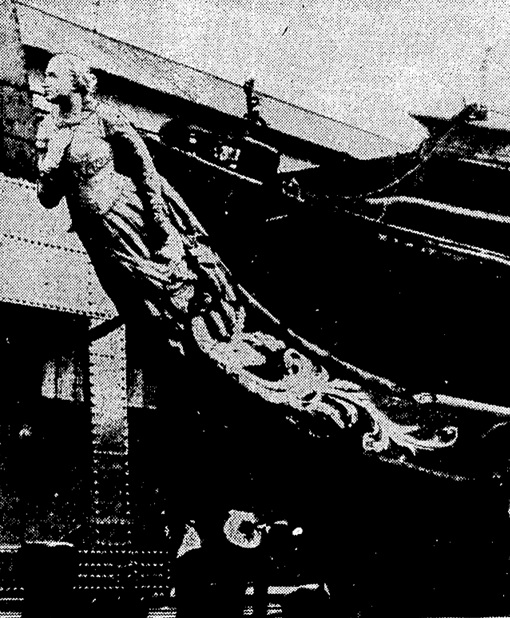
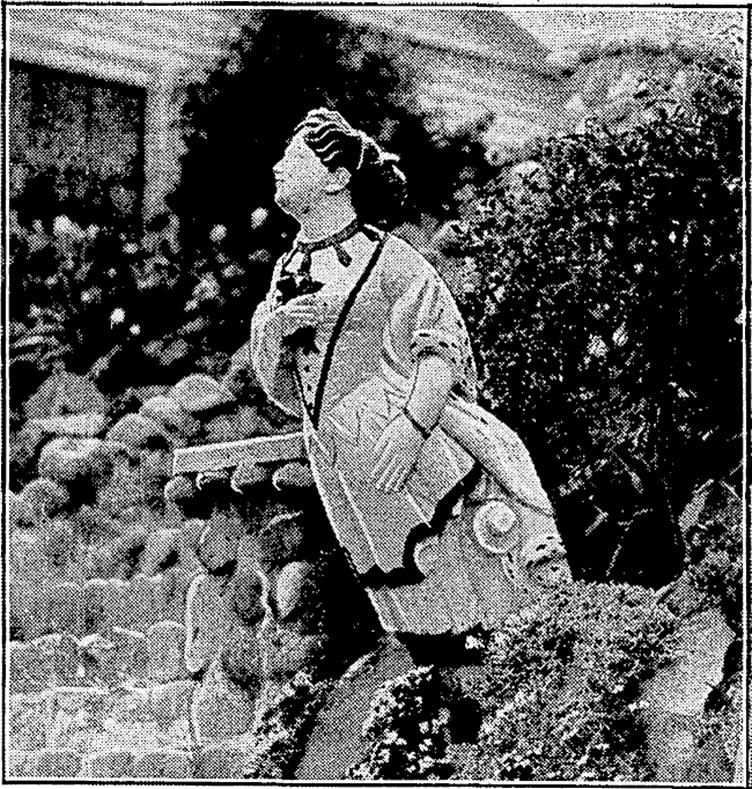
“Mounted in a Roseneath garden, this figurehead was once on the bow of the Helen Denny, well known as a trader and cadet ship on the New Zealand coast”. Evening Post, 25 September 1935, P 9

Many column-inches, commonly with some of the most spectacular images, were dedicated to the figurehead of the Helen Denny. In 1935, “after having been lost track of for a number of years”, The Evening Post reported that “the figurehead of the intercolonial barque Helen Denny has turned up again. The figurehead, which is in a remarkable state of preservation, is the property of a Roseneath [Wellington] resident, and is to be mounted in a garden overlooking the harbour where the old vessel spent many years as a hulk”.

“The form of the figurehead is such as was familiar in bygone days, and is that of a lady attired in a white dress of the mid-Victorian, period, trimmed with green and gold. Clasped in her right hand on her breast is a red rose. She has black hair surmounted by a coronet, and gold bangles encircle her arms”.

The Helen Denny was described as “an iron ship of 695 tons, with a length of 187.5 ft”, and was said to have “took the water in the Clyde in 1866”. “The name Helen Denny was bestowed upon her as a compliment to the wife of the then manager of Denny and Company, the famous Dumbarton shipbuilders… The figurehead is intended as a likeness of that lady, and although its merit cannot readily be judged by comparison, it appears to be a remarkably fine piece of work”. [iv]

“For 10 years she traded out of Glasgow to Rangoon [now Yangon, Myanmar] and those exotic eastern ports… Then the Shaw, Savill Company bought her and brought her into New Zealand waters”.[v] For many years, the Helen Denny was well known as a trader and cadet ship on the New Zealand coast.[vi]

“THE BEAUTIFUL HELEN DENNY, one of Captain Ferdinand Holm’s vessels well known in New Zealand as a training-ship for boys”.
Evening Post, 10 October 1936, P24

The barque was dismantled in 1912 for service as a hulk, after which the figurehead was said to have “certainly had a chequered history”.

The Evening Post in 1935 noted that: “Many years ago it was picked up off the beach by a shipping clerk, now retired, who had it in his garden at Roseneath for some time before passing it on to its present owners. What happened to it prior to this and how it came to be on the beach are not known. There is a well authenticated story to the effect that when Colonel Denny visited New Zealand many years ago, he asked for the figurehead. The company which then had the vessel promised to let him have it when she went out of commission, but this was never done”.[vii]

The figurehead sat in that Roseneath garden for several years. In 1938, it was reported, rather poetically, that “Standing among the flowers of a Roseneath garden, the carved wooden figure of a graceful woman watches with unblinking eyes the steamers loading and discharging merchandise, the fussy tugs, the harbour ferries, yachts, coal-hulks, all the colourful shipping of the port of Wellington. She is watching doubtless, for the coming of the tall and stately sailing vessel whose figurehead once she was—but the old barque Helen Denny, last and loveliest of the colonial clippers, is ending her days as a battered bulk in Lyttelton.”[viii]

The figurehead of the barque Helen Denny.
Evening Post, 30 October 1937, P 24
Other Figureheads in Gardens

Finally, I provide here short notes on three other vessels, whose figureheads were noted in New Zealand suburban gardens. Again, however, this coverage is by no means exhaustive, with snippets of others also appearing in various newspapers in the early 20th Century.

NORTHUMBERLAND

The figurehead of the Northumberland, featuring “a warrior with a sword”, rested “in the garden of Mr Frank Armstrong, at Akitio”, in the Manawatū-Whanganui region.[ix] The Northumberland was wrecked on the Petane Beach (Napier), on May 13th, 1887”.  A 1910 report noted that “After the officers and crew of the Northumberland were saved the vessel broke up and the figurehead was the only thing saved”.[x] A story from the 1920s, however, suggested that more was salvaged. The Hawera Star informed its readers that in the cargo of the ship there “was a quantity of rum”… “and some of it was among the first of the flotsam to come ashore. The crowd immediately broached it and got very tipsy, giving the police a lot of trouble”. This report noted that the “figurehead of the Northumberland was secured by a Westshore fisherman, and was for years a prominent object in his garden”.[xi] 

“The figurehead shown in the photo belonged to the ship Northumberland, wrecked on the Petane Beach (Napier) on May 13th 1887. New Zealand Graphic, 23 November 1910, P 18

AGNES JESSIE

The “figurehead of the barquentine Agnes Jessie, which was wrecked with the loss of five lives” on Mahia Peninsula while on route between Lyttelton and Auckland[xii] in 1877, was “discovered in the garden of Mrs. K. Northe, of Havelock Street, Napier” in the 1930s. The Auckland Star reported that the “figurehead is in a splendid state of preservation, and represents a young woman in the dress of the early Victorian period. It has been in the possession of Mrs. Northe’s family for nearly 40 years, having been washed ashore nearly two months after the wreck happened”.[xiii]

ROBINA DUNLOP

The Robina Dunlop was wrecked in the mouth of the Turakina River, while in transit between Wellington and Batavia (now Jakarta, Indonesia) in 1877.[xiv] In 1924, the Manawatu Times reported on a Mr John Grant of Turakina, who was “was an interested visitor at Saturday’s All Black match. He is 73 years of age and from his upright lissome figure, looks as though he could still play the game with the best of them”. Although it is unclear why this was part of the story, it continued: “Nearly sixty years ago he carried the carved figurehead of the wrecked vessel “The Robina Dunlop” on horseback from the beach, to his father’s home, where it still stands in the garden, a beautifully carved-life slzed representation of the lady after whom the vessel was named”.[xv] This figurehead, also, was later presented to the Devenport Naval base collection in 1936 by Mrs. M. Grant.[xvi]

Figurehead of the Robina Dunlop. Auckland Star, 10 September 1938, P1 (Supplement)

Read Part I here: The Hydrabad

Read Part II here: The Wolverine

References

[i] Sun (Auckland), 22 March 1930, P 17

[ii] Ship’s Figureheads. Wanganui Chronicle, 24 March 1930, P 2

[iii] Curious Figurehead. Sun (Auckland), 5 June 1930, P 10

[iv] An Old Figurehead. Evening Post, 25 September 1935, P 13

[v] Figurehead of the Helen Denny. Dominion, 23 August 1938, P 3

[vi] Evening Post, 25 September 1935, P 9

[vii] An Old Figurehead. Evening Post, 25 September 1935, P 13

[viii] Figurehead of the Helen Denny. Dominion, 23 August 1938, P 3

[ix] John Knox’s Figurehead had a Movable Arm .Star (Christchurch), 7 June 1930, P 21 (Supplement)

[x] New Zealand Graphic, 23 November 1910, P 18

[xi] Local and General. Hawera Star, 7 February 1927, P 4

[xii] Wreck of the Agnes Jessie. West Coast Times,  29 June 1882, P 2

[xiii] News of the Day. Auckland Star, 24 March 1936, P 6

[xiv] Total Wreck of the Barque Robina Dunlop. New Zealand Times, 15 August 1877, P 2

[xv] Personal Paragraphs. Manawatu Times, 29 July 1924, P 4

[xvi] Three More. Auckland Star, 26 March 1936, P 10

Meet Dr Carrot and Potato Pete: The legacy of the Victory Gardens 

An illustrated talk by Gail Pittaway

11 September, Chartwell Room, Hamilton Gardens, 7 pm.

$5.00 entry fee (cash, please!)

Imperial War Museums via Getty Images

At the beginning of the Second World War, Britain imported 60% of its food, much of it by ship. However, with a naval blockade by German warships, this traffic and the nourishment of the nation, were under severe threat.  The government introduced a food rationing scheme in January 1940 to avoid the food shortages endured during the First World War.

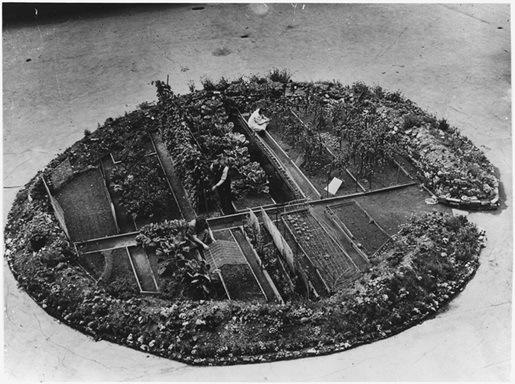
To support the food supply and supplement the increasingly strict rations, a ‘Dig for Victory’ campaign was launched by the Ministry of Agriculture in October 1939, encouraging families to grow and prepare their own food. Everyone was encouraged to turn their flower beds and lawns into vegetable gardens, ‘Victory gardens’. For this propaganda the Ministry even employed Disney cartoonists, who created such characters as Doctor Carrot and Potato Pete.

The Ministry of Food started publishing Food Facts pamphlets in 1940, and magazines, newspapers and daily radio programmes such as ‘The Kitchen Front’ and ‘the Radio Doctor’ were full of ideas and recipes to enable families to make the most of the weekly rations. One of the most significant contributors to this campaign was a New Zealander, Bee Nilson, whose efforts to encourage British householders to make the most of home-grown vegetables to make nourishing meals, despite the privations of war, resulted in an overall improvement of health standards across the population. ‘Rationing enabled the poorest sections of society to eat more protein and vitamins, which led to a substantial upturn in the health of the nation’. (Imperial War Museum)

Gail Pittaway is a writer and lecturer, now part-time, at Wintec, Hamilton, whose research interests include literature, food history, New Zealand cookbooks and garden design. This talk arises from her recently submitted PhD Thesis, A New Zealand Food Memoir, tracing a personal journey through food changes in the middle of the twentieth century. In this research she ‘discovered’ the work of Bee Nilson whom she considers an unacknowledged New Zealand food hero.

A Victory Garden in a bomb crater, London, Office of War Information (NARA record: 1138532)  

‘Fine specimens of nikau palm, fern trees and tai tai’: On early use of the ‘New Zealand palm’

by Mike Lloyd

[This blog is a repost from Mike Lloyd’s ‘The Local Arboretum: Noticeable trees and their stories‘ website]

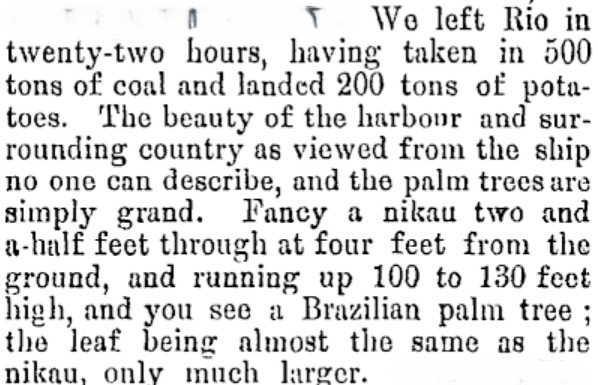
As I noted in the first post on the Arrowsmith Phoenix palms, a worldwide ‘palm craze’ spread among garden enthusiasts from the 1850s on.1 British migrants brought this with them to the colonies where they settled, including New Zealand. At times this led to an appreciation of the nikau (Rhopalostylis sapida), but relative to the palms that fascinated Europeans in their newly built palm houses (like the famous one at Kew), the nikau palm could easily be overlooked. Here’s an interesting travelogue where we can partly see this dynamic expressed:

This is taken from an 1884 letter to the editor of the Taranaki Herald, titled ‘A trip home in the S.S. Doric‘. It is very likely that the ‘Brazilian palm tree’ discussed was in the Rio Botanic Garden’s 750 metre long ‘Avenue of Royal Palms‘. Justifiably, this had worldwide renown though the palm planted there – Roystonea oleracea – actually originates in the Carribean. Evaluating the nikau in relation to it is an ‘apples and oranges’ kind of comparison, which the correspondent isn’t really encouraging. Perhaps he just wishes there were gardens like this in New Zealand, but for sure the mention of the nikau does at least show that New Zealand’s sole endemic palm had some significance for a New Zealander on their trip back ‘home’ (i.e., to England) as early as the 1880s.

Several years before the palm-interested correspondent made these comments, nikau plants and/or seeds were actually travelling about the globe. In September 1865 the Australian government botanist Ferdinand von Mueller wrote to George Grey requesting seeds of what he then called New Zealand Areca palms (Areca sapida being the original botanical name). Two months later he gratefully acknowledged receipt of both seeds and ‘living plants of this noble palm’, which he intended to distribute to interested enthusiasts about the globe.

Nikau seeds and plants were not the only thing travelling the globe in the late 1800s. After a visit in 1881 to New Zealand, Marianne North2 gifted the following artwork to Kew Gardens, London:

Source: ArtUK

By the time of this gift -1882 – nikau palms had been growing in Kew’s Temperate Palm House for a few years. New Zealand travellers, at least those who bypassed Rio, can be found well-pleased upon visiting Kew to find healthy specimens of nikau ‘quite at home’:

Early use of the nikau for decorative and ceremonial occasions

One of the commonest ways in which the nikau was used in New Zealand from the 1850s to the early 1900s was for decorative purposes. Probably, whole plants were not dug up, rather fronds were cut from nikau palms sourced in the ‘bush’. We’ll see some photos shortly, but searching Papers Past using the term ‘nikau palm decoration’ turns up many accounts of such decorative use. As early as 1859 the Nelson Examiner includes in a report on the laying of the foundation stone for Nelson College that

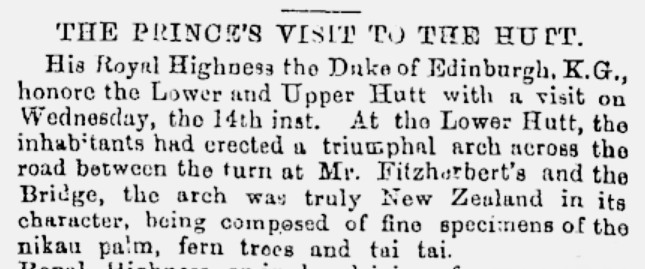
Nikau were obviously growing in Nelson during the reign of Queen Victoria (VR stands for Victoria Regina). Nikau were also growing in Lower Hutt as indicated by this extract from the New Zealand Herald, from which this blogpost’s title comes:

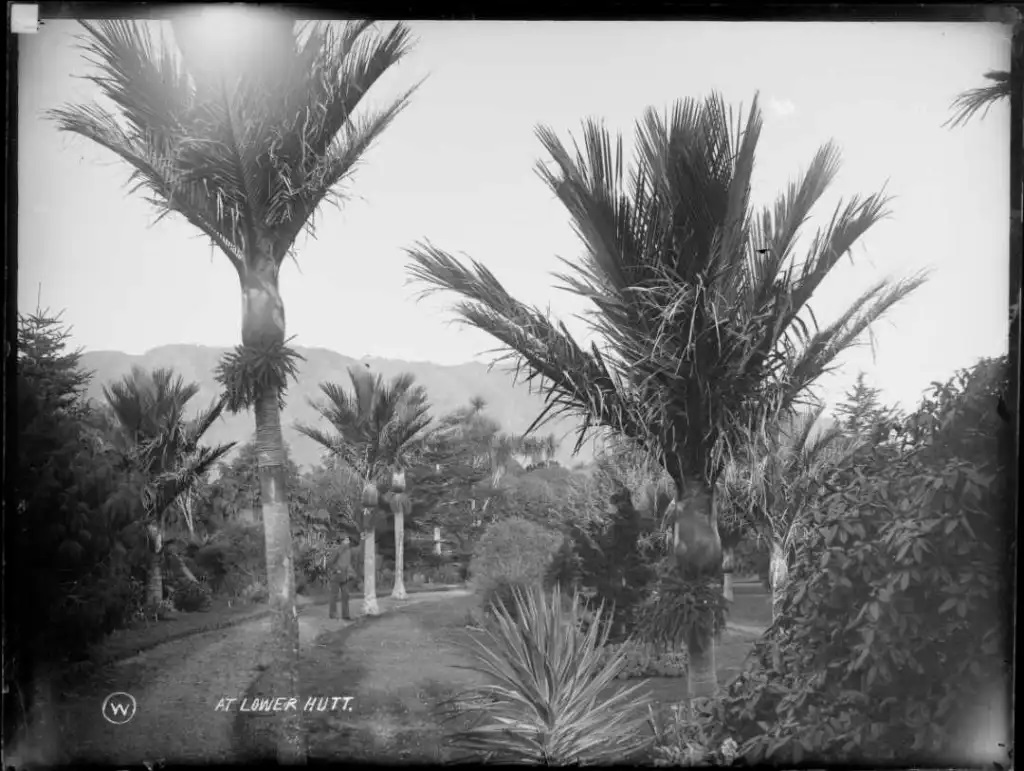
There are no available photos of this arch constructed for the Prince’s visit in1869, but there are many photos available of the remnant nikau palms from which the fronds were probably sourced:

Source: Nikau palm trees at McNab’s Gardens, Lower Hutt, Wellington Region. Williams, E. Ref: 1/1-025586-G. Alexander Turnbull Library, Wellington, /records/22785533

This photo was taken circa 1885, clearly showing nikau large enough to provide fronds for decorative arches. MacNab’s Gardens were originally the private gardens of Alfred Ludlam, who was a politician, farmer, and horticulturalist, as well as being a prime mover in the founding of the Wellington Botanic Gardens. Many of the nikau palms so liked by Ludlam survived the later transition to Bellevue Gardens, and then into the gardens of private residences (see NZ Tree Register). Recognising the status of these remnants the Hutt City Council district plan protects all remnant nikau; it is not known what happened to the ‘tai tai’ (toetoe).

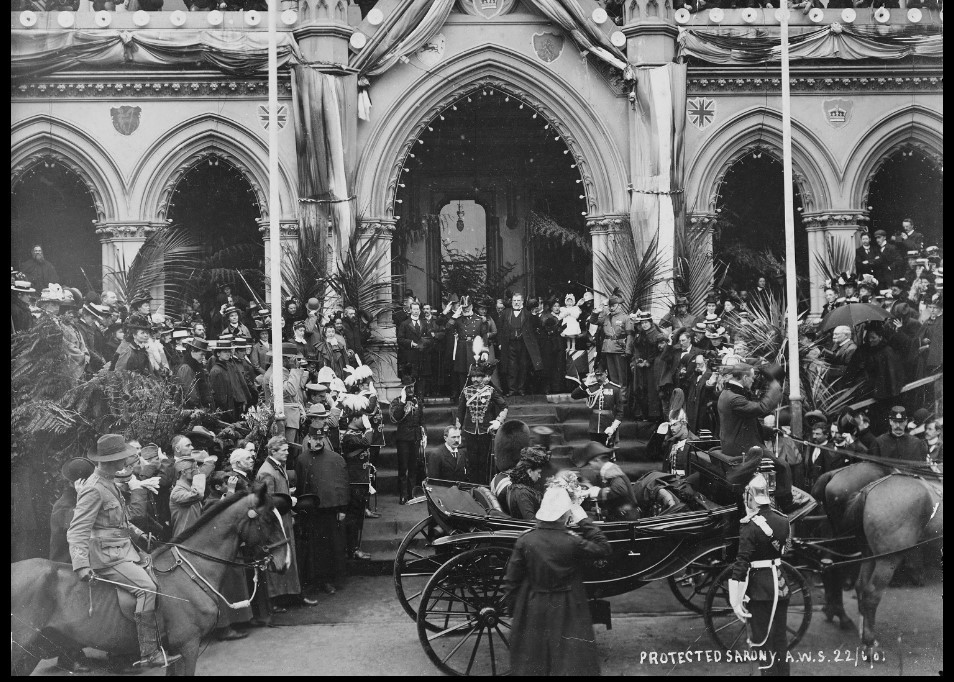
Given there are a good number of historic photos it is worth looking at a few examples to see how nikau (and other plants) were employed for decorative purposes. Here are a few presented in chronological order:

Source: Wellington’s Royal Reception Celebrations, June, 1901.Auckland Libraries Heritage Collections AWNS-19010628-04-02
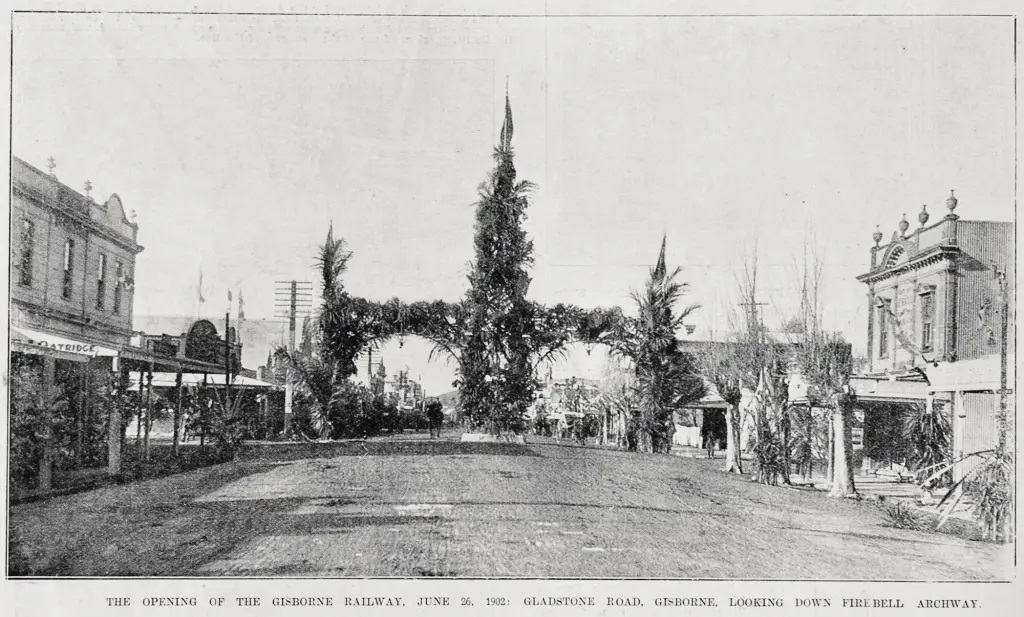
Source: Gladstone Road looking towards the decorated fire bell archway for the opening of the Gisborne-Auckland railway, 26 June 1902. Auckland Libraries Heritage Collections AWNS-19020710-12-02
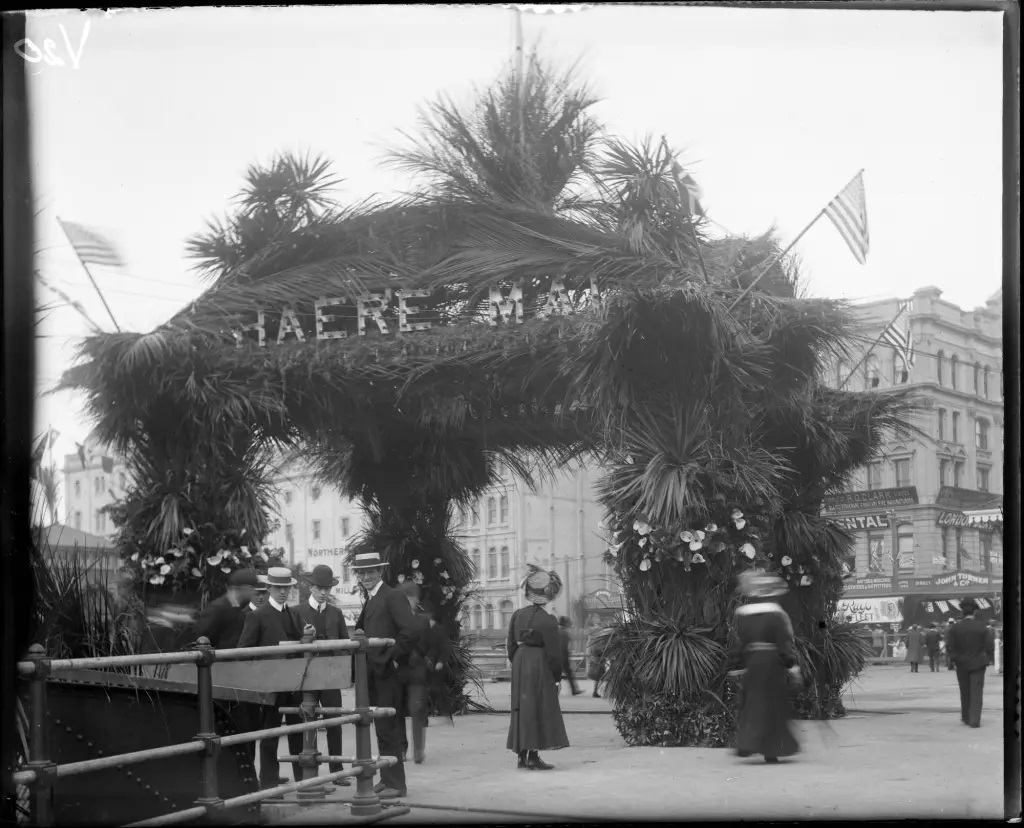
Source: Queens Wharf decorated for the American Fleet, 1908. Auckland Libraries Heritage Collections 2-V0020
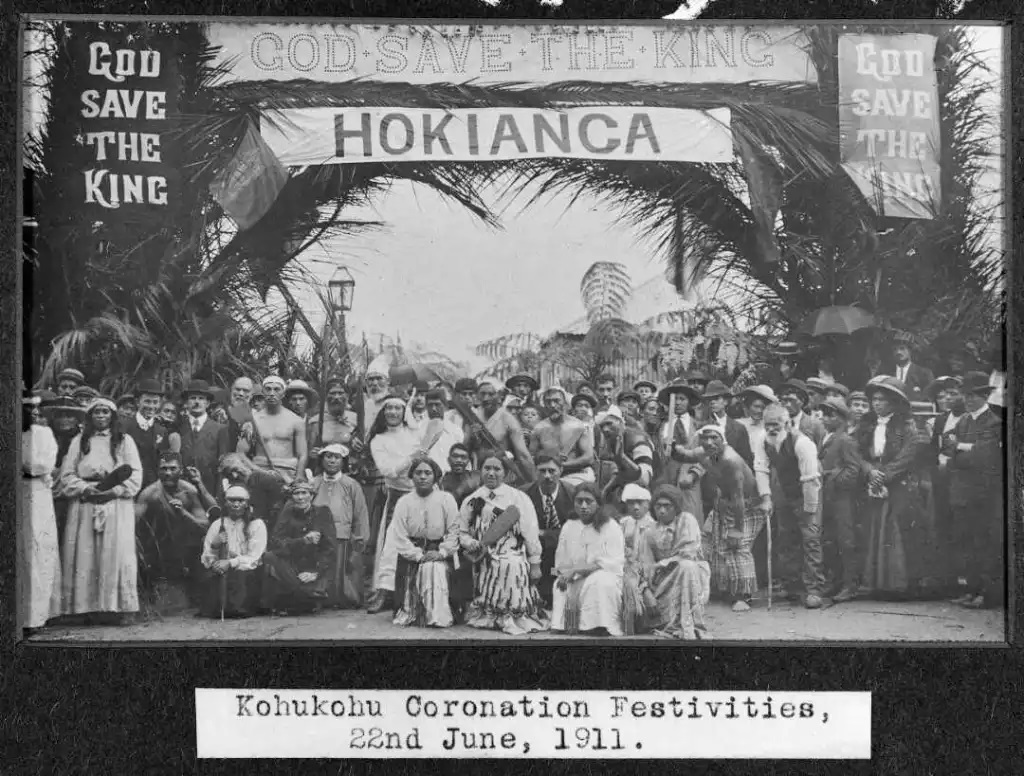
Source: Crowd at Kohukohu, celebrating the coronation of George V, King of Great Britain. Alexander Turnbull Library, Wellington. PAColl-5155

The use of nikau palm fronds as seen above were for decorations in highly ordered ceremonial occasions. It is not hard to imagine why the nikau fronds were chosen: in these places the palms must have been well-established in handy areas; they offered a large frond good for providing a spectacle; they were sturdy and could be easily attached via nails, rope or wire; and, of course, the fronds offered something truly New Zealand in character.

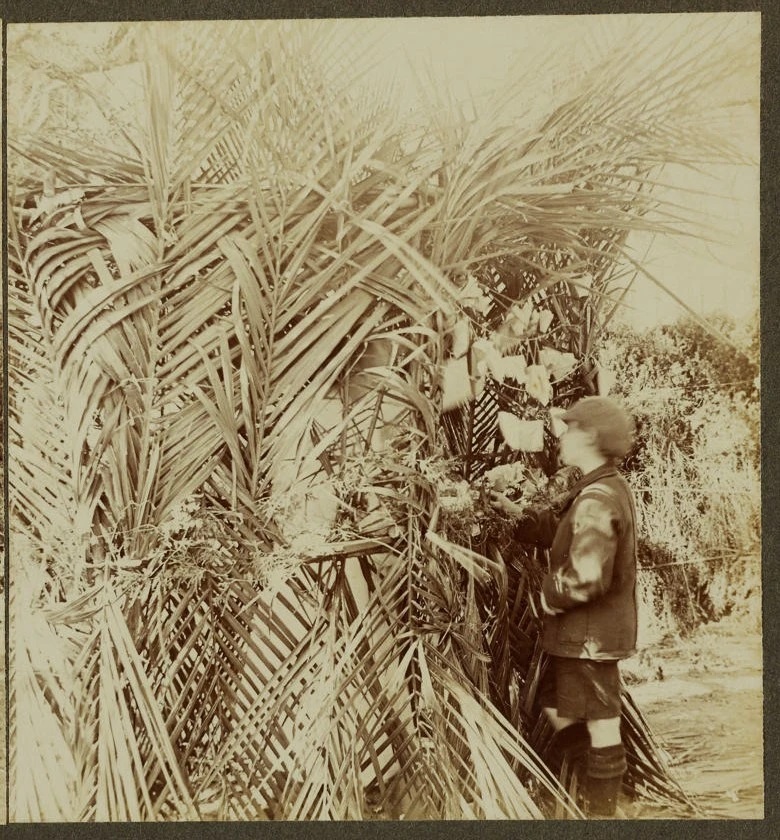
All this is not to forget that nikau fronds were also used in more prosaic occasions such as garden parties:

Source: Garden party at Titirangi, 1919. Auckland Libraries Heritage Collections TAB-P-0188;TAB-P-0190

These two final historic photos take us up to 1919 which is about when, in terms of actual planted palms, introduced exotics like the Phoenix palm came to dominate the use of palms in New Zealand amenity horticulture (at least in the North Island). Nikau were also planted from the 1900s, and the use of fronds for decoration continued, but it probably wasn’t roughly until the 1970s that the resurgence of interest in native plants resulted in higher rates of planting of nikau palms.

Now, walking around any major New Zealand city, sights of nikau growing and flourishing will be found. Here is an example just west of the Wellington railway station, looking up to the New Zealand Parliament buildings, where in 1901 nikau fronds were used as decoration:

Footnotes:

  1. It should be emphasised that this post does not specifically delve into Māori use of the nikau palm, which obviously pre-dates European colonisation of Aotearoa.
  2. For further discussion see: Michele Payne, 2015, Marianne North: A very intrepid painter, Kew: Kew Publishing.

What’s In a Name? Yarrow and the great Achilles

Annette Giesecke, Te Herenga Waka | Victoria University of Wellington

I tried to grow yarrow in my Pennsylvania woodland garden to no avail, but on my New Zealand plot, surrounded by orchards and pasturelands, it grows rampant, undeterred by drought or clay soil. A member of the Asteraceae family and native to temperate regions of the Northern Hemisphere, this handsome perennial plant reaches a height of up to 1 metre (3.5 feet); has fernlike, finely dissected leaves; and its flat or slightly convex flower heads, blooming from spring well into autumn, consist of clusters of small flowers. In the wild, its flowers range in colour from white to pink, but there are red, orange, hot pink, lavender, and yellow cultivated varieties available in garden centres.

Achillea millefolium, the flower of Achilles. Photo by Jitaeri. Image, Wikimedia Commons.

Known also in common parlance as ‘arrowroot’, ‘death flower’, ‘eerie’, ‘hundred-leaved grass’, ‘old man’s mustard’, ‘sanguinary’, ‘seven-year’s love’, ‘snake’s grass’, and ‘soldier’ – yarrow is interesting on so many levels. When established, it is hardy even in adverse conditions, and it is of significant value to wildlife. Its nectar-rich flowers attract butterflies, bees, and other insects, while its leaves, toxic to some animals (including dogs, as I have witnessed), are grazed by others and gathered by nesting birds. The whole plant has a distinctive, sharp odour, that can be described as a mixture of chamomile and pine, or chrysanthemum-like. To the taste, its roots are bitter. Yarrow has been used by humans for millennia as a medicinal plant, useful in treating a wide range of ailments ranging from headaches and indigestion to infections. It effectively staunches bleeding and repels mosquitoes as well. Yarrow also has applications as a fabric dye, yielding a range of yellow tints. And then there is its mysterious botanical name, Achillea millefolium, which translates as ‘Achilles’ thousand-leaved plant’. ‘Thousand-leaved’ is, of course, a reference to yarrow’s dissected leaves, but why is this the plant of Achilles, that ancient Greek hero famed for his exploits in the Trojan War?

In addition to being an extraordinarily effective warrior, Achilles had a range of other skills and talents, all in keeping with his unusual parentage and upbringing. He was the son of the sea goddess Thetis and Peleus, a mortal man. A prophecy had revealed that Thetis was destined to bear a son who would overpower his father, an event that would threaten the established divine hierarchy. For this reason, Zeus, king of the Olympian gods, offered Thetis in marriage to Peleus, a king of the northern Greek district of Phthia, for whom this was a reward. By some accounts, Thetis did not accept this arrangement willingly, causing Peleus to wrestle with her as she changed her shape to fire, water, and then a wild beast to elude his grasp (Apollodorus, Bibliotheca. 13.3). Peleus prevailed, and all the gods were invited to the couple’s wedding… all but one. Only Eris, goddess of strife was excluded. Her presence on this festive occasion, it was thought, would only bring misfortune. Misfortune befell the festive gathering nonetheless, as an angry Eris appeared bearing what would prove to be a fateful wedding gift: a golden apple labeled ‘for the fairest’. Loveliest of the goddesses were Hera (queen of the gods), Athena (goddess of wisdom and defensive war), and Aphrodite (goddess of love and desire), and all three, equally beautiful, laid claim to this golden prize. As no god dared to make this choice, it was agreed to leave the decision to Paris Alexander, the prince of Troy, whose reputation as a lover was well known. Not leaving the outcome of this contest to chance, each goddess offered Paris a bribe. Hera promised that she would make him king of all men, while Athena offered him success in war. Aphrodite, however, knew him best and offered him Helen, the most beautiful woman in the world. It was she who was awarded the golden apple.

In the course of time, Paris traveled to Greece and, while being hospitably entertained in Sparta, made off with Helen, that kingdom’s queen. This was an affront that King Menelaos, Helen’s husband, could not bear, and with his brother Agamemnon, king of Mycenae in the lead, assembled the bravest and strongest men of Greece. A fleet of one thousand ships then sailed to Troy, their purpose being to retrieve Helen, a goal not easily achieved as Homer’s Iliad and Odyssey reveal.

Between Paris’ fateful judgment and his theft of Menelaos’ queen, some fifteen years had passed. Soon after the wedding of Peleus to Thetis, Achilles was born to them, and although half-divine by birth, he was destined to die an early death, as a prophecy foretold. His distraught mother attempted to make her infant immortal, holding him by the ankles and dipping him in the magical waters of the dreaded river Styx. This left him invulnerable, except on his ankles where his mother had held him fast.

While a young child, Achilles, like several other Greek heroes, was sent to live with and be educated by Chiron, a very special centaur. Others were Jason, who went to fetch the famed Golden Fleece; Hercules, renowned for his 12 Labours; and Asklepios, the god Apollo’s son who would become a god of healing. From Chiron, Achilles learned how to hunt, how to play the lyre, and, of particular relevance to yarrow, how to use herbs in healing.

The centaur Chiron teaching Achilles how to play the lyre. Roman fresco from Herculaneum, National Archaeological Museum of Naples, 1st century CE. Image, Wikimedia Commons.

When grown, Achilles would join the Greek forces who fought for the return of Helen, in the course of battle displaying extraordinary cruelty—especially towards Hektor, Troy’s brave and kind defender, a wholly decent, honourable man—but also extraordinary compassion towards his wounded comrades. In Homer’s Iliad, one particular wounded warrior, Eurypylos by name, was not attended to by Achilles himself but by Achilles’ closest friend, whom he, in turn, had instructed in the art of healing. Eurypylos had pleaded for Patroklos’ help, saying:


“Please, I beg of you, lead me to my dark ship, and cut this arrow from my thigh. Warm water will wash away the blackened blood, and then sprinkle good, soothing medicines (ēpia pharmaka esthla) upon it, just as people say Achilles taught you”. (Iliad XI. 828-31)


What, exactly, this good, soothing medicine consisted of is not stated here, but the following lines offer a significant clue:


“Patroklos lay him down, and cut the piercing arrow from his thigh, washing away the dark blood with warm water. And he placed a bitter root upon the wound, first rubbing it with his hands, a root that kills pain (rhizdan pikrēn) and that put an end to all his suffering. The wound was dry, the bleeding stopped”. (Iliad XI.844-48)

Homer did not name this bitter root, but yarrow’s root is bitter, and the plant has analgesic (painkilling) and hemostatic (blood-stopping) properties as well.

The Iliad is conventionally dated to about 750 BCE, and it would be more than 700 years later that Roman encyclopedist Pliny the Elder, author of a multi-volume Natural History (first century CE), provided the next clue: “Achilles, too, the pupil of Chiron, discovered a plant which heals wounds, and which, as being his discovery, is known as the ‘achilleos’ [plant of Achilles].” Yet Pliny proceeded then to identify this plant with one very different from yarrow, writing:

“By some persons this plant is called ‘panaces heracleon’, by others, ‘sideritis’, and by the people of our country, ‘millefolium’: the stalk of it, they say, is a cubit in length, branchy, and covered from the bottom with leaves somewhat smaller than those of fennel. Other authorities, however, while admitting that this last plant is good for wounds, affirm that the genuine achilleos has a bluish stem a foot in length, destitute of branches, and elegantly clothed all over with isolated leaves of a round form. Others again, maintain that it has a squared stem, that the heads of it are small and like those of horehound, and that the leaves are similar to those of the quercus—they say too, that this last has the property of uniting the sinews when cut asunder. Another statement is that the sideritis is a plant that grows on garden walls, and that it emits, when bruised, a fetid smell; that there is also another plant, very similar to it, but with a whiter and more unctuous leaf, a more delicate stem, and mostly found growing in vineyards”. (Natural History 25.19, adapted from John Bowersock trans. 1855. London: Taylor and Francis)

Pliny offered several plants as candidates for Achilles’ plant. One is sideritis (‘mountain tea’), a group of plants in the mint family that don’t remotely resemble yarrow physically but that do have medicinal properties. Another is ‘panaces heracleon’ (‘Hercules’ cure-all’, Opopanax chironium), a yellow-flowering herb that grows 1-3 metres in height but that likewise has medicinal applications. Did Pliny confuse these two with the plant that, much later, with the advent of standardized scientific botanic nomenclature, would be called Achillea millefolium? Or, were all three simply known as ‘Achilles’ plants’ in antiquity? All we can say is that it was Achilles’ reputation as a healer of battle wounds that inspired the choice of yarrow’s scientific name by Carl Linnaeus in the 18th century.

Achilles tending Patroclus wounded by an arrow, identified by inscriptions on the upper part of the vase. Interior of an Athenian drinking cup, ca. 500 BCE attributed to Sosias as painter. From Vulci. Image, Wikimedia Commons.

*All translations of ancient texts are by the author unless stated.

Modern Sources:

Christopher Brickell and Judith D. Zuk (eds.). 1996. The American Horticultural Society, A to Z Encyclopedia of Garden Plants. New York: DK publishing.

David J. Mabberley. 2014. Mabberley’s Plant-book: A Portable Dictionary of Plants, their Classification and Uses 4th Edition. Cambridge: Cambridge UP.

Annette Giesecke. 2020. Classical Mythology A to Z: An Encyclopedia of Gods & Goddesses, Heroes & Heroines, Nymphs, Spirits, Monsters, and Places. New York: Black Dog and Leventhal.

Herb Federation of New Zealand: https://herbs.org.nz/herbs/yarrow-international-herb-of-the-year-2024/

Ship Figureheads as Statuary in New Zealand Gardens, Part 1: The Hydrabad

by Ian Duggan

A number of newspaper reports can be found of the figureheads of ships adorning not their expected vessels, but New Zealand gardens as items of statuary through the early 20th Century. This blog covers one such example, the figurehead of the Hydrabad (commonly incorrectly spelt as “the Hyderabad”, after the city in India), a ship that was wrecked on Waitārere beach on the Horowhenua coast in 1878.

On her sea trials off Glasgow 1865. Original oil painting on canvas. 1800 x 1100mm. Provided by Kete Horowhenua.

What is a figurehead? The Royal Museums Greenwich provide a great overview, at this link, which I provide a brief summary of here. Figureheads are decorative carved wooden sculptures, most frequently female, that decorated the prows of sailing ships. These were said to embody the “spirit of the vessel”, and were considered by the crew of the ships to be lucky charms. A range of subjects were depicted on the figureheads, with many representing a member of the ship-owner’s family or of the owner himself, while others depicted historical figures or an influential individual from contemporary society. Evidence of the use of figureheads dates back to around 3000 BC in Egypt, but while they were a common feature on ships during the sailing age, their use had largely died out by the end of the 19th Century.[i]

Indeed, Wellington’s Evening Star noted in 1911 that, at that stage: “The likeliest place to find a ship’s figurehead nowadays is… in a suburban tea garden. Certainly there are few ships afloat [now] which carry them”.[ii]

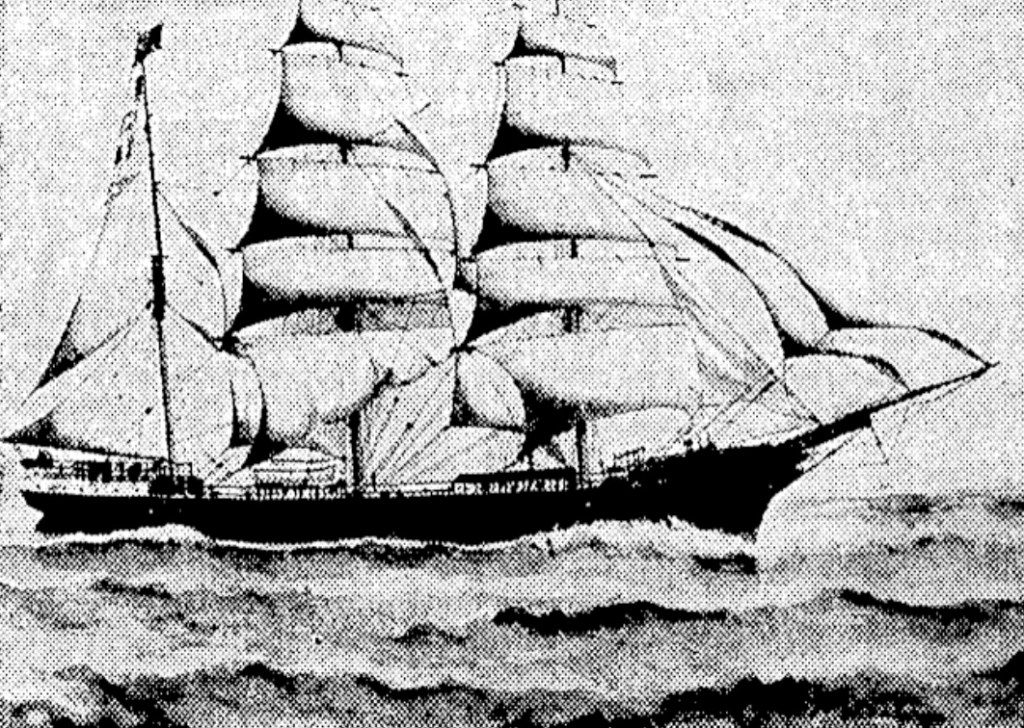
The figurehead of the Hydrabad is one that has gained the most attention in New Zealand newspapers. The Hydrabad was a three-masted iron ship built in Glasgow, Scotland, in 1865, which primarily operated as a cargo vessel between England, Australia and India. However, she was wrecked on the Horowhenua Coast in June 1878, while on her way between Lyttleton and South Australia. At the time she was carrying a cargo of broad-gauge Canterbury railway locomotives and components declared surplus in New Zealand, due to the national standardisation of railway infrastructure[iii]; Canterbury had been building its railway using a 5′ 3″ gauge, whereas the New Zealand government’s public works stipulated that the gauge must not exceed 3′ 6″[iv]. The locomotives were thus destined for use in South Australia.[v]

Figurehead in the garden of A. Jonson. [from Church, I. (1978). The Wreck of the Hydrabad. Dunmore Press Ltd, Palmerston North].

The wreck of the Hydrabad was sold to a Mr Liddell, who bought the figurehead and the vessel’s cannon, taking them to Foxton. On arrival in the town, “both figurehead and cannon were deposited in Mr. Liddell’s yard… in Clyde Street. For many years they lay there until they were acquired by… Mr. A. Jonson and removed to Avenue Road”.[vi]

Skip forward a number of years, and in 1896 the Manawatu Herald reported that Mr Andrew Jonson “long had erected in his garden on the Avenue Road the old figurehead of the Hydrabad”.[vii] And the figurehead appeared to remain in his garden for a long period thereafter. For example, in 1907, it was stated that:

“In the centre of a garden plot in front of a cottage at Foxton is a brightly painted piece of well executed statuary. It is the figure enlarged to far more than life size of an Indian Rajah, dressed in full regalia, with scimitar, and hand uplifted in a threatening attitude. The legs are cut away, but the carving from the knees upwards, and the fierce expression on the black-bearded face of the Eastern potentate, are admirably executed”.

It continued, “The owner, Mr Jonson, narrates in connection with it a story of adventure. Nearly, half a century ago it formed the figure-head of a splendid steam yacht of 1800 tons, built… for the Rajah of Hyderabad. The figurehead, carved from Baltic pine, represented the owner, and for a number of years he took charge of the vessel, the Hyderabad [sic], travelling over the Indian Ocean. Eventually the vessel fell into the hands of Captain [Charles James] Holmwood, by whom it was sailfully navigated until, while laden with railway rolling stock, its career was ended during a storm, when it was stranded about four miles from the mouth of Manawatu river. In this way the fine carving fell into the hands of a Foxton resident, who prizes it highly”.[viii]

Jonson’s story may be somewhat embellished, however. The vessel was actually constructed for the Bombay Iron Shipping Company (in present day Mumbai).

Mr Jonson passed away in 1917, at the age of 75. The Manawatu Standard noted that he was a well-known builder and undertaker in Foxton. His residence in Avenue Road, we are told, “is well known in Foxton, and was of special interest to visitors from the fact that in the front garden was the figurehead consisting of an Indian chief, of the ship Hyderabad [sic]”. Nevertheless, it was also noted that “Some time ago the figurehead was presented by Mr Jonson to the Foxton Borough Council, to be placed in one of the local reserves”.[ix]

So, had the Council taken possession of it? In 1929, we hear a different story: “After remaining for many years at Foxton, the figurehead of the Hyderabad [sic], which lies on Hokio Beach, is to be sent to Auckland to the naval base there at the request of the Commander of HMS Philomel, who is making a collection of old figureheads. The figurehead of the “Hyderabad” [sic] has been in the garden of Mrs Andrew Jonson, in the Avenue at Foxton, since it came into possession of her late husband at the time the vessel was dismantled”. Nevertheless, “Mrs Jonson has given her consent to hand over the figurehead to the naval authorities for safe keeping”.

After so many years in the garden, however, the figurehead by this stage was looking a little worse for wear: “Long exposure to weather has robbed the figurehead of its pristine beauty, but when restored to its original adornment, it will make one of the most interesting exhibits in the collection”.[x]

Did the figurehead finally make it out of the garden, to the safety of the naval base in Auckland? Again, it appears that it still didn’t go anywhere. And this was unfortunate, for in 1933 the Manawatu Standard gave a sad update on the Hydrabad’s figurehead:

“Many of the older residents of the district will learn with regret the disappearance from Foxton of that interesting relic of one of the most remarkable wrecks on this coast, the figurehead of the Hyderabad [sic], which for the past half-century has always been a source of interest to visitors to the town. For the past thirty years the figurehead, a representation of an Indian rajah with turbaned head and drawn scimitar, occupied a prominent position in the garden of Mrs A. Jonson, of Avenue Road. Standing between twelve and fifteen feet high, it presented a striking sight in its gaily painted robes, but with the passage of time and the ravages of the elements this finely executed carving has gone the way of most woodwork, and, badly rotted throughout, it was last week felled and cut up for firewood”.[xi]

A Mr H. Coley, of Foxton, was subsequently interviewed, and stated that: “A year or so ago the naval authorities at Devonport, Auckland, made inquiries about the figurehead of the Hyderabad as it was desired to include it amongst the collection at the Auckland naval base. Mrs Jonson then gave her sanction to its removal, but, unfortunately, nothing further was done….”.[xii]

Shipwrecked ship “The Hydrabad” at Waitarere beach, looking from south to north on the seaward side. credit: Horowhenua Historical Society Inc.


Final confirmation of the circumstances of its destruction was reported in 1935: “Light has been shed upon the fate of the figurehead of the ship Hyderabad [sic], the remains of which lie on Waitarere Beach, where she was wrecked many years ago. Captain Baggett, of the motor-vessel Foxton, said in an interview in Wellington that, after the death of the householder who owned the figurehead, his home was occupied by a family the members of which were unaware of the history and value of the strange relic that stood in the garden. Accordingly they chopped it up for firewood. An attempt was made by a prominent Foxton man to save the figurehead, but he arrived too late to prevent its destruction”. 

At least ten other ship figureheads have been reported in New Zealand newspapers as having decorated gardens, and some of these will be covered in future blogs.

Read Part II here: The Wolverine

Read Part III here: The America, the Helen Denny, and others

REFERENCES


[i] Ship figureheads and decoration, Royal Museums Greenwich. https://www.rmg.co.uk/collections/ship-figureheads-decoration

[ii] Shipping. Evening Star, 29 September 1911, P8

[iii] Hydrabad (1865-1878) Wreck Site, Waitarere Beach, Levin. Heritage NZ.  https://www.heritage.org.nz/list-details/9559/Listing

[iv] Church, I. (1978). The Wreck of the Hydrabad. Dunmore Press Ltd, Palmerston North.

[v] Hydrabad (1865-1878) Wreck Site, Waitarere Beach, LEVIN. Heritage NZ.  https://www.heritage.org.nz/list-details/9559/Listing

[vi] Figurehead of the Hydrabad Demolished. Otaki Mail, 24 April 1933, Page 4

[vii] Manawatu Herald, 26 September 1896, Page 2

[viii] Poverty Bay Herald, 24 October 1907, P4

[ix] Manawatu Standard, 18 October 1917, P4

[x] Daily Chronicle, 11 July 1929, Page 4

[xi] Loss of the Hyderabad. Manawatu Standard, 27 March 1933, P7

[xii] Loss of the Hyderabad. Manawatu Standard, 27 March 1933, P7

A Battleship in the Garden? Unusual Auckland Garden Features from the 1930s

by Ian Duggan

While garden features such as arches and goldfish ponds have been popular and widespread in New Zealand private gardens, some have been more unique. For a short period between the First and Second World War, for example, the newspapers reported on a couple of Auckland residences whose gardens featured ships!

The first, reported in the New Zealand Herald in January 1937, rightly recognised the nautical feature as an “Unusual decoration for the garden”. Little detail was provided about the feature piece, however, except that it was a ship model in the garden of a Mr. W. Freeman, Allendale Road, Mount Albert. The hull consisted largely of border plants, while an ornamental shell provides the bridge”.[i] Beyond that, examination of the photograph shows the ship also featured masts and what appears to be drainpipes for its twin funnels.  

An Unusual Feature in the Garden. New Zealand Herald, 21 January 1937, Page 6

Hot on the heels of Freeman’s ship came a remarkably similar vessel in another garden only a little over five kilometers away. In April 1937, the Auckland Star noted that “There is no limit to garden attractions”.

“Some industrious people cut their hedges and shrubs in various ways to represent figures or objects, but something entirely different in the decorative line has been achieved in the garden in front of the home of Mr. David Kasper, at Titirangi Road, New Lynn. There the taste has been nautical, and a land battleship has been created”.

Here, we are treated to some detail on the ships’ construction:

“In the first place the shape of a battleship, on a miniature scale, was marked out on the front lawn, and then the soil was built up to a height of about two feet. A grey rock-plant was grown on the sides of the “hull”, and the necessary nautical and warlike trimmings were added. Two steel rods have been used for the masts, and a light wire, suspended between them, makes an impressive aerial. The funnel is a drain pipe, painted yellow, with a buff top, and set at a rakish angle “amidships.” There are iron davits “amidships” on the side of the “hull.” The boats are hanging baskets of greenery”. [ii]

An image was provided in the next day’s paper, adding that the “grey rock plant gives the hull a distinctive naval touch” [iii]

Hard Aground. Auckland Star, 29 April 1937, P9

As with any garden, however, the ship didn’t look after itself:

“Just like the nautical battleships which do go to sea, the New Lynn “warship” requires many an overhaul. Weeds will persist in growing on the “quarterdeck,” and as docks and plantain, or even green paspalum would be strangely out of place in such a setting, the “crew” have a fairly busy time”.[iv]

Kasper’s ship remained in situ for at least a number of months afterwards. In August 1938, almost a year and a half after the previous report, another image of the vessel appeared in the Auckland Star where it was reported:

“Quaintly decorated with border plants, this model battleship, in a garden fronting on Titirangi Road, New Lynn, always attracts the attention of passers-by”.[v]

The photograph indicates that the design of the ship had evolved since the previous year, with the addition of life rings to the sides, railings, and what appears to be a steering wheel on the bridge.

Model Battleship. New Zealand Herald, 26 August 1938, Page 6

These snippets throw up a number of questions. How long did these garden ships persist? I can’t find any mentions in the newspapers of them after August 1938. Did the idea of a battleship in the garden lose some appeal with the impending war? From these reports, was anyone else inspired to construct sea-going vessels in their front yards, or were they unique to these two gentlemen? Indeed, were Kasper and Freeman friends? They only lived around five kilometers apart, and their designs appear to possess some common features. Interestingly, I can’t actually find any records of David Kasper outside of this article, even though we are provided with his full name. Not even a record of birth, marriage or death. So, who were these mystery people, and what inspired them? The answer to that question is, unfortunately, likely lost to the mists of time.

Postscript: Slightly post-dating both of these ships is the ‘Floral Ship’ on The Strand in Tauranga, constructed in 1938. I wonder if Kasper and Freeman’s ships provided inspiration for that one, which can be read about on the Historic Tauranga website, here, and from the Tauranga Historical Society, here?

References


[i] Unusual Decoration for the Garden: A Ship Outlined in Flowers. New Zealand Herald, 21 January 1937, Page 6

[ii] Hard Aground: Land Battleship in Suburban Garden. Auckland Star, 28 April 1937, Page 10

[iii] Auckland Star, 29 April 1937, Page 9

[iv] Hard Aground: Land Battleship in Suburban Garden. Auckland Star, 28 April 1937, Page 10

[v] New Zealand Herald, 26 August 1938, Page 6