
by Ian Duggan
Most commonly found growing in bogs – that is, waterlogged wetlands with low nutrient concentrations – carnivorous plants differ from carnivorous animals in that they don’t obtain energy from their prey. Like any other plant, they still need to get that from the sun via photosynthesis. What carnivorous plants do need to obtain from their prey, however, is nutrients, which they acquire via the trapping and consumption of animals such as insects and other invertebrates.
New Zealand has its own native carnivorous plants. The sundews trap their prey with sticky hairs on their leaves, while the bladderworts – as the name suggests – have ‘bladder’ like traps. The most familiar carnivorous plant to most of us though is not a native, but the Venus fly trap (Dionaea muscipula), native to the bogs of North and South Carolina, U.S.A., which have likely been the most cultivated and kept carnivorous plants in New Zealand.
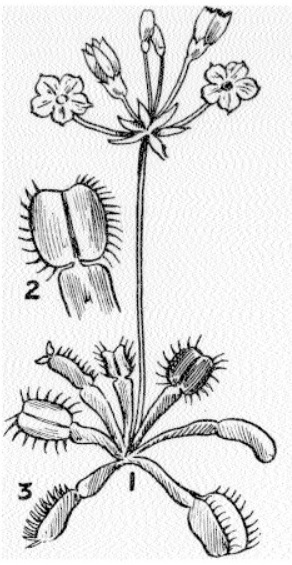
Various colourful descriptions of the Venus fly trap can be found in New Zealand newspapers going back to the 1850s[i]. In the Nelson Evening Mail in 1894, for example, it was noted that “when its peculiarities were described in a paper to a European scientific society it was considered a joke.”[ii] Various newspaper reports in the 1930s describe it as “a deadly little oddity… Shaped like a half-opened oyster, the free edges armed with teeth”.[iii] Some time later, in a 1943 Ashburton Guardian article, it was likened to “a vegetable reproduction of that horrible instrument of torture used by the Spanish Inquisition, the Iron Maiden”[iv]. It is hard to believe any reader could have accurately guessed what the plant looked like from these descriptions. The occasional image could be found, however. A drawing was included in New Zealand Graphic magazine in 1907[v], and in 1910 the same publication provided a photo of a plant under the hyperbolic title: “A man-eating Venus fly trap”[vi]. Pictures were few and far between, nevertheless.
Advertisements for the plants began to appear regularly in Christchurch newspapers from the 1970s, and it is on these ads that I primarily focus here; Christchurch’s ‘The Press’ has its content featured in PapersPast well beyond the 1950s, when coverage of most of the rest of the country’s newspapers cease, so it is here we can most easily get our teeth into the advertising methods used for the plant. On what terms were the plants described by potential sellers?
An early advertisement, from 1970, starts simply and is to the point: “This amazing and incredible plant actually catches flies and eats them too! See these amazing fly catching, fly eating plants at Zenith’s Drive-in Nursery…”. Zenith’s noted that their plants were “Specially imported”, and that the “supplies [were] limited”, suggesting the plants were not readily available in New Zealand at this time. Despite this, they were obtainable for the low cost of $1.25 each.[vii]

Soon, the carnivorous nature of the plants was tied into popular culture, with advertisements from the 1980s making parallels with the 1975 Steven Spielberg film, ‘Jaws’. In that movie, a man-eating Great White Shark attacks beachgoers at the summer resort town of Amity Island. Cashmere Downs Nursery were early adopters of the man-eating vs fly-eating comparison, noting in 1982 that the Venus Fly trap was the “Jaws of the Plant World”.[viii]
These pop-culture comparisons were greatly expanded in 1984. Now it wasn’t only “the ‘Jaws’ of the plant world!!”, it was also described by Zenith’s as being “The most amazing plant in the world… like a piece of science fiction right in your own home!!”[ix]

This sci-fi comparisons continued, and I diverge here momentarily from the advertisements, with press for the musical ‘Little Shop of Horrors’, which was performed in Christchurch in late 1985 and early 1986. Initially a 1960 film, ‘Little Shop of Horrors’ had experienced a resurgence in the 1980s through the “horror comedy rock musical”, which premiered off-Broadway in 1982. A picture from the Press shows “Lorraine North, a promotions officer for the Court Theatre”, who, as described by The Press, “is gobbled up by Audrey II, the carnivorous Venus Fly Trap plant”[x]. The musical was further popularised when it was adapted into a film in 1986 by Frank Oz.

Other advertisements from Zenith’s through the 1970s focussed on the plant’s “Strange and Mysterious” nature.


Adding confusion to the advertisements, however, were the sale of a completely different “Venus Fly Trap”, “for [the] war on flies”. These new Venus Fly Traps, marketed by Arthur Yates and Company, Ltd, were not a natural, but an engineered solution to the fly problem: “Despairing housewives armed with rolled newspaper and fly spray are shooting down squadrons of black buzzing nuisances, only to be greeted an hour or two later by another airbourne invasion. However, this season some very effective fly traps have been developed”…. ”the flies enter the trap at the top and fly downward into the bait which is at the bottom of a large jar. When the jar is full, the top unscrews, and the flies can be disposed of”.[xi],[xii]

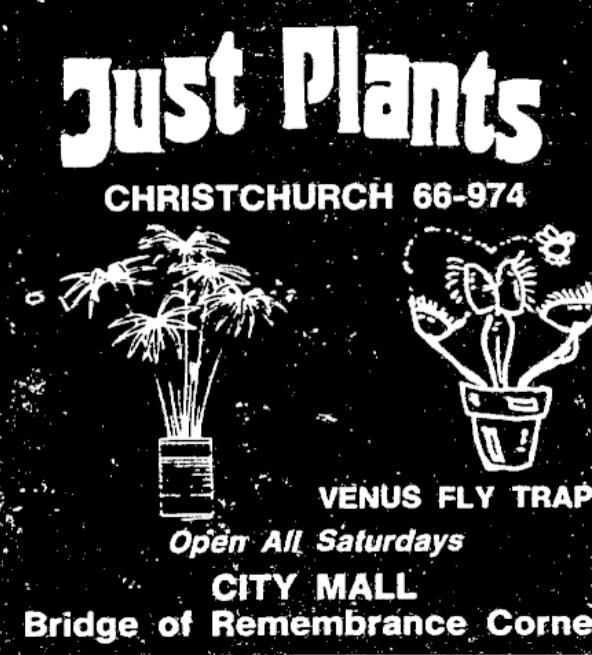
It will be interesting, when they come more readily available, to see how advertising differed in the other major centers. In the meantime, some further advertisements from Christchurch:

References
[i] Influence of Light and Warmth on Plants. Daily Southern Cross, 4 October 1853, P4
[ii] Marvels of Carnivorous Plants. Nelson Evening Mail, 12 January 1894, P4
[iii] An Armoury of odd facts. Evening Post, 7 August 1937, P27
[iv] Ashburton Guardian, 31 December 1943, P2
[v] Insectivorous Plants. New Zealand Graphic. 7 September 1907, P22
[vi] A man-eating Venus fly trap. New Zealand Graphic, 23 February 1910, P40
[vii] Advertisements, Press, 31 January 1970, P30
[viii] Advertisements, Press, 2 October 1982, P24
[ix] Advertisements, Press, 22 December 1984, P14
[x] Press, 5 December 1985, P28
[xi] Two new weapons for war on flies. Press, 17 December 1975, P9
[xii] Advertisements, Press, 31 October 1975, P18
Acknowledgements
Cover Image by Mark Pellegrini, licensed under the Creative Commons Attribution-Share Alike 2.5 Generic license.

 The Garden History Research Foundation
Bravo, a most enjoyable read!
LikeLiked by 1 person