
by Mike Lloyd
As described in a previous blog[1], Phoenix canariensis is well distributed in New Zealand, particularly in the North Island. Generally, the common name ‘Phoenix palm’ is used, perhaps because it is shorter than the alternative ‘Canary Island date palm’. Interestingly, ‘Monte Carlo palm’ is sometimes used, but usually only in the Nelson region. There are grounds to believe that this localised usage has much to do with one man – Percy Adams (1854-1930). It is well known that Adams donated Monte Carlo palms for planting in Nelson, but exactly why they were called such has gone uncommented. Luckily, there is an important resource that sheds some light on this question: Adams’ 52-page life memoir.[2] This tends to be impressionistic rather than chronologically specific, but there is enough detail to suggest that the Nelson-specific use of ‘Monte Carlo palms’ was strongly connected to Percy Adams. One reason for detailing this here is the sad twist of fate that befell the palms planted by Adams in his family home ‘Melrose House’.
Born in Marlborough, Percy Adams’ station-owning family moved to Nelson where his father established a legal practice. Percy did well at Nelson College (1867-1871) and in 1872 enrolled at Trinity College, Cambridge. After graduating he studied law in London, qualifying as a barrister in 1877, and upon his return to Nelson worked in his father’s law firm. His appetite for foreign travel remained strong, and after 1881 when he married Francis Watt they travelled extensively together. Francis had inherited Melrose House (built in 1879), and they had one son (Noel).[3] The Adams were a very wealthy family, and with substantial land at his disposal Percy soon gave attention to developing a garden, something in keeping with the tradition of wealthy Victorian gentlemen collecting plants and being interested in horticulture.[4] This continued after Francis’ early death aged 45 in 1905.
In his garden Percy displayed a liking for both ‘cabbage palms’ (i.e., Cordyline species) and a variety of true palms. Figure one shows this quite clearly (all photo credits in acknowledgments).
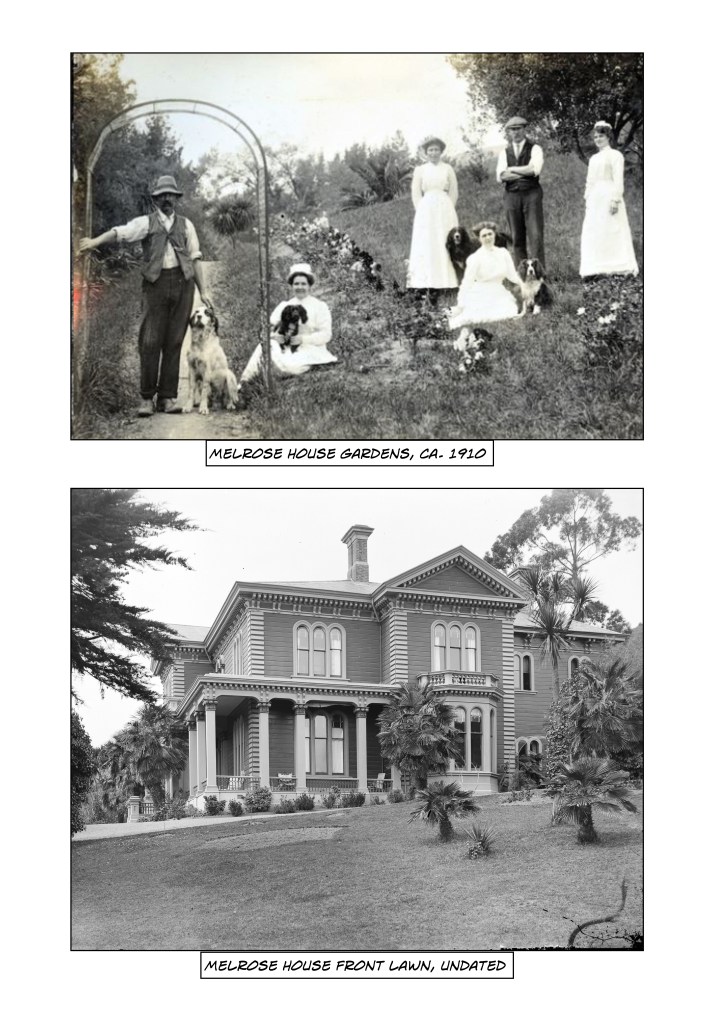
In the top panel, dated circa 1910, the two men are Percy (in cap), and his gardener Joseph Busch (the women are unknown, but at least two are likely to be servants). In the centre background, amongst the other trees and shrubs, is a young Phoenix canariensis. This shows that Percy was planting the palms in the Melrose House gardens in the early 1900s, which makes them amongst the earliest planting of the palms in New Zealand (it is most likely that the oldest Phoenix palms in New Zealand are in Auckland). The second photo shows Melrose House, possibly in the 1920s, with the garden featuring several ‘fan palms’, another palm he favoured (accounts have many mentions of ‘Japanese fan palms’, Livistona chinensis). Interestingly, the small plant in the forefront of the two smaller fan palms, may be a ‘cabbage palm’, or a very young Phoenix canariensis (see below).
Perhaps influenced by the still underdeveloped nature of New Zealand towns and cities, alongside establishing his own garden Percy donated many plants for the beautification of Nelson.[5] Most well-known is his gift of 20 Monte Carlo palms for planting in a reserve originally known as ‘Milton’s Acre’, renamed Anzac Park in 1915.[6] The palms are still there today, providing a good example of how spectacular an avenue of Phoenix palms can be. Figure two shows some early images of the park.

The top photo, probably taken about 1920, shows a young 2 metre high palm. The second, carried in the Auckland Weekly News, is captioned ‘IN A SOUTH ISLAND “GARDEN CITY”. Picturesque Monte Carlo palms and thick beds of flowers make a wonderful display in Anzac Park, Nelson’. Even though the photo is published in an Auckland newspaper where the palms are generally known as Phoenix palms, they are described via the Nelsonian usage, i.e., Monte Carlo palms. This usage can be found as early as 1903: in a long article titled ‘tree-planting and vandalism’, it is noted that, ‘It may not be generally known that a large number of the beautiful palms that grow about Monte Carlo have been brought here in seed and taken most kindly to the soil, showing considerable growth in a year… they are available to the city as a free gift if only they be permitted to remain when put in’.[7]
Whereas Percy was recorded as the donor of Monte Carlo palms, there is no explicit record of him having sourced these seeds himself. Nonetheless, it is reasonable to think this may be the case: first, Percy and his gardener were planting them at Melrose House from the early 1900s; second, very few Nelsonians would have sufficient wealth to travel to Monte Carlo. The latter is something Percy did indeed do, as recorded in his life memoir: ‘I have had three trips to Monte Carlo, with fairly good luck each time. It is a pretty place with beautiful gardens all around it, and which are at most times crowded with well-dressed men and women.’[8] Bayley[9] provides 1893 and 1902 as two dates for such trips to the ‘continent’, which would give time for any gathered seeds to be germinated and grown on. Moreover, elsewhere in his memoir Percy notes a visit to Algeria where, ‘I visited Biskra and stayed there some days. I walked through the much talked of “Count’s Garden” several times’[10]. The Ziban Gardens in Biskra feature multiple plantings of date palms (Phoenix dactylifera). Seeing these may have reinforced the effect of the Monte Carlo gardens, collectively leading to Percy’s desire to see group plantings of palms in Nelson, hence his various donations.
We have to think that if he were alive today he would be very proud of the avenue in Nelson’s Anzac Park (see Google street view for a visual tour through the park), but he would undoubtedly be perplexed as to what happened to other palms he planted. In Figure 1 we saw some of the young palms in the grounds of Melrose House, but if we consult Figure 3 we can note some interesting things.
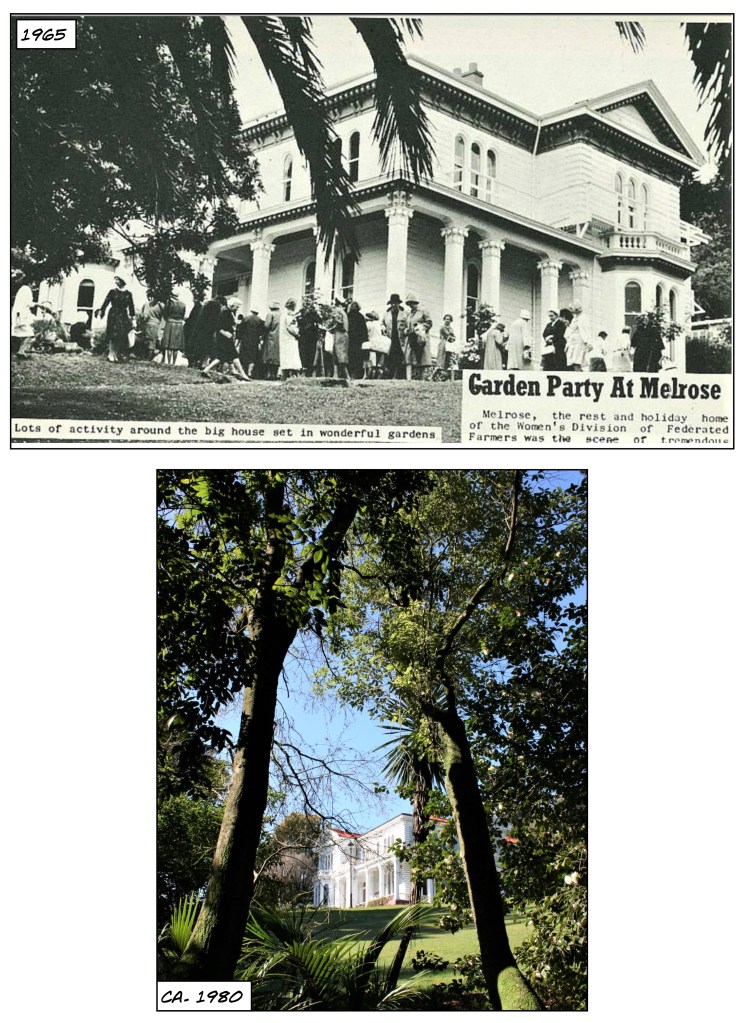
First, we can see from the 1965 photo that all the ‘fan palms’ have disappeared. By 1965 Melrose House had been passed on by Noel Adams to the Women’s Division of Federated Farmers, who were using it as a holiday home for rural women.[11] Obviously for some reason the fan palms were removed. Note, however, that the photo is taken from beneath the fronds of a Monte Carlo palm. This is actually one of two: the 1980 photo shows a large Monte Carlo palm in the spot where either a very young ‘cabbage palm’ or a palm were visible in the ‘front lawn’ photo from circa 1920. It certainly looks at least 60 years old. The palm with fronds visible in the 1965 photo is out of frame in this 1980 photo. By 1980 the Women’s Division of Federated Farmers could no longer afford the maintenance on Melrose House and it was gifted to Nelson City. Over time it became used as a café and event centre, with Nelson City Council contracting garden maintenance to NELMAC, at an estimated annual cost of $50,000.[12] This substantial cost, and the desire to utilise the lawn for café seating, may explain what happened in the 1990s, as illustrated in Figure 4.
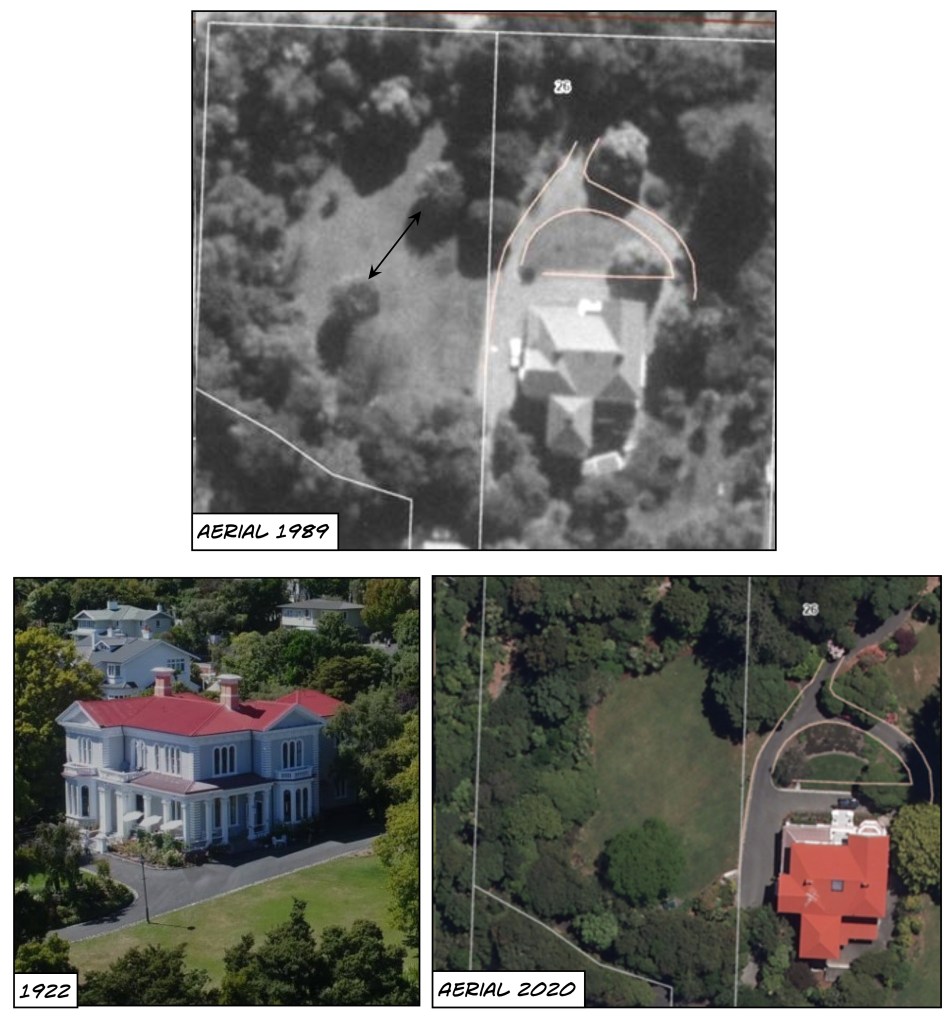
Both Monte Carlo palms, which are quite likely to have been planted by Percy Adams, are visible in the 1989 aerial view, but were thereafter removed as the other two photos show. Inquiries to Nelson City Council could not confirm the exact date of removal, though it was thought to be in the early 1990s.[13] The reason for removal is likely related to the cost of garden maintenance, with this concern not limited to the known upkeep that Monte Carlo palms require (e.g., trunk trimming, frond removal). For example, in an article titled ‘Melrose House needs council help’, one city councillor ‘questioned whether removing trees which screen Melrose House from public view might be a more expedient way to boost its profile’.[14]
The irony of this situation did not go unnoticed. Shortly after the councillor’s suggestion was recorded, another article commented that the ‘suggested removal of trees at Melrose House (Nelson Mail, Mach 2) is rather ironic given that Percy Bolland Adams worked tirelessly to promote the use of trees to beautify Nelson’.[15] Many large Monte Carlo palms still grow in Nelson, and it is clear that Percy Adams had a large part to play in establishing this arboreal legacy. In terms of legacy, however, it still seems to be the case that in New Zealand emphasis is mostly put on buildings, bridges, monuments, and other structures, sometimes to the detriment of trees (and palms). Where historic houses and gardens are gifted to the public, we should strongly assert that the living entities that make up the gardens deserve preservation as much as any building.
Acknowledgments
Thanks to Peter Grundy, Nelson City Council, for information, and Michael Brown for continued fruitful conversations.
Photo credits
(top =A, and so on):
Figure 1: A: Joe Bush and other at ‘Melrose’ Nelson: digital image; Adams, Noel Percy: collection (15-176). Masterton District Library; B: Melrose House. Nelson Provincial Museum, F N Jones Collection: 309743; used with permission of Nelson Provincial Museum.
Figure 2: A: Auckland Libraries Heritage Images Collection; Anzac Park. Nelson. F.G.R. 6467; B: Auckland Libraries Heritage Collection Online. In a South Island ‘Garden City’ Auckland Weekly News. Dudgeon E. 1935-04-03
Figure 3: A: With permission from Melrose House Facebook page; B: With permission from Nelson City Council
Figure 4: A, C: Supplied by Peter Grundy, Nelson City Council; B: With permission from Melrose House Facebook page
References
[1] Lloyd, M. ‘Phoenix Palms: beginning a sociological inquiry’: https://gardenhistoryresearchfoundation.com/2023/05/31/phoenix-palms-beginning-a-sociological-inquiry/
[2] Adams, P. 1925, The Life of Percy Bolland Adams. A.G. Betts & Son: Nelson.
[3] Details from Bayley, R. 2011, Melrose House: A History, Colonel Noel Percy Adams Trust (Melrose Society): Nelson; and Wright, K. 2020, Percy Adams and his Gates, available at: https://www.theprow.org.nz/people/percy-adams-memorial-gates/
[4] Brassey, R. 1998, Mansion House Gardens, Kawau Island: A conservation plan and resource document, Department of Conservation, Auckland Conservancy, p. 10.
[5] Noted in his memoir (1925, p. 10) is a family visit to George Grey on Kawau Island; Grey was a noted plant donor, and the young Percy may have been influenced by Grey’s philanthropic example.
[6] Cadwallader, 2013, https://register.notabletrees.org.nz/tree/view/1091
[7] ‘Tree-planting and vandalism’, Nelson Evening Mail, August 6, 1903, p. 2. Apparently it was not uncommon for gifted plants to be stolen or vandalised.
[8] Adams, 2025, p. 23
[9] Bayley, 2011
[10] Adams, 1925, p. 46
[11] Bayley, 2011
[12] M. van Duk, ‘Finding the way for a fine old house’ Stuff, June 5, 2010.
[13] Personal communication, Peter Grundy, Nelson City Council.
[14] The Nelson Mail, March 2, 2016, p. 3
[15] ‘Lesson from History’, the Nelson Mail, March 24, 2016, p. 5.

 The Garden History Research Foundation
One thought on “Percy Adams and Nelson’s ‘Monte Carlo Palms’”