
By Claire Bibby
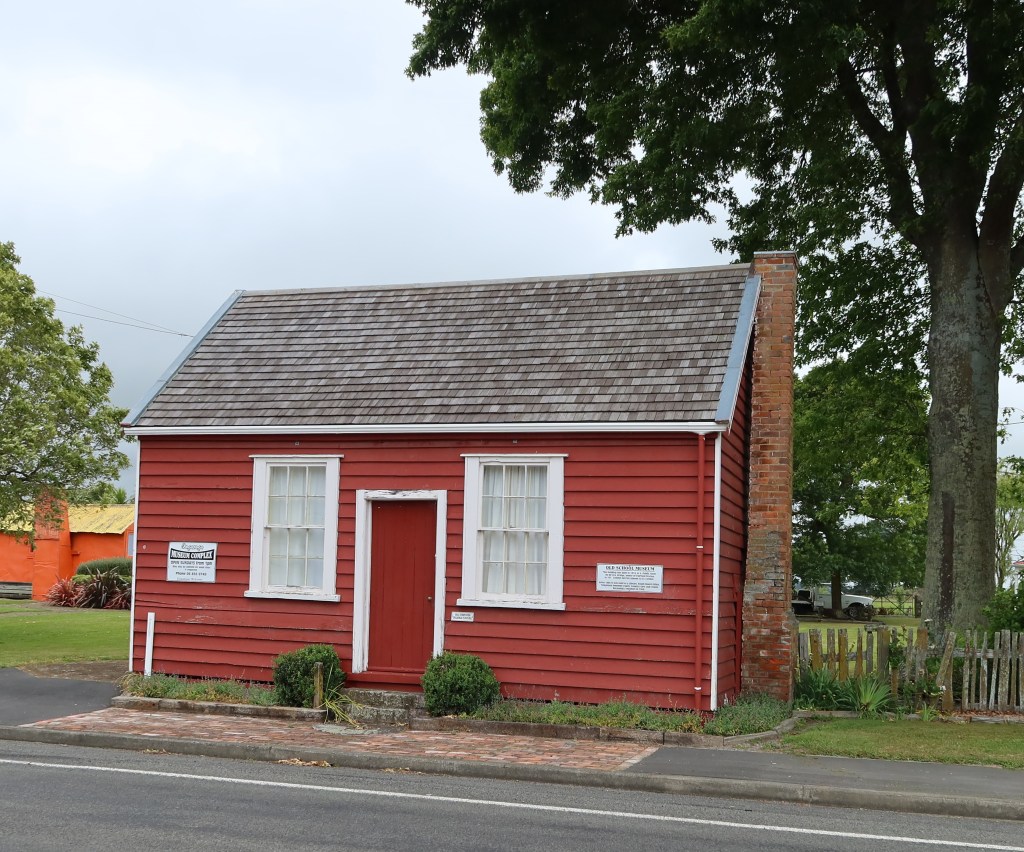
An Old Blush rose grows behind a picket fence at the Ongaonga Museum in Central Hawkes Bay. The interesting story of its arrival to the museum was faithfully recorded in history notebooks kept by my grandfather Mr Edward (Ted) Bibby, MBE (1896-1991).

Ted was a founding member of the Ongaonga museum, which was established in 1966. One of the museum’s objectives was to collect, record and preserve material to the history of Ongaonga District.[1] This included collecting plants sourced from early settler farms for the museum garden. Ted writes of getting a weak graft set on an apple tree of an historic apple and a true primrose from a stockade.[2]
One day a rose came into his care. It didn’t have a name, so he called it the Pioneer Rose.[3] He recorded in his notebook that the rose was brought to him by Juliet Holden of nearby Forest Gate Station, in about 1966.[4]
“It was a rose bush that had very little life in a collect of dead stems,” he wrote. “I understood her to say it came from the old garden of an old house at Forest Gate. I assume it would be the first home burnt down.”[5]
This was verified to me by Juliet Holden many years later, who said the rose had been growing in a paddock on the site of the original cottage.
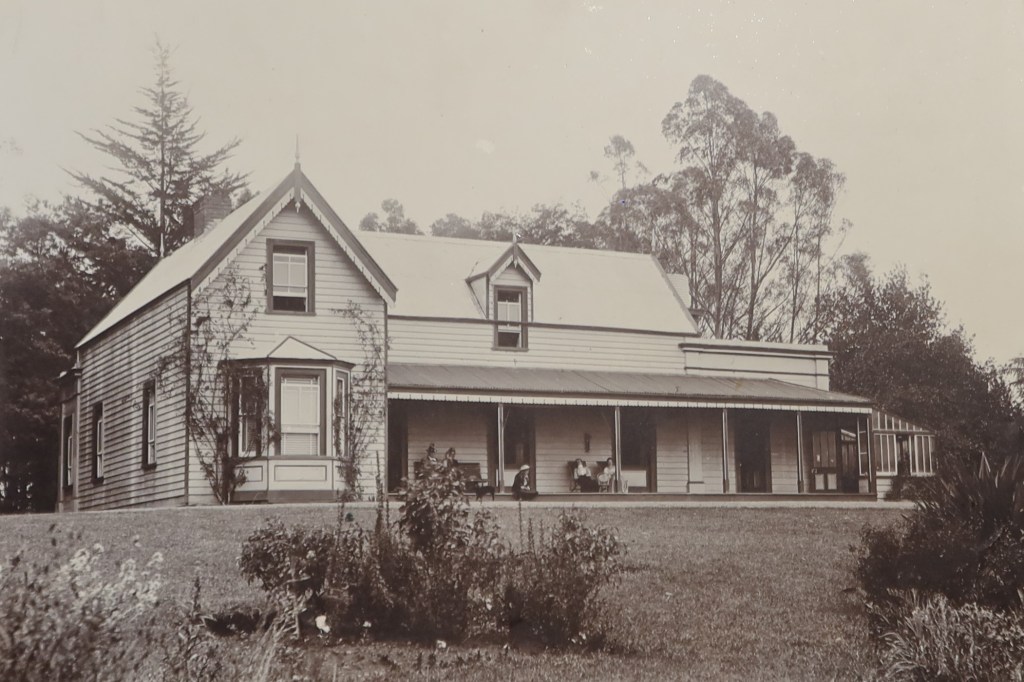
The first Forest Gate homestead burned down on March 4th, 1874.[6] After the fire the homestead was rebuilt in 1875 with more than 20 rooms on a site nearby.[7] This suggests that the rose was likely planted at the original homestead by the first owners, the Duncan family, or by the Herrick family who were living on the property at the time of the fire.[8]
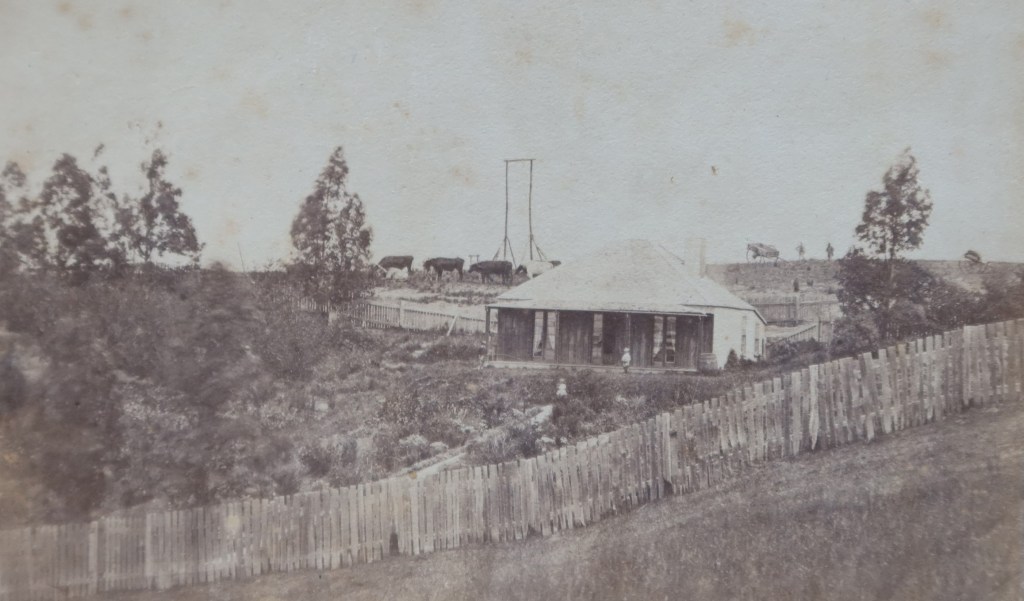
Forest Gate was established in 1853 by Richard J. Duncan, formerly of Forest Gate, Essex.[9] He settled his son, J. Russell Duncan, and wife Elizabeth on the property. During their tenure, the Station was enlarged to 13,000 acres.[10]
In time, the Duncan’s went into partnership with Jasper L. Herrick. In 1870 Mr Herrick married J. Russell Duncan’s sister Emily and took on full responsibility for Forest Gate.[11]
Mr Herrick was well-known in the province having served in the Armed Constabulary following the escape of Te Kooti from the Chatham Islands and as chair of the Waipawa County Council and having been elected to the Hawkes Bay Provincial Council. [12] [13]
It would be nice to think that the rose was planted by the Herricks, as Mr Herrick had close association with the school, opening it in 1876.[14] Furthermore, when the Ongaonga school museum was established in 1966, the sword presented to him by Queen Victoria, was placed on display.[15]
The rose grew happily in its garden at the Ongaonga museum. Ted Bibby wrote “It was planted with the other old-fashioned plants and slowly recovered. Its flowers are much admired, and cuttings were propagated.”[16]
It wasn’t until 1971 that the rose was identified. Ted received a letter from Pieter Bruggeman of Masterton, who had been visiting him and his wife on their Ongaonga farm.[17]
Mr Bruggeman wrote “After I left you, I went to Ongaonga and stopped at the little museum where I soon spotted the rose we talked about. I just couldn’t resist the temptation and after a quick look over my left and right shoulder, I picked three pieces with the flowers on.”
Mr Bruggeman sent his cuttings to Mrs Nancy Steen, in Auckland, author of The Charm of Old Roses (1966) “…and here is her reply,” Mr Bruggerman wrote. “…which I forward to you as I thought you might like to read it and the name of the rose is Old Blush China.”
Ted Bibby wrote in his notebook that it was a horticultural find “…one of the earliest roses brought to New Zealand.”[18]
He seemed confident that the rose had been planted by Mr Duncan. However, he provided no evidence to support this.[19]
Mr Herrick died in tragic circumstances at the age of 58. On 19 December 1890, he was with a party of friends and his daughter, on a picnic to his newly purchased Oporae property, thirty miles out of Dannevirke.[20]
The group made an excursion to the Waihi falls. Whilst his daughter Hetty was sketching and his friends, Mr and Mrs Giblin were collecting ferns, Mr Herrick climbed the waterfall, estimated to be 80 feet high. He took his boots off and was on a ledge below the top of the falls, when, to the horror of the onlookers, he slipped and fell 50 feet into the pool below. He fractured his skull on rock and was pulled out of the water, dying an hour and twenty minutes later. The men in the group went for help, walking through five miles of bush and five miles of cleared land to the road where they were able to get a message taken by horse and rider to Dannevirke. They returned in darkness, using candles to find their way through the bush. The next day the group somehow managed to carry Mr Herrick’s body miles out to a place where horses and traps met them. He was buried in St Peter’s Anglican Church Cemetery at Waipawa.[21]

In an interview in 2018, descendant Robert Herrick said that his great grandfather was collecting a flower for his daughter Hetty when he fell.[22]
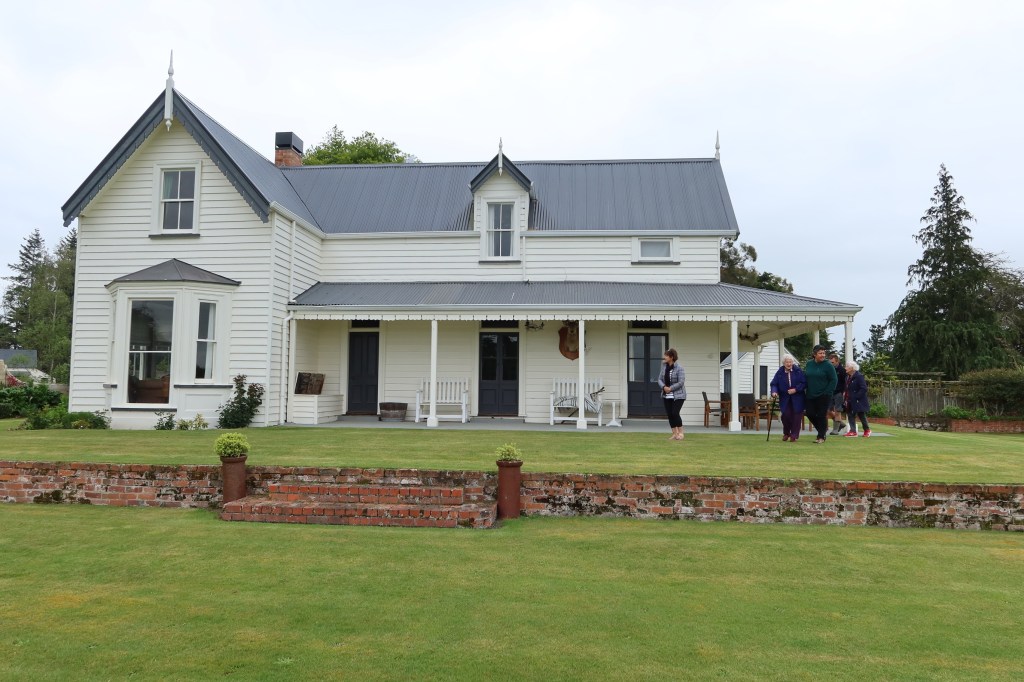
After her husband’s death, Mrs Herrick stayed on at Forest Gate with trustees managing her property. In 1901, Forest Gate was compulsory acquired by the Government and subdivided under legislation breaking up the great estates for closer settlement.[23] The homestead block was bought by the Mackie family.[24] Since 1934 it has been owned by the Holden family, who farm there today.[25] The magnificent Forest Gate homestead still stands and in 2025, will be 150 years old. Along with the dairy safe shed, woolshed, stables and coach house, it is listed with Heritage New Zealand.[26]
The Holdens have an excellent collection of historic photographs of Forest Gate. These were taken by Russell Duncan during his time on the farm, and at the time of its acquisition in 1901. The photographs include specimen trees, the garden and roses. However, it is not possible to discern the actual Old Blush rose.
The descendant of the original Forest Gate Old Blush lives on at the Ongaonga Museum and in the Bibby family. Each of Ted Bibby’s daughters, both in their nineties, have a treasured bush in their Central Hawke’s Bay gardens. My grandfather gave me a bush he had potted up and its descendants grow in my cottage garden and at the historic Halfway House garden at Glenside, north of Wellington.
The pink rose flowers intermittently from spring to late summer. The semi-double loose petals have a bright sheen to their edges. The stems have few thorns and can be trained as a bush or as a semi-climber against a post or wall. The rose can also be used as a low hedge or grown as a small garden feature.
The Helpmefind website informs us that Old China Blush is included in the World Federation of Rose Societies Old Rose Hall of Fame, which recognizes roses of historical or genealogical importance and those roses which have enjoyed continued popularity over a great many years.[27]
Acknowledgements
An earlier version of this blog was published in the Heritage Roses New Zealand Inc. Journal, Volume 48, Issue 2, in February 2023.
[1] Bibby, E.S. (1966). 1966 Aims of Old School Committee. Local History Book 1. (p.60).
[2] Bibby, E.S. (1966). 1971 Chairmans Report to OSM Committee. Local History Book I. (pp 155-156).
[3] Bibby, E.S. (1981). Pioneer Rose. History Notes Book 2. (p.22).
[4] Ibid.
[5] Ibid.
[6] McGregor, M. (1970). Early Stations of Hawke’s Bay. A H & A W Reed Ltd.
[7] Ibid; Gordon, B. (1996). Herrick Family Album. Cosmos Publications. Napier.
[8] Hawke’s Bay Times, Issue 1556, 6 March 1874, p. 138. https://paperspast.natlib.govt.nz/newspapers/HBT18740306.2.10
[9] McGregor, M. (1970). Early Stations of Hawke’s Bay. A H & A W Reed Ltd.
[10] Ibid.
[11] Ibid.
[12] Hawke’s Bay Times, Volume 13, Issue 667, 25 March 1869, p. 8 https://paperspast.natlib.govt.nz/newspapers/HBT18690325.2.1
[13] McGregor, M. (1970). Early Stations of Hawke’s Bay. A H & A W Reed Ltd; Waipawa Mail, Volume XIV, Issue 2547, 20 December 1890, p. 3 https://paperspast.natlib.govt.nz/newspapers/WAIPM18901220.2.23
[14] Ibid.
[15] Ibid.
[16] Bibby, E.S. (1981). Pioneer Rose. History Notes Book 2. (p.22).
[17] Bruggeman, P (1971, 20 August) Letter to Mrs and Mrs Bibby. Alexander Turnbull Library reference 91-147-2/02
[18] Bibby, E.S. (1966). 1971 Chairmans Report to OSM Committee. Local History Book I. (pp 155-156).
[19] Ibid.
[20] Details of the incident are sourced from the Waipawa Mail and Bush Advocate. Where there is a discrepancy, the testimony of the witnesses at the Inquest as reported in the Bush Advocate prevails.
Waipawa Mail, Volume XIV, Issue 2547, 20 December 1890, p. 3 https://paperspast.natlib.govt.nz/newspapers/WAIPM18901220.2.23 Bush Advocate, Volume VI, Issue 409, 23 December 1890, p. 2 https://paperspast.natlib.govt.nz/newspapers/BA18901223.2.10
[21] Central Hawkes Bay District Council. (2022). Jasper Lucas Herrick Lt Col. https://www.chbdc.govt.nz/services/cemeteries/cemetery-database/?rid=102862
[22] Newbigen, J. Herrick (2018). Robert Jasper Interview. Knowledge Bank Hawke’s Bay Archives Digital Trust. https://knowledgebank.org.nz/audio/herrick-robert-jasper-interview/
[23] McGregor, M. (1970). Early Stations of Hawke’s Bay. A H & A W Reed Ltd.
[24] Ibid.
[25] Ibid.
[26] Heritage New Zealand (2022). Forest Gate Station Homestead. https://www.heritage.org.nz/the-list/details/1037
[27] HelpMeFind Roses, Clematis and Peonies and everything gardening related https://www.helpmefind.com/rose/l.php?l=2.2166.20

 The Garden History Research Foundation