
by Mike Lloyd
It is difficult to pinpoint where and when the first Phoenix palm (Phoenix canariensis) was planted in New Zealand. There is a good chance though that it was in Auckland, planted in the early 1900s. D. Hay and Sons’ Montpelier nursery catalogue for 1891 has the palm for sale, but following international trends of the time it was initially sold as an indoor plant[1]. However, by 1899 the same nursery’s catalogue described them as ‘hardy to grow in the open air’[2]. Taking Auckland as the case in point, there seems to have been a rapid uptake in such ‘open air’ planting. As we will see below, there is a remarkable concentration of Phoenix palms in downtown central Auckland. By describing this concentration, part of the legacy of Phoenix palms in the New Zealand cityscape can be appreciated.
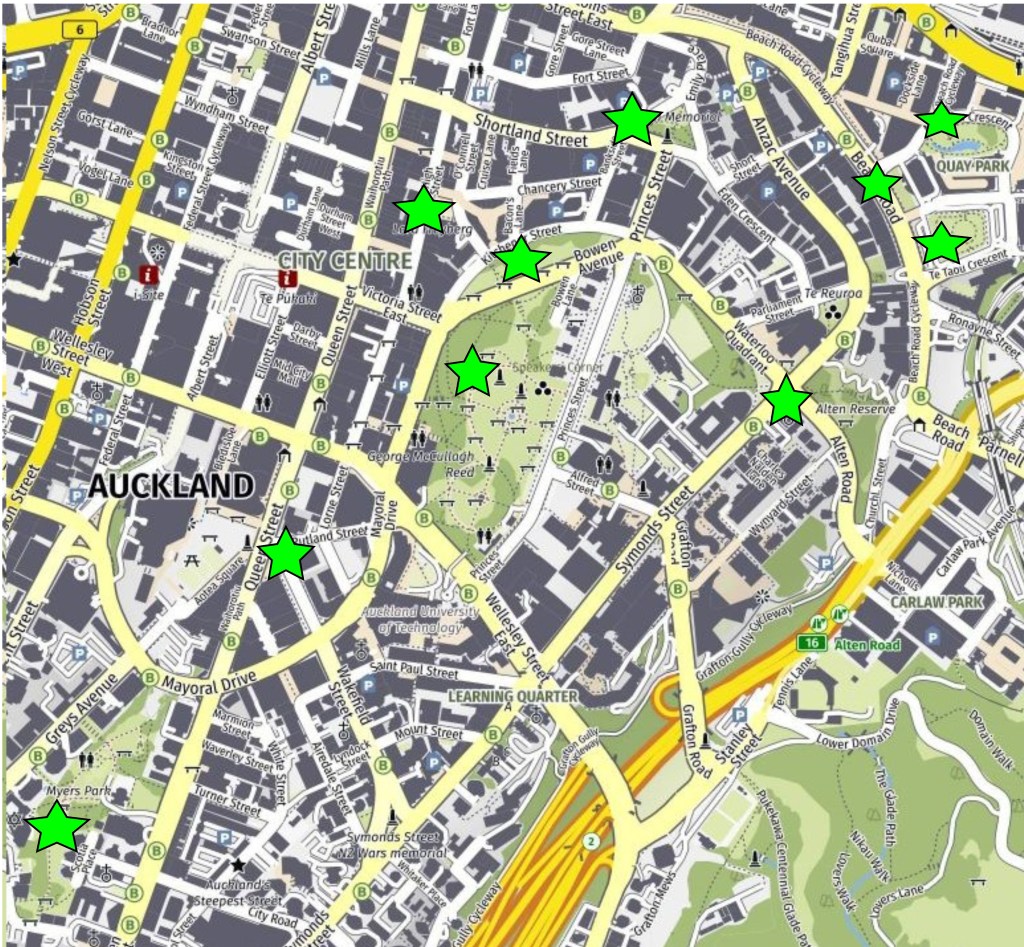
Figure one shows a map of the central Auckland area, where the ten green stars are the sites of the Phoenix palm plantings to be described. Beginning at the Queen Street star (next to Aotea Square), we move clockwise from site to site, thus finishing at Myers Park. All sites have a minimum of two palms, with larger clusters the norm. Most of the palms are planted pre-1940. However, there are a few which are later; these are included here to show that the appeal of the palms lasted beyond the 1900 to 1940 period when planting was at its peak.[3]
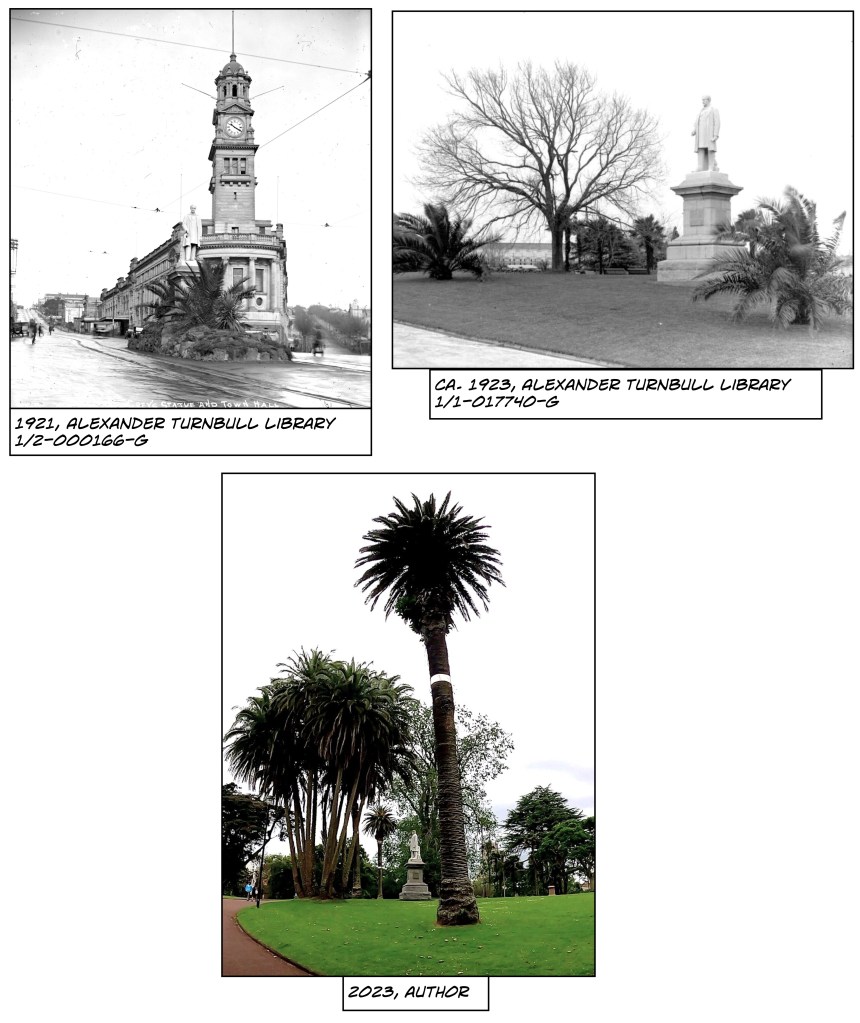
Panel 1 of Figure 2 shows the Sir George Grey memorial in central Queen Street, just in front of the Auckland Town Hall. Clearly visible are two Phoenix palms on either side of the memorial statue. From other historical photographs of the site, an estimated date of planting of about 1916 can be made. This is the only case of an early centre-road planting I am aware of, but as both the statue and the palms ‘increasingly [became] a traffic hazard’ the statue was moved to a new site in 1922[4]. It is not known what happened to the palms. However, the interesting thing is that the new site the statue was removed to – Albert Park – already had two phoenix palms growing. As Panel 3 shows, by 2023 the palms dwarf the statue, and at some point after 1923 a new planting of Phoenix reclinata closer to the statue was introduced. Given the size of the palms in Panel 2, and from an historical source, it is possible to date the planting of these palms as 1905 to 1906. The historical source is an article in the New Zealand Herald detailing ‘Alterations in Albert Park’[5], including the planting of palms in the area between Bowen Avenue and the flagstaff, which is right next to where the George Grey statue was relocated. This is to presume that the ‘proposed work’ was carried out, but given the palms are there to this day, it seems reasonable to see their planting as part of this work, overall making them amongst the oldest in New Zealand.

The same conclusion about age can be reached with the next site visited: a group of phoenix palms in Bowen Ave, just 50 metres north of the Grey statue. Figure 3 shows two historical photographs looking up Bowen Ave, and the 2023 photograph looking down in the other direction. A row of six Phoenix palms can be seen to the left margin of the 1918 photograph. The 1921 photograph shows the palms have grown to about 3 metres tall, and additionally there is what seems to be a slightly younger palm in the foreground on the other side of the avenue. It seems reasonable, given the current size of these palms, to also date their planting to about 1905 to 1906.
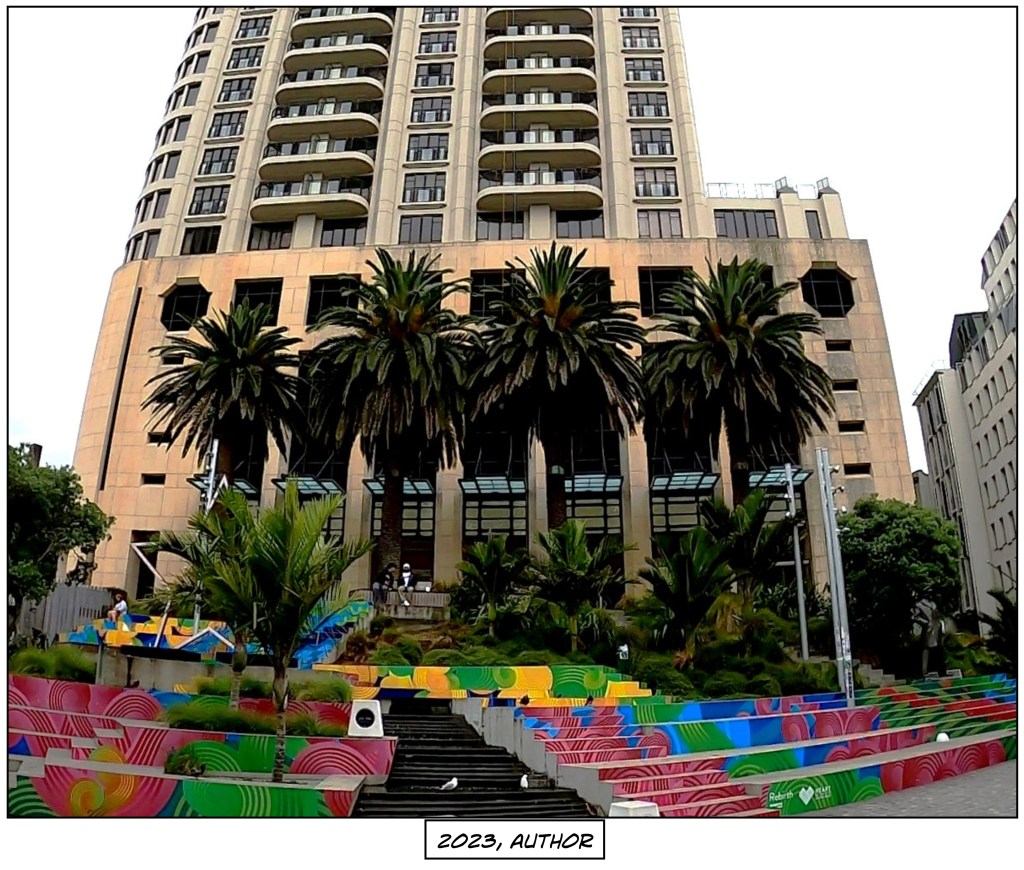
The move to the next site – Freyberg Place – is also short, but this time involves a much more recent planting of Phoenix palms. The age of the four palms seen here is unknown, but going by their size somewhere between 50 to 60 years looks likely. As can be seen, the four palms provide a columnar frontage to the Metropolis Tower apartment building (developed in 1999). The interesting thing about this site is that it was redeveloped from 2015, and the plans from Isthmus Architects included the possibility of removing the palms.[6] This may well reflect the fact that beginning as early as 2004 the Auckland Regional Council moved to classify Phoenix palms as a pest plant, undoubtedly contributing to a devaluation of the palms.[7] Ultimately, the palms were not removed partly because they sit on private land owned by the Metropolis apartments.[8] What can also be seen in Figure 4 is a strong presence of nikau palms. In current landscape architecture circles these are clearly much preferred to the imported Phoenix palm. Nevertheless, the four Phoenix palms remain in Freyberg Place offering a larger ‘monumental’ effect than the smaller nikau palm (which have a different visual appeal).

The next site – Emily Place – is a mere 300 metres north-east from Freyberg Place, but is a much older reserve. As can be seen in Panel 1 of Figure 5, the original planting featured pohutukawa trees across the top and fan palms down the side of the triangular shaped reserve. Panel 2 shows a circa 1945 photograph showing two Phoenix palms have been added in the central area that was previously just lawn. Their size in this photograph suggests an estimated planting date of 1930 – the two 2023 photographs show the height that we would expect of a 90 year old palm. The example of Emily Place shows that over time both the planting and layout of a reserve can change significantly: the fan palms to the left were removed at some stage and replaced with gingko trees, and obviously the two Phoenix palms were also added, making good use of their framing quality when used as a pair. This addition is also of course at a time – the 1930s – when Phoenix palms were still very popular.
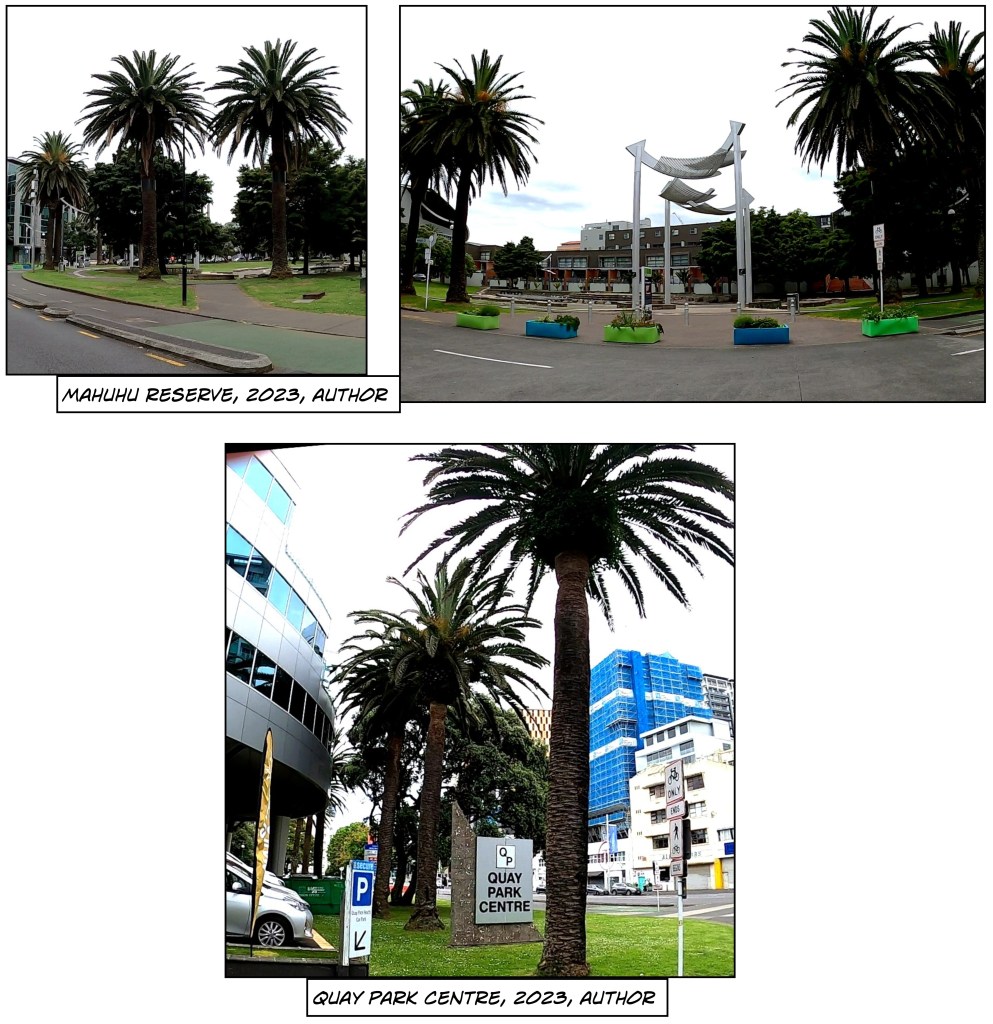
Moving again about another 300 metres north-east we have a significant precinct of Phoenix palms, albeit in 3 separate sites. The first two – Mahuhu ki te Rangi reserve and Quay Park Centre – are shown together in Figure 6. The dates of planting are not known for these sites, but a good estimate would be the early 1960s. The Mahuhu ki te Rangi reserve was redesigned in 1996, with Panel 2 showing how well Phoenix palms go with a monument or other structure. The other thing to note, particularly from the Quay Park Centre palms, is that they are all very well maintained. The trunks have been trimmed of dead and old fronds, maintenance that does incur some cost. This would suggest that these palms, even given their ‘pest plant’ status, are still relatively highly valued.
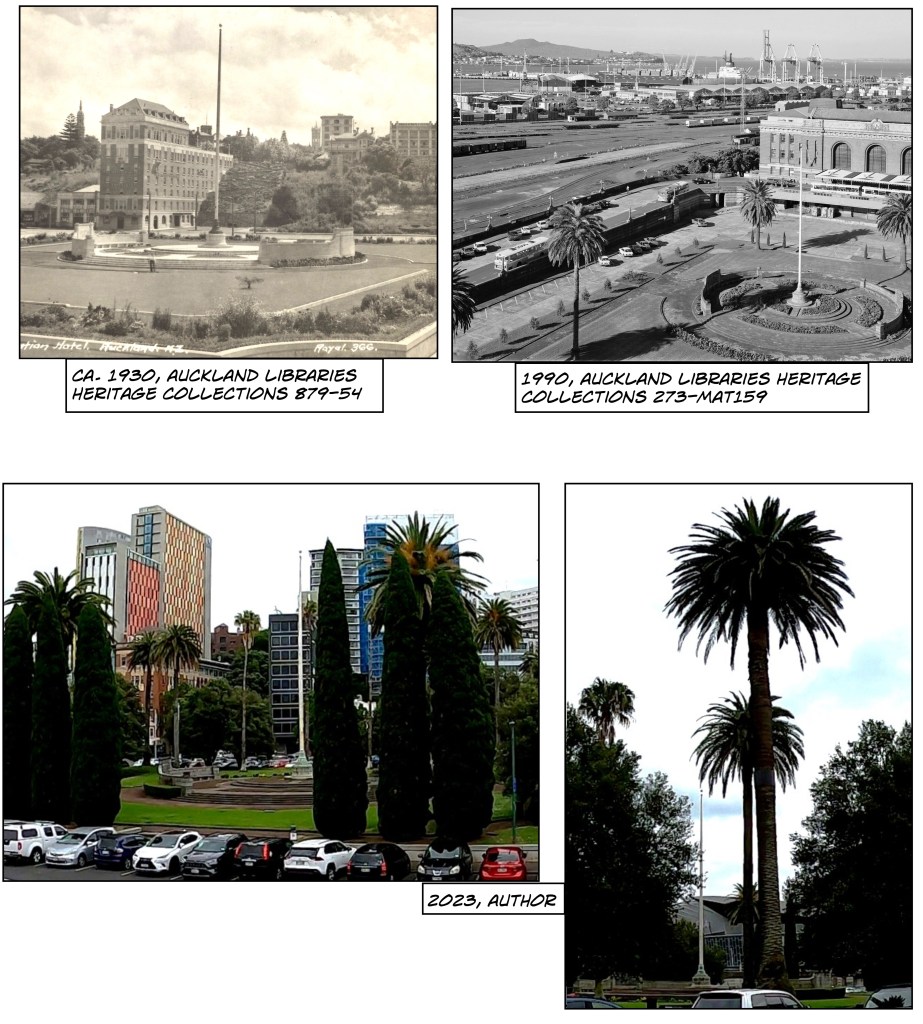
Just across the road from the Quay Park Centre we then come to te Taou Reserve, shown in Figure 7. This carefully laid out area was originally the frontage to the main Auckland railway station (the big building visible in Panel 2), with the Station Hotel across the road (see Panel 1). A close inspection of Panel 1 shows in the foreground the presence of a young Phoenix palm, suggesting a circa 1930 planting date, which is consistent with the current size of the six palms (see Panel 3 and 4). The very formal geometric layout of the reserve is no longer in fashion in contemporary amenity landscaping. However, it still has strong visual appeal with the combination of Phoenix palms and pencil cypresses working particularly well. The six Phoenix palms in te Taou Reserve are registered on the Auckland Schedule of Notable Trees.

From te Taou Reserve, if we travel back towards Queen St taking Anzac Avenue, just where it becomes Symonds Street, we find the pair of large Phoenix palms seen in Figure 8. As can be seen, they now appear on the northern frontage of the University of Auckland, but originally the palms were amongst a mix of native, Australian and European trees planted in Anzac Avenue as a ‘war memorial avenue’.[9] These can be accurately dated as 105 years old, being planted by a group of schoolchildren in a tree-planting ceremony on September 19, 1918, with ‘a very careful selection of trees’ having been made by Thomas Pearson, the city parks superintendent.[10] The latter information is significant as it has an important link to the final site we visit – Myers Park, seen in Figure 9.

Myers Park is a relatively long and narrow park in a gully to the west of upper Queen St, opened in 1915 mainly due to the actions of Arthur Myer, mayor of Auckland between 1905-1909.[11] It has the largest cluster – 25 – of Phoenix palms in our visited sites, including a double row to the south of the park as seen in Panel 4 of Figure 9. Thomas Pearson, who was Auckland Parks Superintendent between 1908 to 1930, designed the planting, it being noted that ‘the great Phoenix Palms are almost regarded as his trademark.’ [12] The historical photographs included in Figure 9 would suggest that the palms were planted circa 1915.
There are many more Phoenix palms to be found in Auckland’s public and private gardens[13], and Thomas Pearson’s keenness for them may well explain other large clusters in Auckland, including Cornwall Park, Ellerslie Racecourse, the Auckland Domain, and Mount Roskill. But the concentration we have seen in the central downtown area is not repeated elsewhere in Auckland, nor in any other New Zealand city.[14] As noted, the Albert Park and Bowen Avenue groups are probably amongst the oldest in the country, and the Myers Park group are not far behind. Despite this significant presence, amongst these palms only the six in te Taou reserve are included in the Auckland Schedule of Notable Trees. This may reflect the vagaries of the process whereby trees are entered on the schedule, or it may partly reflect the Phoenix palm’s ‘pest plant’ classification. Nonetheless, it seems surprising. It is worth noting that the effect of the pest plant classification is that sooner or later Auckland’s Phoenix palm legacy will disappear. Currently, with the death or removal of a Phoenix palm in Auckland there can be no legitimate replanting. Hence, it could be that 100 years from now the visual record presented above will remain, whereas many of the palms will not. Luckily, however, other towns and centres in New Zealand have not followed the Auckland precedent, and it may be that the centre of the exotic appeal of the Phoenix palm moves further south. The good news is that there are already significant collections of the palms in Waihi, Gisborne, Whanganui, Palmerston North, Napier, Nelson, and as far south as Timaru. In the meantime, any visitor to central Auckland with an interest in garden history could follow the above ‘tour’ and take the chance to appreciate the Phoenix palms while they still grow.
Acknowledgments
Thanks to John Adam, Bill Mckay, and Jenny Larking for useful information.
References
[1] In the 1890s the Phoenix palms was the tenth most popular indoor plant in Europe. See Spennerman, D. (2018) ‘Canary Island Date Palms Palm (Phoenix canariensis) in Australia: Introduction and early dispersal. Palms, 62(4): 185-201.
[2] Thanks to Louise Beaumont for access to the catalogues.
[3] See Zona, S. (2008) The horticultural history of the Canary Island Date Palm (Phoenix canariensis), Garden History, 36: 301-308.
[4] ‘A familiar Auckland landmark removed to a new site: Sir George Grey’s statue’, Auckland Weekly News, 14 September, 1922, p. 39.
[5] ‘Alterations in Albert Park’, New Zealand Herald, 22 June, 1905, p. 6.
[6] ‘Bill McKay: New design for Freyberg Place misses the mark’, New Zealand Herald, 15 September, 2015.
[7] See ‘New research rings biosecurity alarm bells’ Press release from Auckland Regional Council, 19 October, 2004, available on Scoop: https://www.scoop.co.nz/stories/AK0410/S00144/new-research-rings-biosecurity-alarm-bells.htm. The ‘pest plant’ classification came into effect in 2007 (personal communication from Ewen Cameron).
[8] Personal communication, Jenny Larking, head of City Centre Programmes, Auckland Council.
[9] See Read, S. & J. Adam, 2019, ‘Memorial avenues in New Zealand’, Australian Garden History, 31(1): 14-19.
[10] ‘Anzac Avenue tree-planting ceremony’, 2018, New Zealand Herald, 20 September, p. 6.
[11] ‘Myers Park, Auckland’, Wikipedia: https://en.wikipedia.org/wiki/Myers_Park,_Auckland accessed 12/12/2023.
[12] ‘Myers Park Designer’, https://www.karangahaperoad.com/myers-park-designer, accessed 12/12/2023
[13] See Wilcox’s 2012 botanical survey showing that Phoenix palms were the fifth most abundant tree in a sample of 1561 home gardens, p. 81 in Wilcox, M. 2012, Auckland’s Remarkable Urban Forest, Auckland: Auckland Botanical Society.
[14] Napier might be the city that gets closest to such a concentration.

 The Garden History Research Foundation
The September 19, 2018 date should be September 19, 1918.
Thanks for this insightful history.
LikeLiked by 1 person
– thanks for picking that up, Wayne!
LikeLike
Of interest reported in Star (Christchurch), Issue 2922, 14 August 1877, Page 3.- “The [Auckland] City Council are engaged in planting a number of trees along the principal streets in the city. Mason Bros. obtained the contract to supply several hundred types of various kinds.” Whilst it’s unclear what James and William Mason planted, James Mason of Parnell Nurseries, Auckland, listed Phoenix dactylifera, the Date Palm, as an Ornamental Tree and Shrub (not an indoor plant) in his 1885-1886 catalogue. Phoenix canariensis was not listed. The Mason’s established large and significant nurseries from 1865-1907 in Ponsonby (aka Dedwood), Parnell, Newmarket and Tamaki. There is a Mason catalogue dated 1873 in Sydney. Along with brother George Mason of Waikato, the three brothers were an influence on the changing landscape (and horticultural economy) of Auckland and wider New Zealand. See Purewa cemetery listing, notable burials, for more information on the Mason brothers influence in ornamental landscaping in Auckland.
LikeLiked by 1 person
Thanks Claire – I will pass it on.
LikeLike
Might be useful to note why the Phoenix palm is deemed to be a pest plant: their fronds are highly poisonous and they are the cause of half of all hand surgery in New Zealand.
See: https://www.rnz.co.nz/national/programmes/afternoons/audio/2018682989/phoenix-palm-beware-the-undercover-menace-in-your-garden
.
LikeLiked by 1 person