
by Mike Lloyd, Victoria University of Wellington (mike.lloyd@vuw.ac.nz)
In the usual process of landscaping, buildings come first and then trees, shrubs and lawns are planted afterwards to beautify a site. Given enough time the two elements appear as a natural unity. That is, traces of both the construction of a building and the design and planting of a garden may disappear, and the two look as if they have always been together. That said, trees can be removed or pruned as they grow too large (or for other reasons), and change can also occur on the building side of the equation. Buildings can be extended, fall into disrepair or be removed, raising the question of the fate of the trees that were formerly in unity with the building. Bowring has called trees which survive disaster ‘survivor trees’[i], arguing that the ‘sticky affect’ of such trees is because of a significantly changed context: terrorist attacks, earthquakes, bombs, war, and tsunamis dramatically alter whole landscapes, meaning that a tree that survives such calamities can become very notable. There are well-known examples of survivor trees, but here I wish to adapt this logic and consider more prosaic, mundane cases of survivorship. In researching Phoenix palms in New Zealand, I have become aware of interesting cases of palms that remain when the buildings they were first associated with have been removed. By using visual resources we can get a feel for these trees, thinking about their place in the landscape and the meanings they invoke.
At the back of an old building

Figure 1 shows before and after details of a Phoenix palm in the Cuba Street precinct of Wellington. Panel 1 shows the heritage listed Toomath’s Building on Ghuznee Street just before the intersection with Wellington’s famous Cuba St. Over 100 years old, it had been empty since 2019, due to designation as a quake-prone building. As the Google Map view of Panel 2 shows, at the back of the building was a Phoenix palm growing up against the property’s boundary. Its location right on the boundary suggested it may not have been a planned planting; overall it seemed ‘punky’, both because it had a certain rude good health, and because of the derelict and graffitied building right next to it. The palm could be clearly seen from the small Cuba Street carpark at the back of the building, adding to its public visibility. Unlike Auckland[ii], Wellington has an absence of Phoenix palms in the central city area, with the nearest palms being one on the Terrace, and two at Government House[iii]. Consequently, even though relatively young – about 25 years from its size – the palm had a certain presence in the Cuba St precinct. As panels 5 and 6 show, however, this presence did not ensure survival. On October 15 2023 a fire broke out and gutted the building; demolition of the building began within days, and the clearance of the site was total.[iv] Even though the palm was in a place – the boundary of the section – where it could have been left to grow, the demolition of the building extended to the removal of the palm. This removal may have something to do with a desire to maximise building space, and the fact that it was a solo tree. Perhaps if it was an older, and bigger palm, more thought would have been given to preservation. That is, both size and the length of historical association with a site may have saved it.
Next to an old hotel
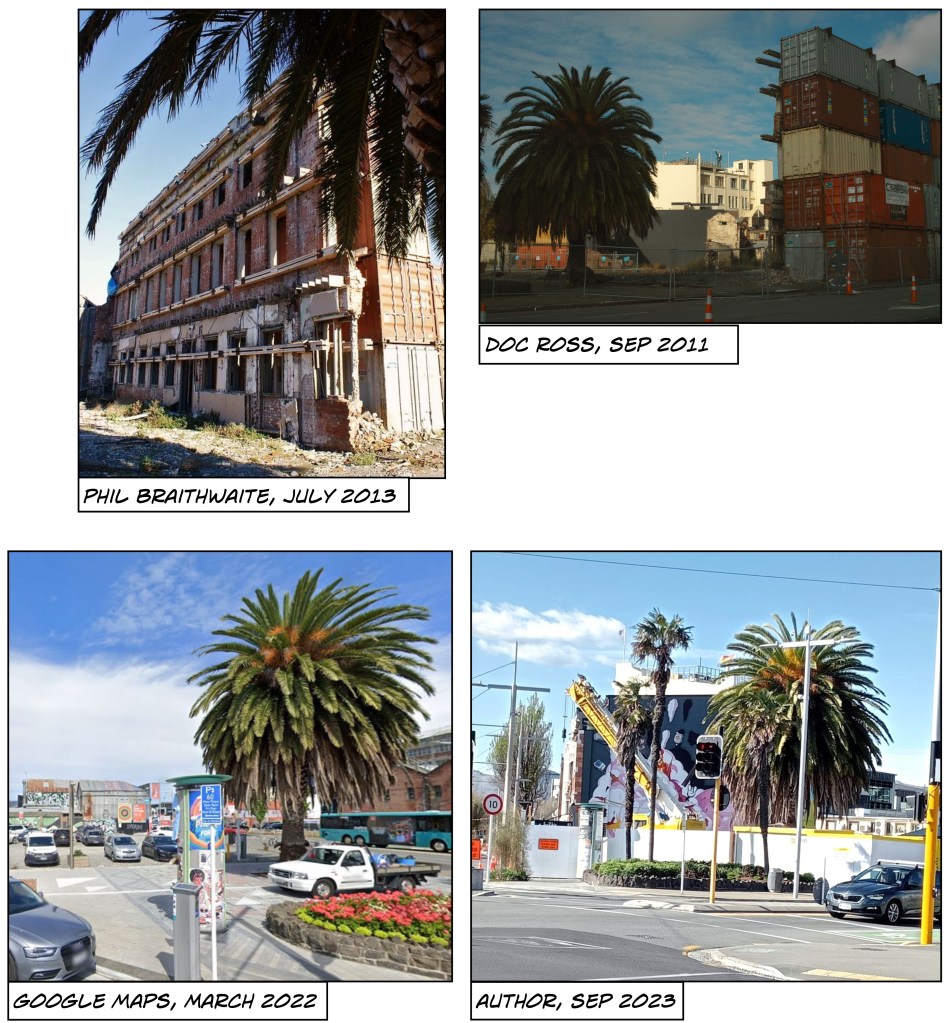
Similar to Wellington, there are very few Phoenix palms in central Christchurch, though this may have more to do with Christchurch’s hard winter frosts leading to an assumption that palms will not grow there. From its size, the single palm seen in Figure 2 was probably planted circa 1975, a long time after the building of the Excelsior Hotel in 1864[v], the façade of which can be seen in Panel 1. It was a listed heritage building, which is why attempts were made to save the façade after it sustained considerable earthquake damage. However, these proved unsuccessful and the remnants were finally demolished in April 2016, leaving the palm as the sole survivor on the Hotel site (it used to be beside an outdoor seating area). Indications are that as a new building goes up next to the palm, where the demolished Excelsior Hotel used to stand, the size and form of the palm will be appreciated. In contrast to the previous example then, this has become a survivor tree appreciated in itself, but also having the potential to act as a reminder of the demolished Excelsior Hotel (visual records[vi] exist which show both the building and the palm).
Bordering a funeral home and a petrol station

As Figure 3 shows, this example takes us from solo palms to a larger cluster, which may favour preservation rather than removal. Panels 1 and 2 show a building known as ‘Libertyland’, an ‘unmissable landmark’ of Palmerston North during almost 70 years of operation as a clothing factory employing up to 80 staff.[vii] As the early aerial photo shows, it was originally an imposing art deco building on the outskirts of the city. As an estimate, the Phoenix palms were planted around the building about 1955, adding to an existing number of well-known clusters in Palmerston North.[viii] As the Bayleys Real Estate photo shows, as the palms grew in size they nicely complemented the lines of the art deco building.[ix] The palms were included in the Palmerston North District register of notable trees, indicating public appreciation, which also applied to the building, but in the latter case, due to the high cost of earthquake strengthening work, it was demolished in 2012.[x] After demolition and sale, the first replacement building was for Lychgate Funeral, followed by a Waitomo petrol station. Obviously, this has meant that the previous ‘natural affinity’ between the art deco Libertyland building and the palms has gone, but given there is no guarantee of even registered notable trees being retained, we should be grateful only one palm was lost in placing the new buildings on the site. Of course, when people fill their car with petrol or go to a funeral, they probably do not deeply reflect on the trees that surround them. Nevertheless, a cluster of 70 year old Phoenix palms does stand out as relatively significant. In response to this possible incongruity, the question may arise of what a cluster of Phoenix palms is doing beside a funeral home and a petrol station. This could easily be answered by the placing of an information board on the site, but if other examples are anything to go by, these tend to focus on buildings and material structures, being less inclined towards noting the associations between buildings and trees.
On the way to the (derelict) freezing works

The 1949 aerial photo in Figure 4 shows the northern part of Tokomaru Bay, giving a good indication of the significant size of the freezing works, wharf, and Shipping Company building. It also shows that in terms of trees and vegetation the site was relatively bare at this time. However, this was all about to change. As reported in the Gisborne Herald, ‘Reporting to the August meeting of the Tokomaru Bay Harbour Board held recently at Te Puia, the harbourmaster, Captain P. W. C. McCallum, said that considerable progress had been made on the beautification scheme at Waima agreed to by the board. The ground between the harbourmaster’s residence and the freezing works, seaward of the main road was bulldozed and levelled, and a manuka shelter frame erected. The area, after cleaning was sown in grass, 12 Phoenix palms and other ornamental shrubs planted, and a strong fence erected the whole length of the road.’[xi] As we can see by the bottom two panels, the Phoenix palms’ trajectory from here on was literally upwards – at 75 years old they are now an impressive sight, providing a distinct tropical island landscape on the drive towards the wharf. The same cannot be said of the freezing works, which closed in July 1952. For about 40 years the works had been the central employer in Tokomaru Bay supporting both permanent staff and a seasonal workforce, to such an extent that the community fielded its own rugby team and supported a theatre.[xii] Only about 400 people now live in Tokomaru Bay, and the derelict freezing works has become a small tourist attraction for those that take the no-exit route off the main highway. Passing the Shipping Company building (to the right of the circled area in Panel 1), a Heritage Trails plaque gives details of the Freezing Works and its history; it is then a short drive past the twelve Phoenix palms to the derelict works and still functioning wharf. In this case, the incongruity noted above between a cluster of palms and a petrol station is not so apparent. Nonetheless, the palms receive no mention in the plaque, even though their planting to beautify the area was intimately connected with the main industry of the area. So, the palms are an interesting survival and historical marker. Whereas post-1950, Phoenix palms continued to be planted throughout New Zealand, the peak period for group-planting was in the prior 30 years; the Gisborne-East Coast meat-freezing industry was also about to undergo a significant decline about this time.[xiii] But buildings can deteriorate rapidly – see the aerial view of the freezing works – so this means that unless a tree or palm is chopped down, its continued growth can be consulted as an historical reminder of past activities. A cluster of Phoenix palms just seemed to go with the Libertyland art deco building; a cluster of palms similarly seemed to fill the need to beautify the Tokomaru Bay freezing works site. Other trees could have been chosen, but just then in the late 1940s to 1950s Phoenix palm clusters still had currency as a suitable plant to ‘go with’ buildings and activities of social significance.
Acknowledgements:
Thanks to: Doc Ross for permission to reproduce his 2011 image of the old Excelsior Hotel; to Phil Braithwaite for permission to use ‘Excelsior Façade’ photo; to Dudley Meadows of Tairawhiti Museum for the historic photo of the Tokomaru Bay Freezing Works.
References
[i] Bowring, J. 2019, ‘Survivor trees: Spectrality and stickiness’, Fabrications, 29(1): 21-36.
[ii] See Lloyd 2023 ‘The significant phoenix palms of central Auckland’, at: https://gardenhistoryresearchfoundation.com/2023/12/13/the-significant-phoenix-palms-of-central-auckland/
[iii] Planted in 1936, the pair are amongst the oldest Phoenix palms in Wellington. See New Zealand Tree Register, https://register.notabletrees.org.nz/tree/view/1889
[iv] ‘Neighbour of demolished Toomath’s Building concerned his building now at risk’, The Post, November 13, 2023.
[v] ‘Excelsior Hotel’, canterburystories.nz, available at: https://canterburystories.nz/exhibitions/places-christchurch-buildings/excelsior-hotel
[vi] Searching DigitalNZ for ‘Excelsior Hotel’ will give over 100 results.
[vii] Tina White, ‘Behind the scenes of a fixture in the city landscape’, Manawatu Standard, April 7, 2018.
[viii] Most well known is the double avenue in the Esplanade, but there are also clusters in Fitzherbert Avenue, the CET Arena, and at Awapuni Racecourse (see New Zealand Tree Register entries).
[ix] It is not just art deco buildings that Phoenix palms go well with. There is a longstanding association between Spanish mission architecture and the palm – see the example of Stanford University (https://trees.stanford.edu/ENCYC/PHOca.htm), and in New Zealand the 106 year old palm in front of Auckland Grammar School main building (https://register.notabletrees.org.nz/tree/view/1946).
[x] White, 2018, cited above.
[xi] ‘Beautification plan begun at Waima: Harbour work’, Gisborne Herald, 26 August, 1949, p. 4.
[xii] See Gundry, S. Making a Killing: A history of the Gisborne-East Coast freezing works industry, 2004, Gisborne: Tairawhiti Museum.
[xiii] Gundry, 2004, cited above.

 The Garden History Research Foundation