
By Ian Duggan, Te Aka Mātuatua – School of Science, The University of Waikato
The hand push mower was invented in 1830, as a superior alternative to the labour-intensive scythe, and it was almost 100 years before the invention of the rotary motor mower. Through this time, mowers were typically propelled by a human, but occasionally other forms of horse-power have been utilised. This was the case at the Devonport Naval Base in Auckland in the early 1930s, from where various images appeared in the newspapers of their donkey driven lawn mower.
“Only a few wild animals are now required at the Devonport naval base to constitute a menagerie”, reported the Auckland Star in February 1931, “for at present there are a donkey and a number of sheep in the yard, and a dog and some cats on the [H.M.S.] Philomel”[i]

NZ Herald, 27 August 1931, P8 [via Papers Past].
The H.M.S. Philomel, it must be noted – as she maintains a central role in this story – was a steam powered naval “Pearl Class cruiser”, commissioned in 1890 by the Royal Navy. In 1914, already aged and largely obsolete, she was loaned to New Zealand. By this stage, seven of the only eight other Pearl-Class cruisers ever constructed had already been sold for scrap. Despite this, during World War One, the Philomel became New Zealand’s first warship, performing convoy escort duties around the Pacific, and carried out operations in the Mediterranean against the Ottoman Turkish forces. In 1921 she was transferred to the Devonport Naval Base for service, with engines removed, serving as a stationary training ship.[ii]
The donkey was a regular feature at naval base social events. For example, a “delightful party” was held in August 1931, when Commander E. L. Berthon and the officers of H.M.S. Philomel entertained about 100 children. “Donkey rides, a merry-go-round, games and many other amusements were provided by the ship’s crew for the entertainment of the little guests.”[iii] At an event later in the month, the Herald suggests there may have been more than one donkey on the base: “outside two donkeys moved in treadmill fashion all the afternoon, taking tiny excursionists on sightseeing trips about the base”.[iv] Nevertheless, at least one of these may have been a temporary visitor, as other contemporary reports seemingly relate to only a single donkey. Nevertheless, the use of a donkey was reported at similar events over several years. For example, in February 1932, around 1000 visitors attended a children’s party on the base, where Marine Miles was in charge of the donkey rides.[v] Similar rides were noted at events in 1933[vi] and 1934, also.[vii]
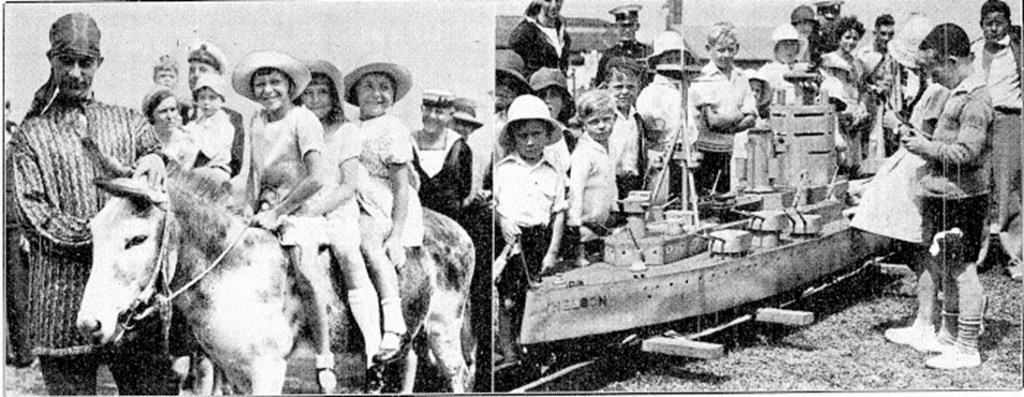
But our interest here isn’t on children’s entertainment, but on the contribution of the Devonport donkey to garden history. In November 1931, among the “News of the Day”, the Auckland Star reported under the heading, “Donkey Does His Bit”:
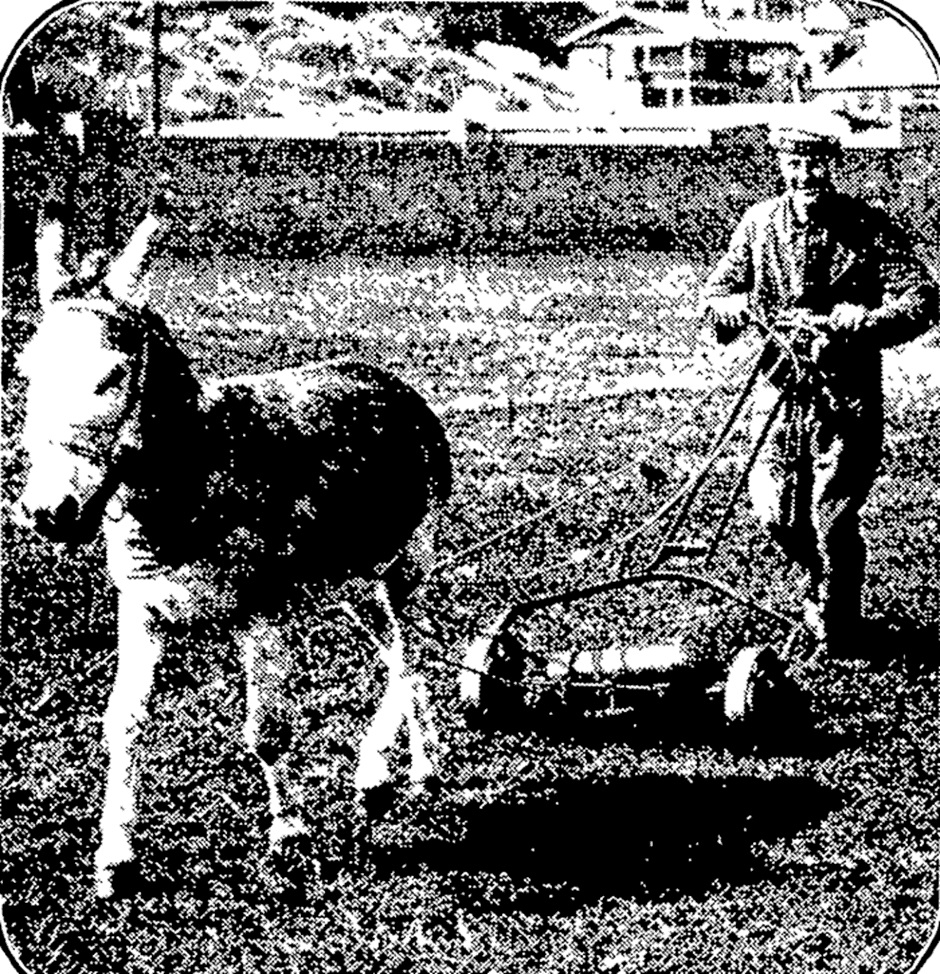
“Donkeys were common enough about Auckland some years ago, but to-day their braying is seldom heard. There is at Devonport, however, one donkey that not only interests young folk, but also earns his carrots. He is one of the mascots attached to the naval base, and this morning he might have been seen pulling the lawnmower which cuts the playing area on which the men of the squadron play their games. The donkey was acquired by an officer on H.M.S. Philomel, who has now returned to England, so it appears likely that the animal will spend the rest of its life at the navy yard”.[viii]
In February 1932, a photograph appeared in the New Zealand Herald under the title, “The Navy Solves a Problem”, where “One of the trainees at the Devonport Naval Base calls in the services of a donkey to assist in cutting the lawn which forms part of the reserve”.[ix] The remaining livestock quartered at the Naval Base at Devonport were soon after seriously depleted, with the entire naval flock of sheep, numbering three head, having disappeared due to not presenting a payable proposition – the flock were deemed “neither useful nor ornamental”. It was subsequently noted that “a somewhat temperamental donkey now grazes in solitary state on the playing fields at the base. The sheep, on the other hand, “were transported… to an unknown destination”, though it was stated that “it is understood that several needy families at Devonport were provided with enough fresh mutton for several meals”.[x]

Further images followed. In September the same year, another came with the caption “Novel Motive Power for the Lawnmower at the Naval Base: A sailor mowing the lawn at the Devonport Naval Base yesterday with the aid the navy’s pet donkey”.[xi]

A third image was published in March 1933, under the heading ‘A Naval Assistant’, with the byline: “The donkey at the Naval Base is a well-known figure and assists in keeping the lawns in perfect order”. It added an extra detail, “Note the shell used as a weight on the mower”.[xii]
That the donkey was temperamental was echoed in a report on another Naval Base party in January 1934. While for the children that day was reported as “Joy Unbounded”, for the animal the Auckland Star noted: “The donkey, which usually draws the lawnmower on the recreation grounds, was used as a riding horse. The animal did not enjoy itself as much as the delighted children whom it carried. Still, it did not often refuse to go.”[xiii] Covering the same event, the New Zealand Herald noted the variety of events on the day: “The youngsters were invited to throw tennis balls at the head of an able seaman clown in an endeavour to remove his hat. Further on the same youngsters were handed bricks which they were permitted to hurl at shelves of crockery… There were hoop-las and skittle alleys and a miniature rifle range for older boys”. The donkey was noted in this report also: “The division’s donkey, which occasionally provides the motive power for the lawnmower on the recreation grounds, was also pressed into service and donkey rides were a popular feature”.[xiv] Following these three years of interest, however, the lawnmowing donkey apparently slipped into obscurity, presumably not ending up on the plates of the needy Devonport locals.
Interestingly, this donkey was not the first equine employed to mow the grass at the naval base. A decade earlier, in 1923, it was reported that the:
H.M.S. Philomel is probably the only ship in the Royal Navy that has a horse for a pet. If she went to sea there might be some difficulty about the horse, although there was a destroyer in the Mediterranean that carried a donkey. This animal, however, was signed on when it was a foal and it grew up on board, developing a fine set of sea legs and an astonishing capacity for rum. It could go down the gangway with the leave men and take its place in the picket boat as nimbly as the goat and some sailors aver that it could pull an oar. That however is another story.
The Philomel’s horse was won by a member of the crew in a half-crown raffle, and in the comfortable surroundings of the dockyard and football ground it has flourished exceedingly. A number of the men can now ride far better than any sailor should. The other day it was necessary to cut the grass on the football ground and the sailors thought their horse might lend a hand. Out of rope and canvas, something that resembled a set of harness was made and the animal was hitched to the mower. The rope reins, according to one sailor, were thick enough to moor a battleship. Three men undertook the mowing job. One held the mower handle and the reins, another had a whip and a third was on hand to give advice. Since joining the navy the horse has been given to understand that everything must be done “at the double,” so when the driver shouted “full steam ahead” and the others made encouraging sounds, he plunged into a gallop. “Hard astern,” or words to that effect came from the man giving advice, and the outfit was heaved to.
At this moment the ship’s goat, which sometimes is seen abroad with leave men, wearing a sailor’s jacket, took an interest in the proceedings. Possibly he made some sarcastic remarks to which the horse objected. At any rate the horse shied at the goat and it seemed that some grass would be cut very rapidly, but the driver pulled hard aport and once more saved the situation. The goat having been ordered off the parade in disgrace another attempt was made to mow the grass, but the horse refused to have anything more to do with the job. He would not move.
“I know what’s the matter,” said the driver, … “he’s out of his stride. He’s always galloped from his paddock and this time he was led. We’ll take him back, gallop him up and then see.” This was done and the horse was again hitched to the mower and he worked as pleasantly as possible. The driver’s reputation as a horseman is now high.[xv]
References
[i] A Floating Aviary. Auckland Star, 12 February 1931, P8
[ii] HMS Philomel, NZ History website: https://nzhistory.govt.nz/war/hms-philomel
[iii] Social Gatherings. Auckland Star, 17 August 1931, P11
[iv] Thrilling Party. New Zealand Herald, 27 August 1931, P12
[v] Children’s Party. New Zealand Herald, 8 February 1932, P10
[vi] A Children’s Party. New Zealand Herald, 1 February 1933, P4
[vii] Auckland Star, 18 January 1934, P20
[viii] News of the Day. Auckland Star, 24 November 1931, P6
[ix] New Zealand Herald, 27 February 1932, PAGE 8
[x] Sheep-farming Venture. New Zealand Herald, 13 August 1932, P12
[xi] New Zealand Herald, 24 September 1932, P8
[xii] Auckland Star, 17 March 1933, P5
[xiii] Joy Unbounded. Auckland Star, 18 January 1934, P20
[xiv] Children’s Delights. New Zealand Herald, 18 January 1934, P10
[xv] BLUEJACKETS’ PETS. New Zealand Herald, 27 October 1923, P14

 The Garden History Research Foundation