
By Ian Duggan, Te Aka Mātuatua – School of Science, The University of Waikato
The tree tomato (Solanum betaceum Cav.) is native to South America. However, in New Zealand it has long been popular in gardens, and Aotearoa is the primary commercial grower of the fruit outside of its native range. Further, like ‘kiwifruit’, New Zealand has been responsible for the ‘tamarillo’ moniker, which has become the standard commercial designation for the versatile fruit.
Early introductions and experiments
The first known record of the tree tomato in New Zealand has been widely attributed to the nursery of D. Hay and Son, near Parnell, Auckland, where it was advertised in their 1891-92 catalogue. They declare they obtained seed in 1891 from a gentleman who had it sent from the hill district of India, where the plant was growing almost wild.[i] However, thanks to the power of Papers Past, we can push the first known mention of the tree tomato in New Zealand back to an independent importation by George Mason of Claudelands Nursery, Hamilton. In May 1890, the Waikato Times reported, Mason had
…a novelty in his nursery in the shape of what is called a tree tomato. This has been raised from seed imported from Ceylon [now Sri Lanka], and has been grown under glass. The plant is now about a foot in height. It bears a fruit which somewhat resembles a tomato in appearance, but the flavour is said to equal that of an apricot. Mr Mason has also about fifty young plants, and these will soon be ready for disposal.[ii]
Advertisements for the fruit trees increased rapidly from this time, particularly in the North Island.
In June 1893 Murray Aston, a correspondent for the Otago Witness visiting Auckland, observed that in the northern city the usual commodities of life ranged pretty much the same in value as in Dunedin, with the important exception of fruit,
…which in comparison with the cost in Otago makes one conjecture that the public here [in Otago] are not being so fairly treated as they deserve. A most delicious fruit is the green fig”, he stated, “which seems quite plentiful up north, and are sold in the shops at 4d per lb… Another, to me novel and at the same time appetising, delicacy in the fruit line (also sold retail at 4d per lb) was the “tree tomato.” In flavour it was not unlike the passion fruit ; in shape it resembled an egg of the common fowl, and its colour was that of a bright, glass-grown, ordinary tomato. I have never seen any of these in Dunedin, and I feel sure they could be imported to yield a good profit to some of our enterprising fruiterers.[iii]
In November 1894 the Dunstan Times, from Central Otago, reported that a quantity of the fruit had been sold the previous season by fruiterers in Wellington, under the name of the ‘Queensland tomato’, which
…quite took the fancy of buyers”. “Although the fruit is said to be delicious, there is a great diversity of opinion as to its flavor [sic], some people thinking it tastes like tomato and guava, others like tomato and melon, and gooseberry. It is said to make excellent tarts and jam”.[iv]
No mention of the name ‘Queensland tomato’ can be found in print beyond this article, however.
Throughout these early years, only yellow- and purple-coloured strains were apparently available in New Zealand, with the red varieties that came to dominate being used only from around the end of World War One. A Mr Bridge, of Mangare, Auckland, is reported to have grown the first red strain in New Zealand at this time, though other strains of that colour were introduced soon after, including from the United States.[v]
Despite recipes galore appearing in newspapers, and its wide availability from nurseries in the decades before, the popularity of the fruit seemingly did not take hold until the 1940s, when the Sub-Tropical Fruits Association began to distribute pamphlets containing recipes within the containers of the fruit. In June 1947, A. B. Congdon, President of the New Zealand Fruitgrowers’ Association stated in an address to a party of fruit growers at Otumoetai that “In my opinion the Sub-Tropical Fruitgrowers’ Association started out on the right foot when they printed recipes on the treatment of tree tomatoes, to pack with the fruit”. He said that if that had not been done, possibly many people would have tried them raw, disliked them, and not bothered to have ordered any more.[vi],[vii]

In late 1947, the tree tomato was reported to be becoming increasingly popular in New Zealand. Because of an increased demand, the area under commercial cultivation underwent rapid expansion. It was estimated in 1947 that there were 136 acres under cultivation, with most of this comprising numerous small plantings of up to an acre in extent, with much of this small adjuncts to citrus culture on small holdings. The number of larger plantings was, however, also increasing. Plantings weren’t distributed evenly across the country, however. Being a sub-tropical shrub “and considerably more frost tender than the lemon”, its commercial culture was largely confined to the frost-free areas of the Auckland Province. By this time the red variety had become the most popular on the market and was thus planted in greater proportion.[viii]
An export industry
Export became a priority in the 1960s. It was reported in 1961 that, prompted by Government exhortations to get out and sell, a group of New Zealand tree-tomato growers had shipped sample packs of fruit to Melbourne, Hong Kong and Italy. Nevertheless, concerns had arisen at this time regarding the name of the fruit.
One of the snags to marketing the fruit in Australia, where it is almost unknown, is the prosaic name. Experienced businessmen in the Australian fruit trade thought it was some variety of tomato. Hopes centre on selling it overseas under its botanical name Solanum.[ix]
These sentiments were echoed in 1962, when exploring trade of fruit to Sydney:
Another fruit which is not yet well known is the tree tomato… exports would be increased if the Australian public realised that this fruit is not just another form of the familiar tomato.[x]

What’s in a name?
In response to these naming concerns, a new name was proposed – but it wasn’t ‘Solanum’. ‘Tamarillo’ was suggested by Mr W. Thomson of Kerikeri, the chairman of the Tree Tomato Advertising and Promotion Committee, and this was approved by grower associations and trade interests in February 1966.[xi] But where did the name Tamarillo come from? Was it a native South American name for the fruit? No! Thomson explained that:
The new name is the result of many months of extensive research… It is a composite name, the first section of which is associated with New Zealand and the second with South America, the countries of adoption and origin respectively.[xii]
…the first section of the composite name, Tama, had been chosen as a compliment to New Zealand, the country of adoption. It also had historical significance, Tama being the commander of one of the early migratory canoes which brought the Maoris (sic) to New Zealand from Polynesia. The Maori people sometimes used the names of people of rank when naming articles of value, including agricultural products. Tama blended well with the South American section of the name and had the advantage that it was easy to pronounce by people not used to the Maori language.
Mr Thomson stated the tree tomato was a native of Brazil and Peru: “In these two countries the fruit is known as Paolo de tomate and tomale de arbol, which, translated literally, means tree tomato”, he said. “Little help is gained, therefore, from the South American names, and likewise from the botanical name, Cyphomandra betacea Sendt [now Solanum betaceum].” “However, in the countries of origin there is a close relative of this family, the tomatillo, meaning a small tomato. “We are endeavouring to get away from the association with the word tomato, but as a compliment to the countries of origin the final portion of this word has been retained as Tillo. The letter T was replaced in Tillo to make it easier to pronounce.” The name Tamarillo was registered with the Patents Office and it was reported that it could be used for the coming season’s export crop.[xiii]
A date of January 31, 1967, was declared as when the tree tomato would be officially rebranded as the tamarillo, with the name applying to the fruit sold on the New Zealand market as well as for export.[xiv] A rebranding ceremony was held at Waitangi in April, attended by about 80 representatives of the Tamarillo Growing Association from Kerikeri, Te Puke and Auckland, where the first tamarillo harvesting season was declared open.[xv]
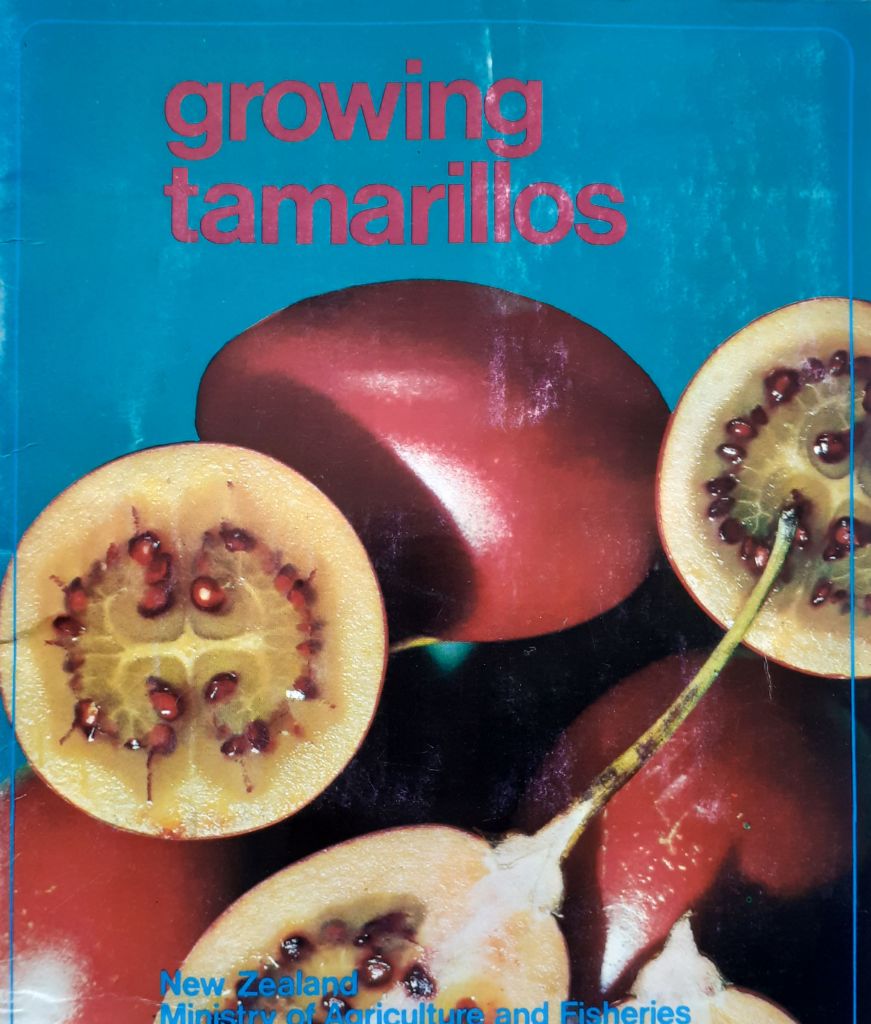
Not everything went to plan with the renaming, however. On 15 January 1970, for example, the name “tamarillo” printed on the label of cans was declared to be not adequate for the New South Wales Department of Health, with the department ruling that cans of the fruit imported from New Zealand must also carry the words “tree tomatoes.” Here, their Department of Health claimed that “tree tomato” was the commonly accepted English name for the fruit. In response, New Zealand trade officers stated that one reason why “tamarillo” was now preferred and used in New Zealand was that United States officials had objected to “tree tomato” as misleading:
“We changed it to get acceptance on the American market, but now find New South Wales doesn’t like the new term. You can’t win.”[xvi]
In 1977, a display of tamarillos and other fruits at department store Haywrights in Christchurch by the Kerikeri Citrus Growers’ Association. Mr D. Anning, one of the organisers of the display, stated that:
Tamarillos are one of the most underrated fruits. They can be eaten raw, sliced up for fruit salads and green salads, or added to chutneys, relish, and casseroles. They can also be stewed like other fruit and made into pies. How many people know that tamarillos have a great tenderising effect on meat?” said Mr Anning. He has been amazed during the week that many people are still unsure what tamarillos are. “They used to be called tree tomatoes,” Mr Anning said. “Many people are still confusing them with kiwi fruit, which changed their name from “Chinese gooseberries.”[xvii]
Nowadays, many of us still enjoy tamarillo, but I bet few of us know the origins of the name.

References
[i] Fletcher, WA. 1975. Growing Tamarillos. New Zealand Ministry of Agriculture and Fisheries, Bulletin. 306.
[ii] The Claudelands Nursery. Waikato Times, 17 May 1890, P2
[iii] A few noted on Auckland. Otago Witness, 1 June 1893, P35
[iv] Local and general. Dunstan Times, 2 November 1894, P2
[v] Fletcher, WA. 1975. Growing Tamarillos. New Zealand Ministry of Agriculture and Fisheries, Bulletin. 306.
[vi] Out and About. Bay of Plenty Times, 25 June 1947, P2
[vii] First General Meeting. Bay of Plenty Times, 2 July 1947, P2
[viii] Free Tomato Increasingly Popular Sub-tropical Fruit In Dominion. Bay of Plenty Times, 22 November 1947, P4
[ix] Tree Tomato Exports. Press, 17 October 1961, P12
[x] Small-Fruit Exports. Press, 24 April 1962, P3
[xi] New Name For The Tree Tomato. Press, 15 February 1966, P1
[xii] Change Of Name. Press, 6 September 1966, P3
[xiii] New Name For The Tree Tomato. Press, 15 February 1966, P 1
[xiv] Change Of Name. Press, 6 September 1966, P3
[xv] Tamarillos (Official). Press, 4 April 1967, P1
[xvi] Name Trouble. Press, 16 January 1970, P20
[xvii] Kerikeri promotion of citrus fruit range. Press, 27 May 1977, P2

 The Garden History Research Foundation