
by Ian Duggan
A number of newspaper reports were published in the early 20th Century on the figureheads of ships featuring as items of statuary in New Zealand gardens. In a previous blog we covered the Hydrabad, whose figurehead ended up in a Foxton garden for many years, before it came to an unfortunate end, chopped up for firewood. In this blog we examine the HMS Wolverine, whose figurehead adorned the garden of a residence in Stanley Bay, Devonport, Auckland.
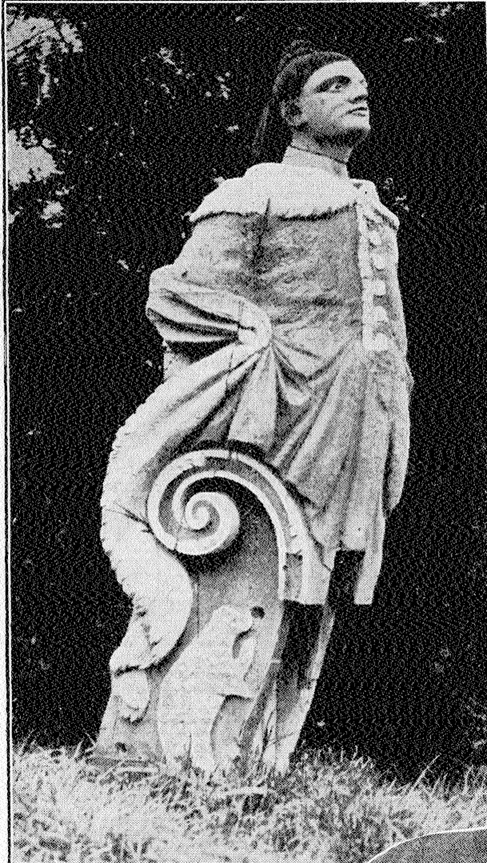
By 1929, the figurehead of the Wolverine was already said to have been “a prominent feature in a garden at Stanley Bay for many decades”[i]. The figurehead was described as “gigantic”; “his knotted wig and closely buttoned coat represents a hunter of the seas; a wolverine is carved on either side of the base of the figure; a faithful modelling of the animal that scours the icy wastes by the frozen northern oceans”.[ii] Elsewhere, however, it is described as the “figure of a Red Indian”.[iii] And, perhaps it was most interestingly stated as such: “Impressive in its rude vigour is the figure-head of the Wolverine, a gigantic male figure representing a hunter of the seas”. [iv]
The garden of interest belonged to a Mr. Arthur Willetts[v], a resident of Waterview Road. Willetts had worked in the then well-known ship-yards of George Niccol Limited, where he built boats for 52 years, up until the time the yards were closed in 1932, the last 20 of which he had spent as foreman. He had joined the firm when he was only 13 years of age, having followed in the footsteps of his father, Mr. James Willetts, who had worked in the Niccol yards before him. Through his career, the younger Willetts had worked on the builds of 80 large boats, including the ferries Condor, Pupuke and Toroa, as well as all the vehicular ferry steamers active in the harbour in 1932. The oldest vessel he helped build still active at the time the boat-yards closed was the scow ‘Tally Ho’, which brought sand to Auckland from the islands in the gulf. Of interest to the current story, of this boat he said he had “built about 38 years ago out of the timbers of the old man-o’-war Wolverine. That warship, which used to be stationed in New Zealand waters in the old days, was one of the old ‘wooden walls’ of England. When her days were ended I helped to break her up in Stanley Bay. We used her timbers, which were wonderfully sound, to build scows and schooners, and her sails were cut down to suit smaller vessels”.[vi]

The HMS Wolverine was launched in the UK in 1863, and was said to be “composite in build”, being constructed of iron frames with teak and oak planking, and “composite in motive power, having both sails and steam”.[vii] A Wikipedia page on the vessel provides a more lengthy synopsis of her life and activities, but briefly: she served in North American and West Indian waters in the 1860s and early 1870s, and from 1875 served as the flagship of the navy in Australian waters. In 1882, she was presented to the Colony of New South Wales as a training ship for the New South Wales Naval Brigade and New South Wales Naval Artillery Volunteers, before being decommissioned in 1892. She later, briefly, became a merchant vessel.
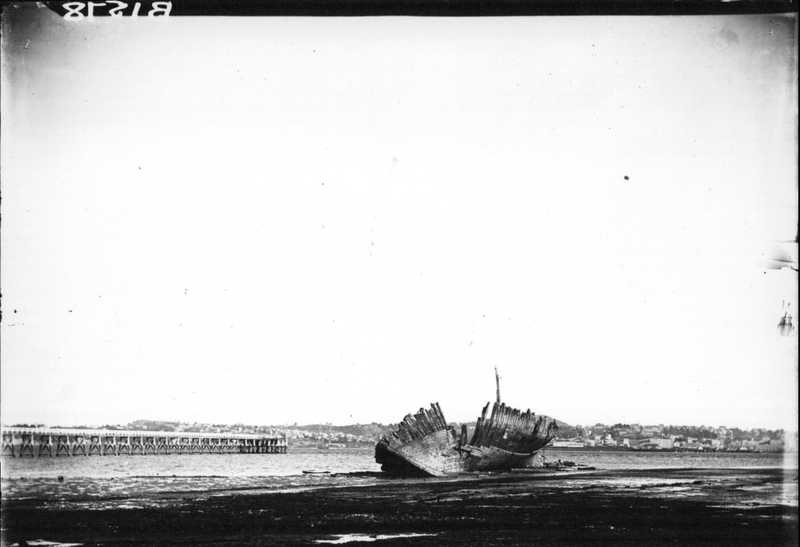
The days of the Wolverine came to an unceremonious end on a voyage from Sydney. Her new owners loaded her with shale and she was dispatched for Liverpool, England, but when some time out she began to leak badly the crew demanded that the master put back to port for repairs. She arrived at Auckland, being the nearest port, in April 1895. The Government authorities then condemned the ship following a survey, and she was sold to Mr. G. T. Niccol[viii] – or, as one report phrased it, “she came into the hands of ship-breakers”.[ix] Niccol and company began to dismantle the Wolverine where she lay, moored off Northcote, and she was later docked at Calliope Dock, where her valuable copper sheathing was stripped, and her copper fastenings taken out. After being undocked the Wolverine lay in Stanley Bay for some time, and eventually the remains of the hull were burnt.[x] In 1900, the last remnants were said to have been blown up with dynamite, after which very little remained.[xi]
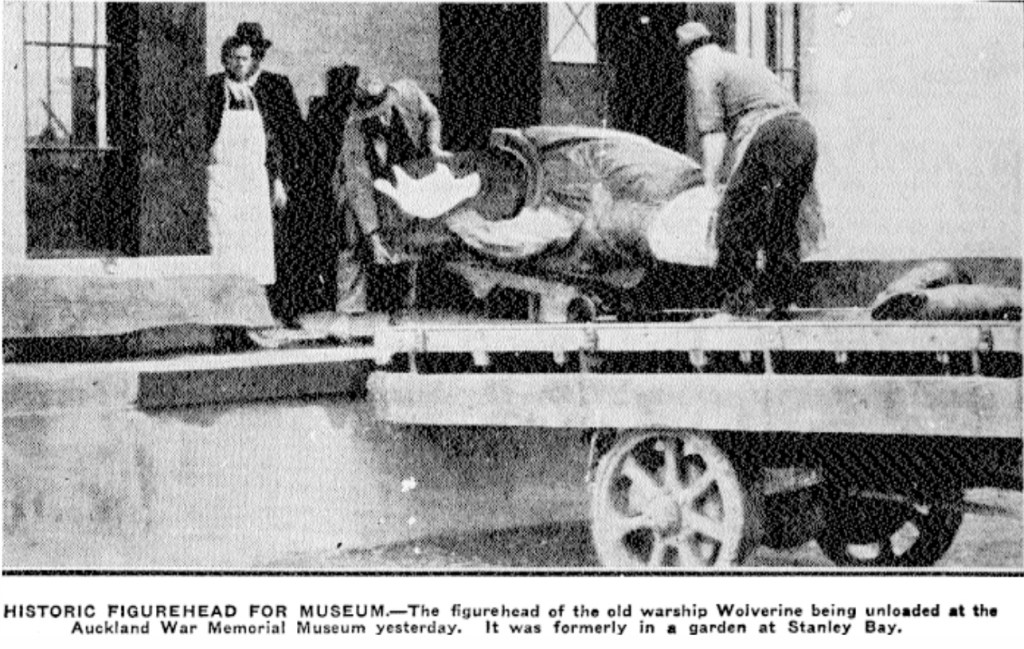
It was during the breaking up of the vessel that the figurehead came into the possession of Arthur Willetts, and placed in his garden – likely in the late 1890s – and there it remained for many years[xii]. Little was noted in the press of its time in the garden, except that the figurehead was taken down from its pedestal in 1921 and repaired, and it was hinted at this time that it would, in all probability, find a last resting place in the museum.[xiii] It wasn’t until mid-1929, however, that this move was made, being first transported to the Auckland War Memorial Museum, though not without some protest: Commander Nelson Clover hoped that the figurehead would instead be erected along with others at the nautical museum at the Devonport naval yards.[xiv] Indeed, by late 1930 he got his wish, when it joined the existing collection of figureheads there.

It is unclear what happened to the Wolverine figurehead thereafter. However, it was noted in 1952 that: “The remains of what were once handsome figureheads from sailing ships are now rotting in a corner of the Devonport Naval Base. The Navy considers restoration impracticable. The figureheads were collected over a period of years, and were originally mounted along the driveways at the base… They have been repaired and repainted periodically, but most of them are now unrecognisable. There were at one time 16 figureheads; to-day only one is standing, and seven others are stored near the workshops behind the base playing field. Outside collectors have shown some interest in the models, but the Naval Board in Wellington considers that their maritime history makes H.M.N.Z.S. Philomel the proper place for them. It is proposed to coat the figureheads with a preservative, and to store them till they can be displayed under shelter”.[xv]

Read Part I here: The Hydrabad
Read Part III here: The America, the Helen Denny, and others
References:
[i] News in Brief. Otago Daily Times, 15 July 1929, P14
[ii] Sun (Auckland), 22 March 1930, P17
[iii] Auckland Star, 12 September 1930, P8
[iv] Maritime Museum. Waihi Daily Telegraph, 2 July 1938, P3
[v] Sun (Auckland), 21 October 1927, P16
[vi] Ship Yards Close. New Zealand Herald, 14 November 1932, P10
[vii] Sun (Auckland), 22 March 1930, P17
[viii] Auckland Star, 25 October 1930, P15 (Supplement)
[ix] Sun (Auckland), 22 March 1930, P17
[x] Auckland Star, 25 October 1930, P15 (Supplement)
[xi] Auckland News Notes. Otago Daily Times, 13 September 1900, P5
[xii] New Zealand Herald, 17 June 1929, P11
[xiii] Auckland Star, 8 August 1921, P4
[xiv] New Zealand Herald, 17 June 1929, P11
[xv] Press, 17 September 1952, Page 8

 The Garden History Research Foundation
2 thoughts on “Ship Figureheads as Statuary in New Zealand Gardens, Part 2: The Wolverine”