
By Lindsay Amner
The sundial in Hamilton’s Garden Place has been an iconic fixture in the centre of the city since 1953. Generations of children have played on it, various vandals have bashed it, and thousands of people have gazed at its various dials without the slightest understanding of how it works.
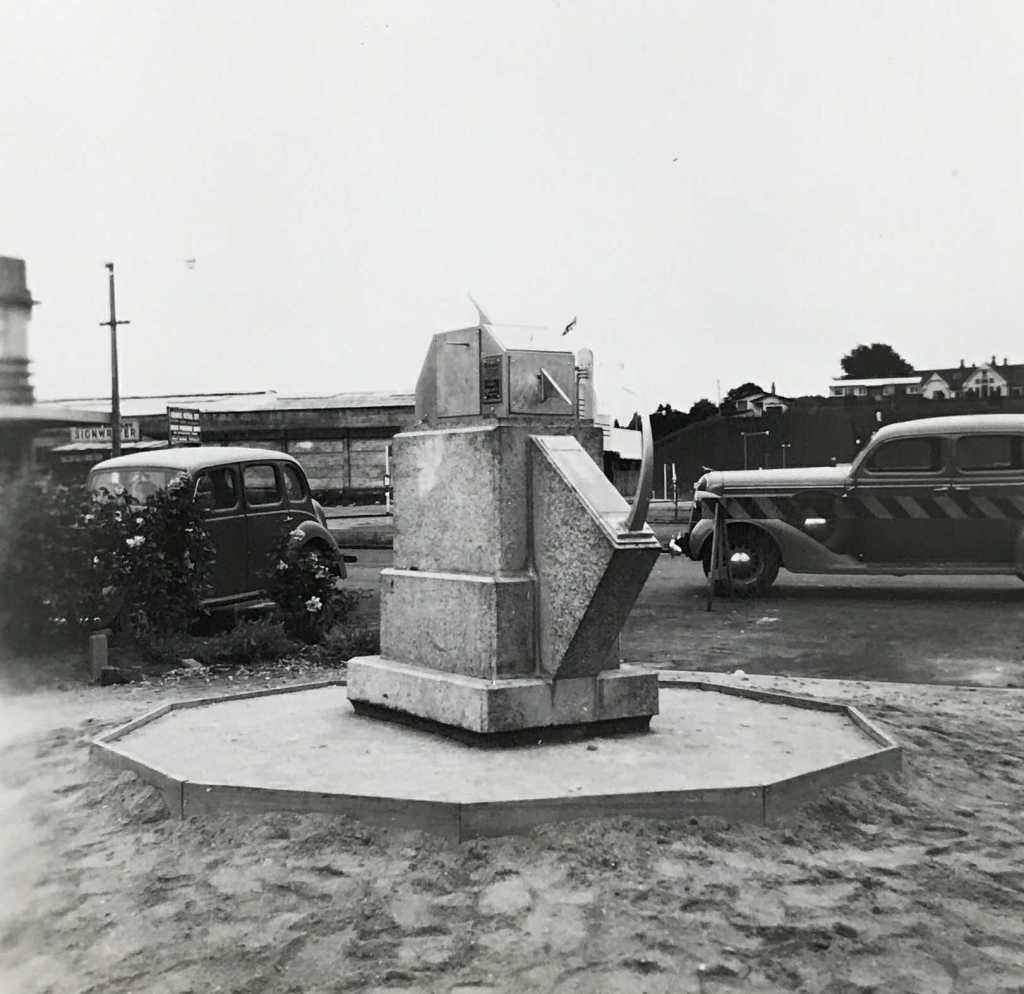
My grandfather, Allan Bryce, designed the sundial and with the aid of my mother Bessie Amner’s research into the Hamilton Astronomical Society, I can provide some of the background as to how the sundial came to be a much loved feature of the central city.
In the early 1930s, the Hamilton Borough Council was discussing the potential removal of the Garden Place hill. The Anglesea Street cutting had been carved through the hill in 1932, and flattening out the eastern, central city part of the hill seemed a good idea to many people.
But to the local star gazers this was a terrible idea. Allan Bryce, a prominent local chiropractor, scientist and astronomer, believed strongly that an astronomical observatory should be built on top of the hill. To push this idea, he and several of his friends formed the Hamilton Astronomical Society in 1933 with the initial aim of opposing the Council’s plan to remove the hill.
In September 1936, Allan Bryce proposed that the Astronomical Society present a sundial as a gift to Hamilton to mark the coronation of King Edward VIII. Allan designed an eight dial sundial – for Edward VIII – and the New Zealand Herald made and engraved the dials in their printing shop for free. The other metal parts of the sundial (the frame, pins, spikes/gnomons, etc) were cast and machined by Robert Alchin. But in December 1936, Edward abdicated, removing the significance of the eight dials and greatly disappointing Allan Bryce.
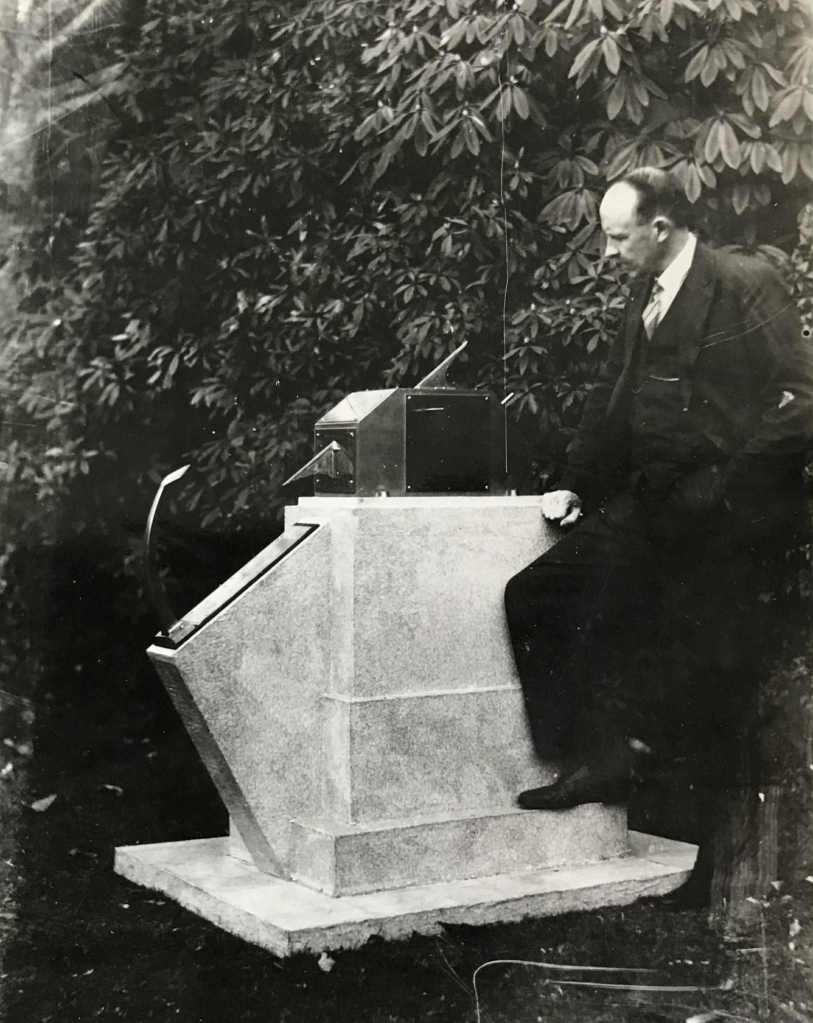
But in spite of the King’s lack of cooperation, the sundial was largely complete in February 1937 and was offered as a gift to the town. The Council ignored the offer, however, probably because the Astronomical Society was one of the most vocal groups opposing the plans for removing the Garden Place hill.
In mid 1938 the Council voted to remove the hill and a year later it was gone. World War Two arrived about the same time as the hill was shoveled into the gullies around Whitiora, mainly filling in areas between Rugby Park and the Waikato River. Ulster Street runs over what was once a gully, now filled with the Garden Place hill, near where the golf driving range is today, and Beetham Park also sits on a hill-filled gully.
With no interest from Council, with a war raging, with much of central Hamilton an Air Force camp, and with the hill where they wanted to put their observatory turned into a carpark, temporary military offices and air raid trenches, the Astronomical Society sadly put their sundial away in Allan Bryce’s shed behind his house on River Road.

When the war ended in 1945, Hamilton town became a city, the air raid trenches were filled in, the temporary buildings were removed and the Astronomical Society reopened their offer to gift the sundial to the new city. Since the hill was gone and therefore opposition to its removal was also gone, the City Council seemed more inclined to accept the gift. In 1947 the Council eventually voted to accept the sundial but then began to debate where it should be placed, along with the town clock. The two timepieces would logically go together but the Council were unable to make a decision about it, so nothing was done for several more years.
The newly crowned Queen Elizabeth II gave new life to the project in 1953. Her visit to New Zealand that year included a stop in Hamilton over 30-31 December. The Council agreed that this event would be perfect for the sundial to finally become part of the cityscape. The sundial was therefore hauled out of Allan Bryce’s shed and refurbished ready for installation at the front of Garden Place.

The granite plinth had been damaged during storage and had to be sent off to Auckland to be refinished and the Astronomical Society recorded the plinth design as follows:
“The ten granite segments will enclose a terrazzo surround at base of dial. The granite slabs will form, when placed in position, a 10 sided step up to the platform on which the pedestal stands. Carved in stone on the vertical polished edges of the slab are the names of 10 places of interest to visitors to Hamilton. The top surface of each slab has a bronze plate set into it indicating the direction from Hamilton to the place named on the step, together with its distance in miles. The following places are named – Auckland, Whitianga, Tauranga, Te Aroha, Rotorua, Chateau, Waitomo Caves, Kawhia, Raglan and Waikato Heads.”
Seventeen years after it was first proposed and built, the sundial was finally installed in December 1953, in time for the Queen’s motorcade to glide serenely past it, and for the young Queen to wave at it.
With the sundial now belonging to the city, the Council took on the job of maintaining it. In 1955 they voted £500 for the building of a stainless steel railing around the sundial to try to prevent some of the vandalism which constantly plagued it. The railing was finally installed in 1957 and the last pieces of the terrazzo surround were completed in 1958.

The original site for the sundial was centrally on the edge of Victoria Street on the front edge of what was then a carpark. In about 1968 Garden Place was refurbished with fountains and grassed areas, and the sundial was moved back about 20 metres from Victoria Street to a position nicely placed near the fountains and the central areas of the park. Then a further Garden Place remodel in the early 2000s saw the sundial moved again, further west away from Victoria Street, to sit in front of the public library. It is still there today, 72 years after its installation, the longest lasting public art feature in the central city and a monument to a group of scientifically minded men, particularly Allan Bryce and Robert Alchin, whose vision for the central city was never realized, but their gift to the city remains.

Sources
Amner, Bessie M.L., Star Struck: the Hamilton Astronomical Society 1933-2003, Self Published, Hamilton, 2005
A History of Garden Place, A DigitalNZ Story by Zokoroa, https://digitalnz.org/stories accessed 24 Sep 2025

 The Garden History Research Foundation