
Diego Molina, British Academy Postdoctoral Fellow, Royal Holloway, University of London. Diego.Molina@rhul.ac.uk
During the early 19th century, Latin American nations obtained their independence from then colonial powers, Spain and Portugal. This political independence, however, did not translate into cultural emancipation. As a general rule, those involved in the insurrections that led to the declarations of independence across the continent were ‘enlightened’ men, usually descendants of Iberians. Thus, mentally and spiritually closer to Europe than to their American territories, these new elites looked again to the north in a search for new models capable of replacing the world of the decadent empires. In this context, they found in England and France –– or more precisely, London and Paris –– the new template that guided the economics, the culture, the politics and, of course, the ways of building their cities and, at the same time, accommodating nature inside them.
For the Post-independence Latin American urban elites, the aim was clear. If they wanted to look modern, it was essential to endow their cities with green spaces that resembled London´s Hyde Park or Paris´ Bois de Vincennes (Figure 1). Some port cities such as Buenos Aires, Rio de Janeiro, Mexico City or Santiago de Chile, underwent a drastic transformation by the hand of French landscape designers such as Charles Thays or Édouard André.[1] In such cities, the incorporation of green spaces into the city was possible due to improvements in their economic situation as a consequence of their integration into the 19th century transatlantic international trade as a raw-material providers. Yet, while landscape and urban historians have extensively explored the creation of green spaces in Latin American temperate cities, we still largely ignore the process that accompanied the creation of modern gardens and parks in biodiverse cities located in the tropical environments.

To contribute to the understanding of how modern urban green spaces were established in tropical environments in the Andes, I have recently published a book entitled: Planting a City in the Tropical Andes Plants and People in Bogotá, 1880 to 1920 (Figure 2). As the first volume of the Routledge Research on Gardens in History, this book examines the creation of a modern flora in Bogotá. The main argument of the book is that the modernisation of this city –– today’s capital of Colombia, located at 2,600 meters above sea level in the tropical Andes –– implied the creation of a sui-generis botanical urban inventory which, in turn, changed the understanding and use of plants in the city.

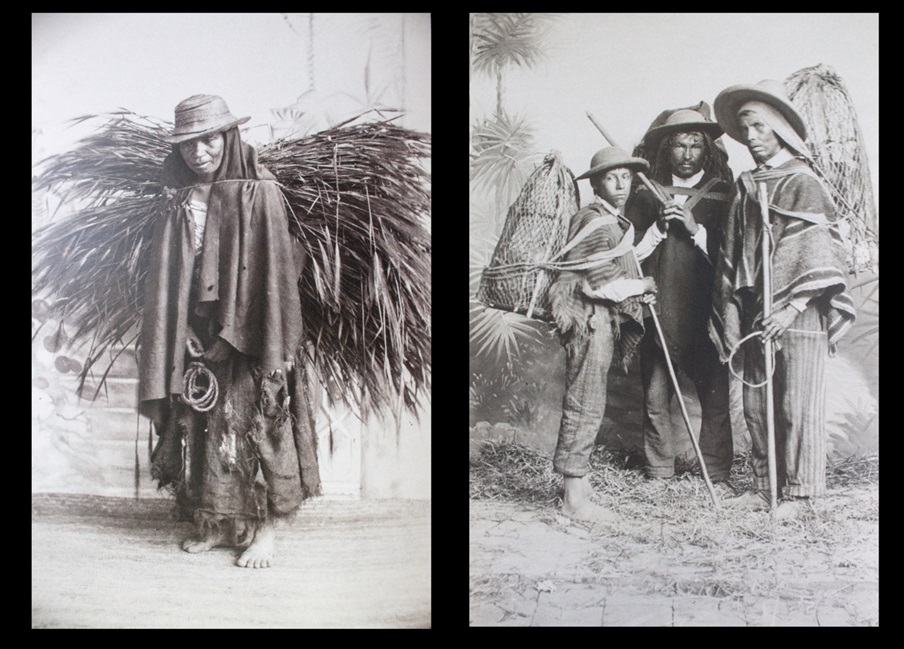
Until its modernisation in the late 19th century, Bogotá was an urban enclave permeated by its surrounding rurality. The interactions and uses of plants reflect this fact. For instance, until then, most of the relations with plants had taken place mostly in forest and moorlands surrounding the city. Indigenous people, or their descendants, endowed with inherited ethnobotanical knowledge, acceded these spaces and, from there, extracted a large range of raw materials, such as fibres and firewood indispensable for the daily life functioning of the city (Figure 3). Likewise, indigenous and mestizo people planted edible, aromatic and medicinal plants in their domestic backyards, known as solares, with which they treated minor illnesses in a city with a precarious medical service. In terms of ornamental plants, only a small minority, usually descended from the European conquerors, enjoyed gardens. During the majority of the city´s history, most gardens were of tiny dimension and all of them were planted in domestic spaces. These small gardens were usually established inside convents or planted by women of the elite in the patios of houses inhabited by the most affluent members of the society (Figure 4). For most of the population of the city, living in ill-aired small and overcrowded spaces, the mere idea of a garden was unconceivable.

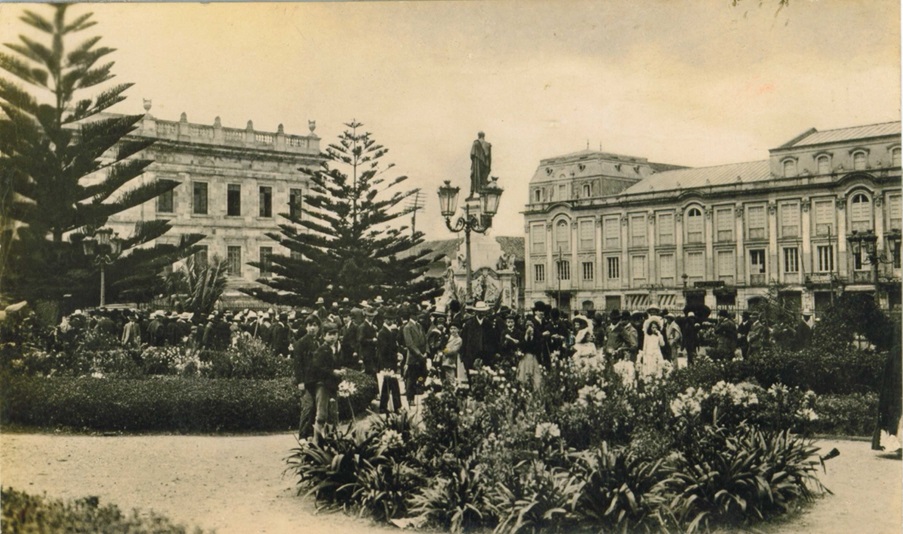
The nineteenth-century modernisation of the city implied a radical transformation of this traditional ways of arranging and interacting with plants. One of its main characteristics was the adoption of new social and cultural customs that included the creation of hitherto unseen public green spaces. This transformation of urban nature was initiated in 1880 when the local government commissioned the self-taught gardener Casiano Salcedo to create a garden in the Plaza de Bolívar. Since its foundation in the sixteenth century by Spaniards, this square had been the symbolic heart of the city, where all kinds of religious and political activities had taken place (Figure 5). Thus, creating a garden there spoke about the symbolic importance that gardens acquired in late-nineteenth-century Bogotá.

By 1882, Casiano Salcedo had transformed this square into the Parque de Bolivar. However, in spite of its pompous denomination as a ‘park’, as a matter of fact, the small green spaces were nothing more than small gardens (Figure 6). A small city of 100,000 inhabitants, poorly connected with the international markets and constantly affected by successive civil wars, simply did not have the economic possibilities to create large green spaces. Consequently, the modern dream of having a park similar to those seen by the elites during their trips to Europe did not fully materialise in Bogotá. This lack of equivalence with the European model of green space was partially countered with the use of European plants in the creation of these spaces. Despite being recognised today as one of the most biodiverse regions on earth with hundreds of species with enormous ornamental potential, back then, the local flora was not considered as a potential raw material in the modernisation of nature in Bogotá. Hence, in the creation of green spaces in the city, Casiano Salcedo mostly used plants imported from Paris through the Vilmorin nurseries, first, and from the Company of Alive plants based in Rochester in New York, later on.

The creation of green spaces in Bogotá was informed by the same ideas that had initially promoted their construction in Europe. Since the end of the eighteenth century, when the Dutch physiologist Jan Ingenhousz[2] had discovered the photosynthetic process, plants had turned into organic filters capable of fighting the miasmas and other noxious elements which promoted disease and moral degeneration. Then, by planting gardens and trees in cities the local authorities not only promoted a healthy body of the citizenry but also for an elevated morality. With this in mind, the local authorities in Bogotá saw in parks therapeutic spaces that promote health, while contributing to the moral education of the population. In that vein, the public gardens inspired by European models and built with plants from Paris needed to be places in which people abided by social behaviours considered as civilised. This idea, however, clashed with the local reality. For example, many ‘ornamental’ trees were seen as a source of firewood and therefore chopped for this purpose by people not used to seeing trees as a source of ‘good air’. To combat these practices, the local authorities of the city hired guards (locally known as celadores) who were responsible for correcting the manners of all the visitors of the gardens, just as the gardeners corrected deviated branches of a tree. In sum, the first public gardens in Bogotá enriched the city with a large number of previously unseen plants, while promoting a disciplined way of interacting with plants.
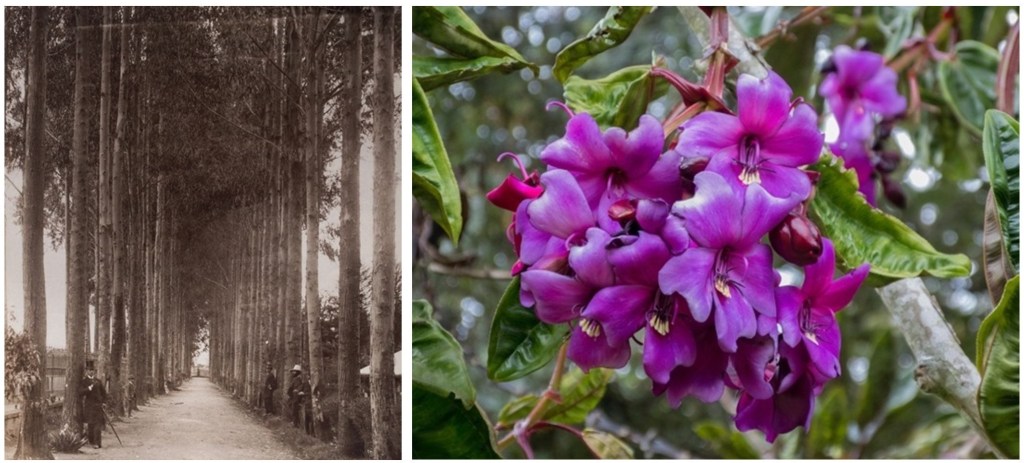
The art of mimicking European-like gardens in Bogotá informed the first green spaces of this Andean city. However, by the beginning of the twentieth century, this practice was unsustainable, simply because many plants brought from abroad did not survive, and their importation was expensive. This ecological reality forced city administrators to look at native species and species of flushing flowers such as the Amarrabollo, which became common in the city and replace intruded trees such as Eucalyptus globulus that had dominated the city landscape until then (Figure 7). This understanding of the local ecological condition had a social counterpart. Despite several attempts to regulate the entrance of the poorest people to parks promoted by some members of the elite, the parks maintained their public nature. It was simply too risky to deprive the labouring classes of these green spaces. In the eyes of the local elites, in doing so, the working classes would rush to local taverns known as Chicherias. In short, the initial European-like green spaces of Bogotá turned into a point of encounter between people and plants from different origins (Figure 8).
Next post… The art of mimicking II: Tropical Gardens in London
Footnotes
[1] Sonia Berjman and Anatole Tchikine, “Landscape Architecture in Latin America: Nineteenth and Twentieth Centuries,” Studies in the History of Gardens & Designed Landscapes 39, no. 3 (July 3, 2019): 175–77, doi:10.1080/14601176.2018.1561817.
[2] Jan Ingenhousz, Experiments upon Vegetables, Discovering Their Great Power of Purifying the Common Air in the Sun-Shine, and of Injuring It in the Shade and at Night. (London: printed for PElmsly; and HPayne, 1779).
 The Garden History Research Foundation