Ship Figureheads as Statuary in New Zealand Gardens, Part 3: the America, the Helen Denny, and others

Ian Duggan

A number of newspaper reports were published in the early 20th Century on the figureheads of ships featuring as items of statuary in New Zealand gardens. In previous blogs we examined the stories of the figureheads of the Hydrabad and HMS Wolverine. But there have been plenty of reports of others that have adorned our gardens besides these. Though not exhaustive, in this final contribution I examine the interesting stories of several more of these, including the figureheads of the America and the Helen Denny.

AMERICA

One of the most interesting remaining stories of ship figureheads appearing in New Zealand gardens is that of one that had lost its provenance. In March 1930, it was reported that an “exceptionally fine figurehead, true to nautical regulations in being one and a-half times life size, has lost her identity. For many years she reposed in the garden of Mr. J. J. Craig’s house, in Mountain Road [Epsom], but after 23-4 years no one remembers where she came from”.[i]
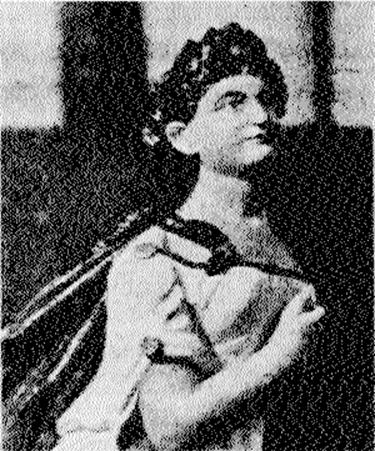
“This exceptionally fine figurehead, true to nautical regulations in being one and a-half times life size, has lost her identity”. Sun (Auckland), 22 March 1930, P 17

Soon after, this figure – like that of the Wolverine in our previous blog – made its way into the collection of ships’ figureheads at the naval headquarters in Devonport, Auckland. Despite the origin being unknown, it was noted to be “in an excellent state of preservation”. The figure was “that of a girl dressed in Grecian costume. The figure is a particularly fine one, and represents a very high degree of perfection in the art of wood-carving. The features are well-proportioned and the flowing garments have a most realistic appearance.”[ii]

It took some time to be confident of its origin, but it was “solved after four months’ investigation by Mr. T. Walsh, of Devonport, who undertook the task at the request of Commander Nelson Clover, [the] officer commanding the naval base at Devonport”.

Of the Devonport naval collection, the figurehead was described as the “largest and most ornately carved”. At first it was assumed to have come from the Constance Craig. “An inspection of the figurehead at the dock”, however, led to the conclusion that it did not come from this vessel: “Practically all the “shell backs” [a term used for an old or experienced sailor, especially one who has crossed the equator] to be found about Auckland waterfront, were consulted about the possible origin of this old piece of ship ornamentation. The Joseph Craig, the Hazel Craig, the Quathlamba, and the Royal Tar were mentioned as being likely ships, but in each case investigation proved that the figure-head did not come from any of the vessels mentioned. The possibility that the late Mr. J. J. Craig had bought the figurehead in Fiji or elsewhere was then examined. After 60 inquiries had been made a chance meeting with a carter formerly employed by J. J. Craig, Ltd., elicited that for many years the figurehead had reposed in a shed on the old Railway Wharf. The following up of this line of inquiry led eventually to establishing that the figurehead belonged to the ship America, which put into Auckland in distress in 1903 and was condemned here”.

Research uncovered at the time found that the America had started life in 1868 under the name ‘Mornington’. “In July, 1903, she sailed from Newcastle [Australia] with 2,400 tons of coal, but was two days out when a leak developed in the stern”… “The ship put into Auckland, and the captain made a great fight to save his ship. She was condemned on September 3, 1903, and cargo and ship were sold. Some years later the ship was dismantled and anchored in “Rotten Row.” When the American fleet visited the Waitemata, in 1908, the America left her moorings and fetched up alongside one of the worships. The weather was exceedingly rough, and every effort to shift the hulk failed”…  “the old hulk was taken to the “bay of wrecks” at Pine Island, where holiday-makers subsequently set her afire”.[iii]

HELEN DENNY                
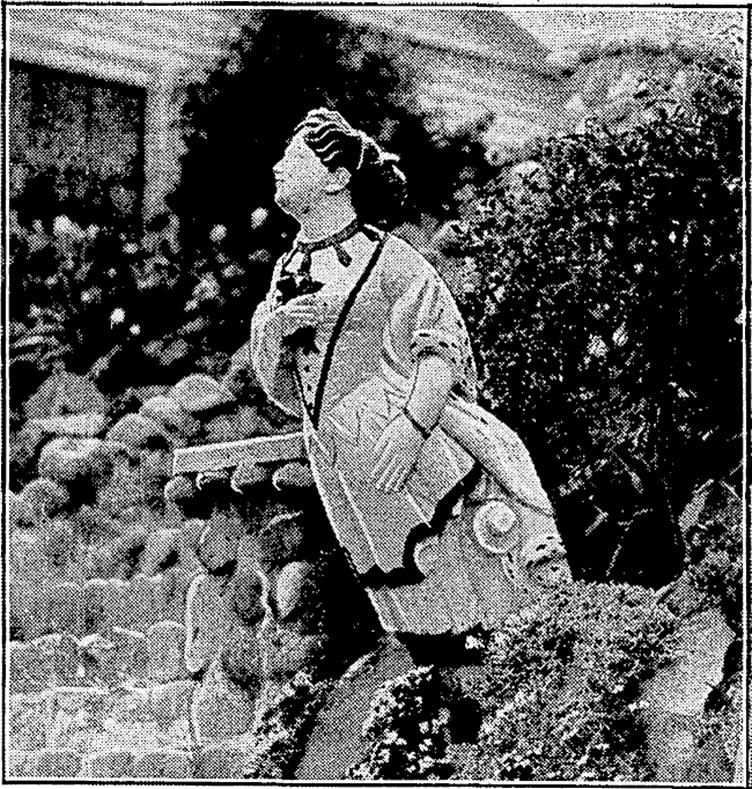
“Mounted in a Roseneath garden, this figurehead was once on the bow of the Helen Denny, well known as a trader and cadet ship on the New Zealand coast”. Evening Post, 25 September 1935, P 9

Many column-inches, commonly with some of the most spectacular images, were dedicated to the figurehead of the Helen Denny. In 1935, “after having been lost track of for a number of years”, The Evening Post reported that “the figurehead of the intercolonial barque Helen Denny has turned up again. The figurehead, which is in a remarkable state of preservation, is the property of a Roseneath [Wellington] resident, and is to be mounted in a garden overlooking the harbour where the old vessel spent many years as a hulk”.

“The form of the figurehead is such as was familiar in bygone days, and is that of a lady attired in a white dress of the mid-Victorian, period, trimmed with green and gold. Clasped in her right hand on her breast is a red rose. She has black hair surmounted by a coronet, and gold bangles encircle her arms”.

The Helen Denny was described as “an iron ship of 695 tons, with a length of 187.5 ft”, and was said to have “took the water in the Clyde in 1866”. “The name Helen Denny was bestowed upon her as a compliment to the wife of the then manager of Denny and Company, the famous Dumbarton shipbuilders… The figurehead is intended as a likeness of that lady, and although its merit cannot readily be judged by comparison, it appears to be a remarkably fine piece of work”. [iv]

“For 10 years she traded out of Glasgow to Rangoon [now Yangon, Myanmar] and those exotic eastern ports… Then the Shaw, Savill Company bought her and brought her into New Zealand waters”.[v] For many years, the Helen Denny was well known as a trader and cadet ship on the New Zealand coast.[vi]
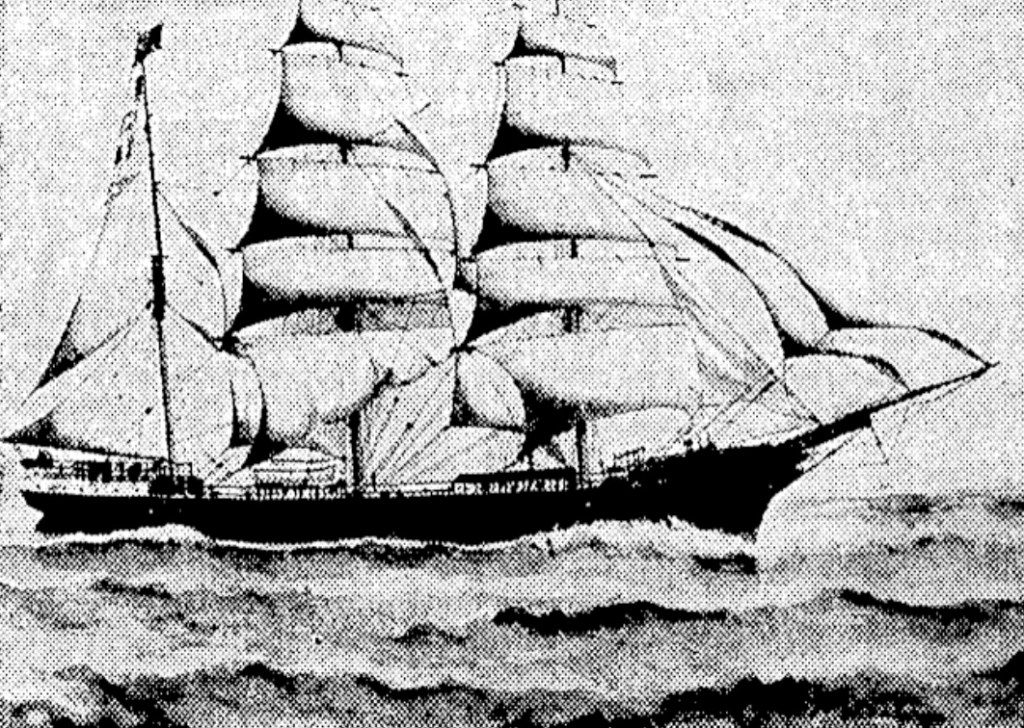
“THE BEAUTIFUL HELEN DENNY, one of Captain Ferdinand Holm’s vessels well known in New Zealand as a training-ship for boys”.
Evening Post, 10 October 1936, P24

The barque was dismantled in 1912 for service as a hulk, after which the figurehead was said to have “certainly had a chequered history”.

The Evening Post in 1935 noted that: “Many years ago it was picked up off the beach by a shipping clerk, now retired, who had it in his garden at Roseneath for some time before passing it on to its present owners. What happened to it prior to this and how it came to be on the beach are not known. There is a well authenticated story to the effect that when Colonel Denny visited New Zealand many years ago, he asked for the figurehead. The company which then had the vessel promised to let him have it when she went out of commission, but this was never done”.[vii]

The figurehead sat in that Roseneath garden for several years. In 1938, it was reported, rather poetically, that “Standing among the flowers of a Roseneath garden, the carved wooden figure of a graceful woman watches with unblinking eyes the steamers loading and discharging merchandise, the fussy tugs, the harbour ferries, yachts, coal-hulks, all the colourful shipping of the port of Wellington. She is watching doubtless, for the coming of the tall and stately sailing vessel whose figurehead once she was—but the old barque Helen Denny, last and loveliest of the colonial clippers, is ending her days as a battered bulk in Lyttelton.”[viii]
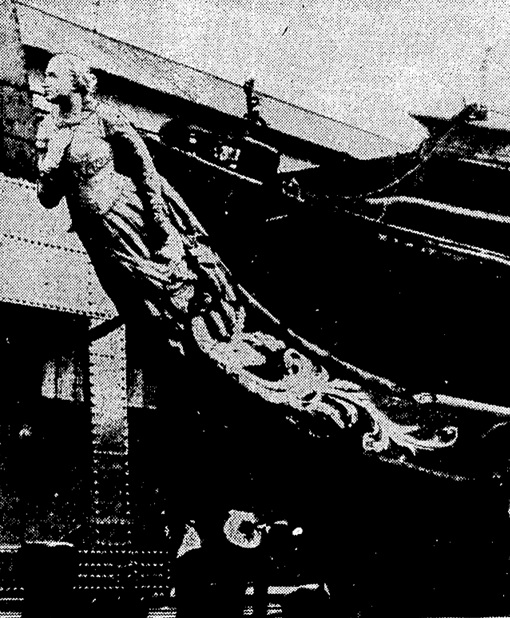
The figurehead of the barque Helen Denny.
Evening Post, 30 October 1937, P 24
Other Figureheads in Gardens

Finally, I provide here short notes on three other vessels, whose figureheads were noted in New Zealand suburban gardens. Again, however, this coverage is by no means exhaustive, with snippets of others also appearing in various newspapers in the early 20th Century.

NORTHUMBERLAND

The figurehead of the Northumberland, featuring “a warrior with a sword”, rested “in the garden of Mr Frank Armstrong, at Akitio”, in the Manawatū-Whanganui region.[ix] The Northumberland was wrecked on the Petane Beach (Napier), on May 13th, 1887”.  A 1910 report noted that “After the officers and crew of the Northumberland were saved the vessel broke up and the figurehead was the only thing saved”.[x] A story from the 1920s, however, suggested that more was salvaged. The Hawera Star informed its readers that in the cargo of the ship there “was a quantity of rum”… “and some of it was among the first of the flotsam to come ashore. The crowd immediately broached it and got very tipsy, giving the police a lot of trouble”. This report noted that the “figurehead of the Northumberland was secured by a Westshore fisherman, and was for years a prominent object in his garden”.[xi] 

“The figurehead shown in the photo belonged to the ship Northumberland, wrecked on the Petane Beach (Napier) on May 13th 1887. New Zealand Graphic, 23 November 1910, P 18

AGNES JESSIE

The “figurehead of the barquentine Agnes Jessie, which was wrecked with the loss of five lives” on Mahia Peninsula while on route between Lyttelton and Auckland[xii] in 1877, was “discovered in the garden of Mrs. K. Northe, of Havelock Street, Napier” in the 1930s. The Auckland Star reported that the “figurehead is in a splendid state of preservation, and represents a young woman in the dress of the early Victorian period. It has been in the possession of Mrs. Northe’s family for nearly 40 years, having been washed ashore nearly two months after the wreck happened”.[xiii]

ROBINA DUNLOP

The Robina Dunlop was wrecked in the mouth of the Turakina River, while in transit between Wellington and Batavia (now Jakarta, Indonesia) in 1877.[xiv] In 1924, the Manawatu Times reported on a Mr John Grant of Turakina, who was “was an interested visitor at Saturday’s All Black match. He is 73 years of age and from his upright lissome figure, looks as though he could still play the game with the best of them”. Although it is unclear why this was part of the story, it continued: “Nearly sixty years ago he carried the carved figurehead of the wrecked vessel “The Robina Dunlop” on horseback from the beach, to his father’s home, where it still stands in the garden, a beautifully carved-life slzed representation of the lady after whom the vessel was named”.[xv] This figurehead, also, was later presented to the Devenport Naval base collection in 1936 by Mrs. M. Grant.[xvi]

Figurehead of the Robina Dunlop. Auckland Star, 10 September 1938, P1 (Supplement)

Read Part I here: The Hydrabad

Read Part II here: The Wolverine

References

[i] Sun (Auckland), 22 March 1930, P 17

[ii] Ship’s Figureheads. Wanganui Chronicle, 24 March 1930, P 2

[iii] Curious Figurehead. Sun (Auckland), 5 June 1930, P 10

[iv] An Old Figurehead. Evening Post, 25 September 1935, P 13

[v] Figurehead of the Helen Denny. Dominion, 23 August 1938, P 3

[vi] Evening Post, 25 September 1935, P 9

[vii] An Old Figurehead. Evening Post, 25 September 1935, P 13

[viii] Figurehead of the Helen Denny. Dominion, 23 August 1938, P 3

[ix] John Knox’s Figurehead had a Movable Arm .Star (Christchurch), 7 June 1930, P 21 (Supplement)

[x] New Zealand Graphic, 23 November 1910, P 18

[xi] Local and General. Hawera Star, 7 February 1927, P 4

[xii] Wreck of the Agnes Jessie. West Coast Times,  29 June 1882, P 2

[xiii] News of the Day. Auckland Star, 24 March 1936, P 6

[xiv] Total Wreck of the Barque Robina Dunlop. New Zealand Times, 15 August 1877, P 2

[xv] Personal Paragraphs. Manawatu Times, 29 July 1924, P 4

[xvi] Three More. Auckland Star, 26 March 1936, P 10

Meet Dr Carrot and Potato Pete: The legacy of the Victory Gardens 

An illustrated talk by Gail Pittaway

11 September, Chartwell Room, Hamilton Gardens, 7 pm.

$5.00 entry fee (cash, please!)

Imperial War Museums via Getty Images

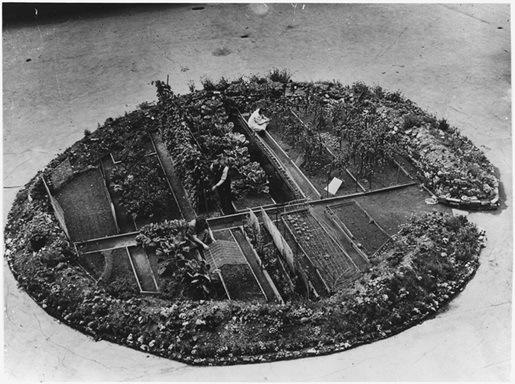
At the beginning of the Second World War, Britain imported 60% of its food, much of it by ship. However, with a naval blockade by German warships, this traffic and the nourishment of the nation, were under severe threat.  The government introduced a food rationing scheme in January 1940 to avoid the food shortages endured during the First World War.

To support the food supply and supplement the increasingly strict rations, a ‘Dig for Victory’ campaign was launched by the Ministry of Agriculture in October 1939, encouraging families to grow and prepare their own food. Everyone was encouraged to turn their flower beds and lawns into vegetable gardens, ‘Victory gardens’. For this propaganda the Ministry even employed Disney cartoonists, who created such characters as Doctor Carrot and Potato Pete.

The Ministry of Food started publishing Food Facts pamphlets in 1940, and magazines, newspapers and daily radio programmes such as ‘The Kitchen Front’ and ‘the Radio Doctor’ were full of ideas and recipes to enable families to make the most of the weekly rations. One of the most significant contributors to this campaign was a New Zealander, Bee Nilson, whose efforts to encourage British householders to make the most of home-grown vegetables to make nourishing meals, despite the privations of war, resulted in an overall improvement of health standards across the population. ‘Rationing enabled the poorest sections of society to eat more protein and vitamins, which led to a substantial upturn in the health of the nation’. (Imperial War Museum)

Gail Pittaway is a writer and lecturer, now part-time, at Wintec, Hamilton, whose research interests include literature, food history, New Zealand cookbooks and garden design. This talk arises from her recently submitted PhD Thesis, A New Zealand Food Memoir, tracing a personal journey through food changes in the middle of the twentieth century. In this research she ‘discovered’ the work of Bee Nilson whom she considers an unacknowledged New Zealand food hero.

A Victory Garden in a bomb crater, London, Office of War Information (NARA record: 1138532)  

“The Zhi Garden Album” and the Vanished Garden Behind It

By Shanshan Liu and Xiao Huang, with contributions from Chang Jingyi and Gu Rui

The Zhi Garden Album (《止園圖》) is a set of twenty paintings created in 1627, currently held in two parts by the Los Angeles County Museum of Art and the Museum of Asian Art in Berlin. Executed in a delicate and realistic style, the album presents a splendid Ming-dynasty garden from multiple perspectives. The first page is inscribed with the phrase “Panoramic View of Zhi Garden.” Who built Zhi Garden? In which city was it located? When was it constructed? Was the garden depicted in the album a real place, or merely a product of the artist’s imagination? These unresolved mysteries have made The Zhi Garden Album a subject of great interest among international scholars.

In the 1950s, American art historian James Cahill first encountered The Zhi Garden Album in Boston. Attributed to the Ming-dynasty painter Zhang Hong (張宏), the album portrays a grand garden in remarkable detail from various viewpoints. Deeply moved by its distinctive realism, Cahill began a long-term engagement with the work. His later research elevated The Zhi Garden Album as a quintessential example of Chinese realist painting, and he systematically articulated Zhang Hong’s unique place in the history of Chinese art.

In 1978, when the Metropolitan Museum of Art in New York began constructing its Chinese-style garden “The Astor Court” (Ming Xuan, 明軒), James Cahill made a special trip to New York to meet with Professor Chen Congzhou (陳從周), a leading Chinese garden scholar who had traveled to the U.S.A. to provide guidance for the project. Their exchange marked an early attempt at cross-disciplinary collaboration between Chinese garden design and art history. In 1996, Cahill partnered with June Li (李關德霞), curator at the Los Angeles County Museum of Art, to organize the exhibition Paintings of Zhi Garden by Zhang Hong:  Revisiting a Seventeenth-Century Chinese Garden. For the first time, all 20 album leaves, previously dispersed across different institutions, were reunited and presented as a complete set.

After returning to China, Chen Congzhou did not forget The Zhi Garden Album. Over several years, he compiled the influential book A Comprehensive Collection of Gardens (Yuan Zong,《園綜》), and included the black and white images of 14 leaves from The Zhi Garden Album, gifted to him by Cahill, as the only visual artwork in the entire volume. Published alongside over 300 garden inscriptions, this marked the first time the album entered the field of Chinese garden scholarship. In 2009, landscape historian Cao Xun (曹汛) discovered a rare surviving copy of Collected Writings from Zhi Garden (Zhi Garden Ji) in the National Library of China. By closely comparing the poems and garden records in the book with visual details from The Zhi Garden Album, he identified the garden owner as Wu Liang (吳亮), the author of the anthology, and successfully located the site of Zhi Garden in Changzhou, Jiangsu Province (江蘇省常州市).

At the invitation of Cao Xun, we established contact with James Cahill and began a collaborative study on Chinese garden painting. In 2012, we co-authored The Immortal Forests and Springs: Garden Paintings in Old China《不朽的林泉:中國古代園林繪畫》, with the first chapter dedicated to The Zhi Garden Album. As the first scholarly monograph to systematically explore the genre of garden painting in China, Garden Paintings in Old China was well received by readers. With its growing influence, the story of Zhi Garden has become increasingly well known. As a rare example of a Ming dynasty garden whose overall layout can be reconstructed from visual depictions, Zhi Garden fills a critical gap in the historical narrative of Chinese garden design.

To enable a wider audience to experience the flourishing aesthetics of private Chinese gardens at their peak, we devoted the next decade to an in-depth exploration of Zhi Garden. In 2022, we published Zhi Garden Album: A Portrait of Peach Blossom Spring (止園圖冊:繪畫中的桃花源) and Dreaming of Zhi Garden: Recreating a Painted Utopia(《止園夢尋:再造紙上桃花源》). These two volumes present high-resolution, full reproductions of all twenty paintings in The Zhi Garden Album, accompanied by detailed interpretations of the garden cultural, historical, and artistic significance.

Zhi Garden Album: A Portrait of Peach Blossom Spring
In Chinese and English
by Liu Shanshan and Huang Xiao
Donghua University Press
Published: January 2022

Dreaming of Zhi Garden: Recreating a Painted Utopia
by Huang Xiao and Liu Shanshan
in Chinese
Tongji University Press
Published: October 2022

The 17th century marked the pinnacle of classical Chinese private garden art, witnessing the emergence of numerous renowned garden designers and historically significant gardens. Unfortunately, many of these gardens have either vanished due to the ravages of war and the erosion of time, or undergone substantial transformation. As a result, reconstructing the gardens of the 17th century has become a crucial focus in the study of Chinese garden history. Among them, Zhi Garden stands out as a representative example of this golden era.

Zhi Garden was first established in the 38th year of the Wanli reign (1610). The name “Zhi Garden” (Garden of Restraint) is drawn from the poet Tao Yuanming’s verse in On Giving Up Wine (陶淵明《止酒》): “At last I realize that restraint is good; today I truly give it up.” The garden was designed by Zhou Tingce (周廷策), a prominent garden designer of the late Ming dynasty. Together with his father, Zhou Bingzhong (周秉忠), he belonged to one of the most distinguished families of garden makers during that time. Behind Zhi Garden stood the influential Wu family, who constructed more than 30 gardens during the Ming and Qing dynasties, earning them the reputation of a garden-making lineage. In modern times, the Wu family produced many cultural luminaries, including Wu Zuguang (吳祖光), Wu Zuqiang (吳祖強), and Wu Guanzhong (吳冠中), who continue to exert significant influence in the world of art and culture.

The physical structure of Zhi Garden has long since vanished, the garden faded into obscurity in the latter half of the 17th century and was subsequently forgotten by history. However, traces remain in the form of ruins, visual records, and historical texts. Drawing upon garden inscriptions, pictorial evidence, and topographical features, we have identified the original site of Zhi Garden to be located just outside Qingshan Gate, north of Wujin City in Changzhou. Today, the location of the garden site is found in Tianning District, Changzhou (常州市天甯區), although it has not yet undergone systematic archaeological excavation. The most significant historical material related to the garden is The Zhi Garden Album, which consists of one aerial view and nineteen detailed scenes. Together, these images comprehensively document the garden’s layout and its scenic architecture (Liu and Huang, 2024). The perspectives used in the album are based on real views within the garden, rendered through a realistic painting style that incorporates stylistic and technical adjustments by the artist. The Zhi Garden Album emphasizes visual correction grounded in lived spatial experience, offering a faithful representation of the actual scenery and enhancing the album’s function as a spatial guide.

The original site of Zhi Garden

Zhi Garden was designed as a suburban garden, distinguished by its unique approach route: visitors could arrive by boat from outside the city gate. The garden featured two main entrances, located on the north and south sides.

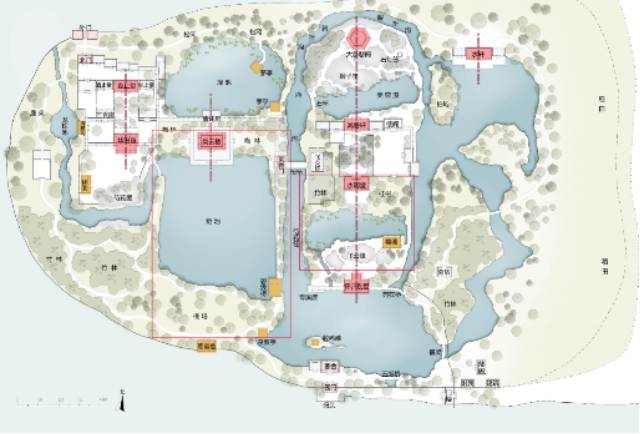
The overall layout of Zhi Garden was divided into four sections: the eastern, central, and western zones, along with an outer area. The eastern section served as the starting point for the garden tour, guiding visitors through a carefully orchestrated sequence of views. The central zone was characterized by expansive water features, creating a sense of openness and spatial depth. The western section was primarily residential, while the outer area on the eastern side seamlessly connected the garden to the surrounding countryside.

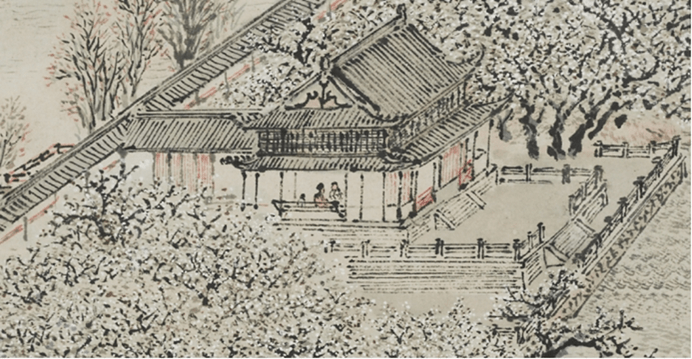
The main hall of the central section in Zhi Garden was Liyun Lou
(Liyun Lou, literally “Pear Mist Hall”)

The owner acclaimed Zhi Garden as a garden “celebrated solely for the beauty of its water.” Situated beside the city moat at the junction of three rivers, the site incorporated an unusually rich variety of aquatic features. Because the terrain was relatively flat, dramatic vertical elements such as waterfalls were rare. Instead, the designer used rills, brooks, ditches, and channels, the linear waterways, to connect ponds, pools, lotus basins, and sunken hollows—broader expanses of water—thereby weaving an unbroken, serpentine network that animated the entire garden on a horizontal plane.

In Zhi Garden, rock and earth artificial hills ranked second only to water in importance. According to The Record of Zhi Garden, “the garden devotes three parts to earthen hills and one part to bamboo and trees.” The combined presence of rockeries and vegetation formed wooded hillscapes that covered roughly 40% of the garden, comparable in scale to its water features. Zhi Garden featured a full range of rockwork, from large to small: limestone rockeries, yellow stone mounds, earthen hills, terraced stone flower platforms, and individually placed ornamental peaks. Among them, Feiyun Peak (Flying Cloud Peak) within the wooded mountain grove was the most technically demanding to construct and best exemplifies the artistic mastery of the garden’s designer, Zhou Tingce. The artificial mountain appears as if it had flown down from the heavens and landed gently on an island surrounded by water. With no surrounding natural hills to borrow for visual continuity, the sense of its miraculous arrival is all the more striking.

The architecture of Zhi Garden formed a harmonious balance with the garden’s mountains, waters, and plantings, embodying a subtle interplay between the artificial and the natural. Although architectural structures occupied a relatively small proportion of the overall layout, they played a commanding role in organizing space, often serving as focal points along clearly defined axial sequences. This spatial arrangement reveals the principle of “the dynamic balance between the regular and the irregular” (qi zheng ping heng奇正平衡) that underpins classical Chinese garden design.

Architectural Layout of Zhi Garden
Illustrated by Huang Xiao, Ge Yiying, and Wang Xiaozhu

Drawing on compelling reconstruction evidence and the garden’s exceptional historical significance, the Changzhou municipal government has decided to launch a project to rebuild Zhi Garden, with the aim of promoting the legacy of Jiangnan garden art and preserving local cultural heritage. This remarkable cross-border scholarly journey now holds the promise of bringing a once-imagined garden back into the real world. It signals the vast potential of international collaboration in the shared study and preservation of humanity’s invaluable heritage.

Author Biographies
Liu Shanshan Shanshan Liu is an associate professor in the History of Architecture at Beijing University of Civil Engineering and Architecture in Beijing, China. She holds a doctorate in Architectural History and Theory from Tsinghua University. She has published several monographs in Chinese and English, including Garden Paintings in Old China (2012), Zhi Garden Album: A Portrait of Peach Blossom Spring (2022).

Huang Xiao is an associate professor at Beijing Forestry University and serves as the Secretary-General of the Research Center for Chinese Landscape Thought. His published works include The Vanished Garden: Zhi Garden of Ming-Dynasty Changzhou, Studies on Private Gardens in Ancient Northern China, and Architectural Atlas of Jiangsu and Shanghai.


References
[1] James Cahill, Huang Xiao, Liu Shanshan. The Immortal Landscape [M]. SDX Joint Publishing Company, 2012.
[2] Huang Xiao, Liu Shanshan. Dreaming of Zhi Garden [M]. Tongji University Press, 2022.
[3] Huang Xiao, Liu Shanshan. “The Poetic and Literary Context of Ming Literati Gardens: A Case Study of Wu Liang’s Zhi Garden” [J]. Art Panorama, 2023(02):122–126.
[4] Huang Xiao, Liu Shanshan. “The Subtle Delight of ‘Restraint’ in Wu Liang’s Zhi Garden” [J]. Journal of the China Garden Museum, 2021(00):21–26.
[5] Huang Xiao, Ge Yiying, Zhou Hongjun. “The Dynamic Balance of Order and Irregularity in Ming Garden Architecture: A Comparison of The Craft of Gardens and Zhi Garden” [J]. New Architecture, 2020(01):19–24.
[6] Huang Xiao, Zhu Yundi, Ge Yiying, et al. “View, Movement, Dwelling: Zhou Tingce and Flying Cloud Peak in Zhi Garden Garden” [J]. Landscape Architecture, 2019, 26(03):8–13. DOI:10.14085/j.fjyl.2019.03.0008.06.
[7] Zhou Hongjun, Surij, Huang Xiao. “Exploring the Water Management Strategies of Zhi Garden Garden in Ming-Dynasty Changzhou” [J]. Landscape Architecture, 2017, No.139(02). [8] Li, June; James Cahill.  Paintings of Zhi Garden by Zhang Hong:  Revisiting a Seventeenth-Century Chinese Garden.  Los Angeles: Los Angeles County Museum of Art, 1996

Ship Figureheads as Statuary in New Zealand Gardens, Part 1: The Hydrabad

by Ian Duggan

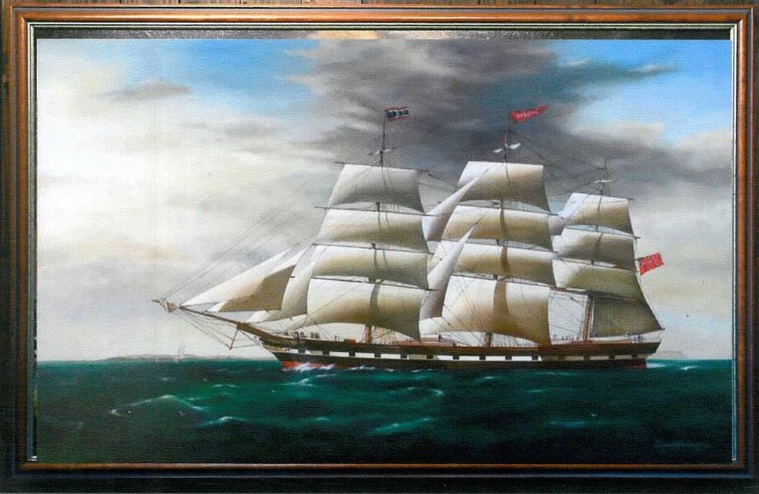
A number of newspaper reports can be found of the figureheads of ships adorning not their expected vessels, but New Zealand gardens as items of statuary through the early 20th Century. This blog covers one such example, the figurehead of the Hydrabad (commonly incorrectly spelt as “the Hyderabad”, after the city in India), a ship that was wrecked on Waitārere beach on the Horowhenua coast in 1878.

On her sea trials off Glasgow 1865. Original oil painting on canvas. 1800 x 1100mm. Provided by Kete Horowhenua.

What is a figurehead? The Royal Museums Greenwich provide a great overview, at this link, which I provide a brief summary of here. Figureheads are decorative carved wooden sculptures, most frequently female, that decorated the prows of sailing ships. These were said to embody the “spirit of the vessel”, and were considered by the crew of the ships to be lucky charms. A range of subjects were depicted on the figureheads, with many representing a member of the ship-owner’s family or of the owner himself, while others depicted historical figures or an influential individual from contemporary society. Evidence of the use of figureheads dates back to around 3000 BC in Egypt, but while they were a common feature on ships during the sailing age, their use had largely died out by the end of the 19th Century.[i]

Indeed, Wellington’s Evening Star noted in 1911 that, at that stage: “The likeliest place to find a ship’s figurehead nowadays is… in a suburban tea garden. Certainly there are few ships afloat [now] which carry them”.[ii]

The figurehead of the Hydrabad is one that has gained the most attention in New Zealand newspapers. The Hydrabad was a three-masted iron ship built in Glasgow, Scotland, in 1865, which primarily operated as a cargo vessel between England, Australia and India. However, she was wrecked on the Horowhenua Coast in June 1878, while on her way between Lyttleton and South Australia. At the time she was carrying a cargo of broad-gauge Canterbury railway locomotives and components declared surplus in New Zealand, due to the national standardisation of railway infrastructure[iii]; Canterbury had been building its railway using a 5′ 3″ gauge, whereas the New Zealand government’s public works stipulated that the gauge must not exceed 3′ 6″[iv]. The locomotives were thus destined for use in South Australia.[v]

Figurehead in the garden of A. Jonson. [from Church, I. (1978). The Wreck of the Hydrabad. Dunmore Press Ltd, Palmerston North].

The wreck of the Hydrabad was sold to a Mr Liddell, who bought the figurehead and the vessel’s cannon, taking them to Foxton. On arrival in the town, “both figurehead and cannon were deposited in Mr. Liddell’s yard… in Clyde Street. For many years they lay there until they were acquired by… Mr. A. Jonson and removed to Avenue Road”.[vi]

Skip forward a number of years, and in 1896 the Manawatu Herald reported that Mr Andrew Jonson “long had erected in his garden on the Avenue Road the old figurehead of the Hydrabad”.[vii] And the figurehead appeared to remain in his garden for a long period thereafter. For example, in 1907, it was stated that:

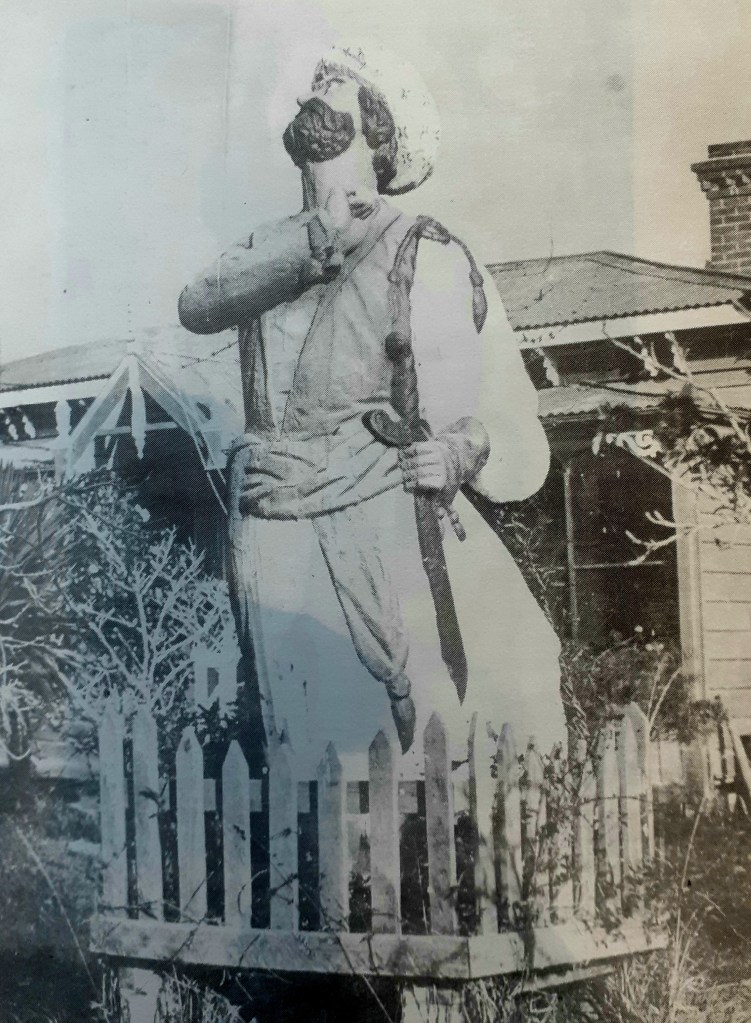
“In the centre of a garden plot in front of a cottage at Foxton is a brightly painted piece of well executed statuary. It is the figure enlarged to far more than life size of an Indian Rajah, dressed in full regalia, with scimitar, and hand uplifted in a threatening attitude. The legs are cut away, but the carving from the knees upwards, and the fierce expression on the black-bearded face of the Eastern potentate, are admirably executed”.

It continued, “The owner, Mr Jonson, narrates in connection with it a story of adventure. Nearly, half a century ago it formed the figure-head of a splendid steam yacht of 1800 tons, built… for the Rajah of Hyderabad. The figurehead, carved from Baltic pine, represented the owner, and for a number of years he took charge of the vessel, the Hyderabad [sic], travelling over the Indian Ocean. Eventually the vessel fell into the hands of Captain [Charles James] Holmwood, by whom it was sailfully navigated until, while laden with railway rolling stock, its career was ended during a storm, when it was stranded about four miles from the mouth of Manawatu river. In this way the fine carving fell into the hands of a Foxton resident, who prizes it highly”.[viii]

Jonson’s story may be somewhat embellished, however. The vessel was actually constructed for the Bombay Iron Shipping Company (in present day Mumbai).

Mr Jonson passed away in 1917, at the age of 75. The Manawatu Standard noted that he was a well-known builder and undertaker in Foxton. His residence in Avenue Road, we are told, “is well known in Foxton, and was of special interest to visitors from the fact that in the front garden was the figurehead consisting of an Indian chief, of the ship Hyderabad [sic]”. Nevertheless, it was also noted that “Some time ago the figurehead was presented by Mr Jonson to the Foxton Borough Council, to be placed in one of the local reserves”.[ix]

So, had the Council taken possession of it? In 1929, we hear a different story: “After remaining for many years at Foxton, the figurehead of the Hyderabad [sic], which lies on Hokio Beach, is to be sent to Auckland to the naval base there at the request of the Commander of HMS Philomel, who is making a collection of old figureheads. The figurehead of the “Hyderabad” [sic] has been in the garden of Mrs Andrew Jonson, in the Avenue at Foxton, since it came into possession of her late husband at the time the vessel was dismantled”. Nevertheless, “Mrs Jonson has given her consent to hand over the figurehead to the naval authorities for safe keeping”.

After so many years in the garden, however, the figurehead by this stage was looking a little worse for wear: “Long exposure to weather has robbed the figurehead of its pristine beauty, but when restored to its original adornment, it will make one of the most interesting exhibits in the collection”.[x]

Did the figurehead finally make it out of the garden, to the safety of the naval base in Auckland? Again, it appears that it still didn’t go anywhere. And this was unfortunate, for in 1933 the Manawatu Standard gave a sad update on the Hydrabad’s figurehead:

“Many of the older residents of the district will learn with regret the disappearance from Foxton of that interesting relic of one of the most remarkable wrecks on this coast, the figurehead of the Hyderabad [sic], which for the past half-century has always been a source of interest to visitors to the town. For the past thirty years the figurehead, a representation of an Indian rajah with turbaned head and drawn scimitar, occupied a prominent position in the garden of Mrs A. Jonson, of Avenue Road. Standing between twelve and fifteen feet high, it presented a striking sight in its gaily painted robes, but with the passage of time and the ravages of the elements this finely executed carving has gone the way of most woodwork, and, badly rotted throughout, it was last week felled and cut up for firewood”.[xi]

A Mr H. Coley, of Foxton, was subsequently interviewed, and stated that: “A year or so ago the naval authorities at Devonport, Auckland, made inquiries about the figurehead of the Hyderabad as it was desired to include it amongst the collection at the Auckland naval base. Mrs Jonson then gave her sanction to its removal, but, unfortunately, nothing further was done….”.[xii]

Shipwrecked ship “The Hydrabad” at Waitarere beach, looking from south to north on the seaward side. credit: Horowhenua Historical Society Inc.


Final confirmation of the circumstances of its destruction was reported in 1935: “Light has been shed upon the fate of the figurehead of the ship Hyderabad [sic], the remains of which lie on Waitarere Beach, where she was wrecked many years ago. Captain Baggett, of the motor-vessel Foxton, said in an interview in Wellington that, after the death of the householder who owned the figurehead, his home was occupied by a family the members of which were unaware of the history and value of the strange relic that stood in the garden. Accordingly they chopped it up for firewood. An attempt was made by a prominent Foxton man to save the figurehead, but he arrived too late to prevent its destruction”. 

At least ten other ship figureheads have been reported in New Zealand newspapers as having decorated gardens, and some of these will be covered in future blogs.

Read Part II here: The Wolverine

Read Part III here: The America, the Helen Denny, and others

REFERENCES


[i] Ship figureheads and decoration, Royal Museums Greenwich. https://www.rmg.co.uk/collections/ship-figureheads-decoration

[ii] Shipping. Evening Star, 29 September 1911, P8

[iii] Hydrabad (1865-1878) Wreck Site, Waitarere Beach, Levin. Heritage NZ.  https://www.heritage.org.nz/list-details/9559/Listing

[iv] Church, I. (1978). The Wreck of the Hydrabad. Dunmore Press Ltd, Palmerston North.

[v] Hydrabad (1865-1878) Wreck Site, Waitarere Beach, LEVIN. Heritage NZ.  https://www.heritage.org.nz/list-details/9559/Listing

[vi] Figurehead of the Hydrabad Demolished. Otaki Mail, 24 April 1933, Page 4

[vii] Manawatu Herald, 26 September 1896, Page 2

[viii] Poverty Bay Herald, 24 October 1907, P4

[ix] Manawatu Standard, 18 October 1917, P4

[x] Daily Chronicle, 11 July 1929, Page 4

[xi] Loss of the Hyderabad. Manawatu Standard, 27 March 1933, P7

[xii] Loss of the Hyderabad. Manawatu Standard, 27 March 1933, P7

A Battleship in the Garden? Unusual Auckland Garden Features from the 1930s

by Ian Duggan

While garden features such as arches and goldfish ponds have been popular and widespread in New Zealand private gardens, some have been more unique. For a short period between the First and Second World War, for example, the newspapers reported on a couple of Auckland residences whose gardens featured ships!

The first, reported in the New Zealand Herald in January 1937, rightly recognised the nautical feature as an “Unusual decoration for the garden”. Little detail was provided about the feature piece, however, except that it was a ship model in the garden of a Mr. W. Freeman, Allendale Road, Mount Albert. The hull consisted largely of border plants, while an ornamental shell provides the bridge”.[i] Beyond that, examination of the photograph shows the ship also featured masts and what appears to be drainpipes for its twin funnels.  

An Unusual Feature in the Garden. New Zealand Herald, 21 January 1937, Page 6

Hot on the heels of Freeman’s ship came a remarkably similar vessel in another garden only a little over five kilometers away. In April 1937, the Auckland Star noted that “There is no limit to garden attractions”.

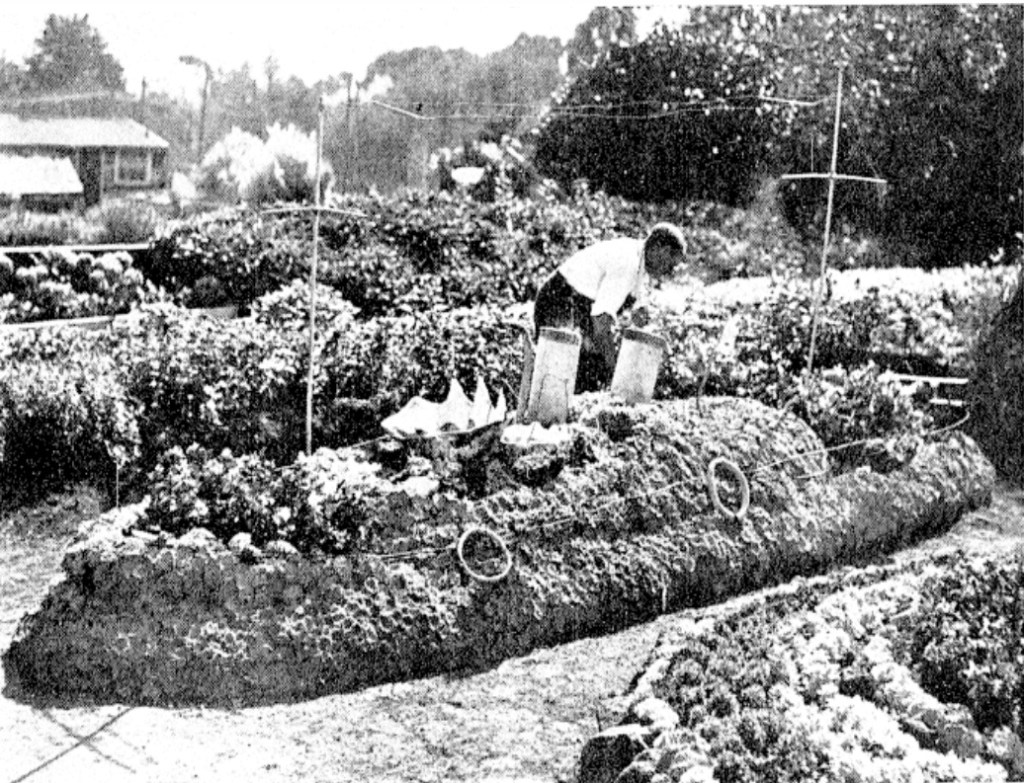
“Some industrious people cut their hedges and shrubs in various ways to represent figures or objects, but something entirely different in the decorative line has been achieved in the garden in front of the home of Mr. David Kasper, at Titirangi Road, New Lynn. There the taste has been nautical, and a land battleship has been created”.

Here, we are treated to some detail on the ships’ construction:

“In the first place the shape of a battleship, on a miniature scale, was marked out on the front lawn, and then the soil was built up to a height of about two feet. A grey rock-plant was grown on the sides of the “hull”, and the necessary nautical and warlike trimmings were added. Two steel rods have been used for the masts, and a light wire, suspended between them, makes an impressive aerial. The funnel is a drain pipe, painted yellow, with a buff top, and set at a rakish angle “amidships.” There are iron davits “amidships” on the side of the “hull.” The boats are hanging baskets of greenery”. [ii]

An image was provided in the next day’s paper, adding that the “grey rock plant gives the hull a distinctive naval touch” [iii]

Hard Aground. Auckland Star, 29 April 1937, P9

As with any garden, however, the ship didn’t look after itself:

“Just like the nautical battleships which do go to sea, the New Lynn “warship” requires many an overhaul. Weeds will persist in growing on the “quarterdeck,” and as docks and plantain, or even green paspalum would be strangely out of place in such a setting, the “crew” have a fairly busy time”.[iv]

Kasper’s ship remained in situ for at least a number of months afterwards. In August 1938, almost a year and a half after the previous report, another image of the vessel appeared in the Auckland Star where it was reported:

“Quaintly decorated with border plants, this model battleship, in a garden fronting on Titirangi Road, New Lynn, always attracts the attention of passers-by”.[v]

The photograph indicates that the design of the ship had evolved since the previous year, with the addition of life rings to the sides, railings, and what appears to be a steering wheel on the bridge.

Model Battleship. New Zealand Herald, 26 August 1938, Page 6

These snippets throw up a number of questions. How long did these garden ships persist? I can’t find any mentions in the newspapers of them after August 1938. Did the idea of a battleship in the garden lose some appeal with the impending war? From these reports, was anyone else inspired to construct sea-going vessels in their front yards, or were they unique to these two gentlemen? Indeed, were Kasper and Freeman friends? They only lived around five kilometers apart, and their designs appear to possess some common features. Interestingly, I can’t actually find any records of David Kasper outside of this article, even though we are provided with his full name. Not even a record of birth, marriage or death. So, who were these mystery people, and what inspired them? The answer to that question is, unfortunately, likely lost to the mists of time.

Postscript: Slightly post-dating both of these ships is the ‘Floral Ship’ on The Strand in Tauranga, constructed in 1938. I wonder if Kasper and Freeman’s ships provided inspiration for that one, which can be read about on the Historic Tauranga website, here, and from the Tauranga Historical Society, here?

References


[i] Unusual Decoration for the Garden: A Ship Outlined in Flowers. New Zealand Herald, 21 January 1937, Page 6

[ii] Hard Aground: Land Battleship in Suburban Garden. Auckland Star, 28 April 1937, Page 10

[iii] Auckland Star, 29 April 1937, Page 9

[iv] Hard Aground: Land Battleship in Suburban Garden. Auckland Star, 28 April 1937, Page 10

[v] New Zealand Herald, 26 August 1938, Page 6

New Zealand’s Garden Great and the Women who Made Him

Clare Gleeson, author of The Fairer Side of Buxton: Alfred Buxton’s Gardens and the Women Who Loved Them (The Cuba Press)

As a historian, my interest in New Zealand’s gardening history developed alongside my interest in gardening.  Having read of well-known garden designers elsewhere, such as England’s William Robinson and Australia’s Edna Walling, I was pleased to find that New Zealand did have a ‘great’ in her garden history, Alfred Buxton. It is now over 120 years since Alfred Buxton, New Zealand’s most prominent garden designer during the first half of the twentieth century and the father of landscape design in New Zealand, created the earliest of his magnificent gardens and my research showed that it was the so-called ‘fairer sex’ that was responsible for many of Buxton’s 350 plus commissions and played a large part in ensuring Buxton’s legacy.  

Alfred Buxton, 1903.  Credit: ‘Cyclopedia of New Zealand’

Alfred Buxton was firstly, and most famously a designer of rural gardens and although it was the farmer signing the contract and cheques, it was probably the farmer’s wife who was the driving force behind the garden’s commission.  As well as this group there was a cohort of women, both farmers and businesswomen, who commissioned a garden from Buxton in their own right.  Whether farmers or businesswomen, all of the women in this group were independent and successful; Buxton’s gardens were not cheap.

Leslie Hills, Canterbury, designed for Duncan Rutherford.  R P Moore photograph, c1924.  Credit:  Author’s collection.

Although the relationship between Buxton and women can be viewed as simply that of a garden designer creating a beautiful garden for a customer, the connection between them is more nuanced than this.

Social interaction between a garden owner and others in their family or community often led to additional commissions for Buxton’s business.  The cluster of Buxton gardens in localities or within families demonstrates the importance of word-of-mouth advertising, and women were essential to these interchanges.  They also contributed to Buxton’s success in other ways.  His elaborate plans often required months of work by a team of employees on a remote garden site, and the largely thankless task of accommodating and feeding these men invariably fell on the shoulders of the woman of the house.

Buxton’s plan for Beaumaris, home of the Taylor family, Wairarapa.  Credit: Taylor family

Buxton provided women with something they were eager to have.  When single businesswoman and lime kiln operator Sophia McDonald commissioned a Buxton garden she was advertising her success in a man’s world.  Eliza White’s garden at Sumner, her weekend home, was a clear indication that her business was thriving.   Women pastoralists elected to spend money on their garden as well as their farms, and headmistresses developed attractive school grounds for ‘their girls’ to enjoy.

A beautiful garden was an extension of the home and helped fulfil women’s desire to create a treasured living environment for their families.  The garden was somewhere a woman could relax with her family, and for children to play, and was the perfect place to entertain.  It was also physical evidence of the family’s financial and social success.  To have a Buxton garden was to have ‘arrived’. 

Aerial photograph of Lesmahagow, the McSkimming garden at Benhar, Otago, 2022.  Credit: Fern & Thistle, Benhar

For farmers’ and their gardens enabled them to interact with a wider community.   Tennis clubs used the grass and asphalt courts, the local hunt met in the garden before following the hounds, and community groups and horticultural societies were frequent visitors.  In remote rural areas the garden was pivotal to bringing people, in particular women, together.

There is no doubt Buxton’s beautiful gardens brought joy to the families who lived in them.  The many exotic trees changed through the seasons as they turned from green to gold and then back to green. Rustic bridges spanning waterlily-filled ponds, plantings of bamboo and delicate Japanese lanterns evoked an exotic world far from the farm gate.  Summer houses were perfect for escaping the drudgery of daily farm life, and ferneries and grottos provided a cool refuge on a hot summer’s day.

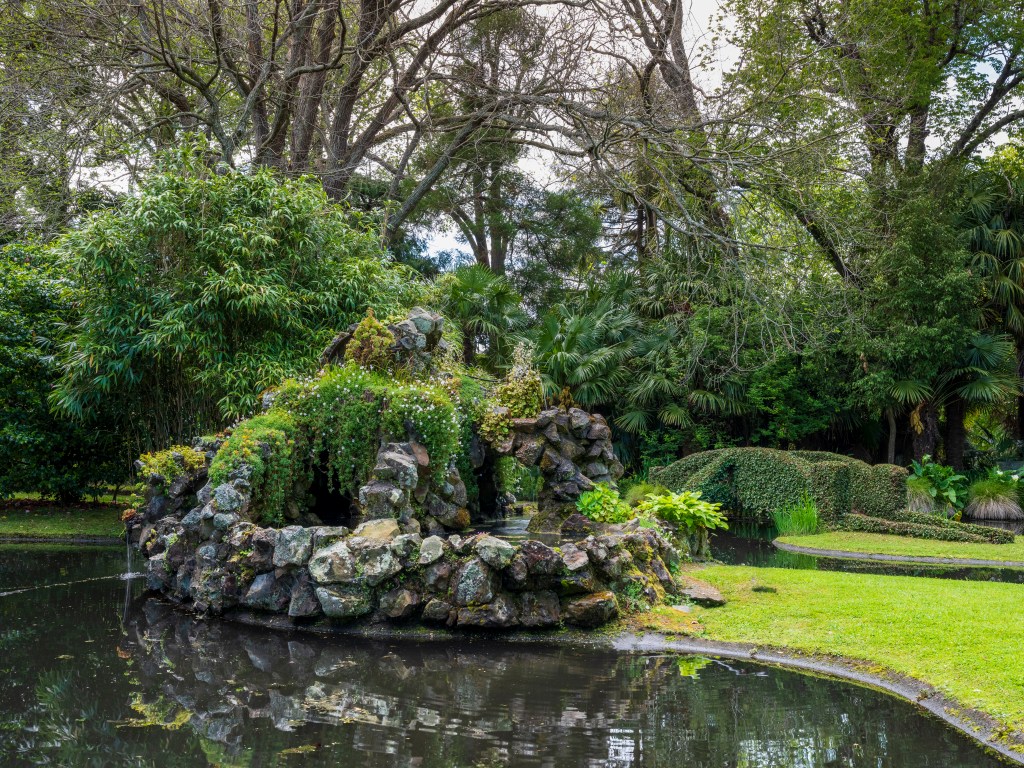
The cascade at the Tanner garden, Lansdale, Longburn, 2023.  Credit: Chris Coad

Buxton’s gardens often acted as the catalyst for a new and fascinating hobby.  As plantings matured and changed, the garden was somewhere the owner could add their personal touch while working within Buxton’s overall concept.  The flower beds allowed the gardener to use her imagination and skill as she filled them with the blooms of her choice. 

Roses were a favourite of both Buxton and the women he worked for, and the rose garden was always a special part of a Buxton design.  Planting plans show that although the location of roses was always indicated, the choice of which varieties to plant was not.  This enabled the owner to choose her favourites and make it her rose garden.  Once established the roses and other flowers could be picked for the house, included in a bridal bouquet or entered into local horticultural competitions.

The avenue of lime trees at Greytown Soldiers’ Memorial Park, 2024.  Chris Coad.

Women were proud of their gardens and loved to share them with family, neighbours, the wider community and even with royalty – in 1958 Gladys Hudson of Greenhill hosted the Queen Mother for a weekend.   In the 1940s, renowned New Zealand artist Rita Angus found that painting her parents’ garden at Waikanae helped her recover from a breakdown.  Barbara Matthews wrote about the same garden for New Zealand Gardener some years later. 

Photographs of women in Buxton gardens depict families in their Sunday best, sisters pausing to smile for the camera, daughters on their wedding day and mothers nursing babies.  The subjects are captured under trees, beside flower beds, sitting on benches and posed on a Buxton bridge.  Shots of eager young tennis players, beautifully outfitted members of the hunt and exquisitely dressed locals attending garden fêtes, fundraisers and parties in Buxton gardens all feature women.

The gardeners taking a break in the Tatham garden, Homewood, Wairarapa, c1917.

Women who grew up in a Buxton garden often have special memories.  Details of glorious plantings of daffodils, trees to climb and orchards to snack in are still vivid decades later.  Robin McConachy whose children grew up in her old family garden, watched it grow and develop.  The garden Annie Brown remembers was already mature when she and her sisters knew it and they were able to enjoy it at its best.

In times of sadness Buxton gardens offered solace and hope to the women who lived in them; indeed, some gardens were created as a means of alleviating overwhelming grief.  The Buxton-designed plantings around war memorials softened the starkness of the concrete monuments and gave women a place to sit or wander while remembering their loved one. 

Parorangi, Kimbolton, designed for Manawatu sheep breeder, Ernest Short.  R P Moore photograph, c1924.  Credit: Buxton family collection.

Alfred Buxton’s success owed much to the women who commissioned his designs, and he repaid them by creating wonderful spaces for them and their families, with many still there today.  By enjoying and cherishing their gardens, and sharing the memories they created, these women have ensured that Buxton’s legacy endures.

Wardian Cases, Plant Humanities and the Royal Botanic Gardens, Kew

James Beattie, Te Herenga Waka—Victoria University of Wellington

I recently spent a day at Royal Botanic Gardens, Kew, where I was hosted by post-doctoral researcher, Dr Diego Molina. Diego works on South American-European plant exchanges, and has just published a book on this topic, with our very own Routledge series, Planting a City in the Tropical Andes: Plants and People in Bogotá, 1880 to 1920.

For someone studying plant exchanges, there is probably nowhere better than Kew. Kew is well-known to historians for its role as a global “sorting house” for plants from around the world. In the nineteenth century, Kew was indisputably at the centre of a global network of botanists and collectors. It received everything from samples of woods, dried specimens, descriptions and, of course, living species. Kew’s role was to investigate species new to European science, improve them, and then send them to the colonies.[1]

The improvement of nature formed a key part of Kew’s aim, which was then known as economic botany. To this end, Kew’s Economic Botany Collection originated as The Museum of Economic Botany, which formed “a ‘library’ of useful plants for manufacturers and a popular attraction for visitors to the Gardens.”[2]

Diego took me to visit the Economic Botany Collection, which today contains “90,000 plant raw materials and artefacts representing all aspects of craft and daily life worldwide”.[3]  The breadth of its collection includes everything from dyestuffs and wooden spears to samples of handicrafts and clothing made from plant fibre—all of which are arranged taxonomically, by wood type not by object or use! It still collects over 800 specimens per year.

Displayed prominently at the Economic Botany Collection was a wonderful example of the Wardian Case. Both the Wardian case—effectively a mini-glasshouse whose use took off after the repeal of the Glass Tax in 1845—and the steamship facilitated the successful transportation of live plants, making possible the importance of places like Kew. Until the widespread use of Wardian cases, losses of plants moving between continents were remarkably high.[4]

Original Wardian Case, Economic Botany Collection, Royal Botanic Garden, Kew.

East India Company surgeon and plant collector John Livingstone (1770–1838?), writing in 1819, gloomily listed all that could (and very often did) go wrong in transporting live plants from China: from lack of adequate preparation to saltwater poisoning, neglect, and the sinking of vessels. He estimated “that one thousand plants have been lost, for one, which survived the voyage to England.” Given the high failure rate, he reckoned that “every plant [from China] now in England must have been introduced at the enormous expense of upwards of ₤300.”[5]

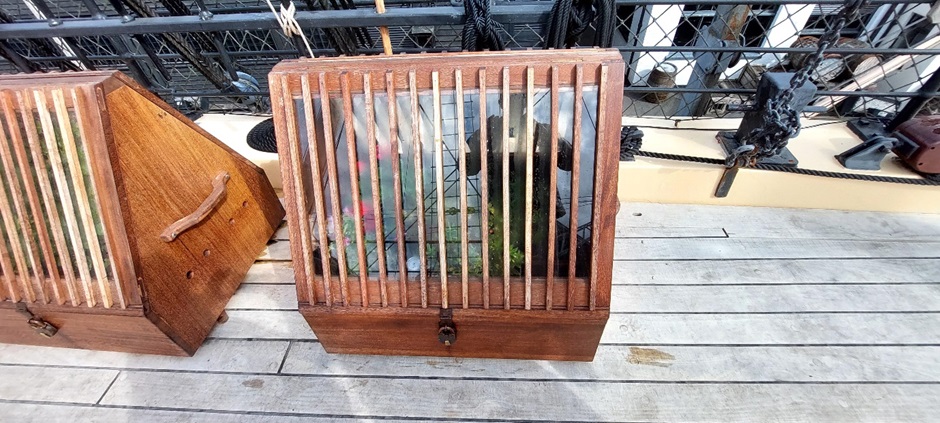
An excellent illustration of how these cases which shaped our modern world travelled was in evidence on the upper deck of the SS Great Britain, now moored in dry dock as a museum ship in Bristol. The Great Britain was the first ship to be built of iron and equipped with a screw propellor in an ocean-going vessel. It cut the voyage from Britain to the US down to 14 days.

Photograph of reproduction Wardian Cases on upper deck of SS Great Britain.
Arrangement of reproduction Wardian Cases on upper deck of SS Great Britain.

The end of my day’s research involved meeting with other humanities and science researchers at Kew. This included historical geographer Professor Felix Driver, University College London. Felix was a Principal Investigator of Mobile Museum, a major research project on the mobility of biocultural collections, in collaboration with the Royal Botanic Gardens, Kew. With Caroline Cornish, Humanities Research Coordinator at Kew, he is now leading a project on plant humanities.[6]

These projects bring together humanities and science scholars to work together to examine historical plant collections. What can these collections reveal about past environmental injustices and present environmental issues? How can these plant collections aid in reconstructing past environments and climates, and the drivers of those changes?

We could well take a leaf out of these inspiring projects in the UK to return museums and botanical gardens to the central place they once had in research in Aotearoa New Zealand. Another important role is by showcasing the centrality of humanities scholarship on the natural world and humans. Thanks to these new research projects, institutions like Kew are once again at the forefront of interdisciplinary research, by asking questions about our future and the future of our planet.


Thanks.

I would like to thank Diego Molina, Felix Driver, Caroline Cornish and the staff of Royal Botanic Gardens, Kew, for hosting me. All photographs are mine.

Notes

[1] For an excellent introduction, see: Richard Harry Drayton, Nature’s Government: Science, Imperial Britain, and the ‘Improvement’ of the World (New Haven: Yale University Press, 2000).

[2] https://www.kew.org/science/collections-and-resources/collections/economic-botany-collection

[3] https://ecbot.science.kew.org/

[4] For more information, see Luke Keogh, The Wardian Case: How a Simple Box Moved Plants and Changed the World (Chicago: Chicago University Press, 2020). On New Zealand and the Wardian case, see James Beattie, ‘Thomas McDonnell’s Opium: Circulating, Plants, Patronage, and Power in Britain, China and New Zealand, 1830s-1850s’, in Sarah Burke Cahalan and Yota Basaki, eds., The Botany of Empire in the Long Eighteenth Century (Washington, D.C.: Dumbarton Oaks/Harvard University Press, 2017), 163-188.

[5] J. Livingstone, ‘Observations on the Difficulties which have existed in the Transportation of Plants from China to England, and suggestions for obviating them’, Transactions of the Horticultural Society of London, Vol. III, (1819), p. 427.

[6] For more information, see also: The Plant Humanities Lab, Dumbarton Oaks Research Library and Collection.