
by Ian Duggan, Te Aka Mātuatua – School of Science, The University of Waikato
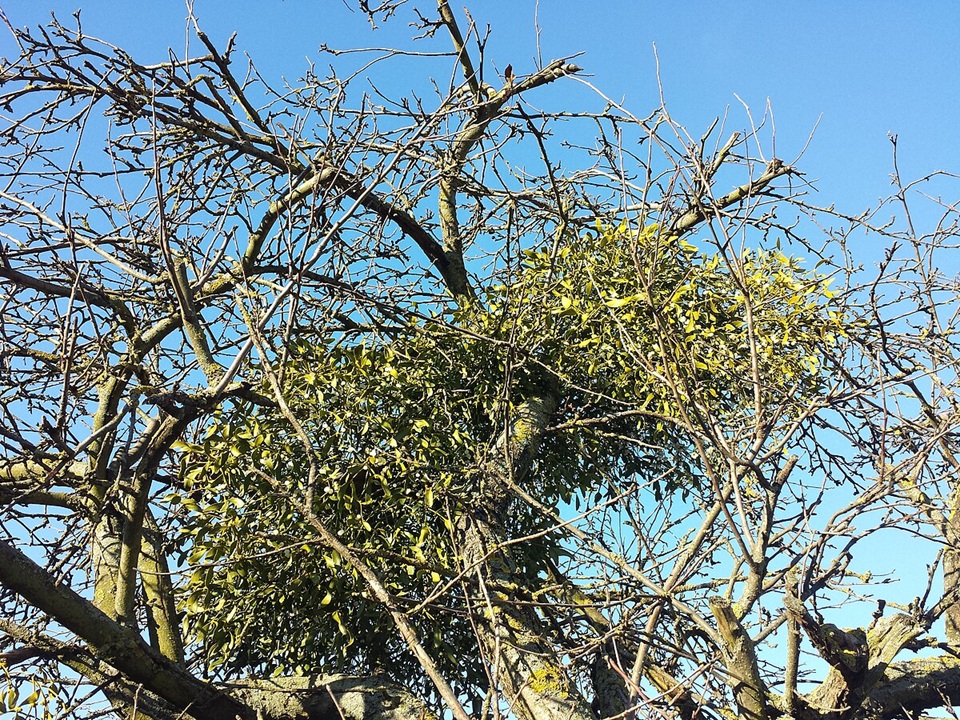
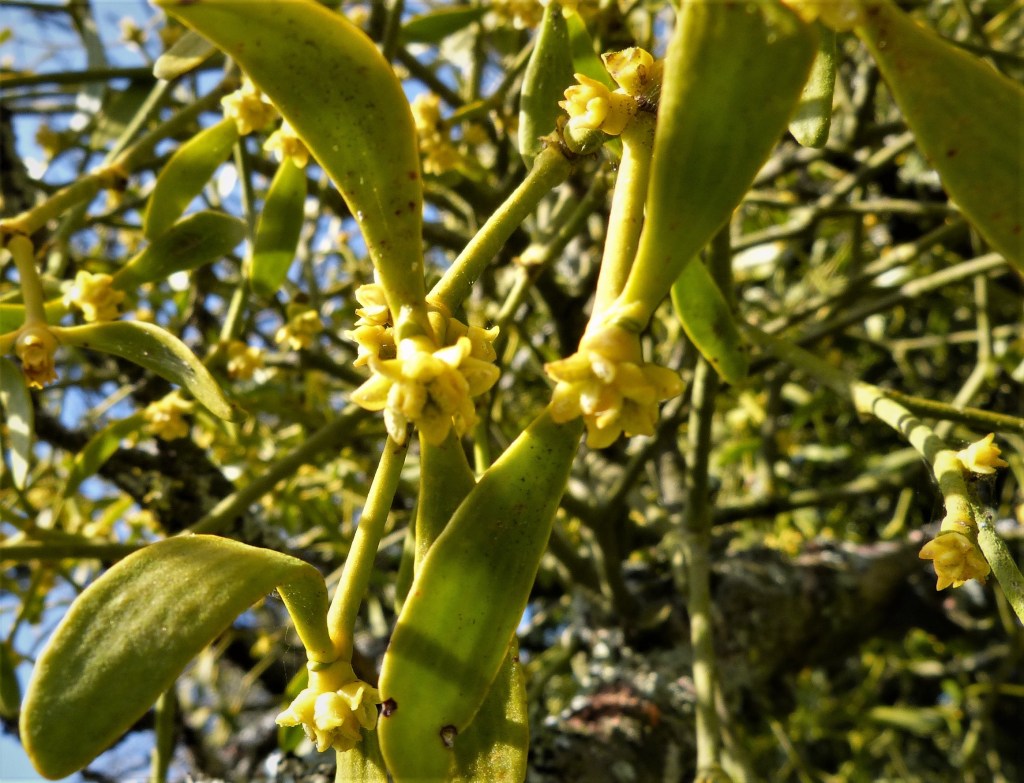
The mistletoe species most associated with Christmas globally is Viscum album – the so-called European mistletoe – which is native to Europe, but also to western and southern Asia. Being a hemiparasite, mistletoe grow attached to a host tree or shrub by a structure called the haustorium, through which they extract water and nutrients from the host plant, but not being entirely parasitic, they still need to obtain their own energy via photosynthesis. The most common host in Britain is the apple tree, followed by lime, hawthorn and poplar.[i]
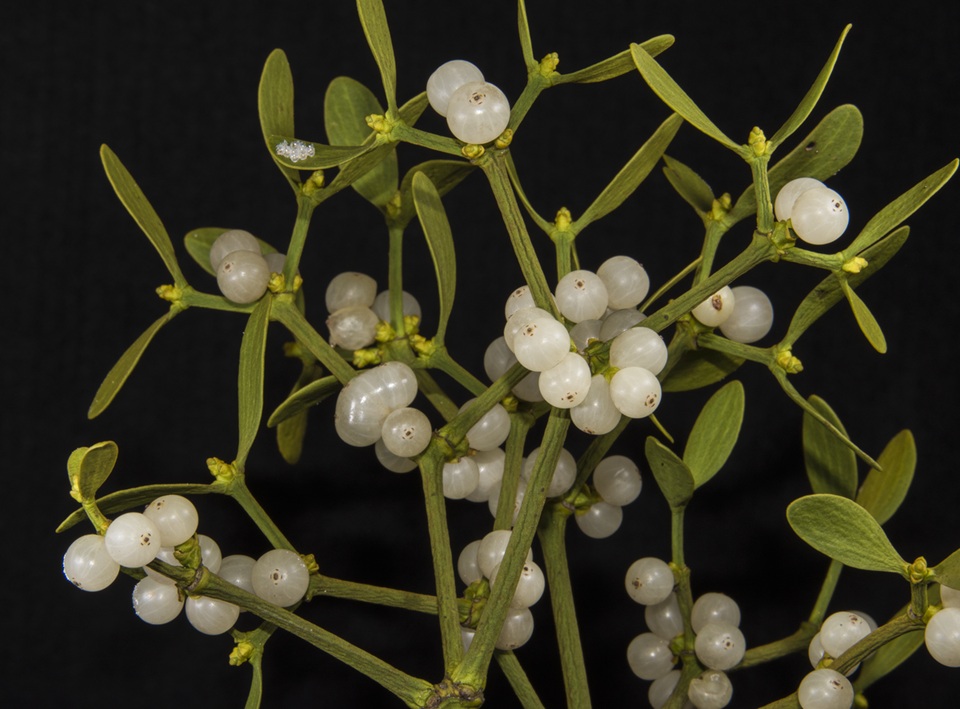
The term ‘mistletoe’, however, includes not just this one species, but many hemiparasitic plants with similar habits found in other parts of the world. This includes New Zealand, which compared to Britain is relatively high in mistletoe diversity. We have eight extant native species, compared to just one in the British Isles. All of our species are at threat from introduced mammals including Australian possums, land clearance, and declines in bird pollinators, and one of our native species has already succumbed to these pressures, presumed extinct.[ii] This blog will not concern itself greatly with the native mistletoes, however, which grow in our beech and lowland forests. We will focus instead primarily on New Zealand occurrences of the Christmas associated European mistletoe, which has either not survived following its introduction, or is now only observed very sporadically.
While the European mistletoe became associated with Christmas elsewhere as a decoration under which lovers are expected to kiss, the tradition never caught on in New Zealand, despite our native mistletoe diversity. For example, as far back as 1898, the Auckland Star declared: “With us in New Zealand the mistletoe does not enter into our Christmas rejoicings”.[iii] Nevertheless, we were certainly aware of the tradition: “Although English Mistletoe may not have been seen by New Zealanders hanging from lamps and ceilings during the festive season, few have not heard about it”, declared the same newspaper in 1938. [iv] Journalist and naturalist James Drummond elaborated with some possible reasons why the tradition never caught on in the early 1930s: “kissing under the mistletoe at this season is not in vogue in New Zealand. Native mistletoes are not grown in cultivation, and it would be troublesome to gather their flowers from forest trees on which they live parasitically. It may be considered not worthwhile, or there may be sufficient kissing all the year round without encouraging it under the mistletoe at Christmas time”.[v]
It is not well appreciated that European mistletoe has been used and grown in New Zealand. In 1914, for example, it was found growing in Christchurch on its preferred host, an apple tree, providing confidence that it wasn’t being confused with one of its native cousins:
“In a florist’s shop in High Street [Christchurch] may be seen a fine piece of the genuine English mistletoe, and its freshness was a sure proof that it had been grown in the Dominion. As it is a rarity in New Zealand, a “Press” reporter made a few inquiries about it, and found that it had been grown at [Christchurch suburb] Papanui, the grower having got out some apple trees from England with the mistletoe growing on them. A well-known nurseryman of the town told the Pressman that repeated efforts had been made to grow the mistletoe from seed placed in the bark of trees, but the efforts had, not been successful”. [vi]
In 1942, another report was made of the plant in Christchurch, again from an apple tree, which suggested European mistletoe had been grown in the city for some time:
“A large bunch of mistletoe plant, rare to New Zealand, is at present growing on an apple tree in an Avonside garden, Christchurch. The mistletoe, a small parasitical shrub, takes root abundantly on apple trees in Europe and England, and there are several stories and legends about it. The Druids regarded the mistletoe as sacred, and whenever a plant was found a ceremony was held and two white bulls were slaughtered as a sacrificial offering to the gods. A Scandinavian legend tells how Hoder the Blind God, slew Baldur, the Sun God, with an arrow fashioned from a mistletoe branch. In England the plant is traditionally associated with Christmas, when many [what might now be considered “problematic”] pranks are played by youths, who greet girls at parties by kissing them in doorways under a sprig of mistletoe. The European mistletoe bears small white berries and flowers, but the Christchurch plant has never displayed flowers in its fifty years of growth”.[vii]
Nevertheless, some were reported to flower and fruit that same year:
“The hope was expressed recently that someone in the city would report that he had been successful in acclimatising a berrying English mistletoe in a Christchurch garden… We are pleased to be informed that in the garden of St. Winifred’s Convalescent Hospital there is a plant of it growing on a fruit tree. The plant produces berries regularly in due season.”[viii]
Beyond Christchurch, the European mistletoe was also recorded growing in the Hawke’s Bay in 1940:
“A parasitic growth on the branch of a wattle tree taken from a property at Kereru, Hawke’s Bay, has been identified as the British variety of mistletoe. Though there are many varieties of New Zealand mistletoe, the English species is not particularly common in New Zealand, and it is concluded the seed was propagated through a bird, which had been feeding on the berries of the mistletoe, wiping its beak on the bark of the wattle tree. The parasitic growth looks as if it had been skilfully grafted, with no sign of the graft remaining.[ix]
Beyond these early newspaper reports, the New Zealand Plant Conservation Network currently reports the New Zealand distribution of Viscum album as having been “present locally in the Wairarapa in the vicinity of Masterton & Greytown, but seems to have died out in the early 1970s”, indicating its historical presence elsewhere is not well appreciated.[x]
Despite many of our native mistletoes flowering around Christmas, the use of our native species has thankfully never caught on, though not without an effort by some people. Back in Christchurch, the sale of a consignment of native mistletoe in some Christchurch florist’s shops leading up to the Christmas of 1984 was said to have “concerned D.S.I.R. botanists”:
“The mistletoe, which arrived at the Christchurch flower market in the week before Christmas, was apparently consigned under the label “Elytranthe tetrapetala” (red mistletoe). But, according to D.S.I.R. sources, at least some, if not all, of the flowering sprays in the consignment were the less common scarlet mistletoe, Elytranthe colensoi. Scarlet mistletoe is the biggest and most attractive of the New Zealand mistletoe, but compared with others in the South Island it has a limited distribution and a restricted host range. Its numbers are believed to be decreasing, and it is being considered for inclusion in the D.S.I.R. list of rare or endangered native species”.
Dr B. P. J. Molloy, of the D.S.I.R.’s Botany Division, noted at the time that there was no legal reason why they should not be picked for sale from plants growing on private land: “However, the practice of exploiting uncommon native plants is questionable… Most of the people who bought mistletoe from florists before Christmas would have been disappointed soon after by its bedraggled appearance… Unlike normal plants, mistletoe depends entirely on its host for its moisture supply, and once severed from the plant it wilts quickly. Plunging it in water does not help, because cut mistletoe is unable to take up water”.
This, apparently, was not the first sale of native scarlet mistletoe in Christchurch: “About five years ago [i.e., around 1980], after a consignment of mistletoe appeared on the Christchurch market at Christmas, Dr Molloy traced it to a tennis club in the Moutere area near Nelson — one of the few places where scarlet mistletoe is relatively abundant. On that occasion he had visited the club’s secretary, and had received an assurance that the venture would not be repeated… He was hopeful of meeting a similar response this time”.[xi]
One final positive note: The Department of Conservation released a Christmas media statement a few days ago, noting that the once widespread native scarlet, red and yellow mistletoes were on the increase in the Hope River Valley, in South Westland. The population numbers there have increased 57% there in the last 19 years due to intensive possum control.[xii]
References
[i] Briggs, J. 2021. Mistletoe, Viscum album (Santalaceae), in Britain and Ireland: a discussion and review of current status and trends. British & Irish Botany 3(4): 419-454
[ii] Mistletoes. Department of Conservation website: https://www.doc.govt.nz/nature/native-plants/mistletoe/
[iii] The Mistletoe. Auckland Star, 24 Dec 1898, P1 (Supplement)
[iv] Auckland Star, 31 Dec 1938, P19
[v] Do People Kiss Under Mistletoe? Star (Christchurch), 24 Dec 1931, P8
[vi] The City. Ashburton Guardian, 3 Jul 1914, P2
[vii] European Plant in City. Pahiatua Herald, 29 Jun 1942, P 4
[viii] Local and General, Waikato Times, 18 Sep 1942, P2
[ix] English Mistletoe on Wattle. Central Hawke’s Bay Press, 1 Mar 1940, P5
[x] https://www.nzpcn.org.nz/flora/species/viscum-album/
[xi] Mistletoe sales worry botanists. By Derrick Rooney. Press, 9 Jan 1985, P7
[xii] https://www.doc.govt.nz/news/media-releases/2025-media-releases/native-mistletoe-on-the-increase-in-time-for-christmas/
 The Garden History Research Foundation