What’s In a Name? Yarrow and the great Achilles

Annette Giesecke, Te Herenga Waka | Victoria University of Wellington

I tried to grow yarrow in my Pennsylvania woodland garden to no avail, but on my New Zealand plot, surrounded by orchards and pasturelands, it grows rampant, undeterred by drought or clay soil. A member of the Asteraceae family and native to temperate regions of the Northern Hemisphere, this handsome perennial plant reaches a height of up to 1 metre (3.5 feet); has fernlike, finely dissected leaves; and its flat or slightly convex flower heads, blooming from spring well into autumn, consist of clusters of small flowers. In the wild, its flowers range in colour from white to pink, but there are red, orange, hot pink, lavender, and yellow cultivated varieties available in garden centres.

Achillea millefolium, the flower of Achilles. Photo by Jitaeri. Image, Wikimedia Commons.

Known also in common parlance as ‘arrowroot’, ‘death flower’, ‘eerie’, ‘hundred-leaved grass’, ‘old man’s mustard’, ‘sanguinary’, ‘seven-year’s love’, ‘snake’s grass’, and ‘soldier’ – yarrow is interesting on so many levels. When established, it is hardy even in adverse conditions, and it is of significant value to wildlife. Its nectar-rich flowers attract butterflies, bees, and other insects, while its leaves, toxic to some animals (including dogs, as I have witnessed), are grazed by others and gathered by nesting birds. The whole plant has a distinctive, sharp odour, that can be described as a mixture of chamomile and pine, or chrysanthemum-like. To the taste, its roots are bitter. Yarrow has been used by humans for millennia as a medicinal plant, useful in treating a wide range of ailments ranging from headaches and indigestion to infections. It effectively staunches bleeding and repels mosquitoes as well. Yarrow also has applications as a fabric dye, yielding a range of yellow tints. And then there is its mysterious botanical name, Achillea millefolium, which translates as ‘Achilles’ thousand-leaved plant’. ‘Thousand-leaved’ is, of course, a reference to yarrow’s dissected leaves, but why is this the plant of Achilles, that ancient Greek hero famed for his exploits in the Trojan War?

In addition to being an extraordinarily effective warrior, Achilles had a range of other skills and talents, all in keeping with his unusual parentage and upbringing. He was the son of the sea goddess Thetis and Peleus, a mortal man. A prophecy had revealed that Thetis was destined to bear a son who would overpower his father, an event that would threaten the established divine hierarchy. For this reason, Zeus, king of the Olympian gods, offered Thetis in marriage to Peleus, a king of the northern Greek district of Phthia, for whom this was a reward. By some accounts, Thetis did not accept this arrangement willingly, causing Peleus to wrestle with her as she changed her shape to fire, water, and then a wild beast to elude his grasp (Apollodorus, Bibliotheca. 13.3). Peleus prevailed, and all the gods were invited to the couple’s wedding… all but one. Only Eris, goddess of strife was excluded. Her presence on this festive occasion, it was thought, would only bring misfortune. Misfortune befell the festive gathering nonetheless, as an angry Eris appeared bearing what would prove to be a fateful wedding gift: a golden apple labeled ‘for the fairest’. Loveliest of the goddesses were Hera (queen of the gods), Athena (goddess of wisdom and defensive war), and Aphrodite (goddess of love and desire), and all three, equally beautiful, laid claim to this golden prize. As no god dared to make this choice, it was agreed to leave the decision to Paris Alexander, the prince of Troy, whose reputation as a lover was well known. Not leaving the outcome of this contest to chance, each goddess offered Paris a bribe. Hera promised that she would make him king of all men, while Athena offered him success in war. Aphrodite, however, knew him best and offered him Helen, the most beautiful woman in the world. It was she who was awarded the golden apple.

In the course of time, Paris traveled to Greece and, while being hospitably entertained in Sparta, made off with Helen, that kingdom’s queen. This was an affront that King Menelaos, Helen’s husband, could not bear, and with his brother Agamemnon, king of Mycenae in the lead, assembled the bravest and strongest men of Greece. A fleet of one thousand ships then sailed to Troy, their purpose being to retrieve Helen, a goal not easily achieved as Homer’s Iliad and Odyssey reveal.

Between Paris’ fateful judgment and his theft of Menelaos’ queen, some fifteen years had passed. Soon after the wedding of Peleus to Thetis, Achilles was born to them, and although half-divine by birth, he was destined to die an early death, as a prophecy foretold. His distraught mother attempted to make her infant immortal, holding him by the ankles and dipping him in the magical waters of the dreaded river Styx. This left him invulnerable, except on his ankles where his mother had held him fast.

While a young child, Achilles, like several other Greek heroes, was sent to live with and be educated by Chiron, a very special centaur. Others were Jason, who went to fetch the famed Golden Fleece; Hercules, renowned for his 12 Labours; and Asklepios, the god Apollo’s son who would become a god of healing. From Chiron, Achilles learned how to hunt, how to play the lyre, and, of particular relevance to yarrow, how to use herbs in healing.

The centaur Chiron teaching Achilles how to play the lyre. Roman fresco from Herculaneum, National Archaeological Museum of Naples, 1st century CE. Image, Wikimedia Commons.

When grown, Achilles would join the Greek forces who fought for the return of Helen, in the course of battle displaying extraordinary cruelty—especially towards Hektor, Troy’s brave and kind defender, a wholly decent, honourable man—but also extraordinary compassion towards his wounded comrades. In Homer’s Iliad, one particular wounded warrior, Eurypylos by name, was not attended to by Achilles himself but by Achilles’ closest friend, whom he, in turn, had instructed in the art of healing. Eurypylos had pleaded for Patroklos’ help, saying:


“Please, I beg of you, lead me to my dark ship, and cut this arrow from my thigh. Warm water will wash away the blackened blood, and then sprinkle good, soothing medicines (ēpia pharmaka esthla) upon it, just as people say Achilles taught you”. (Iliad XI. 828-31)


What, exactly, this good, soothing medicine consisted of is not stated here, but the following lines offer a significant clue:


“Patroklos lay him down, and cut the piercing arrow from his thigh, washing away the dark blood with warm water. And he placed a bitter root upon the wound, first rubbing it with his hands, a root that kills pain (rhizdan pikrēn) and that put an end to all his suffering. The wound was dry, the bleeding stopped”. (Iliad XI.844-48)

Homer did not name this bitter root, but yarrow’s root is bitter, and the plant has analgesic (painkilling) and hemostatic (blood-stopping) properties as well.

The Iliad is conventionally dated to about 750 BCE, and it would be more than 700 years later that Roman encyclopedist Pliny the Elder, author of a multi-volume Natural History (first century CE), provided the next clue: “Achilles, too, the pupil of Chiron, discovered a plant which heals wounds, and which, as being his discovery, is known as the ‘achilleos’ [plant of Achilles].” Yet Pliny proceeded then to identify this plant with one very different from yarrow, writing:

“By some persons this plant is called ‘panaces heracleon’, by others, ‘sideritis’, and by the people of our country, ‘millefolium’: the stalk of it, they say, is a cubit in length, branchy, and covered from the bottom with leaves somewhat smaller than those of fennel. Other authorities, however, while admitting that this last plant is good for wounds, affirm that the genuine achilleos has a bluish stem a foot in length, destitute of branches, and elegantly clothed all over with isolated leaves of a round form. Others again, maintain that it has a squared stem, that the heads of it are small and like those of horehound, and that the leaves are similar to those of the quercus—they say too, that this last has the property of uniting the sinews when cut asunder. Another statement is that the sideritis is a plant that grows on garden walls, and that it emits, when bruised, a fetid smell; that there is also another plant, very similar to it, but with a whiter and more unctuous leaf, a more delicate stem, and mostly found growing in vineyards”. (Natural History 25.19, adapted from John Bowersock trans. 1855. London: Taylor and Francis)

Pliny offered several plants as candidates for Achilles’ plant. One is sideritis (‘mountain tea’), a group of plants in the mint family that don’t remotely resemble yarrow physically but that do have medicinal properties. Another is ‘panaces heracleon’ (‘Hercules’ cure-all’, Opopanax chironium), a yellow-flowering herb that grows 1-3 metres in height but that likewise has medicinal applications. Did Pliny confuse these two with the plant that, much later, with the advent of standardized scientific botanic nomenclature, would be called Achillea millefolium? Or, were all three simply known as ‘Achilles’ plants’ in antiquity? All we can say is that it was Achilles’ reputation as a healer of battle wounds that inspired the choice of yarrow’s scientific name by Carl Linnaeus in the 18th century.
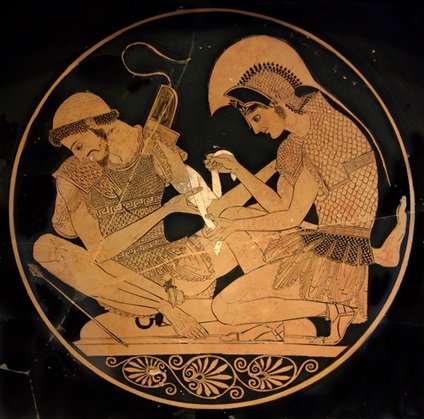
Achilles tending Patroclus wounded by an arrow, identified by inscriptions on the upper part of the vase. Interior of an Athenian drinking cup, ca. 500 BCE attributed to Sosias as painter. From Vulci. Image, Wikimedia Commons.

*All translations of ancient texts are by the author unless stated.

Modern Sources:

Christopher Brickell and Judith D. Zuk (eds.). 1996. The American Horticultural Society, A to Z Encyclopedia of Garden Plants. New York: DK publishing.

David J. Mabberley. 2014. Mabberley’s Plant-book: A Portable Dictionary of Plants, their Classification and Uses 4th Edition. Cambridge: Cambridge UP.

Annette Giesecke. 2020. Classical Mythology A to Z: An Encyclopedia of Gods & Goddesses, Heroes & Heroines, Nymphs, Spirits, Monsters, and Places. New York: Black Dog and Leventhal.

Herb Federation of New Zealand: https://herbs.org.nz/herbs/yarrow-international-herb-of-the-year-2024/

New Zealand’s Garden(s) of the Hesperides (Part I)

by Annette Giesecke

Maud at Cornwall Park, Hastings, 31 March 1922, Hastings, by Leslie Adkin. Gift of G. L. Adkin family estate, 1964. Courtesy of Te Papa (A.005756).

In the year 1936, author and theatre director Oliver Neal Gillespie (1883–1957) penned an impassioned eulogy of the town of Hastings and its environs. Titled “Highlights of Hastings — The Hawke’s Bay Garden of the Hesperides,” Gillespie’s piece appeared in The New Zealand Railways Magazine (Volume 11, Issue 6, September 1) and opened with a highly evocative description of the region’s landscape:

It is an old saying that the wealth of a land is in its soil. If it is truth, then Hastings is built upon treasure trove. As a matter of fact, the inevitable and rapid growth of the town has its tragic side. Each extra increment of its population spreads over and hides a rich lode. Such is the inordinate, the abounding and extraordinary fertility of the land of the district, that it amounts to sheer extravagance to cover it with paved roads, footpaths, homes and buildings, however handsome they may be. For aeons, the wandering rivers have been bringing in this huge, spreading series of flats, the countless riches of their gatherings. In many places, there are six feet of this black opulence from which any growing thing will spring with vivid life and swift strength. In a land of sunshine and warm and friendly rains, this area rightly claims many leadership rights. Its actual hours of sunshine place it along with Nelson and Napier among the world leaders in the blue sky’s greatest gift. Its rainfall, still, is ample for all purposes, but its rainy days might have been arranged on a limit fixed by tennis or cricket enthusiasts. It is an open air man’s paradise.[i]

There is a clear emphasis on the fertility of Hastings’ soil —“inordinate, abounding, and extraordinary” as he calls it — as well as on the region’s abundant sunshine and ample supply of water, all of which sustain a proliferation of plant growth. These noteworthy attributes, shared by Nelson and Napier, suffice to qualify Hastings as nothing short of “paradise.” Interestingly, Gillespie makes no further mention of the Hesperides’ garden but does later equate Hastings with Arcadia, a fabled, idyllic region in Greece, and with the Garden of Eden, especially Hastings’ Cornwall Park with its “sparkling sheets of ornamental waters”, “winding streams lined with roughcast edging interspersed with seats and novel bridges”, “long avenue of tall palms”, and “vivid green velvet of the lawns.”[ii] In what sense, then, was Hastings a twentieth-century Garden of the Hesperides, and what relation did that famous garden bear to Eden and Arcadia?

The Hesperides in Mythology

Garden of the Hesperides, Attic Red-Figure Lekythos, about 420–400 B.C.
Attributed to Circle of Meidias Painter [Greek (Attic), active 420 – 390 B.C.]. Image courtesy of the J. Paul Getty Museum, Malibu, inv. 91.AE.9, open access.

In classical mythology, the Hesperides were nymphs entrusted with tending the trees that yielded the golden apples so famous in classical mythology. The Hesperides were between four and seven in number, and their names are variously given as Aegle, Erytheia, Hestia, Arethusa, Hespere, Hesperusa, and Hespereia. Accounts of their birth and the location of their garden, the Garden of the Hesperides, are also various. The poet Hesiod (lived circa 725 BCE), an early source, names the elemental deities Nyx (“Night”) and Erebus (“Darkness”) as their parents, but later accounts state that their parents were either the sea god Phorcys and his sister Ceto; or Zeus, king of the Olympian gods, and Themis, the personification of justice; or the second-generation Titan god Atlas, who supported the heavens on his shoulders, and Hesperis, daughter of Hesper, the evening star. The location of the Hesperides’ garden, equally difficult to pin down, was said to be either in North Africa, specifically what was called Libya in antiquity, near the Atlas mountains (modern Morocco); or in the westernmost Mediterranean on the shores of the river Oceanus; or, alternatively, in the lands of the Hyperboreans, in the far east or to the far north, all of these locations being at the “ends of the earth” as it was then conceived.

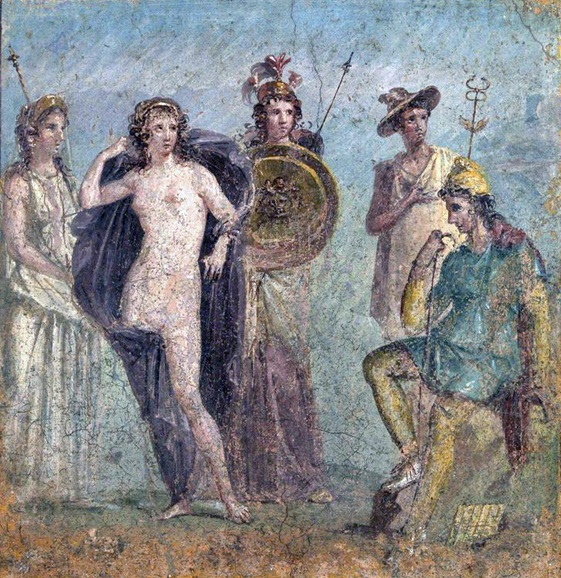
As for the golden apples, the trees that produced them were presents made by the Earth goddess Gaia to Hera, queen of the gods, on the occasion of her marriage to Zeus. The apples were sources of immortality, and thus highly prized. One of these apples ostensibly caused the Trojan War: the goddesses Hera, Aphrodite, and Athena all desired a certain golden apple inscribed with the words “for the fairest.” The Trojan prince Paris was selected to decide who the fairest among them was—an impossible choice to make objectively. He chose Aphrodite, who had also offered him a most enticing bribe: Helen, the loveliest woman in the world. Hera, meanwhile, had offered empire without end, and Athena offered success in war. Aphrodite, however, knew the philandering young prince Paris best. He was notorious for his enthusiasm for women. It was accordingly Aphrodite who was awarded the apple. Paris now faced a challenge in claiming his prize, as Helen was married to Menelaüs, the Spartan king. When Paris absconded with her to Troy, a thousand Greek ships, carrying Greece’s elite warriors, sailed in hostile pursuit. The Greeks besieged Troy for a period of ten years until that city, at long last, fell, consumed by flames when the Greeks, hidden in the belly of the Trojan Horse, emerged from their hiding place with torches and swords in hand.

The Judgment of Paris, depicting Paris (seated) with the god Hermes to his left as well as the goddesses Athena (wearing a helmet and carrying a shield), Hera (wearing a diadem and holding a scepter), and Aphrodite (alluringly disrobed). Fresco from Pompeii, House of the Judgement of Paris (45-79 CE). Image courtesy Wikimedia commons.

The golden apples that Aphrodite supplied to young Hippomenes in order to help him win the hand of Atalanta were also said to be from the Hesperides’ trees. Atalanta wished to remain a huntress, unmarried and a virgin like the goddess Artemis, but numerous men pursued her. Conceding to her father’s entreaties that she consider marriage, she agreed to marry whoever could outrun her. Many unsuccessfully attempted to win her hand and paid the penalty for loss with their lives. Still, one, undaunted, prevailed. This youth, Hippomenes, a great-grandson of the god Poseidon, called upon the goddess Aphrodite for aid, and she responded, bringing him three golden apples from her sanctuary on the isle of Cyprus. The race commenced, and Meleager threw one apple after another out to the side of the race course. Atalanta could not resist the apples, retrieving each of them in turn. Atalanta’s dash after the last apple allowed the youth to win the race and so win her as bride. Atalanta developed affection for her new mate, but the couple’s joy did not last, for in his excitement over his victory, Hippomenes had forgotten to thank Aphrodite. The angry goddess drove him wild with passion, and consequently, they defiled a temple of the goddess Cybele with their lovemaking. For this Cybele punished them by transforming them into lions that she then fastened to the yoke of her carriage.

Atalanta and Hippomemes. In the foreground Atalanta kneeling to pick up an apple and Hippomemes running with an apple in either hand; in the landscape background Atalanta running, from a series of four mythological scenes. Engraving byVirgil Solis, German, ca. 1535–62. Image courtesy The Metropolitan Museum of Art, open access.

Finally, there was the saga of Hercules and the golden apples. As the eleventh of his famous Twelve Labours, Hercules was told by the evil king Eurystheus to bring him apples from the Hesperides’ garden. Not knowing the garden’s location, Hercules first consulted the nymphs of the river Eridanus, who in turn directed him to the sea god Nereus. Hercules seized Nereus, who possessed prophetic powers, while he was asleep and held him fast while the latter repeatedly changed shape; Nereus would only prophesy under compulsion. Directed by Nereus, Hercules commenced his journey and, on the way, came upon the Titan god Prometheus, whom he released from the torment of having his liver eaten away eternally by vultures. From Prometheus Hercules received further advice regarding the accomplishment of his labour: he should ask Atlas, the Hesperides’ neighbor, to fetch the apples in his stead. This Hercules did, asking Atlas to bring the apples in exchange for relieving him, temporarily, of the heavens’ burden. Not surprisingly, Atlas was not keen to resume the onerous task of supporting the heavens on his shoulders, but Hercules tricked him by asking for a temporary reprieve in order to place a pillow on his shoulders as a cushion. According to a variant of this story, which did not involve Atlas, Hercules slew the sleepless, hundred-eyed dragon Ladon that guarded the apple trees and retrieved the apples himself. In any event, Hercules brought the apples to Eurystheus who ultimately returned the sacred apples to him. Hercules, in turn, gave the apples to Athena to return to the Hesperides.[iii]

Hercules stealing the golden apples from the Garden of the Hesperides. Detail of The Twelve Labours Roman mosaic from Llíria (Valencia, Spain), 201-250 CE. Photo by Louis Garcia, Wikimedia Commons.

To Be Continued (in Parts II and III): The Hesperides’ Garden and its Afterlife: Exotic, Fertile Place; Were the Golden Apples Not Apples at All?


Notes

[i] The New Zealand Railways Magazine, Volume 11, Issue 6 (September 1, 1936), page 9.

[ii] Page 10.

[iii] For more detail detail about the Greek gods, goddesses, heroes, and heroines, see Annette Giesecke, Classical Mythology A to Z (2020: Hachette, Black Dog and Leventhal, Running Press).