What’s In a Name? Yarrow and the great Achilles

Annette Giesecke, Te Herenga Waka | Victoria University of Wellington

I tried to grow yarrow in my Pennsylvania woodland garden to no avail, but on my New Zealand plot, surrounded by orchards and pasturelands, it grows rampant, undeterred by drought or clay soil. A member of the Asteraceae family and native to temperate regions of the Northern Hemisphere, this handsome perennial plant reaches a height of up to 1 metre (3.5 feet); has fernlike, finely dissected leaves; and its flat or slightly convex flower heads, blooming from spring well into autumn, consist of clusters of small flowers. In the wild, its flowers range in colour from white to pink, but there are red, orange, hot pink, lavender, and yellow cultivated varieties available in garden centres.

Achillea millefolium, the flower of Achilles. Photo by Jitaeri. Image, Wikimedia Commons.

Known also in common parlance as ‘arrowroot’, ‘death flower’, ‘eerie’, ‘hundred-leaved grass’, ‘old man’s mustard’, ‘sanguinary’, ‘seven-year’s love’, ‘snake’s grass’, and ‘soldier’ – yarrow is interesting on so many levels. When established, it is hardy even in adverse conditions, and it is of significant value to wildlife. Its nectar-rich flowers attract butterflies, bees, and other insects, while its leaves, toxic to some animals (including dogs, as I have witnessed), are grazed by others and gathered by nesting birds. The whole plant has a distinctive, sharp odour, that can be described as a mixture of chamomile and pine, or chrysanthemum-like. To the taste, its roots are bitter. Yarrow has been used by humans for millennia as a medicinal plant, useful in treating a wide range of ailments ranging from headaches and indigestion to infections. It effectively staunches bleeding and repels mosquitoes as well. Yarrow also has applications as a fabric dye, yielding a range of yellow tints. And then there is its mysterious botanical name, Achillea millefolium, which translates as ‘Achilles’ thousand-leaved plant’. ‘Thousand-leaved’ is, of course, a reference to yarrow’s dissected leaves, but why is this the plant of Achilles, that ancient Greek hero famed for his exploits in the Trojan War?

In addition to being an extraordinarily effective warrior, Achilles had a range of other skills and talents, all in keeping with his unusual parentage and upbringing. He was the son of the sea goddess Thetis and Peleus, a mortal man. A prophecy had revealed that Thetis was destined to bear a son who would overpower his father, an event that would threaten the established divine hierarchy. For this reason, Zeus, king of the Olympian gods, offered Thetis in marriage to Peleus, a king of the northern Greek district of Phthia, for whom this was a reward. By some accounts, Thetis did not accept this arrangement willingly, causing Peleus to wrestle with her as she changed her shape to fire, water, and then a wild beast to elude his grasp (Apollodorus, Bibliotheca. 13.3). Peleus prevailed, and all the gods were invited to the couple’s wedding… all but one. Only Eris, goddess of strife was excluded. Her presence on this festive occasion, it was thought, would only bring misfortune. Misfortune befell the festive gathering nonetheless, as an angry Eris appeared bearing what would prove to be a fateful wedding gift: a golden apple labeled ‘for the fairest’. Loveliest of the goddesses were Hera (queen of the gods), Athena (goddess of wisdom and defensive war), and Aphrodite (goddess of love and desire), and all three, equally beautiful, laid claim to this golden prize. As no god dared to make this choice, it was agreed to leave the decision to Paris Alexander, the prince of Troy, whose reputation as a lover was well known. Not leaving the outcome of this contest to chance, each goddess offered Paris a bribe. Hera promised that she would make him king of all men, while Athena offered him success in war. Aphrodite, however, knew him best and offered him Helen, the most beautiful woman in the world. It was she who was awarded the golden apple.

In the course of time, Paris traveled to Greece and, while being hospitably entertained in Sparta, made off with Helen, that kingdom’s queen. This was an affront that King Menelaos, Helen’s husband, could not bear, and with his brother Agamemnon, king of Mycenae in the lead, assembled the bravest and strongest men of Greece. A fleet of one thousand ships then sailed to Troy, their purpose being to retrieve Helen, a goal not easily achieved as Homer’s Iliad and Odyssey reveal.

Between Paris’ fateful judgment and his theft of Menelaos’ queen, some fifteen years had passed. Soon after the wedding of Peleus to Thetis, Achilles was born to them, and although half-divine by birth, he was destined to die an early death, as a prophecy foretold. His distraught mother attempted to make her infant immortal, holding him by the ankles and dipping him in the magical waters of the dreaded river Styx. This left him invulnerable, except on his ankles where his mother had held him fast.

While a young child, Achilles, like several other Greek heroes, was sent to live with and be educated by Chiron, a very special centaur. Others were Jason, who went to fetch the famed Golden Fleece; Hercules, renowned for his 12 Labours; and Asklepios, the god Apollo’s son who would become a god of healing. From Chiron, Achilles learned how to hunt, how to play the lyre, and, of particular relevance to yarrow, how to use herbs in healing.

The centaur Chiron teaching Achilles how to play the lyre. Roman fresco from Herculaneum, National Archaeological Museum of Naples, 1st century CE. Image, Wikimedia Commons.

When grown, Achilles would join the Greek forces who fought for the return of Helen, in the course of battle displaying extraordinary cruelty—especially towards Hektor, Troy’s brave and kind defender, a wholly decent, honourable man—but also extraordinary compassion towards his wounded comrades. In Homer’s Iliad, one particular wounded warrior, Eurypylos by name, was not attended to by Achilles himself but by Achilles’ closest friend, whom he, in turn, had instructed in the art of healing. Eurypylos had pleaded for Patroklos’ help, saying:


“Please, I beg of you, lead me to my dark ship, and cut this arrow from my thigh. Warm water will wash away the blackened blood, and then sprinkle good, soothing medicines (ēpia pharmaka esthla) upon it, just as people say Achilles taught you”. (Iliad XI. 828-31)


What, exactly, this good, soothing medicine consisted of is not stated here, but the following lines offer a significant clue:


“Patroklos lay him down, and cut the piercing arrow from his thigh, washing away the dark blood with warm water. And he placed a bitter root upon the wound, first rubbing it with his hands, a root that kills pain (rhizdan pikrēn) and that put an end to all his suffering. The wound was dry, the bleeding stopped”. (Iliad XI.844-48)

Homer did not name this bitter root, but yarrow’s root is bitter, and the plant has analgesic (painkilling) and hemostatic (blood-stopping) properties as well.

The Iliad is conventionally dated to about 750 BCE, and it would be more than 700 years later that Roman encyclopedist Pliny the Elder, author of a multi-volume Natural History (first century CE), provided the next clue: “Achilles, too, the pupil of Chiron, discovered a plant which heals wounds, and which, as being his discovery, is known as the ‘achilleos’ [plant of Achilles].” Yet Pliny proceeded then to identify this plant with one very different from yarrow, writing:

“By some persons this plant is called ‘panaces heracleon’, by others, ‘sideritis’, and by the people of our country, ‘millefolium’: the stalk of it, they say, is a cubit in length, branchy, and covered from the bottom with leaves somewhat smaller than those of fennel. Other authorities, however, while admitting that this last plant is good for wounds, affirm that the genuine achilleos has a bluish stem a foot in length, destitute of branches, and elegantly clothed all over with isolated leaves of a round form. Others again, maintain that it has a squared stem, that the heads of it are small and like those of horehound, and that the leaves are similar to those of the quercus—they say too, that this last has the property of uniting the sinews when cut asunder. Another statement is that the sideritis is a plant that grows on garden walls, and that it emits, when bruised, a fetid smell; that there is also another plant, very similar to it, but with a whiter and more unctuous leaf, a more delicate stem, and mostly found growing in vineyards”. (Natural History 25.19, adapted from John Bowersock trans. 1855. London: Taylor and Francis)

Pliny offered several plants as candidates for Achilles’ plant. One is sideritis (‘mountain tea’), a group of plants in the mint family that don’t remotely resemble yarrow physically but that do have medicinal properties. Another is ‘panaces heracleon’ (‘Hercules’ cure-all’, Opopanax chironium), a yellow-flowering herb that grows 1-3 metres in height but that likewise has medicinal applications. Did Pliny confuse these two with the plant that, much later, with the advent of standardized scientific botanic nomenclature, would be called Achillea millefolium? Or, were all three simply known as ‘Achilles’ plants’ in antiquity? All we can say is that it was Achilles’ reputation as a healer of battle wounds that inspired the choice of yarrow’s scientific name by Carl Linnaeus in the 18th century.
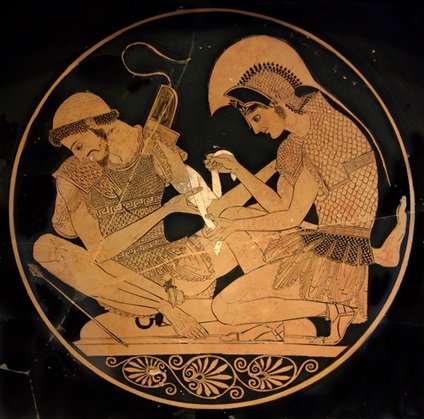
Achilles tending Patroclus wounded by an arrow, identified by inscriptions on the upper part of the vase. Interior of an Athenian drinking cup, ca. 500 BCE attributed to Sosias as painter. From Vulci. Image, Wikimedia Commons.

*All translations of ancient texts are by the author unless stated.

Modern Sources:

Christopher Brickell and Judith D. Zuk (eds.). 1996. The American Horticultural Society, A to Z Encyclopedia of Garden Plants. New York: DK publishing.

David J. Mabberley. 2014. Mabberley’s Plant-book: A Portable Dictionary of Plants, their Classification and Uses 4th Edition. Cambridge: Cambridge UP.

Annette Giesecke. 2020. Classical Mythology A to Z: An Encyclopedia of Gods & Goddesses, Heroes & Heroines, Nymphs, Spirits, Monsters, and Places. New York: Black Dog and Leventhal.

Herb Federation of New Zealand: https://herbs.org.nz/herbs/yarrow-international-herb-of-the-year-2024/
Ship Figureheads as Statuary in New Zealand Gardens, Part 1: The Hydrabad

by Ian Duggan

A number of newspaper reports can be found of the figureheads of ships adorning not their expected vessels, but New Zealand gardens as items of statuary through the early 20th Century. This blog covers one such example, the figurehead of the Hydrabad (commonly incorrectly spelt as “the Hyderabad”, after the city in India), a ship that was wrecked on Waitārere beach on the Horowhenua coast in 1878.

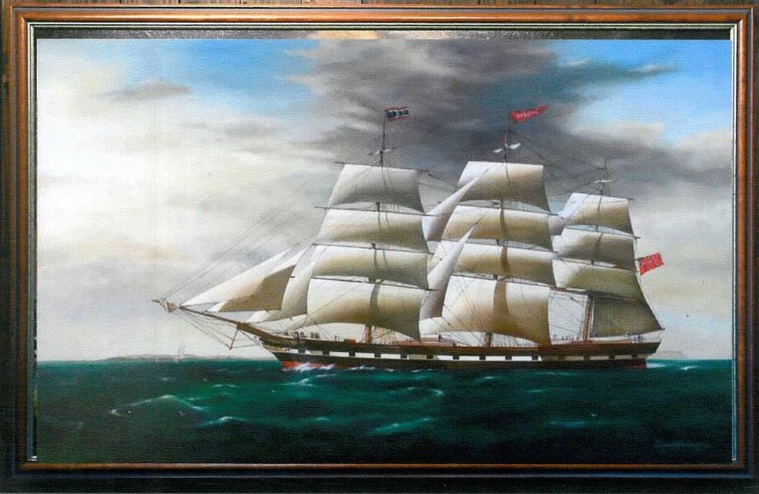
On her sea trials off Glasgow 1865. Original oil painting on canvas. 1800 x 1100mm. Provided by Kete Horowhenua.

What is a figurehead? The Royal Museums Greenwich provide a great overview, at this link, which I provide a brief summary of here. Figureheads are decorative carved wooden sculptures, most frequently female, that decorated the prows of sailing ships. These were said to embody the “spirit of the vessel”, and were considered by the crew of the ships to be lucky charms. A range of subjects were depicted on the figureheads, with many representing a member of the ship-owner’s family or of the owner himself, while others depicted historical figures or an influential individual from contemporary society. Evidence of the use of figureheads dates back to around 3000 BC in Egypt, but while they were a common feature on ships during the sailing age, their use had largely died out by the end of the 19th Century.[i]

Indeed, Wellington’s Evening Star noted in 1911 that, at that stage: “The likeliest place to find a ship’s figurehead nowadays is… in a suburban tea garden. Certainly there are few ships afloat [now] which carry them”.[ii]

The figurehead of the Hydrabad is one that has gained the most attention in New Zealand newspapers. The Hydrabad was a three-masted iron ship built in Glasgow, Scotland, in 1865, which primarily operated as a cargo vessel between England, Australia and India. However, she was wrecked on the Horowhenua Coast in June 1878, while on her way between Lyttleton and South Australia. At the time she was carrying a cargo of broad-gauge Canterbury railway locomotives and components declared surplus in New Zealand, due to the national standardisation of railway infrastructure[iii]; Canterbury had been building its railway using a 5′ 3″ gauge, whereas the New Zealand government’s public works stipulated that the gauge must not exceed 3′ 6″[iv]. The locomotives were thus destined for use in South Australia.[v]

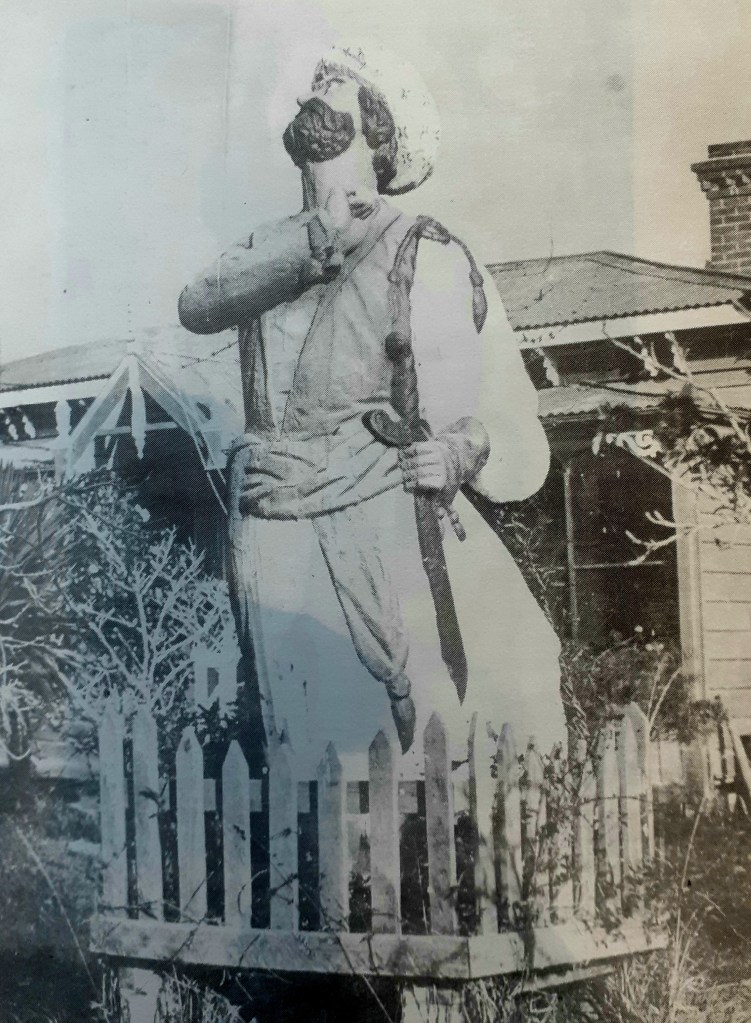
Figurehead in the garden of A. Jonson. [from Church, I. (1978). The Wreck of the Hydrabad. Dunmore Press Ltd, Palmerston North].

The wreck of the Hydrabad was sold to a Mr Liddell, who bought the figurehead and the vessel’s cannon, taking them to Foxton. On arrival in the town, “both figurehead and cannon were deposited in Mr. Liddell’s yard… in Clyde Street. For many years they lay there until they were acquired by… Mr. A. Jonson and removed to Avenue Road”.[vi]

Skip forward a number of years, and in 1896 the Manawatu Herald reported that Mr Andrew Jonson “long had erected in his garden on the Avenue Road the old figurehead of the Hydrabad”.[vii] And the figurehead appeared to remain in his garden for a long period thereafter. For example, in 1907, it was stated that:

“In the centre of a garden plot in front of a cottage at Foxton is a brightly painted piece of well executed statuary. It is the figure enlarged to far more than life size of an Indian Rajah, dressed in full regalia, with scimitar, and hand uplifted in a threatening attitude. The legs are cut away, but the carving from the knees upwards, and the fierce expression on the black-bearded face of the Eastern potentate, are admirably executed”.

It continued, “The owner, Mr Jonson, narrates in connection with it a story of adventure. Nearly, half a century ago it formed the figure-head of a splendid steam yacht of 1800 tons, built… for the Rajah of Hyderabad. The figurehead, carved from Baltic pine, represented the owner, and for a number of years he took charge of the vessel, the Hyderabad [sic], travelling over the Indian Ocean. Eventually the vessel fell into the hands of Captain [Charles James] Holmwood, by whom it was sailfully navigated until, while laden with railway rolling stock, its career was ended during a storm, when it was stranded about four miles from the mouth of Manawatu river. In this way the fine carving fell into the hands of a Foxton resident, who prizes it highly”.[viii]

Jonson’s story may be somewhat embellished, however. The vessel was actually constructed for the Bombay Iron Shipping Company (in present day Mumbai).

Mr Jonson passed away in 1917, at the age of 75. The Manawatu Standard noted that he was a well-known builder and undertaker in Foxton. His residence in Avenue Road, we are told, “is well known in Foxton, and was of special interest to visitors from the fact that in the front garden was the figurehead consisting of an Indian chief, of the ship Hyderabad [sic]”. Nevertheless, it was also noted that “Some time ago the figurehead was presented by Mr Jonson to the Foxton Borough Council, to be placed in one of the local reserves”.[ix]

So, had the Council taken possession of it? In 1929, we hear a different story: “After remaining for many years at Foxton, the figurehead of the Hyderabad [sic], which lies on Hokio Beach, is to be sent to Auckland to the naval base there at the request of the Commander of HMS Philomel, who is making a collection of old figureheads. The figurehead of the “Hyderabad” [sic] has been in the garden of Mrs Andrew Jonson, in the Avenue at Foxton, since it came into possession of her late husband at the time the vessel was dismantled”. Nevertheless, “Mrs Jonson has given her consent to hand over the figurehead to the naval authorities for safe keeping”.

After so many years in the garden, however, the figurehead by this stage was looking a little worse for wear: “Long exposure to weather has robbed the figurehead of its pristine beauty, but when restored to its original adornment, it will make one of the most interesting exhibits in the collection”.[x]

Did the figurehead finally make it out of the garden, to the safety of the naval base in Auckland? Again, it appears that it still didn’t go anywhere. And this was unfortunate, for in 1933 the Manawatu Standard gave a sad update on the Hydrabad’s figurehead:

“Many of the older residents of the district will learn with regret the disappearance from Foxton of that interesting relic of one of the most remarkable wrecks on this coast, the figurehead of the Hyderabad [sic], which for the past half-century has always been a source of interest to visitors to the town. For the past thirty years the figurehead, a representation of an Indian rajah with turbaned head and drawn scimitar, occupied a prominent position in the garden of Mrs A. Jonson, of Avenue Road. Standing between twelve and fifteen feet high, it presented a striking sight in its gaily painted robes, but with the passage of time and the ravages of the elements this finely executed carving has gone the way of most woodwork, and, badly rotted throughout, it was last week felled and cut up for firewood”.[xi]

A Mr H. Coley, of Foxton, was subsequently interviewed, and stated that: “A year or so ago the naval authorities at Devonport, Auckland, made inquiries about the figurehead of the Hyderabad as it was desired to include it amongst the collection at the Auckland naval base. Mrs Jonson then gave her sanction to its removal, but, unfortunately, nothing further was done….”.[xii]

Shipwrecked ship “The Hydrabad” at Waitarere beach, looking from south to north on the seaward side. credit: Horowhenua Historical Society Inc.


Final confirmation of the circumstances of its destruction was reported in 1935: “Light has been shed upon the fate of the figurehead of the ship Hyderabad [sic], the remains of which lie on Waitarere Beach, where she was wrecked many years ago. Captain Baggett, of the motor-vessel Foxton, said in an interview in Wellington that, after the death of the householder who owned the figurehead, his home was occupied by a family the members of which were unaware of the history and value of the strange relic that stood in the garden. Accordingly they chopped it up for firewood. An attempt was made by a prominent Foxton man to save the figurehead, but he arrived too late to prevent its destruction”. 

At least ten other ship figureheads have been reported in New Zealand newspapers as having decorated gardens, and some of these will be covered in future blogs.

Read Part II here: The Wolverine

Read Part III here: The America, the Helen Denny, and others

REFERENCES


[i] Ship figureheads and decoration, Royal Museums Greenwich. https://www.rmg.co.uk/collections/ship-figureheads-decoration

[ii] Shipping. Evening Star, 29 September 1911, P8

[iii] Hydrabad (1865-1878) Wreck Site, Waitarere Beach, Levin. Heritage NZ.  https://www.heritage.org.nz/list-details/9559/Listing

[iv] Church, I. (1978). The Wreck of the Hydrabad. Dunmore Press Ltd, Palmerston North.

[v] Hydrabad (1865-1878) Wreck Site, Waitarere Beach, LEVIN. Heritage NZ.  https://www.heritage.org.nz/list-details/9559/Listing

[vi] Figurehead of the Hydrabad Demolished. Otaki Mail, 24 April 1933, Page 4

[vii] Manawatu Herald, 26 September 1896, Page 2

[viii] Poverty Bay Herald, 24 October 1907, P4

[ix] Manawatu Standard, 18 October 1917, P4

[x] Daily Chronicle, 11 July 1929, Page 4

[xi] Loss of the Hyderabad. Manawatu Standard, 27 March 1933, P7

[xii] Loss of the Hyderabad. Manawatu Standard, 27 March 1933, P7

A Battleship in the Garden? Unusual Auckland Garden Features from the 1930s

by Ian Duggan

While garden features such as arches and goldfish ponds have been popular and widespread in New Zealand private gardens, some have been more unique. For a short period between the First and Second World War, for example, the newspapers reported on a couple of Auckland residences whose gardens featured ships!

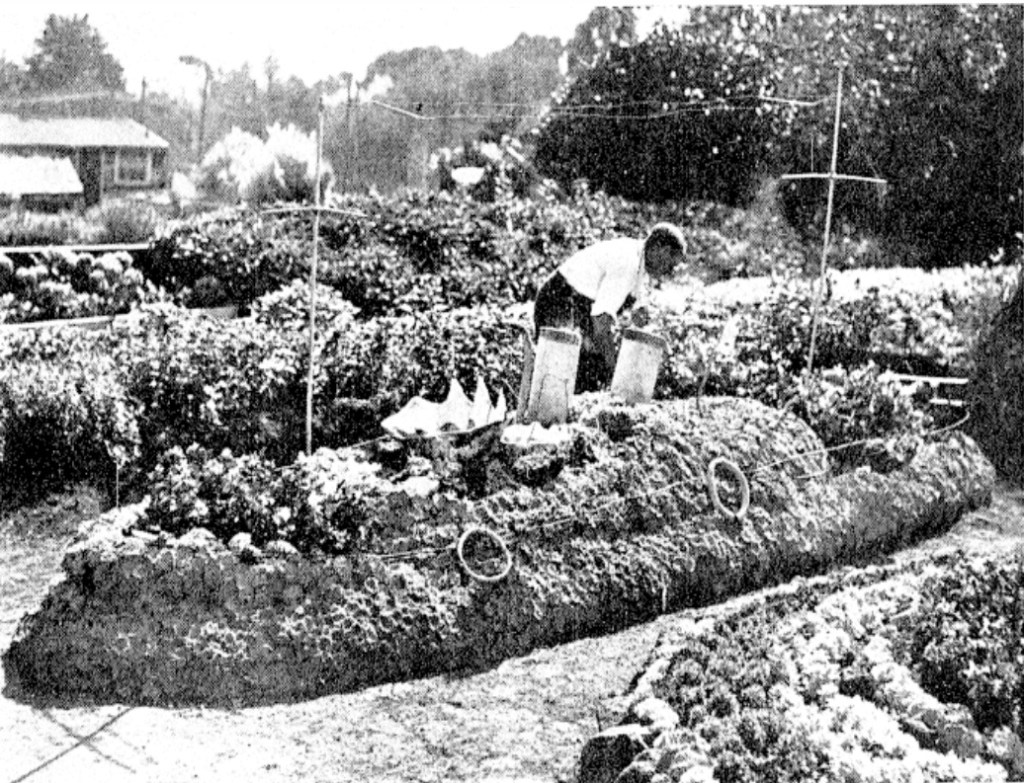
The first, reported in the New Zealand Herald in January 1937, rightly recognised the nautical feature as an “Unusual decoration for the garden”. Little detail was provided about the feature piece, however, except that it was a ship model in the garden of a Mr. W. Freeman, Allendale Road, Mount Albert. The hull consisted largely of border plants, while an ornamental shell provides the bridge”.[i] Beyond that, examination of the photograph shows the ship also featured masts and what appears to be drainpipes for its twin funnels.  

An Unusual Feature in the Garden. New Zealand Herald, 21 January 1937, Page 6

Hot on the heels of Freeman’s ship came a remarkably similar vessel in another garden only a little over five kilometers away. In April 1937, the Auckland Star noted that “There is no limit to garden attractions”.

“Some industrious people cut their hedges and shrubs in various ways to represent figures or objects, but something entirely different in the decorative line has been achieved in the garden in front of the home of Mr. David Kasper, at Titirangi Road, New Lynn. There the taste has been nautical, and a land battleship has been created”.

Here, we are treated to some detail on the ships’ construction:

“In the first place the shape of a battleship, on a miniature scale, was marked out on the front lawn, and then the soil was built up to a height of about two feet. A grey rock-plant was grown on the sides of the “hull”, and the necessary nautical and warlike trimmings were added. Two steel rods have been used for the masts, and a light wire, suspended between them, makes an impressive aerial. The funnel is a drain pipe, painted yellow, with a buff top, and set at a rakish angle “amidships.” There are iron davits “amidships” on the side of the “hull.” The boats are hanging baskets of greenery”. [ii]

An image was provided in the next day’s paper, adding that the “grey rock plant gives the hull a distinctive naval touch” [iii]

Hard Aground. Auckland Star, 29 April 1937, P9

As with any garden, however, the ship didn’t look after itself:

“Just like the nautical battleships which do go to sea, the New Lynn “warship” requires many an overhaul. Weeds will persist in growing on the “quarterdeck,” and as docks and plantain, or even green paspalum would be strangely out of place in such a setting, the “crew” have a fairly busy time”.[iv]

Kasper’s ship remained in situ for at least a number of months afterwards. In August 1938, almost a year and a half after the previous report, another image of the vessel appeared in the Auckland Star where it was reported:

“Quaintly decorated with border plants, this model battleship, in a garden fronting on Titirangi Road, New Lynn, always attracts the attention of passers-by”.[v]

The photograph indicates that the design of the ship had evolved since the previous year, with the addition of life rings to the sides, railings, and what appears to be a steering wheel on the bridge.

Model Battleship. New Zealand Herald, 26 August 1938, Page 6

These snippets throw up a number of questions. How long did these garden ships persist? I can’t find any mentions in the newspapers of them after August 1938. Did the idea of a battleship in the garden lose some appeal with the impending war? From these reports, was anyone else inspired to construct sea-going vessels in their front yards, or were they unique to these two gentlemen? Indeed, were Kasper and Freeman friends? They only lived around five kilometers apart, and their designs appear to possess some common features. Interestingly, I can’t actually find any records of David Kasper outside of this article, even though we are provided with his full name. Not even a record of birth, marriage or death. So, who were these mystery people, and what inspired them? The answer to that question is, unfortunately, likely lost to the mists of time.

Postscript: Slightly post-dating both of these ships is the ‘Floral Ship’ on The Strand in Tauranga, constructed in 1938. I wonder if Kasper and Freeman’s ships provided inspiration for that one, which can be read about on the Historic Tauranga website, here, and from the Tauranga Historical Society, here?

References


[i] Unusual Decoration for the Garden: A Ship Outlined in Flowers. New Zealand Herald, 21 January 1937, Page 6

[ii] Hard Aground: Land Battleship in Suburban Garden. Auckland Star, 28 April 1937, Page 10

[iii] Auckland Star, 29 April 1937, Page 9

[iv] Hard Aground: Land Battleship in Suburban Garden. Auckland Star, 28 April 1937, Page 10

[v] New Zealand Herald, 26 August 1938, Page 6