
by Ian Duggan
A number of newspaper reports can be found of the figureheads of ships adorning not their expected vessels, but New Zealand gardens as items of statuary through the early 20th Century. This blog covers one such example, the figurehead of the Hydrabad (commonly incorrectly spelt as “the Hyderabad”, after the city in India), a ship that was wrecked on Waitārere beach on the Horowhenua coast in 1878.
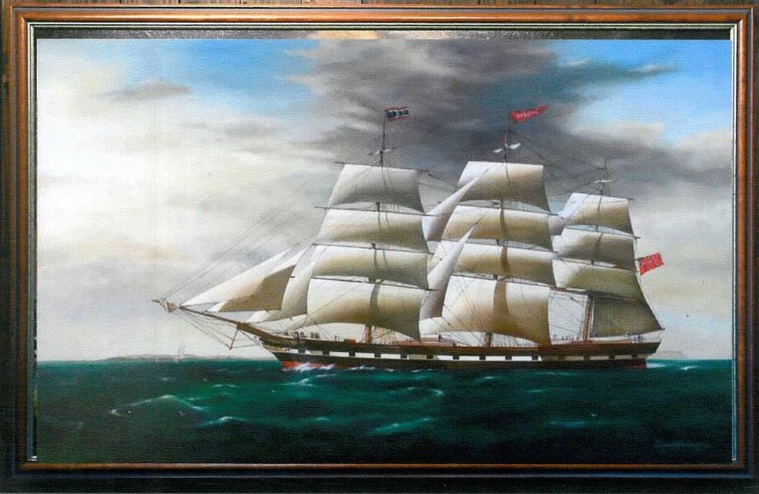
What is a figurehead? The Royal Museums Greenwich provide a great overview, at this link, which I provide a brief summary of here. Figureheads are decorative carved wooden sculptures, most frequently female, that decorated the prows of sailing ships. These were said to embody the “spirit of the vessel”, and were considered by the crew of the ships to be lucky charms. A range of subjects were depicted on the figureheads, with many representing a member of the ship-owner’s family or of the owner himself, while others depicted historical figures or an influential individual from contemporary society. Evidence of the use of figureheads dates back to around 3000 BC in Egypt, but while they were a common feature on ships during the sailing age, their use had largely died out by the end of the 19th Century.[i]
Indeed, Wellington’s Evening Star noted in 1911 that, at that stage: “The likeliest place to find a ship’s figurehead nowadays is… in a suburban tea garden. Certainly there are few ships afloat [now] which carry them”.[ii]
The figurehead of the Hydrabad is one that has gained the most attention in New Zealand newspapers. The Hydrabad was a three-masted iron ship built in Glasgow, Scotland, in 1865, which primarily operated as a cargo vessel between England, Australia and India. However, she was wrecked on the Horowhenua Coast in June 1878, while on her way between Lyttleton and South Australia. At the time she was carrying a cargo of broad-gauge Canterbury railway locomotives and components declared surplus in New Zealand, due to the national standardisation of railway infrastructure[iii]; Canterbury had been building its railway using a 5′ 3″ gauge, whereas the New Zealand government’s public works stipulated that the gauge must not exceed 3′ 6″[iv]. The locomotives were thus destined for use in South Australia.[v]
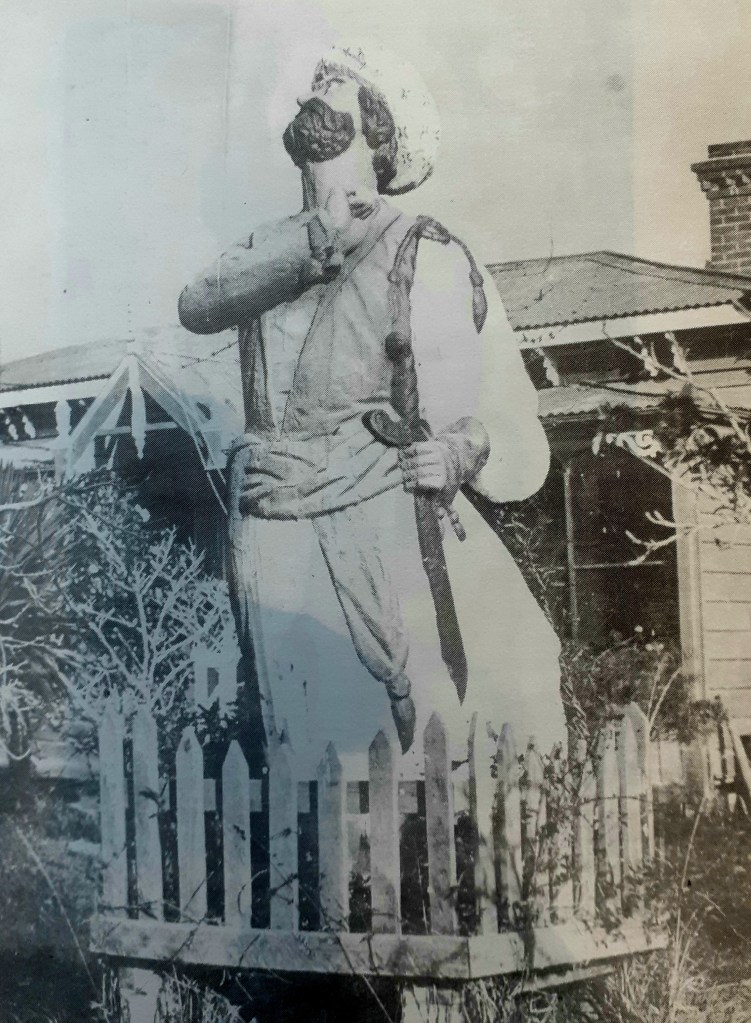
The wreck of the Hydrabad was sold to a Mr Liddell, who bought the figurehead and the vessel’s cannon, taking them to Foxton. On arrival in the town, “both figurehead and cannon were deposited in Mr. Liddell’s yard… in Clyde Street. For many years they lay there until they were acquired by… Mr. A. Jonson and removed to Avenue Road”.[vi]
Skip forward a number of years, and in 1896 the Manawatu Herald reported that Mr Andrew Jonson “long had erected in his garden on the Avenue Road the old figurehead of the Hydrabad”.[vii] And the figurehead appeared to remain in his garden for a long period thereafter. For example, in 1907, it was stated that:
“In the centre of a garden plot in front of a cottage at Foxton is a brightly painted piece of well executed statuary. It is the figure enlarged to far more than life size of an Indian Rajah, dressed in full regalia, with scimitar, and hand uplifted in a threatening attitude. The legs are cut away, but the carving from the knees upwards, and the fierce expression on the black-bearded face of the Eastern potentate, are admirably executed”.
It continued, “The owner, Mr Jonson, narrates in connection with it a story of adventure. Nearly, half a century ago it formed the figure-head of a splendid steam yacht of 1800 tons, built… for the Rajah of Hyderabad. The figurehead, carved from Baltic pine, represented the owner, and for a number of years he took charge of the vessel, the Hyderabad [sic], travelling over the Indian Ocean. Eventually the vessel fell into the hands of Captain [Charles James] Holmwood, by whom it was sailfully navigated until, while laden with railway rolling stock, its career was ended during a storm, when it was stranded about four miles from the mouth of Manawatu river. In this way the fine carving fell into the hands of a Foxton resident, who prizes it highly”.[viii]
Jonson’s story may be somewhat embellished, however. The vessel was actually constructed for the Bombay Iron Shipping Company (in present day Mumbai).
Mr Jonson passed away in 1917, at the age of 75. The Manawatu Standard noted that he was a well-known builder and undertaker in Foxton. His residence in Avenue Road, we are told, “is well known in Foxton, and was of special interest to visitors from the fact that in the front garden was the figurehead consisting of an Indian chief, of the ship Hyderabad [sic]”. Nevertheless, it was also noted that “Some time ago the figurehead was presented by Mr Jonson to the Foxton Borough Council, to be placed in one of the local reserves”.[ix]
So, had the Council taken possession of it? In 1929, we hear a different story: “After remaining for many years at Foxton, the figurehead of the Hyderabad [sic], which lies on Hokio Beach, is to be sent to Auckland to the naval base there at the request of the Commander of HMS Philomel, who is making a collection of old figureheads. The figurehead of the “Hyderabad” [sic] has been in the garden of Mrs Andrew Jonson, in the Avenue at Foxton, since it came into possession of her late husband at the time the vessel was dismantled”. Nevertheless, “Mrs Jonson has given her consent to hand over the figurehead to the naval authorities for safe keeping”.
After so many years in the garden, however, the figurehead by this stage was looking a little worse for wear: “Long exposure to weather has robbed the figurehead of its pristine beauty, but when restored to its original adornment, it will make one of the most interesting exhibits in the collection”.[x]
Did the figurehead finally make it out of the garden, to the safety of the naval base in Auckland? Again, it appears that it still didn’t go anywhere. And this was unfortunate, for in 1933 the Manawatu Standard gave a sad update on the Hydrabad’s figurehead:
“Many of the older residents of the district will learn with regret the disappearance from Foxton of that interesting relic of one of the most remarkable wrecks on this coast, the figurehead of the Hyderabad [sic], which for the past half-century has always been a source of interest to visitors to the town. For the past thirty years the figurehead, a representation of an Indian rajah with turbaned head and drawn scimitar, occupied a prominent position in the garden of Mrs A. Jonson, of Avenue Road. Standing between twelve and fifteen feet high, it presented a striking sight in its gaily painted robes, but with the passage of time and the ravages of the elements this finely executed carving has gone the way of most woodwork, and, badly rotted throughout, it was last week felled and cut up for firewood”.[xi]
A Mr H. Coley, of Foxton, was subsequently interviewed, and stated that: “A year or so ago the naval authorities at Devonport, Auckland, made inquiries about the figurehead of the Hyderabad as it was desired to include it amongst the collection at the Auckland naval base. Mrs Jonson then gave her sanction to its removal, but, unfortunately, nothing further was done….”.[xii]

Final confirmation of the circumstances of its destruction was reported in 1935: “Light has been shed upon the fate of the figurehead of the ship Hyderabad [sic], the remains of which lie on Waitarere Beach, where she was wrecked many years ago. Captain Baggett, of the motor-vessel Foxton, said in an interview in Wellington that, after the death of the householder who owned the figurehead, his home was occupied by a family the members of which were unaware of the history and value of the strange relic that stood in the garden. Accordingly they chopped it up for firewood. An attempt was made by a prominent Foxton man to save the figurehead, but he arrived too late to prevent its destruction”.
At least ten other ship figureheads have been reported in New Zealand newspapers as having decorated gardens, and some of these will be covered in future blogs.
Read Part II here: The Wolverine
Read Part III here: The America, the Helen Denny, and others
REFERENCES
[i] Ship figureheads and decoration, Royal Museums Greenwich. https://www.rmg.co.uk/collections/ship-figureheads-decoration
[ii] Shipping. Evening Star, 29 September 1911, P8
[iii] Hydrabad (1865-1878) Wreck Site, Waitarere Beach, Levin. Heritage NZ. https://www.heritage.org.nz/list-details/9559/Listing
[iv] Church, I. (1978). The Wreck of the Hydrabad. Dunmore Press Ltd, Palmerston North.
[v] Hydrabad (1865-1878) Wreck Site, Waitarere Beach, LEVIN. Heritage NZ. https://www.heritage.org.nz/list-details/9559/Listing
[vi] Figurehead of the Hydrabad Demolished. Otaki Mail, 24 April 1933, Page 4
[vii] Manawatu Herald, 26 September 1896, Page 2
[viii] Poverty Bay Herald, 24 October 1907, P4
[ix] Manawatu Standard, 18 October 1917, P4
[x] Daily Chronicle, 11 July 1929, Page 4
[xi] Loss of the Hyderabad. Manawatu Standard, 27 March 1933, P7
[xii] Loss of the Hyderabad. Manawatu Standard, 27 March 1933, P7

 The Garden History Research Foundation
2 thoughts on “Ship Figureheads as Statuary in New Zealand Gardens, Part 1: The Hydrabad”