
by Mike Lloyd
[This blog is a repost from Mike Lloyd’s ‘The Local Arboretum: Noticeable trees and their stories‘ website]
As I noted in the first post on the Arrowsmith Phoenix palms, a worldwide ‘palm craze’ spread among garden enthusiasts from the 1850s on.1 British migrants brought this with them to the colonies where they settled, including New Zealand. At times this led to an appreciation of the nikau (Rhopalostylis sapida), but relative to the palms that fascinated Europeans in their newly built palm houses (like the famous one at Kew), the nikau palm could easily be overlooked. Here’s an interesting travelogue where we can partly see this dynamic expressed:
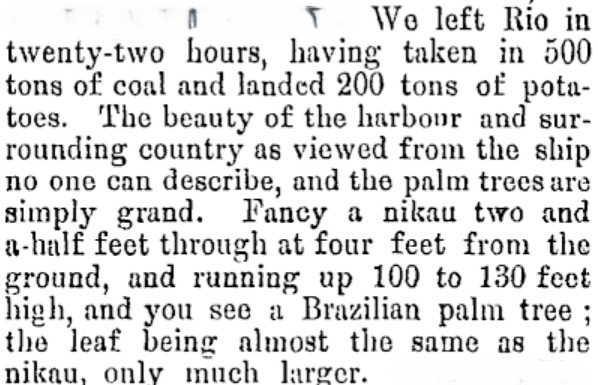
This is taken from an 1884 letter to the editor of the Taranaki Herald, titled ‘A trip home in the S.S. Doric‘. It is very likely that the ‘Brazilian palm tree’ discussed was in the Rio Botanic Garden’s 750 metre long ‘Avenue of Royal Palms‘. Justifiably, this had worldwide renown though the palm planted there – Roystonea oleracea – actually originates in the Carribean. Evaluating the nikau in relation to it is an ‘apples and oranges’ kind of comparison, which the correspondent isn’t really encouraging. Perhaps he just wishes there were gardens like this in New Zealand, but for sure the mention of the nikau does at least show that New Zealand’s sole endemic palm had some significance for a New Zealander on their trip back ‘home’ (i.e., to England) as early as the 1880s.
Several years before the palm-interested correspondent made these comments, nikau plants and/or seeds were actually travelling about the globe. In September 1865 the Australian government botanist Ferdinand von Mueller wrote to George Grey requesting seeds of what he then called New Zealand Areca palms (Areca sapida being the original botanical name). Two months later he gratefully acknowledged receipt of both seeds and ‘living plants of this noble palm’, which he intended to distribute to interested enthusiasts about the globe.
Nikau seeds and plants were not the only thing travelling the globe in the late 1800s. After a visit in 1881 to New Zealand, Marianne North2 gifted the following artwork to Kew Gardens, London:

By the time of this gift -1882 – nikau palms had been growing in Kew’s Temperate Palm House for a few years. New Zealand travellers, at least those who bypassed Rio, can be found well-pleased upon visiting Kew to find healthy specimens of nikau ‘quite at home’:

Early use of the nikau for decorative and ceremonial occasions
One of the commonest ways in which the nikau was used in New Zealand from the 1850s to the early 1900s was for decorative purposes. Probably, whole plants were not dug up, rather fronds were cut from nikau palms sourced in the ‘bush’. We’ll see some photos shortly, but searching Papers Past using the term ‘nikau palm decoration’ turns up many accounts of such decorative use. As early as 1859 the Nelson Examiner includes in a report on the laying of the foundation stone for Nelson College that

Nikau were obviously growing in Nelson during the reign of Queen Victoria (VR stands for Victoria Regina). Nikau were also growing in Lower Hutt as indicated by this extract from the New Zealand Herald, from which this blogpost’s title comes:
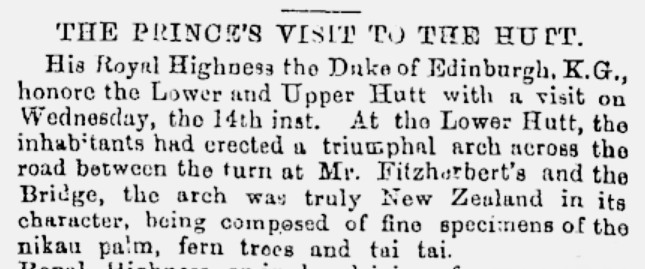
There are no available photos of this arch constructed for the Prince’s visit in1869, but there are many photos available of the remnant nikau palms from which the fronds were probably sourced:
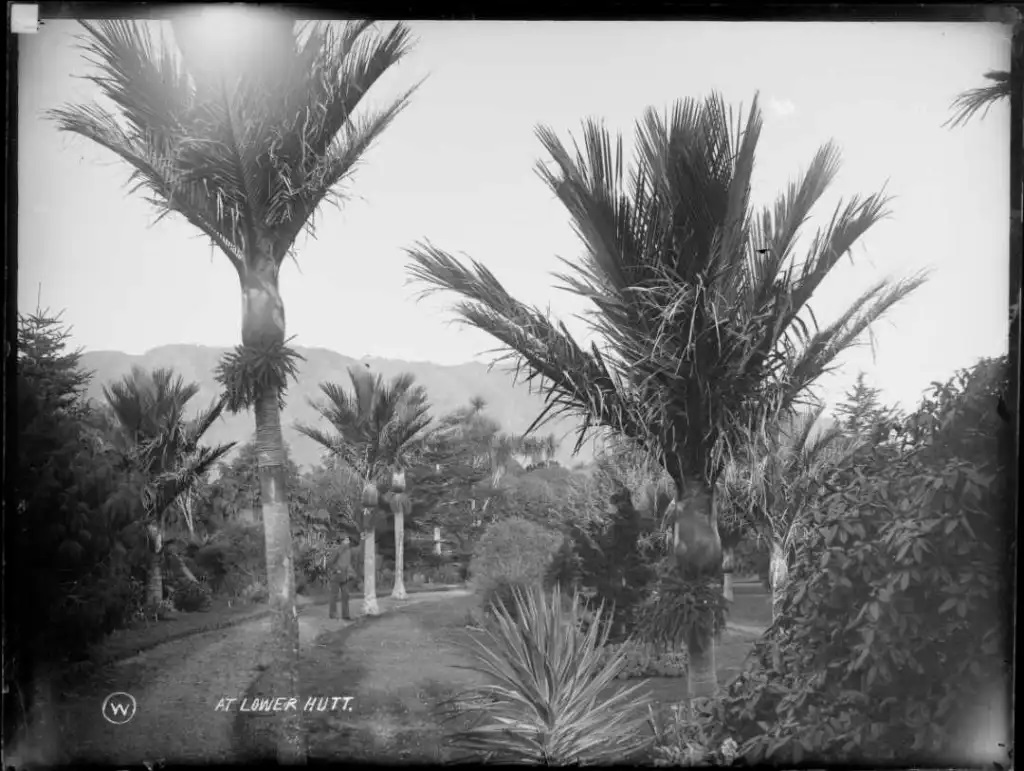
This photo was taken circa 1885, clearly showing nikau large enough to provide fronds for decorative arches. MacNab’s Gardens were originally the private gardens of Alfred Ludlam, who was a politician, farmer, and horticulturalist, as well as being a prime mover in the founding of the Wellington Botanic Gardens. Many of the nikau palms so liked by Ludlam survived the later transition to Bellevue Gardens, and then into the gardens of private residences (see NZ Tree Register). Recognising the status of these remnants the Hutt City Council district plan protects all remnant nikau; it is not known what happened to the ‘tai tai’ (toetoe).
Given there are a good number of historic photos it is worth looking at a few examples to see how nikau (and other plants) were employed for decorative purposes. Here are a few presented in chronological order:
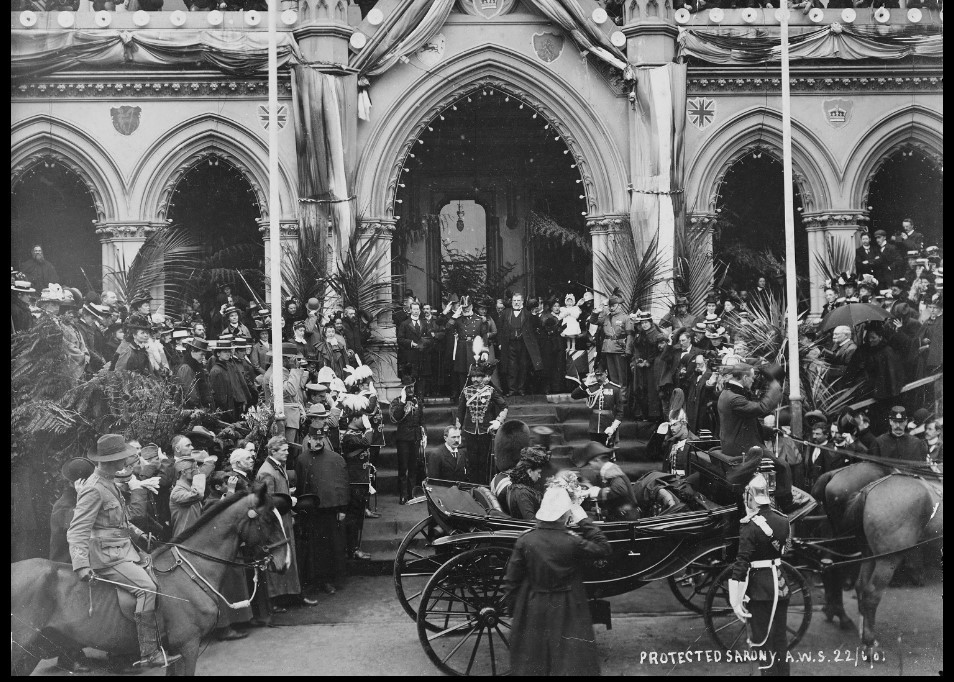
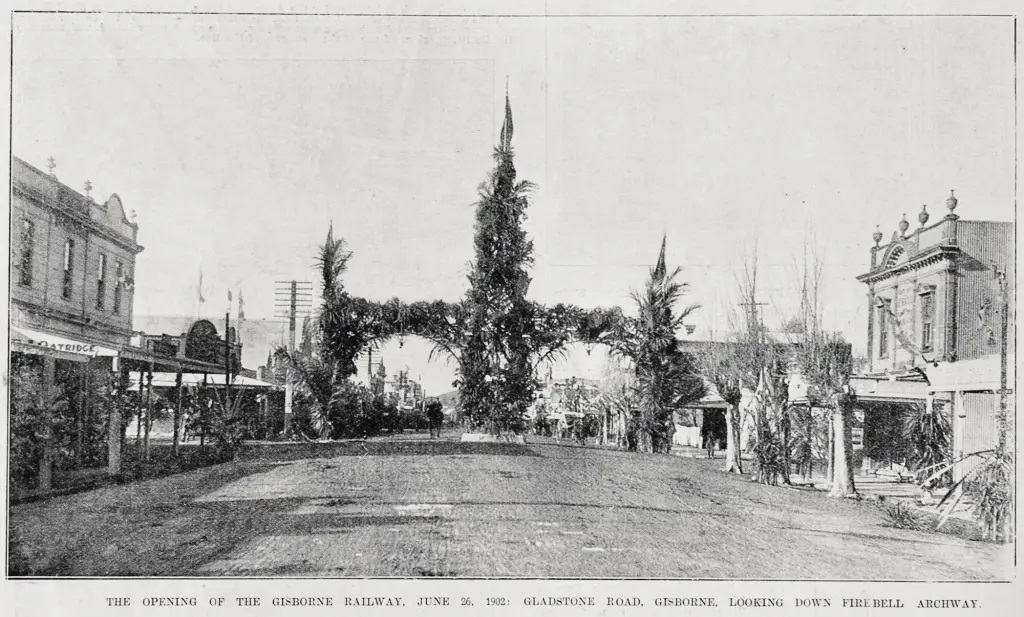
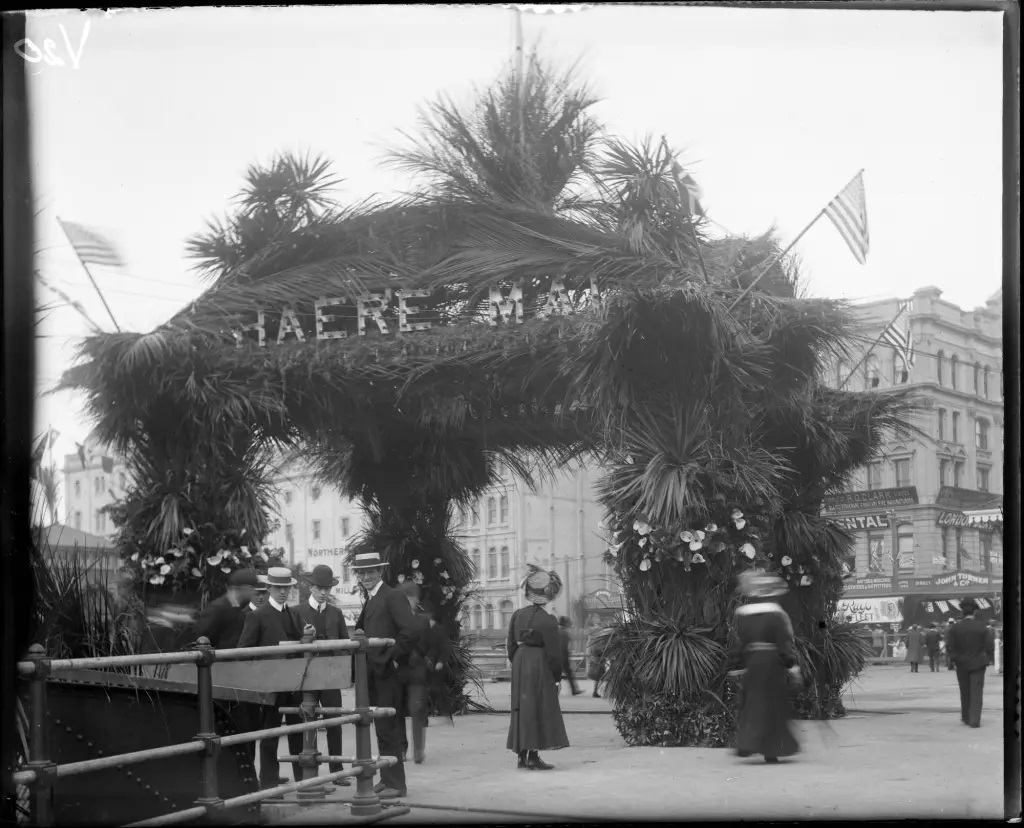
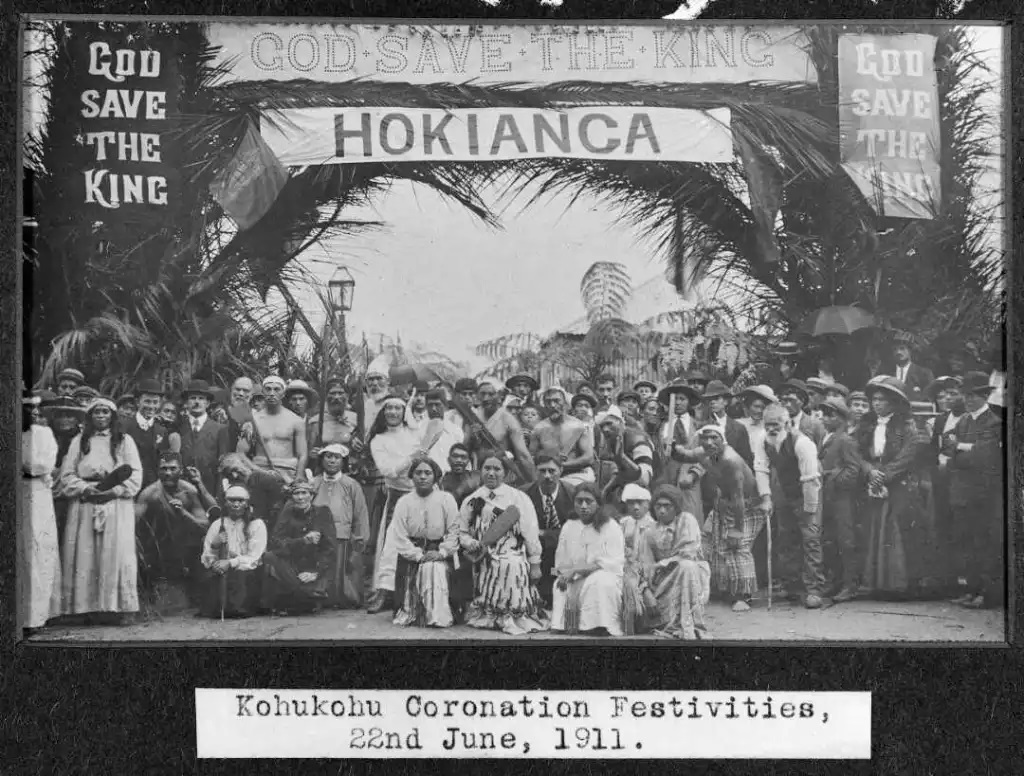
The use of nikau palm fronds as seen above were for decorations in highly ordered ceremonial occasions. It is not hard to imagine why the nikau fronds were chosen: in these places the palms must have been well-established in handy areas; they offered a large frond good for providing a spectacle; they were sturdy and could be easily attached via nails, rope or wire; and, of course, the fronds offered something truly New Zealand in character.
All this is not to forget that nikau fronds were also used in more prosaic occasions such as garden parties:

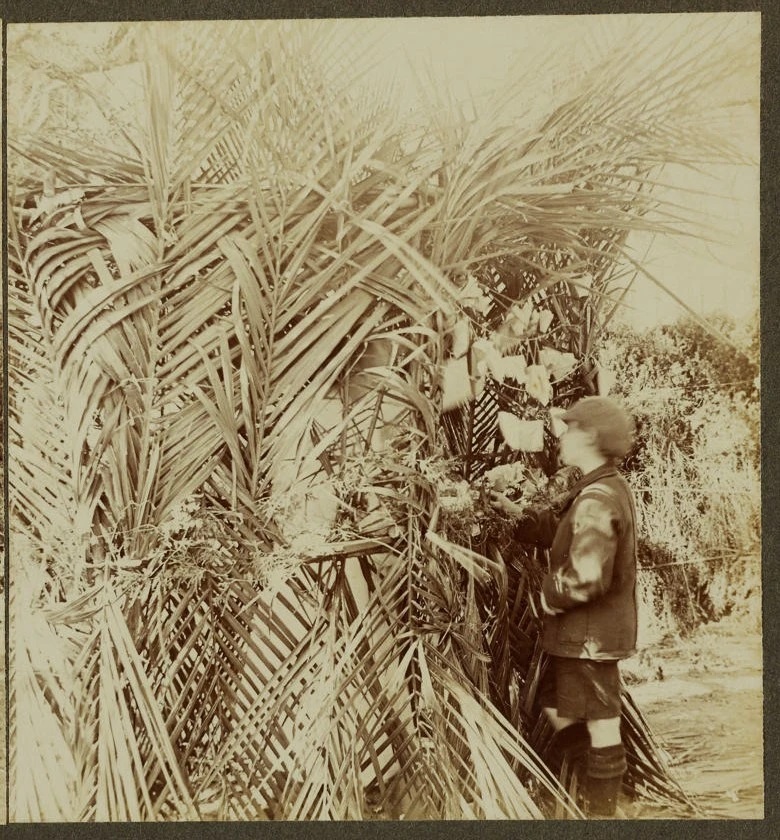
These two final historic photos take us up to 1919 which is about when, in terms of actual planted palms, introduced exotics like the Phoenix palm came to dominate the use of palms in New Zealand amenity horticulture (at least in the North Island). Nikau were also planted from the 1900s, and the use of fronds for decoration continued, but it probably wasn’t roughly until the 1970s that the resurgence of interest in native plants resulted in higher rates of planting of nikau palms.
Now, walking around any major New Zealand city, sights of nikau growing and flourishing will be found. Here is an example just west of the Wellington railway station, looking up to the New Zealand Parliament buildings, where in 1901 nikau fronds were used as decoration:

Footnotes:
- It should be emphasised that this post does not specifically delve into Māori use of the nikau palm, which obviously pre-dates European colonisation of Aotearoa.
- For further discussion see: Michele Payne, 2015, Marianne North: A very intrepid painter, Kew: Kew Publishing.

 The Garden History Research Foundation