
by Peter Sergel
The imaginary gardens described by Lewis Carroll include elements of old gardens, reflect the changing culture of the Enlightenment and, like all good art, they can perhaps challenge our perception of the world.
I’ve always been intrigued by imaginary gardens and had the privilege of turning some of my own imaginary gardens into real ones at a place called Hamilton Gardens. But like many others I’ve always been intrigued by the evocative imaginary gardens described in books. This includes the books of famous authors like: Frances Hodgson Burnett, Kenneth Grahame, Arthur Ransome, Walter de la Mare, John Hadfield, Sidonic Gabrielle Colette, Beatrix Potter, Arthur Ransome, P.G. Woodhouse and Oscar Wilde. In some cases a safe idyllic garden provides the ideal setting for grisly discovery and you get the impression that Agatha Christie’s imaginary gardens are littered with dead bodies.
But of all of those strange and fascinating imaginary gardens, probably the most famous and surreal is the garden described in the story called Through the Looking-Glass, and What Alice Found There, first published in 1871. It was written by Charles Dodgson (1832-1898) who often used the pen name of Lewis Carroll.
In this book Alice enters a fantasy world by climbing through a large ‘looking-glass’ mirror into a room that she can see on the other side. In that reflected world things are reversed, including logic. After she’s left that room she starts running through a garden towards a hill, yet constantly finds herself arriving back to the house she’s just left. That description reflected a new garden fashion for winding, sinuous paths that often doubled back on themselves. This fashion was promoted in the early 19th century by the very influential garden writer, John Claudios Loudon. Loudon and his wife Jane told their readers that you shouldn’t follow fashions, yet for a while they more or less defined garden fashions throughout the British Empire. Another influence was the self-proclaimed expert on China, Sir William Temple. He’d never been to China but confidently told everyone that the Chinese never used straight lines and, since everything Chinese was fashionable, meandering, curved garden paths became a new fashion.
Not everyone approved. Shirley Hibberd told his readers the curved paths were ‘enough to make the butcher’s boy dizzy’. Some other unnamed person apparently said “It’s easy to design a garden these days. You get your gardener very drunk, then get another chap to follow him with a field marker.” There was also a fashion for mazes, and some of these had curved forms. So Alice wasn’t alone in getting confused by curved paths that could direct you away from the feature you were heading towards. For her that feature was a hill, where she thought she might find a good view over the looking glass garden.
The hill Alice is heading for was a regular feature in Tudor and Stuart gardens. They had been created in gardens since at least the 13th century to gain a view over walls and hedges and were generally called ‘mounts’. Another influential figure, Francis Bacon, wrote in his famous essay On Gardens in 1625 that “I would have a Mount on some Pretty Height … to looke abroad into the fields”. Apart from gaining a view, these mounts were often a way to get rid of material from newly dug moats, cellars or fishponds. They often had some form of underlying structure like the remains of a building or unwanted rubble. Henry VIII’s enormous mount at Hampton Court was made in 1532 from more than 250,000 bricks and topped by a three storied banqueting house. Of course his mount was bigger and grander than anyone else’s.
As Alice heads for the garden mount, she comes across a large flower-bed with a border of daisies, with a willow tree growing in the middle. “O tiger-lily, I wish you could talk” says Alice. “We can talk” replies the tiger-lily “when there’s anyone worth talking to”. It was probably inevitable that it would be the tiger-lily that would take the lead ahead of the other rather rude talking flowers that included roses, daisies, violets and delphinium. Tiger-lilies had been introduced to Britain from China in 1811 and like everything else from China they held an exotic fascination. In the Victorian era there was another popular fashion for associating each flower with a symbolic meaning and so the tiger-lily was said to symbolise confidence, pride and a boastful attitude, which you can see reflected in its stroppy response to Alice.

A book published in 2001 by Peter Thompson called The Looking Glass Garden has nothing to do with these looking glass plants. Instead it’s about plants and design from the Southern Hemisphere, including New Zealand, Australia, South Africa and Chile. The title is inspired by a question Alice asks herself as she’s falling (like Robert Kennedy Junior) down a very deep rabbit hole.
“I wonder if I shall fall right through the earth! How funny it’ll seem to come out among the people that walk with their heads downwards! The antipathies I think… but I shall have to ask them what the name of the country is, you know. Please Ma’am, is this New Zealand?”
Rather more pleasingly, to fall through the centre of the world from our part of New Zealand might land us somewhere closer to Salvador Dali’s Surrealist Museum. Dali was directly inspired by Alice’s adventures because he saw them as a journey through the subconscious. The elephants that Alice sees drinking nectar from giant flowers could easily have inspired Dali’s paintings and sculpture of long legged elephants. He illustrated a book of Alice in Wonderland and in 1977, painted the white rabbit with one of his iconic melting pocket watches and created a bronze sculpture of Alice with roses blossoming from her head and hands.
Carroll’s story is full of surrealist details and characters. Alice through the Looking Glass was a sequel to his Alice’s Adventures in Wonderland (1865), in which many of the characters are anthropomorphic playing cards. In the Looking Glass book the theme is chess. In my 1896 edition the author has added a note at the front to explain how the chess pieces and characters will play out ‘in accordance with the laws of the game’, which he explains with a diagram and a series of chess moves. Each character in the book is associated with a particular chess piece in this introduction.
The first chess piece that Alice meets in the Looking Glass Garden is the Red Queen. The queen gives Alice a sound piece of advice that many have found useful. “Curtsey while you’re thinking what to say. It saves time.” In response you’ll generally find that people will frown and ask you what you’re doing. After a brief discussion, the Red Queen and Alice walk to the top of the hill. From there Alice could look out in all directions and see that the surrounding garden was divided into squares just like a large chess board. The squares were divided by a number of little brooks running straight from side to side and the squares defined by a number of hedges that reached from brook to brook. The tradition of large-scale chess-like patterns in gardens were sometimes found in Renaissance and Baroque gardens with the formal layout of parterre or knot gardens incorporating checkerboard-like geometric patterns. There were references to chess board patterns in Tudor and Georgian gardens with black and white chequerboard paving or alternate squares in different coloured mulches, like white limechip, crushed red bricks or black coal.

This certainly wasn’t the first garden to be set out like a chess board. The ancient Indian encyclopedia called the Brhat-Samhita mentions gardens being set out like an ashtapada, which is an eight by eight, sixty four square grid orientated to the four cardinal directions. Ashtapada was a board game that used this grid but there was another 64 square grid game that their ancient culture had invented called chaturanga. We now call that game chess. Both games were older than the 6th century encyclopedia description and were said to have been played by Siddhartha Gautama, the Buddha himself.
The Red Queen explains that the entire garden is laid out in squares, like a gigantic chessboard, and says that Alice, representing a pawn, could become a queen if she can advance all the way to the eighth rank on the board. Beyond the hill there’s a stream where Alice rows a boat for a sheep while collecting beautiful scented rushes that immediately begin to fade like melting snow. Later there’s a forest where she meets a very confused knight. Finally she crosses the final brook to reach “a lawn as soft as moss, with little flower-beds dotted about here and there”, which sounds as if she’s back in a garden setting.
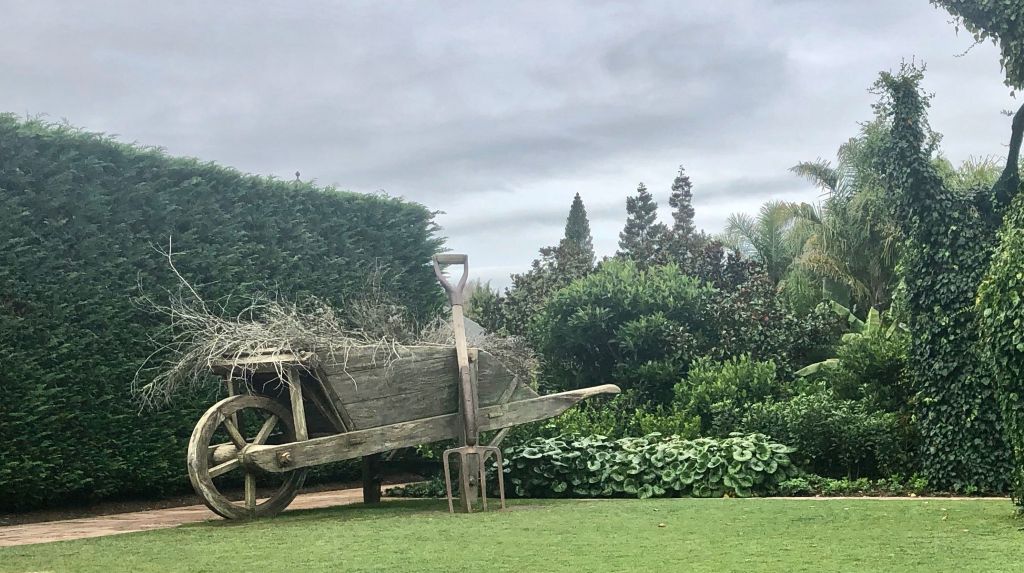
Since Tudor and Stuart times, gardens sometimes featured topiary figures representing chess pieces. A famous surviving example is Levens Hall in Cumbria, whose overgrown topiary figures partially inspired the Surrealist Garden at Hamilton Gardens. If you Google Looking Glass Garden you’ll come across references to this garden. The explanation, apparently written by AI, mentions that “this is because of its dreamlike, unsettling disorientating atmosphere, distortions of scale, biomorphic topiary and fantasy environment that visitors can walk through’. Proposed further development of this garden using AI to create a metaversal experience may make it far more surreal than Carroll’s Looking Glass Garden. AI’s regular reference to this particular garden is probably because of the number of people writing about their impression of shrinking. Objects in the Hamilton Surrealist Garden like: the wheelbarrow, garden gate, tap, flowers, spade and deckchair are ten times the normal size so a visitor can feel they’ve shrunk like Alice, who experiences a garden as a very small person. She leans against a buttercup to rest and fans herself with one of the leaves. Then she meets a large blue caterpillar sitting on top of a mushroom smoking a long hookah.
At this point in Alice in Wonderland films, like William Sterling’s 1972 and Tim Burton’s 2010 versions, the garden setting gets quite trippy. Mind altering drugs like opium and laudanum were freely available from places like Harrods at the time of Carroll’s writing, but there’s no evidence he used them. However, he did suffer from migraines and hallucinogenic experiences that have come to be formally referred to as AIWS, Alice in Wonderland Syndrome. But the Alice gardens are still weird places, the product of Lewis Carroll’s fantasies that could so easily be interpreted as horror stories.
The Lewis Carroll characters in these books became quite popular garden sculptures through the early 19th century. The best known New Zealand examples used to be the fantastic old stone figures of the Duchess and Knave in the Larnach Castle garden, which had clearly been inspired by the original Tenniel drawings. The Alice stories were very much in fashion when the Larnach children were growing up. When the Barker family took over the Larnach estate they continued that theme with an Oamaru stone Cheshire Cat and the Queen of Hearts throne. There used to be a Looking Glass Garden in the Papamoa Hills near Te Puke that featured fairytale and whimsical detail. It’s apparently fallen into disrepair and the last Tripadvisor post says that ‘the toilet has been taken over by spiders’. That’s quite a Looking Glass feature, especially if the spider can talk. Some major gardens have featured Alice in Wonderland garden displays with Alice themed props, fantastical floral arrangements or have used garden features as storytelling devices, sometimes with interactive mobile phone apps. These include: the New York and Atlanta Botanic Gardens, the Hunter Valley Garden near Sydney and the Alice in Wonderland Garden in Bucharest.

Mention has been made of Carroll’s significant influence on literature, garden design and popular culture by subverting Victorian-era expectations, symbolising childlike desire, and inspiring surrealist and whimsical themes. There have been imaginary gardens that have had a major influence on garden design such as: Genji Monogatari, Dream of the Red Chamber and The Decameron, but Lewis Carroll’s stories didn’t encourage a new type of garden. Instead I would argue that Carroll was reflecting changes that were occurring during the Romantic Period (1738-1850). Renaissance and Baroque gardens had been neat, formal and well mannered, with nature apparently well under control. You played by the rules, like the playing card characters who repainted the white roses red to avoid having their heads cut off. But then around the mid 18th century something bizarre started to happen. A new form of garden design became popular called the Picturesque and old garden traditions were turned on their head, a little like a Looking Glass Garden. Instead of neatly trimmed hedges and grass, naturalistic unpruned planting and long grass started to become fashionable. Flat neat paths were replaced with rough uneven ground like the ‘ridges and furrows’ on the Red Queen’s croquet lawn. Instead of gardens that projected complete control and order there were newly created overgrown gothic ruins, dangerous rustic bridges and cliffs. Instead of well mannered promenading along wide walks, there were caves where garden staff would sometimes be required to make the sound of tormented animals or a thunder noise or pretend to be a hermit living in a cave. ‘Now chaps, this afternoon we’ve got visitors so I want you all to stand at the back of the cave and make tormented animal noises.’
Most of the main transformations that have shaped the modern world were reflected in a new form of garden and for the Romantic Period that was the Picturesque. You really need to understand the Romantic Period to understand the Picturesque gardens, but the Picturesque gardens themselves are a very direct way of understanding the Romantic Period. These new forms of garden may have sometimes been strange but they were an indication of a new sensitivity that liberated most of the arts with a reaction against rationality and order. It was replaced with individual expression, risk taking and mysticism that challenged the old order and rules. Emphasis was placed on subjectivity, emotional response and imagination over rationality and reason. This was reflected in garden design and the arts and then, through Lewis Carroll, it was also reflected in children’s literature.
Not everyone can visualise imaginary gardens but most people like having their imagination prompted, which you can see from the numbers who visit the Tolkien hobbit gardens at Hobbiton, near Matamata. With the help of AI, amazing gardens are now being created online where budgets, clients and planning regulations offer no restraint to the imagination. It’s likely they’ll substantially replace the imaginary gardens that have been described in literature, but I can’t help feeling something is missing. If you don’t need to use your own imagination, those imaginary gardens can never be as memorable or personal. Some writers, like the English novelist and playwright Susan Hill, say that their love of gardens started with the garden briefly described in Alice in Wonderland. She mentions that she can always “imagine every detail of that garden and could wander freely among its beds and borders, up and down the broad paths in the summer sunshine.” Yet the description in the book is very brief.
“She knelt down and looked along the passage into the loveliest garden you ever saw. How she longed to get out of that dark hall and wander about among those beds of bright flowers and those cool fountains”.
It seems that the lack of detail has engaged Hill’s imagination. It’s just a tantalising glimpse of a magical place of brightness, Victorian gardenesque spender and moving water beyond the gloomy inner room in which Alice is trapped, because of her size.
Perhaps the poor and destitute in Gaza can carry on by imagining the garden of Jannah, described in the Quran. A charbagh garden filled with lush greenery, bountiful fruit and four rivers of water, milk, honey and wine. And that’s perhaps the value of imaginary gardens. They’re a place to escape to, as perfect or strange as you want them to be. Albert Einstein said that “Imagination is more important than knowledge because knowledge is limited. Logic will get you from A to B. Imagination will take you everywhere”. Through a looking glass into remarkable gardens or perhaps, through ignorance, down a rabbit hole.
References
Anita Brookner, Romanticism and its Discontents, Penguin Books, 2001
Jane Brown, The Pursuit of Paradise – A Social History of Gardens and Gardening, Harper Collins, 1999,
Lewis Carroll, Alice’s Adventures in Wonderland and Through the Looking Glass, Collins’ Clear Type Press, 1896
Jane Fearnley-Whittingstall, The Garden – An English Love Affair, Seven Dials Paperback, 2002
Susan Hill & Angela Barrett, Through the Garden Gate, Hamish Hamilton London, 1986
John Dixon Hunt, The Picturesque Garden in Europe, Thames & Hudson, 2002
Peter Sergel, Inspiration in the Garden, Penguin Viking, 2004
Charles Watkins & Ben Cowell, Uvedale Price – Decoding the Picturesque, Bydell Press, 2012

 The Garden History Research Foundation