Upcoming talk in Hamilton: “Finding Mrs Mitchinson: The Life of a Forgotten Colonial Plantswoman”

by Annette Bainbridge, Garden History Research Foundation

20 March 2025, 7.00-8.30 p.m. The Link Room at Hamilton Gardens (entry $5 waged; $2 unwaged – please bring cash!)

Mary Mitchinson (1860-1937) ran the Caledonian Nursery in New Plymouth for over ten years after the death of her husband in 1895. An entrepreneur, medal-winning horticulturist and importer of rare and exotic plants, Mary Mitchinson dominated Taranaki’s garden scene from the mid-1890s into the early twentieth-century. This talk will follow her career, the challenges she faced as a businesswoman in a male-dominated market, her role in expanding the reach of Taranaki nurseries throughout New Zealand and the way in which she helped to shape Taranaki’s 19th-century image as “The Garden of New Zealand”.

Ship Figureheads as Statuary in New Zealand Gardens, Part 1: The Hydrabad

by Ian Duggan

A number of newspaper reports can be found of the figureheads of ships adorning not their expected vessels, but New Zealand gardens as items of statuary through the early 20th Century. This blog covers one such example, the figurehead of the Hydrabad (commonly incorrectly spelt as “the Hyderabad”, after the city in India), a ship that was wrecked on Waitārere beach on the Horowhenua coast in 1878.

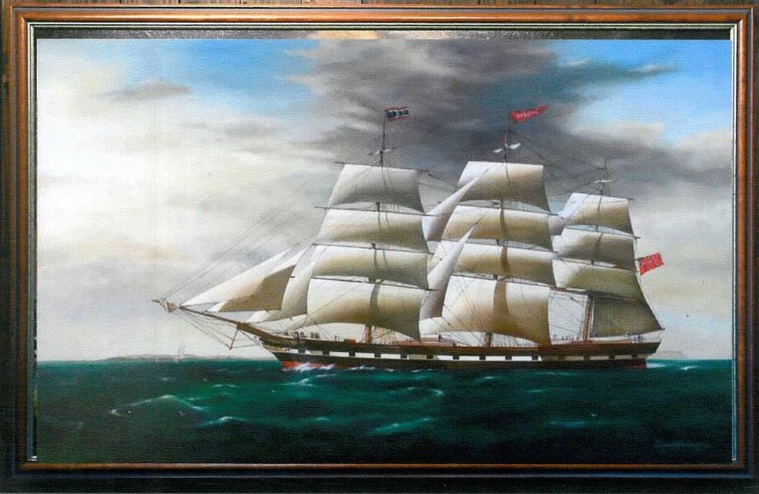
On her sea trials off Glasgow 1865. Original oil painting on canvas. 1800 x 1100mm. Provided by Kete Horowhenua.

What is a figurehead? The Royal Museums Greenwich provide a great overview, at this link, which I provide a brief summary of here. Figureheads are decorative carved wooden sculptures, most frequently female, that decorated the prows of sailing ships. These were said to embody the “spirit of the vessel”, and were considered by the crew of the ships to be lucky charms. A range of subjects were depicted on the figureheads, with many representing a member of the ship-owner’s family or of the owner himself, while others depicted historical figures or an influential individual from contemporary society. Evidence of the use of figureheads dates back to around 3000 BC in Egypt, but while they were a common feature on ships during the sailing age, their use had largely died out by the end of the 19th Century.[i]

Indeed, Wellington’s Evening Star noted in 1911 that, at that stage: “The likeliest place to find a ship’s figurehead nowadays is… in a suburban tea garden. Certainly there are few ships afloat [now] which carry them”.[ii]

The figurehead of the Hydrabad is one that has gained the most attention in New Zealand newspapers. The Hydrabad was a three-masted iron ship built in Glasgow, Scotland, in 1865, which primarily operated as a cargo vessel between England, Australia and India. However, she was wrecked on the Horowhenua Coast in June 1878, while on her way between Lyttleton and South Australia. At the time she was carrying a cargo of broad-gauge Canterbury railway locomotives and components declared surplus in New Zealand, due to the national standardisation of railway infrastructure[iii]; Canterbury had been building its railway using a 5′ 3″ gauge, whereas the New Zealand government’s public works stipulated that the gauge must not exceed 3′ 6″[iv]. The locomotives were thus destined for use in South Australia.[v]

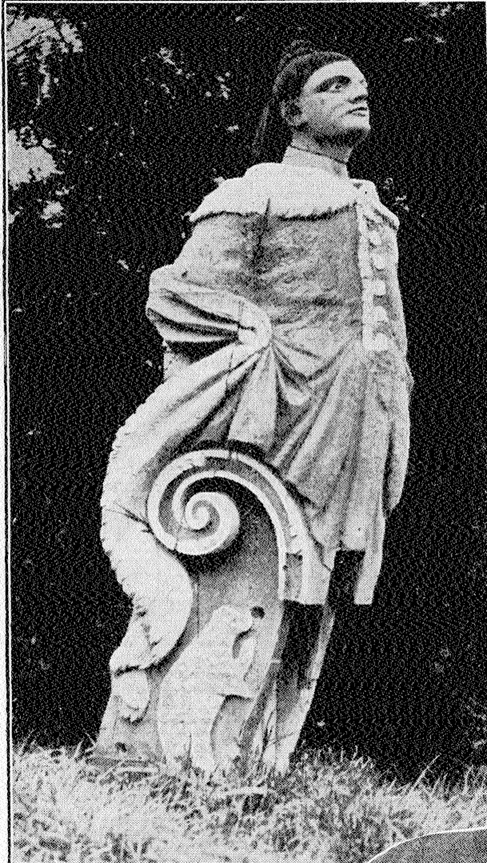
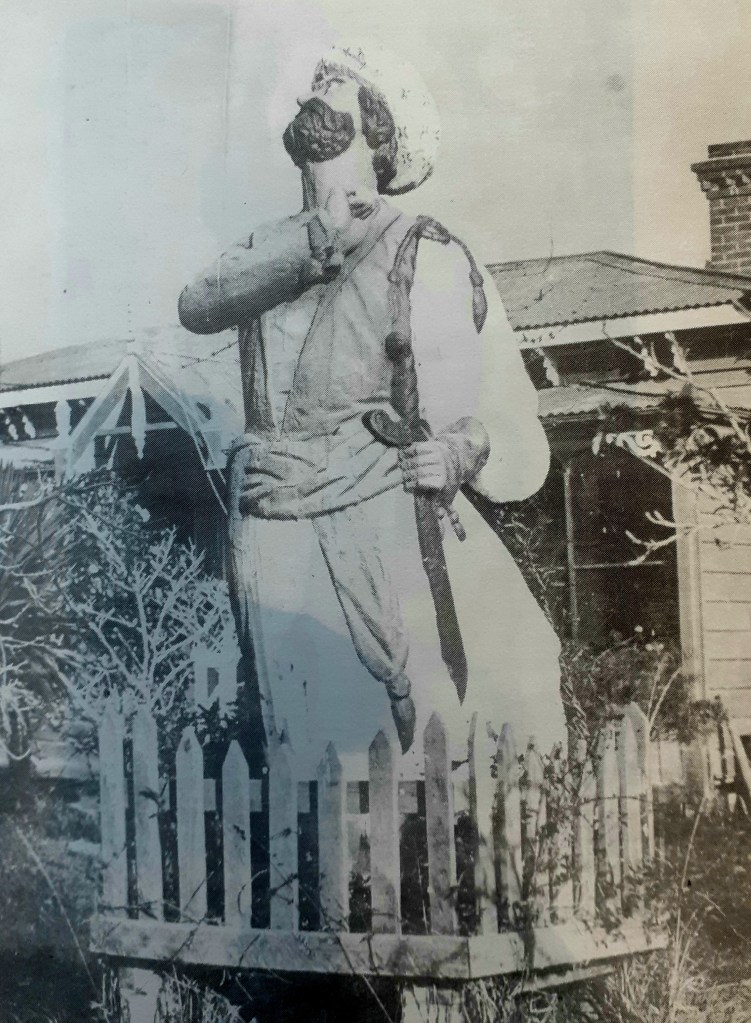
Figurehead in the garden of A. Jonson. [from Church, I. (1978). The Wreck of the Hydrabad. Dunmore Press Ltd, Palmerston North].

The wreck of the Hydrabad was sold to a Mr Liddell, who bought the figurehead and the vessel’s cannon, taking them to Foxton. On arrival in the town, “both figurehead and cannon were deposited in Mr. Liddell’s yard… in Clyde Street. For many years they lay there until they were acquired by… Mr. A. Jonson and removed to Avenue Road”.[vi]

Skip forward a number of years, and in 1896 the Manawatu Herald reported that Mr Andrew Jonson “long had erected in his garden on the Avenue Road the old figurehead of the Hydrabad”.[vii] And the figurehead appeared to remain in his garden for a long period thereafter. For example, in 1907, it was stated that:

“In the centre of a garden plot in front of a cottage at Foxton is a brightly painted piece of well executed statuary. It is the figure enlarged to far more than life size of an Indian Rajah, dressed in full regalia, with scimitar, and hand uplifted in a threatening attitude. The legs are cut away, but the carving from the knees upwards, and the fierce expression on the black-bearded face of the Eastern potentate, are admirably executed”.

It continued, “The owner, Mr Jonson, narrates in connection with it a story of adventure. Nearly, half a century ago it formed the figure-head of a splendid steam yacht of 1800 tons, built… for the Rajah of Hyderabad. The figurehead, carved from Baltic pine, represented the owner, and for a number of years he took charge of the vessel, the Hyderabad [sic], travelling over the Indian Ocean. Eventually the vessel fell into the hands of Captain [Charles James] Holmwood, by whom it was sailfully navigated until, while laden with railway rolling stock, its career was ended during a storm, when it was stranded about four miles from the mouth of Manawatu river. In this way the fine carving fell into the hands of a Foxton resident, who prizes it highly”.[viii]

Jonson’s story may be somewhat embellished, however. The vessel was actually constructed for the Bombay Iron Shipping Company (in present day Mumbai).

Mr Jonson passed away in 1917, at the age of 75. The Manawatu Standard noted that he was a well-known builder and undertaker in Foxton. His residence in Avenue Road, we are told, “is well known in Foxton, and was of special interest to visitors from the fact that in the front garden was the figurehead consisting of an Indian chief, of the ship Hyderabad [sic]”. Nevertheless, it was also noted that “Some time ago the figurehead was presented by Mr Jonson to the Foxton Borough Council, to be placed in one of the local reserves”.[ix]

So, had the Council taken possession of it? In 1929, we hear a different story: “After remaining for many years at Foxton, the figurehead of the Hyderabad [sic], which lies on Hokio Beach, is to be sent to Auckland to the naval base there at the request of the Commander of HMS Philomel, who is making a collection of old figureheads. The figurehead of the “Hyderabad” [sic] has been in the garden of Mrs Andrew Jonson, in the Avenue at Foxton, since it came into possession of her late husband at the time the vessel was dismantled”. Nevertheless, “Mrs Jonson has given her consent to hand over the figurehead to the naval authorities for safe keeping”.

After so many years in the garden, however, the figurehead by this stage was looking a little worse for wear: “Long exposure to weather has robbed the figurehead of its pristine beauty, but when restored to its original adornment, it will make one of the most interesting exhibits in the collection”.[x]

Did the figurehead finally make it out of the garden, to the safety of the naval base in Auckland? Again, it appears that it still didn’t go anywhere. And this was unfortunate, for in 1933 the Manawatu Standard gave a sad update on the Hydrabad’s figurehead:

“Many of the older residents of the district will learn with regret the disappearance from Foxton of that interesting relic of one of the most remarkable wrecks on this coast, the figurehead of the Hyderabad [sic], which for the past half-century has always been a source of interest to visitors to the town. For the past thirty years the figurehead, a representation of an Indian rajah with turbaned head and drawn scimitar, occupied a prominent position in the garden of Mrs A. Jonson, of Avenue Road. Standing between twelve and fifteen feet high, it presented a striking sight in its gaily painted robes, but with the passage of time and the ravages of the elements this finely executed carving has gone the way of most woodwork, and, badly rotted throughout, it was last week felled and cut up for firewood”.[xi]

A Mr H. Coley, of Foxton, was subsequently interviewed, and stated that: “A year or so ago the naval authorities at Devonport, Auckland, made inquiries about the figurehead of the Hyderabad as it was desired to include it amongst the collection at the Auckland naval base. Mrs Jonson then gave her sanction to its removal, but, unfortunately, nothing further was done….”.[xii]

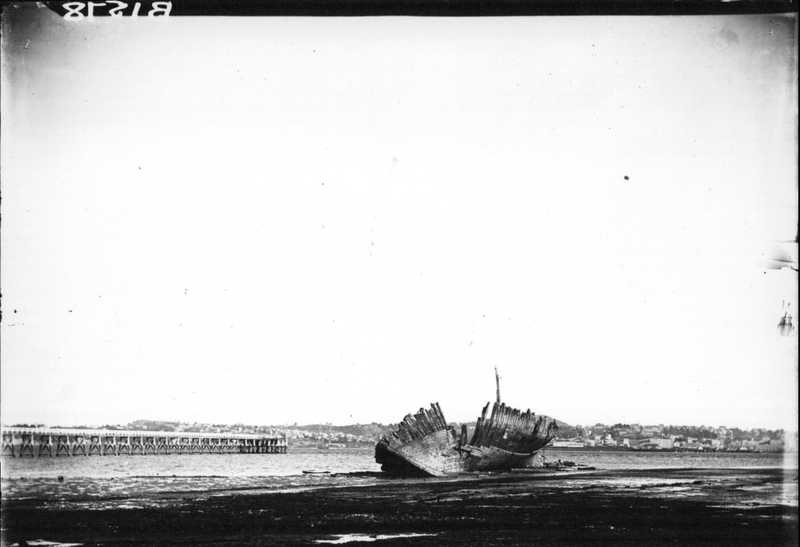
Shipwrecked ship “The Hydrabad” at Waitarere beach, looking from south to north on the seaward side. credit: Horowhenua Historical Society Inc.


Final confirmation of the circumstances of its destruction was reported in 1935: “Light has been shed upon the fate of the figurehead of the ship Hyderabad [sic], the remains of which lie on Waitarere Beach, where she was wrecked many years ago. Captain Baggett, of the motor-vessel Foxton, said in an interview in Wellington that, after the death of the householder who owned the figurehead, his home was occupied by a family the members of which were unaware of the history and value of the strange relic that stood in the garden. Accordingly they chopped it up for firewood. An attempt was made by a prominent Foxton man to save the figurehead, but he arrived too late to prevent its destruction”. 

At least ten other ship figureheads have been reported in New Zealand newspapers as having decorated gardens, and some of these will be covered in future blogs.

Read Part II here: The Wolverine

Read Part III here: The America, the Helen Denny, and others

REFERENCES


[i] Ship figureheads and decoration, Royal Museums Greenwich. https://www.rmg.co.uk/collections/ship-figureheads-decoration

[ii] Shipping. Evening Star, 29 September 1911, P8

[iii] Hydrabad (1865-1878) Wreck Site, Waitarere Beach, Levin. Heritage NZ.  https://www.heritage.org.nz/list-details/9559/Listing

[iv] Church, I. (1978). The Wreck of the Hydrabad. Dunmore Press Ltd, Palmerston North.

[v] Hydrabad (1865-1878) Wreck Site, Waitarere Beach, LEVIN. Heritage NZ.  https://www.heritage.org.nz/list-details/9559/Listing

[vi] Figurehead of the Hydrabad Demolished. Otaki Mail, 24 April 1933, Page 4

[vii] Manawatu Herald, 26 September 1896, Page 2

[viii] Poverty Bay Herald, 24 October 1907, P4

[ix] Manawatu Standard, 18 October 1917, P4

[x] Daily Chronicle, 11 July 1929, Page 4

[xi] Loss of the Hyderabad. Manawatu Standard, 27 March 1933, P7

[xii] Loss of the Hyderabad. Manawatu Standard, 27 March 1933, P7

A Battleship in the Garden? Unusual Auckland Garden Features from the 1930s

by Ian Duggan

While garden features such as arches and goldfish ponds have been popular and widespread in New Zealand private gardens, some have been more unique. For a short period between the First and Second World War, for example, the newspapers reported on a couple of Auckland residences whose gardens featured ships!

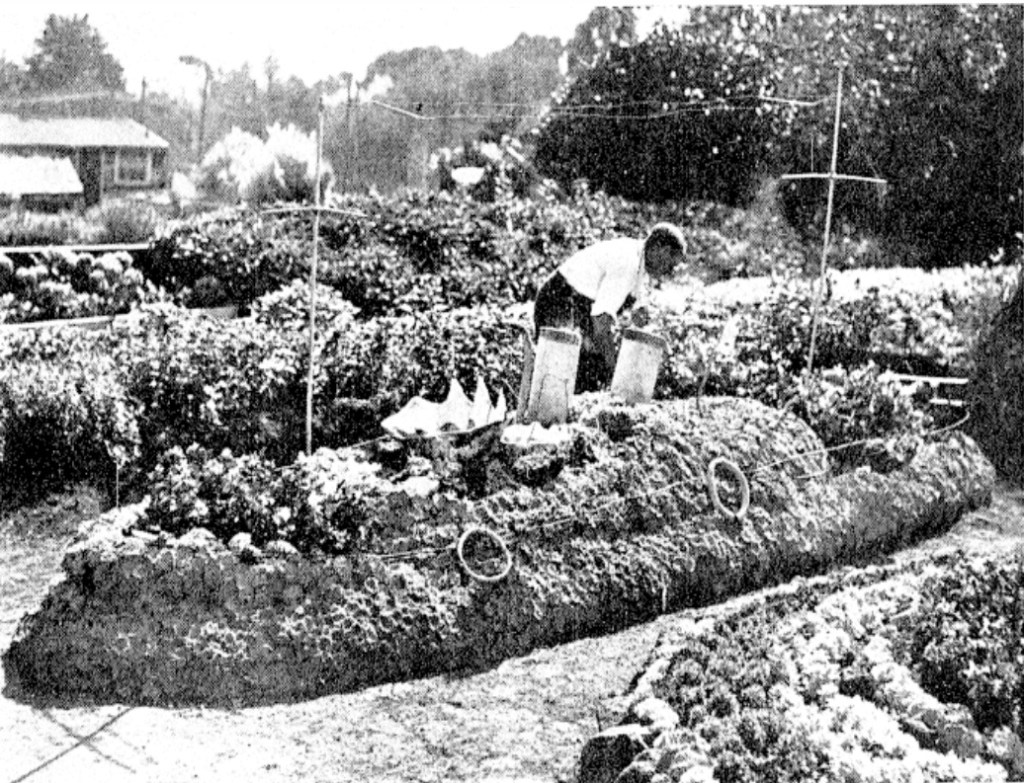
The first, reported in the New Zealand Herald in January 1937, rightly recognised the nautical feature as an “Unusual decoration for the garden”. Little detail was provided about the feature piece, however, except that it was a ship model in the garden of a Mr. W. Freeman, Allendale Road, Mount Albert. The hull consisted largely of border plants, while an ornamental shell provides the bridge”.[i] Beyond that, examination of the photograph shows the ship also featured masts and what appears to be drainpipes for its twin funnels.  

An Unusual Feature in the Garden. New Zealand Herald, 21 January 1937, Page 6

Hot on the heels of Freeman’s ship came a remarkably similar vessel in another garden only a little over five kilometers away. In April 1937, the Auckland Star noted that “There is no limit to garden attractions”.

“Some industrious people cut their hedges and shrubs in various ways to represent figures or objects, but something entirely different in the decorative line has been achieved in the garden in front of the home of Mr. David Kasper, at Titirangi Road, New Lynn. There the taste has been nautical, and a land battleship has been created”.

Here, we are treated to some detail on the ships’ construction:

“In the first place the shape of a battleship, on a miniature scale, was marked out on the front lawn, and then the soil was built up to a height of about two feet. A grey rock-plant was grown on the sides of the “hull”, and the necessary nautical and warlike trimmings were added. Two steel rods have been used for the masts, and a light wire, suspended between them, makes an impressive aerial. The funnel is a drain pipe, painted yellow, with a buff top, and set at a rakish angle “amidships.” There are iron davits “amidships” on the side of the “hull.” The boats are hanging baskets of greenery”. [ii]

An image was provided in the next day’s paper, adding that the “grey rock plant gives the hull a distinctive naval touch” [iii]

Hard Aground. Auckland Star, 29 April 1937, P9

As with any garden, however, the ship didn’t look after itself:

“Just like the nautical battleships which do go to sea, the New Lynn “warship” requires many an overhaul. Weeds will persist in growing on the “quarterdeck,” and as docks and plantain, or even green paspalum would be strangely out of place in such a setting, the “crew” have a fairly busy time”.[iv]

Kasper’s ship remained in situ for at least a number of months afterwards. In August 1938, almost a year and a half after the previous report, another image of the vessel appeared in the Auckland Star where it was reported:

“Quaintly decorated with border plants, this model battleship, in a garden fronting on Titirangi Road, New Lynn, always attracts the attention of passers-by”.[v]

The photograph indicates that the design of the ship had evolved since the previous year, with the addition of life rings to the sides, railings, and what appears to be a steering wheel on the bridge.

Model Battleship. New Zealand Herald, 26 August 1938, Page 6

These snippets throw up a number of questions. How long did these garden ships persist? I can’t find any mentions in the newspapers of them after August 1938. Did the idea of a battleship in the garden lose some appeal with the impending war? From these reports, was anyone else inspired to construct sea-going vessels in their front yards, or were they unique to these two gentlemen? Indeed, were Kasper and Freeman friends? They only lived around five kilometers apart, and their designs appear to possess some common features. Interestingly, I can’t actually find any records of David Kasper outside of this article, even though we are provided with his full name. Not even a record of birth, marriage or death. So, who were these mystery people, and what inspired them? The answer to that question is, unfortunately, likely lost to the mists of time.

Postscript: Slightly post-dating both of these ships is the ‘Floral Ship’ on The Strand in Tauranga, constructed in 1938. I wonder if Kasper and Freeman’s ships provided inspiration for that one, which can be read about on the Historic Tauranga website, here, and from the Tauranga Historical Society, here?

References


[i] Unusual Decoration for the Garden: A Ship Outlined in Flowers. New Zealand Herald, 21 January 1937, Page 6

[ii] Hard Aground: Land Battleship in Suburban Garden. Auckland Star, 28 April 1937, Page 10

[iii] Auckland Star, 29 April 1937, Page 9

[iv] Hard Aground: Land Battleship in Suburban Garden. Auckland Star, 28 April 1937, Page 10

[v] New Zealand Herald, 26 August 1938, Page 6

Upcoming Talk in Hamilton (NZ): Peter Shaw, Japan; An Autobiography

Join acclaimed author and curator Peter Shaw, who will discuss his new book Japan; An Autobiography—a pocket-sized illustrated account of the country’s culture; its gardens, art, architecture, food, religion, history and people.

Biography

Peter Shaw has been at various times a teacher, journalist, music critic, radio broadcaster, art curator and writer. Born at Taumarunui, he later lived in Tauranga, Thames and Auckland, where in 1981 he became METRO’s first Lively Arts writer. Peter taught design history at UNITEC, Auckland and then spent over twenty years as curator of the Fletcher Trust Art Collection.

His History of New Zealand Architecture was first published in 1991 and went into three editions. He has designed exhibitions and written many art and ceramics catalogues as well as books on Waitangi and the architecture of Napier and Hastings.

An accidental tourist to Japan in 1989, his curiosity about the country was awakened and in succeeding years he has made repeated visits, the result of which is this book—the subject of today’s talk. Peter Shaw now lives in Pirongia where he intermittently works on a memoir.

The Link Room, Hamilton Gardens, 12 December 2024, 7.30-9.00 p.m.

$10 entry, includes Christmas supper. A Christmas raffle will also be held.

The art of mimicking I: European Gardens in Bogotá (Colombia)

Diego Molina, British Academy Postdoctoral Fellow, Royal Holloway, University of London. Diego.Molina@rhul.ac.uk

During the early 19th century, Latin American nations obtained their independence from then colonial powers, Spain and Portugal. This political independence, however, did not translate into cultural emancipation. As a general rule, those involved in the insurrections that led to the declarations of independence across the continent were ‘enlightened’ men, usually descendants of Iberians. Thus, mentally and spiritually closer to Europe than to their American territories, these new elites looked again to the north in a search for new models capable of replacing the world of the decadent empires. In this context, they found in England and France –– or more precisely, London and Paris –– the new template that guided the economics, the culture, the politics and, of course, the ways of building their cities and, at the same time, accommodating nature inside them.

For the Post-independence Latin American urban elites, the aim was clear. If they wanted to look modern, it was essential to endow their cities with green spaces that resembled London´s Hyde Park or Paris´ Bois de Vincennes (Figure 1). Some port cities such as Buenos Aires, Rio de Janeiro, Mexico City or Santiago de Chile, underwent a drastic transformation by the hand of French landscape designers such as Charles Thays or Édouard André.[1] In such cities, the incorporation of green spaces into the city was possible due to improvements in their economic situation as a consequence of their integration into the 19th century transatlantic international trade as a raw-material providers. Yet, while landscape and urban historians have extensively explored the creation of green spaces in Latin American temperate cities, we still largely ignore the process that accompanied the creation of modern gardens and parks in biodiverse cities located in the tropical environments.

Figure 1. Vue du Bois de Vincennes, ca. 1853–70. Source: Public Domain under Creative commons License

To contribute to the understanding of how modern urban green spaces were established in tropical environments in the Andes, I have recently published a book entitled: Planting a City in the Tropical Andes Plants and People in Bogotá, 1880 to 1920 (Figure 2). As the first volume of the Routledge Research on Gardens in History, this book examines the creation of a modern flora in Bogotá. The main argument of the book is that the modernisation of this city –– today’s capital of Colombia, located at 2,600 meters above sea level in the tropical Andes –– implied the creation of a sui-generis botanical urban inventory which, in turn, changed the understanding and use of plants in the city.

Figure 2. Cover of my book, Planting a City in the Tropical Andes Plants and People in Bogotá, 1880 to 1920

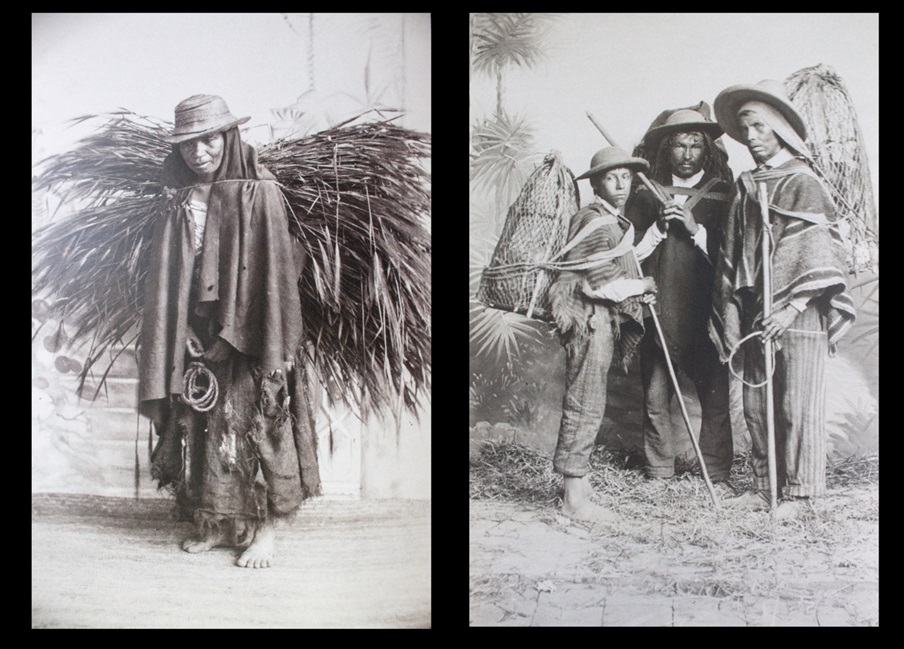
Until its modernisation in the late 19th century, Bogotá was an urban enclave permeated by its surrounding rurality. The interactions and uses of plants reflect this fact. For instance, until then, most of the relations with plants had taken place mostly in forest and moorlands surrounding the city. Indigenous people, or their descendants, endowed with inherited ethnobotanical knowledge, acceded these spaces and, from there, extracted a large range of raw materials, such as fibres and firewood indispensable for the daily life functioning of the city (Figure 3). Likewise, indigenous and mestizo people planted edible, aromatic and medicinal plants in their domestic backyards, known as solares, with which they treated minor illnesses in a city with a precarious medical service. In terms of ornamental plants, only a small minority, usually descended from the European conquerors, enjoyed gardens. During the majority of the city´s history, most gardens were of tiny dimension and all of them were planted in domestic spaces. These small gardens were usually established inside convents or planted by women of the elite in the patios of houses inhabited by the most affluent members of the society (Figure 4). For most of the population of the city, living in ill-aired small and overcrowded spaces, the mere idea of a garden was unconceivable.

Figure 3. Left) Anonymous, Straw seller-woman in the nineteenth-century Bogotá, ca 1890. Right) Anonymous, Men with chicken baskets, ca 1890, photograph, 13,8 x 9,6 cm. Courtesy of the Association Ernest Bourgarel.

Figure 4. People in a patio with plants. Courtesy of the Biblioteca Pública Piloto de Medellín.

The nineteenth-century modernisation of the city implied a radical transformation of this traditional ways of arranging and interacting with plants. One of its main characteristics was the adoption of new social and cultural customs that included the creation of hitherto unseen public green spaces. This transformation of urban nature was initiated in 1880 when the local government commissioned the self-taught gardener Casiano Salcedo to create a garden in the Plaza de Bolívar. Since its foundation in the sixteenth century by Spaniards, this square had been the symbolic heart of the city, where all kinds of religious and political activities had taken place (Figure 5). Thus, creating a garden there spoke about the symbolic importance that gardens acquired in late-nineteenth-century Bogotá.

Figure 5. Edward Mark, Plaza de Bolívar, 1846, watercolour. Source: Public Domain under Creative Commons License.

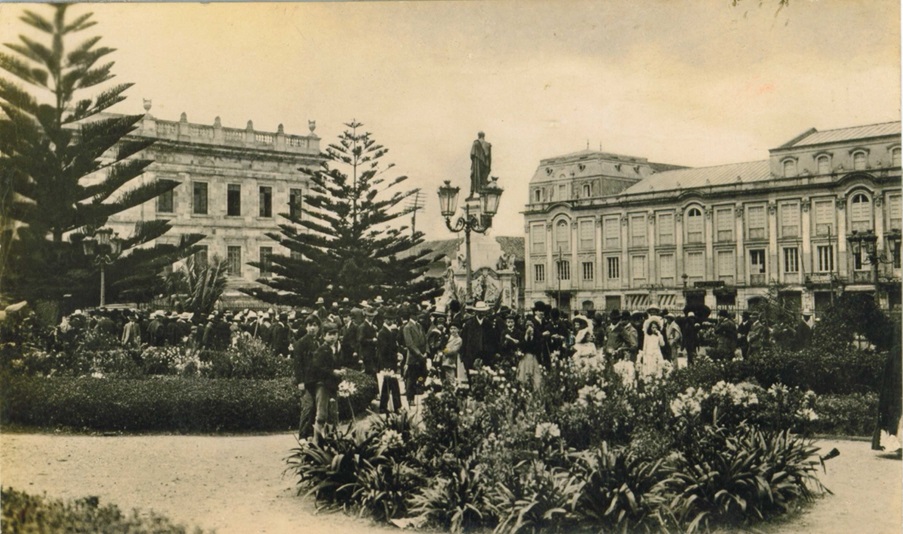
By 1882, Casiano Salcedo had transformed this square into the Parque de Bolivar. However, in spite of its pompous denomination as a ‘park’, as a matter of fact, the small green spaces were nothing more than small gardens (Figure 6). A small city of 100,000 inhabitants, poorly connected with the international markets and constantly affected by successive civil wars, simply did not have the economic possibilities to create large green spaces. Consequently, the modern dream of having a park similar to those seen by the elites during their trips to Europe did not fully materialise in Bogotá. This lack of equivalence with the European model of green space was partially countered with the use of European plants in the creation of these spaces. Despite being recognised today as one of the most biodiverse regions on earth with hundreds of species with enormous ornamental potential, back then, the local flora was not considered as a potential raw material in the modernisation of nature in Bogotá. Hence, in the creation of green spaces in the city, Casiano Salcedo mostly used plants imported from Paris through the Vilmorin nurseries, first, and from the Company of Alive plants based in Rochester in New York, later on.

Figure 6.  Julio Racines, Garden in the Plaza de Bolívar in Bogotá, ca. 1890, photograph,13 X 18 cm. Courtesy of the Biblioteca Pública Piloto de Medellín.

The creation of green spaces in Bogotá was informed by the same ideas that had initially promoted their construction in Europe. Since the end of the eighteenth century, when the Dutch physiologist Jan Ingenhousz[2] had discovered the photosynthetic process, plants had turned into organic filters capable of fighting the miasmas and other noxious elements which promoted disease and moral degeneration. Then, by planting gardens and trees in cities the local authorities not only promoted a healthy body of the citizenry but also for an elevated morality. With this in mind, the local authorities in Bogotá saw in parks therapeutic spaces that promote health, while contributing to the moral education of the population. In that vein, the public gardens inspired by European models and built with plants from Paris needed to be places in which people abided by social behaviours considered as civilised. This idea, however, clashed with the local reality. For example, many ‘ornamental’ trees were seen as a source of firewood and therefore chopped for this purpose by people not used to seeing trees as a source of ‘good air’. To combat these practices, the local authorities of the city hired guards (locally known as celadores) who were responsible for correcting the manners of all the visitors of the gardens, just as the gardeners corrected deviated branches of a tree. In sum, the first public gardens in Bogotá enriched the city with a large number of previously unseen plants, while promoting a disciplined way of interacting with plants.

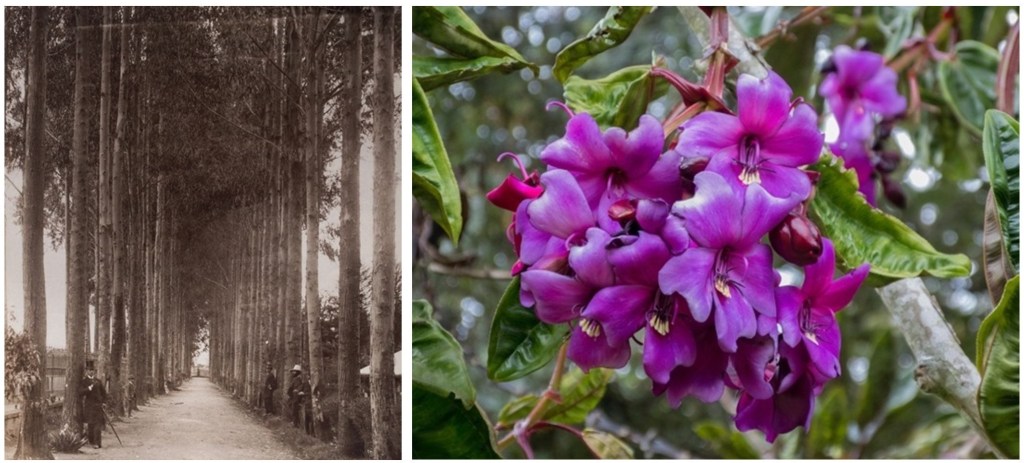
Figure 7. Left E. globulus-made promenade in the Parque Centenario in Bogotá,1883, photograph. Courtesy of the Association Ernest Bourgarel.Right: Amarrabollo (Meriania nobilis) Source: Author’s image.

The art of mimicking European-like gardens in Bogotá informed the first green spaces of this Andean city. However, by the beginning of the twentieth century, this practice was unsustainable, simply because many plants brought from abroad did not survive, and their importation was expensive. This ecological reality forced city administrators to look at native species and species of flushing flowers such as the Amarrabollo, which became common in the city and replace intruded trees such as Eucalyptus globulus that had dominated the city landscape until then (Figure 7). This understanding of the local ecological condition had a social counterpart. Despite several attempts to regulate the entrance of the poorest people to parks promoted by some members of the elite, the parks maintained their public nature. It was simply too risky to deprive the labouring classes of these green spaces. In the eyes of the local elites, in doing so, the working classes would rush to local taverns known as Chicherias. In short, the initial European-like green spaces of Bogotá turned into a point of encounter between people and plants from different origins (Figure 8).

Figure 8. People in the Parque de Bolívar, ca. Source: Postcard printed by Editores Duffo. Public Domain under Creative Commons License.

Next post… The art of mimicking II: Tropical Gardens in London


Footnotes

[1] Sonia Berjman and Anatole Tchikine, “Landscape Architecture in Latin America: Nineteenth and Twentieth Centuries,” Studies in the History of Gardens & Designed Landscapes 39, no. 3 (July 3, 2019): 175–77, doi:10.1080/14601176.2018.1561817.

[2] Jan Ingenhousz, Experiments upon Vegetables, Discovering Their Great Power of Purifying the Common Air in the Sun-Shine, and of Injuring It in the Shade and at Night. (London: printed for PElmsly; and HPayne, 1779).

New Zealand’s Garden Great and the Women who Made Him

Clare Gleeson, author of The Fairer Side of Buxton: Alfred Buxton’s Gardens and the Women Who Loved Them (The Cuba Press)

As a historian, my interest in New Zealand’s gardening history developed alongside my interest in gardening.  Having read of well-known garden designers elsewhere, such as England’s William Robinson and Australia’s Edna Walling, I was pleased to find that New Zealand did have a ‘great’ in her garden history, Alfred Buxton. It is now over 120 years since Alfred Buxton, New Zealand’s most prominent garden designer during the first half of the twentieth century and the father of landscape design in New Zealand, created the earliest of his magnificent gardens and my research showed that it was the so-called ‘fairer sex’ that was responsible for many of Buxton’s 350 plus commissions and played a large part in ensuring Buxton’s legacy.  

Alfred Buxton, 1903.  Credit: ‘Cyclopedia of New Zealand’

Alfred Buxton was firstly, and most famously a designer of rural gardens and although it was the farmer signing the contract and cheques, it was probably the farmer’s wife who was the driving force behind the garden’s commission.  As well as this group there was a cohort of women, both farmers and businesswomen, who commissioned a garden from Buxton in their own right.  Whether farmers or businesswomen, all of the women in this group were independent and successful; Buxton’s gardens were not cheap.

Leslie Hills, Canterbury, designed for Duncan Rutherford.  R P Moore photograph, c1924.  Credit:  Author’s collection.

Although the relationship between Buxton and women can be viewed as simply that of a garden designer creating a beautiful garden for a customer, the connection between them is more nuanced than this.

Social interaction between a garden owner and others in their family or community often led to additional commissions for Buxton’s business.  The cluster of Buxton gardens in localities or within families demonstrates the importance of word-of-mouth advertising, and women were essential to these interchanges.  They also contributed to Buxton’s success in other ways.  His elaborate plans often required months of work by a team of employees on a remote garden site, and the largely thankless task of accommodating and feeding these men invariably fell on the shoulders of the woman of the house.

Buxton’s plan for Beaumaris, home of the Taylor family, Wairarapa.  Credit: Taylor family

Buxton provided women with something they were eager to have.  When single businesswoman and lime kiln operator Sophia McDonald commissioned a Buxton garden she was advertising her success in a man’s world.  Eliza White’s garden at Sumner, her weekend home, was a clear indication that her business was thriving.   Women pastoralists elected to spend money on their garden as well as their farms, and headmistresses developed attractive school grounds for ‘their girls’ to enjoy.

A beautiful garden was an extension of the home and helped fulfil women’s desire to create a treasured living environment for their families.  The garden was somewhere a woman could relax with her family, and for children to play, and was the perfect place to entertain.  It was also physical evidence of the family’s financial and social success.  To have a Buxton garden was to have ‘arrived’. 

Aerial photograph of Lesmahagow, the McSkimming garden at Benhar, Otago, 2022.  Credit: Fern & Thistle, Benhar

For farmers’ and their gardens enabled them to interact with a wider community.   Tennis clubs used the grass and asphalt courts, the local hunt met in the garden before following the hounds, and community groups and horticultural societies were frequent visitors.  In remote rural areas the garden was pivotal to bringing people, in particular women, together.

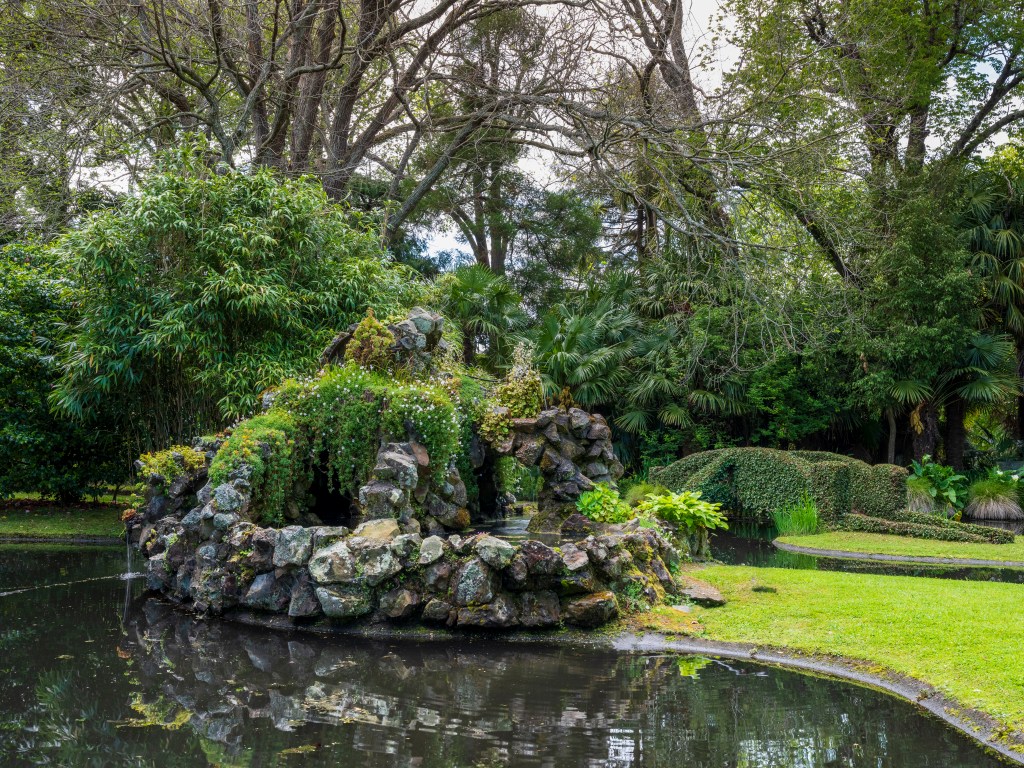
There is no doubt Buxton’s beautiful gardens brought joy to the families who lived in them.  The many exotic trees changed through the seasons as they turned from green to gold and then back to green. Rustic bridges spanning waterlily-filled ponds, plantings of bamboo and delicate Japanese lanterns evoked an exotic world far from the farm gate.  Summer houses were perfect for escaping the drudgery of daily farm life, and ferneries and grottos provided a cool refuge on a hot summer’s day.

The cascade at the Tanner garden, Lansdale, Longburn, 2023.  Credit: Chris Coad

Buxton’s gardens often acted as the catalyst for a new and fascinating hobby.  As plantings matured and changed, the garden was somewhere the owner could add their personal touch while working within Buxton’s overall concept.  The flower beds allowed the gardener to use her imagination and skill as she filled them with the blooms of her choice. 

Roses were a favourite of both Buxton and the women he worked for, and the rose garden was always a special part of a Buxton design.  Planting plans show that although the location of roses was always indicated, the choice of which varieties to plant was not.  This enabled the owner to choose her favourites and make it her rose garden.  Once established the roses and other flowers could be picked for the house, included in a bridal bouquet or entered into local horticultural competitions.

The avenue of lime trees at Greytown Soldiers’ Memorial Park, 2024.  Chris Coad.

Women were proud of their gardens and loved to share them with family, neighbours, the wider community and even with royalty – in 1958 Gladys Hudson of Greenhill hosted the Queen Mother for a weekend.   In the 1940s, renowned New Zealand artist Rita Angus found that painting her parents’ garden at Waikanae helped her recover from a breakdown.  Barbara Matthews wrote about the same garden for New Zealand Gardener some years later. 

Photographs of women in Buxton gardens depict families in their Sunday best, sisters pausing to smile for the camera, daughters on their wedding day and mothers nursing babies.  The subjects are captured under trees, beside flower beds, sitting on benches and posed on a Buxton bridge.  Shots of eager young tennis players, beautifully outfitted members of the hunt and exquisitely dressed locals attending garden fêtes, fundraisers and parties in Buxton gardens all feature women.

The gardeners taking a break in the Tatham garden, Homewood, Wairarapa, c1917.

Women who grew up in a Buxton garden often have special memories.  Details of glorious plantings of daffodils, trees to climb and orchards to snack in are still vivid decades later.  Robin McConachy whose children grew up in her old family garden, watched it grow and develop.  The garden Annie Brown remembers was already mature when she and her sisters knew it and they were able to enjoy it at its best.

In times of sadness Buxton gardens offered solace and hope to the women who lived in them; indeed, some gardens were created as a means of alleviating overwhelming grief.  The Buxton-designed plantings around war memorials softened the starkness of the concrete monuments and gave women a place to sit or wander while remembering their loved one. 

Parorangi, Kimbolton, designed for Manawatu sheep breeder, Ernest Short.  R P Moore photograph, c1924.  Credit: Buxton family collection.

Alfred Buxton’s success owed much to the women who commissioned his designs, and he repaid them by creating wonderful spaces for them and their families, with many still there today.  By enjoying and cherishing their gardens, and sharing the memories they created, these women have ensured that Buxton’s legacy endures.

Wardian Cases, Plant Humanities and the Royal Botanic Gardens, Kew

James Beattie, Te Herenga Waka—Victoria University of Wellington

I recently spent a day at Royal Botanic Gardens, Kew, where I was hosted by post-doctoral researcher, Dr Diego Molina. Diego works on South American-European plant exchanges, and has just published a book on this topic, with our very own Routledge series, Planting a City in the Tropical Andes: Plants and People in Bogotá, 1880 to 1920.

For someone studying plant exchanges, there is probably nowhere better than Kew. Kew is well-known to historians for its role as a global “sorting house” for plants from around the world. In the nineteenth century, Kew was indisputably at the centre of a global network of botanists and collectors. It received everything from samples of woods, dried specimens, descriptions and, of course, living species. Kew’s role was to investigate species new to European science, improve them, and then send them to the colonies.[1]

The improvement of nature formed a key part of Kew’s aim, which was then known as economic botany. To this end, Kew’s Economic Botany Collection originated as The Museum of Economic Botany, which formed “a ‘library’ of useful plants for manufacturers and a popular attraction for visitors to the Gardens.”[2]

Diego took me to visit the Economic Botany Collection, which today contains “90,000 plant raw materials and artefacts representing all aspects of craft and daily life worldwide”.[3]  The breadth of its collection includes everything from dyestuffs and wooden spears to samples of handicrafts and clothing made from plant fibre—all of which are arranged taxonomically, by wood type not by object or use! It still collects over 800 specimens per year.

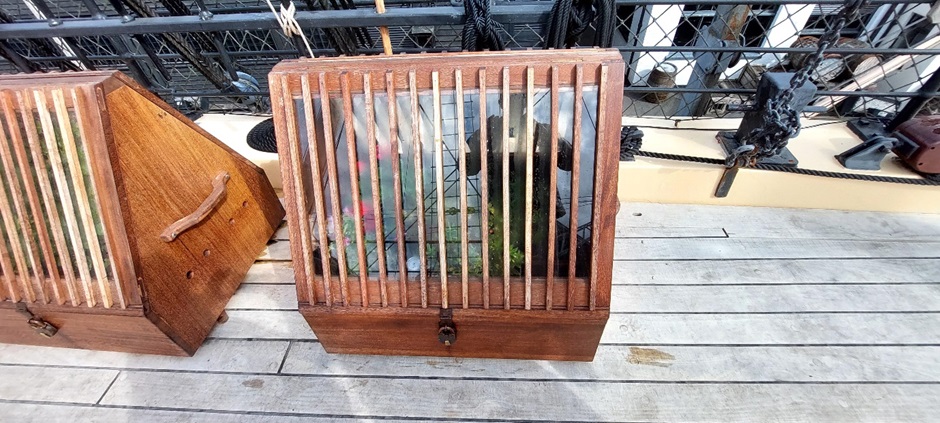
Displayed prominently at the Economic Botany Collection was a wonderful example of the Wardian Case. Both the Wardian case—effectively a mini-glasshouse whose use took off after the repeal of the Glass Tax in 1845—and the steamship facilitated the successful transportation of live plants, making possible the importance of places like Kew. Until the widespread use of Wardian cases, losses of plants moving between continents were remarkably high.[4]

Original Wardian Case, Economic Botany Collection, Royal Botanic Garden, Kew.

East India Company surgeon and plant collector John Livingstone (1770–1838?), writing in 1819, gloomily listed all that could (and very often did) go wrong in transporting live plants from China: from lack of adequate preparation to saltwater poisoning, neglect, and the sinking of vessels. He estimated “that one thousand plants have been lost, for one, which survived the voyage to England.” Given the high failure rate, he reckoned that “every plant [from China] now in England must have been introduced at the enormous expense of upwards of ₤300.”[5]

An excellent illustration of how these cases which shaped our modern world travelled was in evidence on the upper deck of the SS Great Britain, now moored in dry dock as a museum ship in Bristol. The Great Britain was the first ship to be built of iron and equipped with a screw propellor in an ocean-going vessel. It cut the voyage from Britain to the US down to 14 days.

Photograph of reproduction Wardian Cases on upper deck of SS Great Britain.
Arrangement of reproduction Wardian Cases on upper deck of SS Great Britain.

The end of my day’s research involved meeting with other humanities and science researchers at Kew. This included historical geographer Professor Felix Driver, University College London. Felix was a Principal Investigator of Mobile Museum, a major research project on the mobility of biocultural collections, in collaboration with the Royal Botanic Gardens, Kew. With Caroline Cornish, Humanities Research Coordinator at Kew, he is now leading a project on plant humanities.[6]

These projects bring together humanities and science scholars to work together to examine historical plant collections. What can these collections reveal about past environmental injustices and present environmental issues? How can these plant collections aid in reconstructing past environments and climates, and the drivers of those changes?

We could well take a leaf out of these inspiring projects in the UK to return museums and botanical gardens to the central place they once had in research in Aotearoa New Zealand. Another important role is by showcasing the centrality of humanities scholarship on the natural world and humans. Thanks to these new research projects, institutions like Kew are once again at the forefront of interdisciplinary research, by asking questions about our future and the future of our planet.


Thanks.

I would like to thank Diego Molina, Felix Driver, Caroline Cornish and the staff of Royal Botanic Gardens, Kew, for hosting me. All photographs are mine.

Notes

[1] For an excellent introduction, see: Richard Harry Drayton, Nature’s Government: Science, Imperial Britain, and the ‘Improvement’ of the World (New Haven: Yale University Press, 2000).

[2] https://www.kew.org/science/collections-and-resources/collections/economic-botany-collection

[3] https://ecbot.science.kew.org/

[4] For more information, see Luke Keogh, The Wardian Case: How a Simple Box Moved Plants and Changed the World (Chicago: Chicago University Press, 2020). On New Zealand and the Wardian case, see James Beattie, ‘Thomas McDonnell’s Opium: Circulating, Plants, Patronage, and Power in Britain, China and New Zealand, 1830s-1850s’, in Sarah Burke Cahalan and Yota Basaki, eds., The Botany of Empire in the Long Eighteenth Century (Washington, D.C.: Dumbarton Oaks/Harvard University Press, 2017), 163-188.

[5] J. Livingstone, ‘Observations on the Difficulties which have existed in the Transportation of Plants from China to England, and suggestions for obviating them’, Transactions of the Horticultural Society of London, Vol. III, (1819), p. 427.

[6] For more information, see also: The Plant Humanities Lab, Dumbarton Oaks Research Library and Collection.

New Zealand’s Garden(s) of the Hesperides (Part I)

by Annette Giesecke

Maud at Cornwall Park, Hastings, 31 March 1922, Hastings, by Leslie Adkin. Gift of G. L. Adkin family estate, 1964. Courtesy of Te Papa (A.005756).

In the year 1936, author and theatre director Oliver Neal Gillespie (1883–1957) penned an impassioned eulogy of the town of Hastings and its environs. Titled “Highlights of Hastings — The Hawke’s Bay Garden of the Hesperides,” Gillespie’s piece appeared in The New Zealand Railways Magazine (Volume 11, Issue 6, September 1) and opened with a highly evocative description of the region’s landscape:

It is an old saying that the wealth of a land is in its soil. If it is truth, then Hastings is built upon treasure trove. As a matter of fact, the inevitable and rapid growth of the town has its tragic side. Each extra increment of its population spreads over and hides a rich lode. Such is the inordinate, the abounding and extraordinary fertility of the land of the district, that it amounts to sheer extravagance to cover it with paved roads, footpaths, homes and buildings, however handsome they may be. For aeons, the wandering rivers have been bringing in this huge, spreading series of flats, the countless riches of their gatherings. In many places, there are six feet of this black opulence from which any growing thing will spring with vivid life and swift strength. In a land of sunshine and warm and friendly rains, this area rightly claims many leadership rights. Its actual hours of sunshine place it along with Nelson and Napier among the world leaders in the blue sky’s greatest gift. Its rainfall, still, is ample for all purposes, but its rainy days might have been arranged on a limit fixed by tennis or cricket enthusiasts. It is an open air man’s paradise.[i]

There is a clear emphasis on the fertility of Hastings’ soil —“inordinate, abounding, and extraordinary” as he calls it — as well as on the region’s abundant sunshine and ample supply of water, all of which sustain a proliferation of plant growth. These noteworthy attributes, shared by Nelson and Napier, suffice to qualify Hastings as nothing short of “paradise.” Interestingly, Gillespie makes no further mention of the Hesperides’ garden but does later equate Hastings with Arcadia, a fabled, idyllic region in Greece, and with the Garden of Eden, especially Hastings’ Cornwall Park with its “sparkling sheets of ornamental waters”, “winding streams lined with roughcast edging interspersed with seats and novel bridges”, “long avenue of tall palms”, and “vivid green velvet of the lawns.”[ii] In what sense, then, was Hastings a twentieth-century Garden of the Hesperides, and what relation did that famous garden bear to Eden and Arcadia?

The Hesperides in Mythology

Garden of the Hesperides, Attic Red-Figure Lekythos, about 420–400 B.C.
Attributed to Circle of Meidias Painter [Greek (Attic), active 420 – 390 B.C.]. Image courtesy of the J. Paul Getty Museum, Malibu, inv. 91.AE.9, open access.

In classical mythology, the Hesperides were nymphs entrusted with tending the trees that yielded the golden apples so famous in classical mythology. The Hesperides were between four and seven in number, and their names are variously given as Aegle, Erytheia, Hestia, Arethusa, Hespere, Hesperusa, and Hespereia. Accounts of their birth and the location of their garden, the Garden of the Hesperides, are also various. The poet Hesiod (lived circa 725 BCE), an early source, names the elemental deities Nyx (“Night”) and Erebus (“Darkness”) as their parents, but later accounts state that their parents were either the sea god Phorcys and his sister Ceto; or Zeus, king of the Olympian gods, and Themis, the personification of justice; or the second-generation Titan god Atlas, who supported the heavens on his shoulders, and Hesperis, daughter of Hesper, the evening star. The location of the Hesperides’ garden, equally difficult to pin down, was said to be either in North Africa, specifically what was called Libya in antiquity, near the Atlas mountains (modern Morocco); or in the westernmost Mediterranean on the shores of the river Oceanus; or, alternatively, in the lands of the Hyperboreans, in the far east or to the far north, all of these locations being at the “ends of the earth” as it was then conceived.

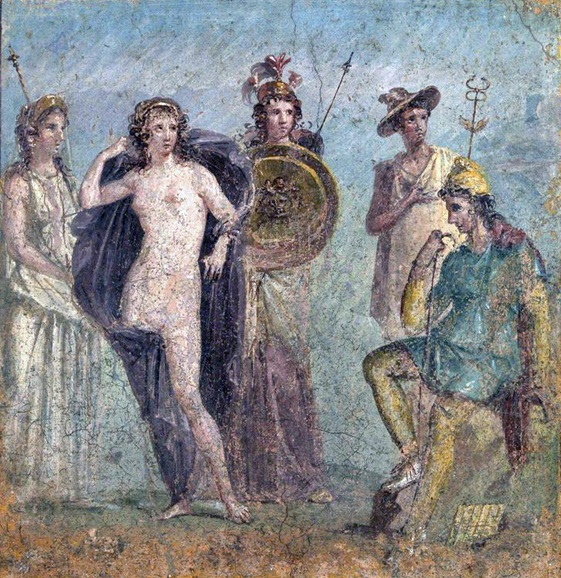
As for the golden apples, the trees that produced them were presents made by the Earth goddess Gaia to Hera, queen of the gods, on the occasion of her marriage to Zeus. The apples were sources of immortality, and thus highly prized. One of these apples ostensibly caused the Trojan War: the goddesses Hera, Aphrodite, and Athena all desired a certain golden apple inscribed with the words “for the fairest.” The Trojan prince Paris was selected to decide who the fairest among them was—an impossible choice to make objectively. He chose Aphrodite, who had also offered him a most enticing bribe: Helen, the loveliest woman in the world. Hera, meanwhile, had offered empire without end, and Athena offered success in war. Aphrodite, however, knew the philandering young prince Paris best. He was notorious for his enthusiasm for women. It was accordingly Aphrodite who was awarded the apple. Paris now faced a challenge in claiming his prize, as Helen was married to Menelaüs, the Spartan king. When Paris absconded with her to Troy, a thousand Greek ships, carrying Greece’s elite warriors, sailed in hostile pursuit. The Greeks besieged Troy for a period of ten years until that city, at long last, fell, consumed by flames when the Greeks, hidden in the belly of the Trojan Horse, emerged from their hiding place with torches and swords in hand.

The Judgment of Paris, depicting Paris (seated) with the god Hermes to his left as well as the goddesses Athena (wearing a helmet and carrying a shield), Hera (wearing a diadem and holding a scepter), and Aphrodite (alluringly disrobed). Fresco from Pompeii, House of the Judgement of Paris (45-79 CE). Image courtesy Wikimedia commons.

The golden apples that Aphrodite supplied to young Hippomenes in order to help him win the hand of Atalanta were also said to be from the Hesperides’ trees. Atalanta wished to remain a huntress, unmarried and a virgin like the goddess Artemis, but numerous men pursued her. Conceding to her father’s entreaties that she consider marriage, she agreed to marry whoever could outrun her. Many unsuccessfully attempted to win her hand and paid the penalty for loss with their lives. Still, one, undaunted, prevailed. This youth, Hippomenes, a great-grandson of the god Poseidon, called upon the goddess Aphrodite for aid, and she responded, bringing him three golden apples from her sanctuary on the isle of Cyprus. The race commenced, and Meleager threw one apple after another out to the side of the race course. Atalanta could not resist the apples, retrieving each of them in turn. Atalanta’s dash after the last apple allowed the youth to win the race and so win her as bride. Atalanta developed affection for her new mate, but the couple’s joy did not last, for in his excitement over his victory, Hippomenes had forgotten to thank Aphrodite. The angry goddess drove him wild with passion, and consequently, they defiled a temple of the goddess Cybele with their lovemaking. For this Cybele punished them by transforming them into lions that she then fastened to the yoke of her carriage.

Atalanta and Hippomemes. In the foreground Atalanta kneeling to pick up an apple and Hippomemes running with an apple in either hand; in the landscape background Atalanta running, from a series of four mythological scenes. Engraving byVirgil Solis, German, ca. 1535–62. Image courtesy The Metropolitan Museum of Art, open access.

Finally, there was the saga of Hercules and the golden apples. As the eleventh of his famous Twelve Labours, Hercules was told by the evil king Eurystheus to bring him apples from the Hesperides’ garden. Not knowing the garden’s location, Hercules first consulted the nymphs of the river Eridanus, who in turn directed him to the sea god Nereus. Hercules seized Nereus, who possessed prophetic powers, while he was asleep and held him fast while the latter repeatedly changed shape; Nereus would only prophesy under compulsion. Directed by Nereus, Hercules commenced his journey and, on the way, came upon the Titan god Prometheus, whom he released from the torment of having his liver eaten away eternally by vultures. From Prometheus Hercules received further advice regarding the accomplishment of his labour: he should ask Atlas, the Hesperides’ neighbor, to fetch the apples in his stead. This Hercules did, asking Atlas to bring the apples in exchange for relieving him, temporarily, of the heavens’ burden. Not surprisingly, Atlas was not keen to resume the onerous task of supporting the heavens on his shoulders, but Hercules tricked him by asking for a temporary reprieve in order to place a pillow on his shoulders as a cushion. According to a variant of this story, which did not involve Atlas, Hercules slew the sleepless, hundred-eyed dragon Ladon that guarded the apple trees and retrieved the apples himself. In any event, Hercules brought the apples to Eurystheus who ultimately returned the sacred apples to him. Hercules, in turn, gave the apples to Athena to return to the Hesperides.[iii]

Hercules stealing the golden apples from the Garden of the Hesperides. Detail of The Twelve Labours Roman mosaic from Llíria (Valencia, Spain), 201-250 CE. Photo by Louis Garcia, Wikimedia Commons.

To Be Continued (in Parts II and III): The Hesperides’ Garden and its Afterlife: Exotic, Fertile Place; Were the Golden Apples Not Apples at All?


Notes

[i] The New Zealand Railways Magazine, Volume 11, Issue 6 (September 1, 1936), page 9.

[ii] Page 10.

[iii] For more detail detail about the Greek gods, goddesses, heroes, and heroines, see Annette Giesecke, Classical Mythology A to Z (2020: Hachette, Black Dog and Leventhal, Running Press).

Te Parapara Garden at Hamilton Gardens

Peter Sergel

Each major development in the evolution of civilisation has generally led to the emergence of a different form of garden and at Hamilton Gardens it’s proposed to develop thirty of those different garden forms. (1) So Hamilton Gardens won’t just tell the story of gardens but a wider story of civilsation. One of humanity’s earliest developments was agriculture and the Hamilton Gardens site provided an ideal example of this. The pre-European gardens along the Waikato riverbanks are considered to have been the most extensively cropped lands in Polynesia. They were also ideal because traditional Maaori gardens weren’t just productive gardens, they included spiritual and aesthetic dimensions. (2) So the original intention was to re-create a garden that might have existed on these riverbanks in pre-European times. However, for various reasons the garden became more of a modern artwork, inspired by those early gardens. Pre-European gardens were a form of swidden agriculture, planted in patches of cleared, burnt over land rather than permanent gardens set within elaborate fencing and palisades. Carved features also looked very different before the introduction of metal tools. However, while this can’t really be called a pre-European garden, there are still many aspects that are significant and the garden itself has been referred to as one of the ‘treasures of Tainui’.

Credit: Hamilton Gardens

The Polynesians who reached Aotearoa some time between 1250 and 1275 must have been well prepared. (3) It’s unlikely to have been the grim survival depicted in the paintings of Goldie and Steele. (4) However, for a tropical culture to survive in the colder temperate climate, a lot of rapid adaptation and innovation was required, particularly since New Zealand cooled significantly with the Little Ice Age just after the Polynesians arrived. That story of settlement and exploration is told in Te Parapara Garden, primarily a symbolic garden rather than an example of a garden design tradition.

According to oral history, the great Tainui and Te Arawa craft sailed to Aotearoa together from east Polynesia, both arriving when the poohutukawa were in full bloom. (5) Near the entrance to Te Parapara Garden a pou represents Hoturoa, the captain of the Tainui waka. His figure is carved in the Tahitian style of ancestral Polynesia. The Tainui waka first made landfall at Whangaparaaoa, then moved on to Toorere, Whitianga and Waitemataa. At Waitemataa it was placed on rollers and pushed across the isthmus from the Waitemataa Harbour to the Manukau Harbour. The log rollers were said to have been cut from Pomaderris apetala that had been part of the floor of the waka. When the Tainui waka made its final landing at Kaawhia, the Pomaderris apparently sprouted and was later used for a variety of medical conditions. (6) A Pomaderris is planted just inside the entrance to Te Parapara. There is also a poohutukawa (Metrosideros excelsa) beside the entrance representing Tangi te Korowhiti, the name given to the poohutukawa the Tainui craft was tied to at the end of its voyage at Kaawhia. (7)

The path into this garden is called Te Ara Whakataukii or ‘Path of Proverbs’, which showcases uncultivated food from the forest and grassland. Plants along the walk are associated with fifteen whakataukii (traditional proverbs or sayings of ancestors) about the journey through time and the significance of Maramataka. (8) The first proverb, ‘He purapura i ruia mai i Rangiaatea’ (‘The seed scattered abroad from Raiatea’), refers to Raiatea in the Society Islands as the origin of the Maaori people. A second, ‘Te iti oneone i kapunga mai i Hawaiki’ (‘A little bit of earth from Hawaiiki in the hollow of the hand’), refers to the soil brought to Aotearoa by the first voyages to ensure their crops would be successful. That seems to have worked, and no more so than along the fertile banks of the Waikato River.

Credit: Hamilton Gardens

Hamilton Gardens is located in an area settled by the Waikato Tainui iwi, who take their name from that famous waka. The general area was primarily a Ngaati Wairere settlement with many paa and settlement sites along the banks of the Waikato River. The only part of my Maaori introduction that I could ever remember without notes was ‘He piko, he taniwha, He piko, he taniwha‘ (‘At every bend in the river there was a chief’). Taawhiao, the second Maaori king, is reported to have described this district: “I whakawhiti aru ai te koopuu mania o Kirikiriroa, me oona maara kai te ngawhaa whakatupu ake te whenua moomona” (“I cross the smooth belly of Kirikiriroa, its gardens bursting with the fullness of good things”). (9)

Central Hamilton was known as Kirikiriroa but the biggest nearby Paa site was Te Rapa, located between the river and the present Waikato Hospital. These areas alongside the Waikato River were renowned throughout Aotearoa for the quality of their gardening skills. Hamilton Gardens was the site of Te Parapara Paa, which in pre-European times was home to Hanui, a famous Ngati Wairere chief and one of the figures carved on the whatanoa gateway of Waikato Stadium. Like other gardens from the ancient world, they were often closely associated with rituals and spiritual beliefs. According to oral tradition, a site at or near the present Te Parapara Garden was associated with sacred rituals concerning the harvesting of food crops and the collection of berries from the forest. There was said to be a tuahu (sacred altar) called Te Ikamauroa there associated with these rituals. The gods being acknowledged were similar to ancient Polynesian ones: Pani, the female goddess who according to oral history gave birth to the first kuumara tubes, and Rongo, the male god of gardening and peace, who was summoned by the priest at planting time to take up residence in the small stone statue at the head of a garden. (10) Special gardens like Te Parapara had mauri (stone objects) planted within the garden as a talisman for sacred rituals associated with gardening.

For a culture highly skilled at navigating by the stars, garden orientation may have made reference to astronomical observation, like most other gardens of the ancient world. There are certainly references to the use of the phases of the moon to guide planting. (11) Particular prominence is given to the Matariki constellation that rises in the predawn sky during June and July. It’s a star cluster recognised in other ancient cultures and known by different names including Pleiades, Messier 45, the Seven Sisters, and Subaru. (12) For Maaori, when Matariki is seen rising, it’s the sign of a new year and a time to celebrate, mourn the dead, and anticipate new life and the planting of a new harvest. Each year Matariki is celebrated at Hamilton Gardens with hundreds of people gathering at dawn to hear a karanga, waiata and a koorero about Matariki. Rangihaeata (the new dawn) is the appropriate time to hold such an event.

In Te Parapara Garden, the poutumu (heavy posts) in the palisade bear the names of the stars in the Matariki constellation. The smaller uncarved pouhimu depict the stars and ancient local deities. Pouwhakarae are posts that represent specific ancestral figures important in Ngaati Wairere whakapapa and special locations. Lines of pou along a palisade fence would sometimes show lines of descent and various ancestors and deities. Poutakitaki (structural support posts) are named after phases of the moon.

The waharoa or entrance marks the separation between the entrance path Te Ara Whakatauki (path of proverbs) and the area of the garden enclosed with a palisade. While the entrance path features plants indigenous to Waikato, the enclosed garden beyond the entranceway features five introduced plants. Early Maaori seem to have quickly worked out ways to use the indigenous plants they found and in some cases deliberately cultivated, like the flax and karaka. Some of these useful plants are listed in the footnote.(11) Examples include the Mamaku pith and cabbage tree roots and the karaka kernels that had to be cooked continuously for a day or two. Bush was burned to encourage growth of bracken fern, and the root of the fern was pounded into flour that was baked as cakes. (12) Other plants had medical benefits and these are marked with numbers in the Valley Walk area of Hamilton Gardens.

Adaption to the new environment is said to have occurred in three stages that transformed the old East Polynesian island culture. The Maaori settlement period was primarily about hunting and gathering, with seal rookeries, moa and other ground-dwelling birds being major sources of food. In the second phase gardening became increasingly important, and some native plants also started to be cultivated like the karaka, cabbage tree and bracken fern. As populations and competition for resources increased, larger tribal communities and alliances formed in settled areas. (13)

Early settlers and missionaries frequently wrote about the neatness and precision of the planted crops. (14) Like earlier Polynesian cultures, Maaori put a lot of effort into the modification of local soils, terracing, stone or wooden boundary walls, pest control by fumigation, weeding, cultivation, drainage ditches and storage pits. Fourteen types of specialist garden tools have been identified, made from pounamu, argillite and tora (albatross bone). (15)

Credit: Hamilton Gardens

Gardening could have involved six hour days from the whole community for half the year. To get some idea of the work involved, you only have to look at 1950s aerial photographs of the Waikato River terraces that were covered in tapaahi depressions or borrow pits. (16) They were a distinctive feature along the Waikato riverbanks that became more obvious when the land was cleared for farming. It’s not until you stand in these holes that you realise how many thousands of baskets of pumice sand were removed over a very long period. (17) Pumice was added to the soil to increase aeration, improve drainage and make cultivation easier. Charcoal was also added from burnt over forest and you can still see these modified ‘Maaori soils’ along some sections of eroded riverbank. Modern experiments have shown the soil warms sooner with these modifications to the soil. (18)

Like earlier Polynesian gardens, stone walls were often used to define family boundaries and provide wind shelter in exposed areas of Aotearoa. But stones were also useful for holding radiant heat because they faced a challenge no other Polynesian culture had: a short growing season and frosts, particularly during the Little Ice Age (1300-1850).

There’s a general assumption that the first settlers in Aotearoa would have brought their full stock of useful plants, like banana, breadfruit, pandanus, sugarcane, coconut, arrowroot, giant taro, ginger, turmeric, kava, Polynesian bamboo and Malay apple. (19) However, there is only evidence of five surviving for any length of time in the colder climate.

  • Ti Pore or Pacific Island cabbage tree (Cordyline fruticosa) had been used throughout the Pacific. It was used for garlands, skirts, roofing thatch, sandals, baskets, rain capes, rope and fishnets. They have a carrot-like rhizome and through selective breeding a sugar-laden rhizome variety was developed.
  • Taro (Colocasia esculenta) was grown for its edible tubers and leaves that were cooked.
  • Hue or bottle gourd (Lagenaria siceraria) produces a fruit that was dried and used as a storage vessel.
  • Aute or paper mulberry (Broussonetia papyrifera) was regularly cut when it was two to four metres tall to produce fibrous inner bark. This was used to make tapa cloth for kites and loincloths.
  • Uwhi or winged yam (Dioscorea alata) was grown for food in the north.
  • Kuumara or sweet potato (Ipomoea batatas) was the most valuable staple crop. Heritage varieties are used in Te Parapara garden, two of those DNA-tested to the 13th century and the others possibly introduced by the early sailors and whalers. (20)

Kuumara were treated with great care according to traditional methods, which involved making a puke-ahu or mound in which the tuber was planted. These mounds improved drainage, generally preventing the tuber from rotting. But it also increased the surface area around the tuber, which increased the temperature and extended the growing season. The worst pest to damage the pre-European kuumara crops was the Kumara Caterpillar Moth. (21) This could be picked off by hand but early European visitors reported the kuumara fields were often fumigated with the pungent smoke from fires in which kawakawa (Macropiper excelsum) leaves had been placed. (22)

Kuumara would grow continually in tropical Polynesia but in the colder Aotearoa climate it was essential to safely store kuumara for long periods. They were often stored in sunken huts with a thatched roof and side drains. But the Maaori had invented specialised underground chambers called rua that could keep the kuumara dryer and cooler. (23) These sometimes had ornamental carved entrances, like the example at Hamilton Gardens, (24) but many were cut into banks with doors to keep out rodents and entrances hidden to avoid theft. (25) The one in our garden has a massive concrete roof and would probably make a good nuclear fallout shelter.

Like most populations in the ancient world, life was short and brutal and analysis of bone fragments (26) suggest there was often a seasonal shortage of food. Kuumara crops and kuumara stores needed to be protected from theft and invasion. That meant settlement in tribal districts and fostering strong tribal alliances. Where this provided security and an abundance of food, it also encouraged the development of ancient crafts and arts. Ancient Maaori had an eastern Polynesian cultural aesthetic that could produce fine works of art. It’s unclear if there was any ornamental gardening on any scale, but the productive gardens were very carefully laid out. Most followed a quincunx pattern: the ‘five’ side of a dice repeated to form alternating rows. Best also described garden paths bordered with neat rows of stones.

Some of the Maaori craft can be seen in the carvings in Te Parapara Garden. The carved figures on the Waharoa (entrance portal) represent the story of Ruarangi and his battle with the Tahurangi. The pou whakarae (carved posts on the taaepa or palisade) represent specific ancestral figures important in Ngaati Wairere genealogy. The magnificent paataka (four legged storehouse) and the whataarangi (two legged storehouse) were used to store a range of food, tools and other possessions, and were designed with an overhang to keep out rats. (27) The structures are covered in kokowai or red ochre prepared in the traditional manner on an open fire. (28)

Credit: Hamilton Gardens

Te Parapara Garden was developed from 2005 to 2010 in association with Nga Mana Toopu O Kirikiriroa. The fundraising and oversight of the garden’s development was the responsibility of Te Parapara Garden Trust. The Trust’s patron, Harry Puke, played a particularly valuable role in ensuring all of the many different organisations and interests were consulted. Most of the design and research was done by his son Wiremu Puke, who was partially inspired by the discovery of pre-European garden sites during the excavation of the Wairere Drive in northern Hamilton. Much of the funding for this garden was provided by the Ministry of Internal Affairs through a lottery grant. The project was managed by Parks Manager Bill Featherstone. Other key people in the development of this garden included Piri Poutapu, Dante Bonica, carvers Sam Roa, Shane Tamaki and carvers of the Te Puia Maaori Arts and Crafts Institute at Whakarewarewa. The garden was officially opened in December 2008 by the Governor General His Excellency Anand Satyanand, witnessed by the Maaori King Te Arikinui Tuheitia Paki and Hamilton Mayor Bob Simcock.

References
  1. Peter Sergel, The Time Traveller’s Guide to Hamilton Gardens, Phantom House, 2023
  2. The Maaori language in this article uses double vowels instead of macrons, in accordance with the practices of Waikato Tainui.
  3. Andrew Crowe, Pathway of the Birds- The voyaging achievements of Maaori and their Polynesian ancestors, Bateman, 2018, p.180
  4. James Belich, Making Peoples, A History of the New Zealanders from Polynesian Settlement to the End of the Nineteenth Century, Penguin Books, 1996, p.38
  5. Andrew Crowe, Pathway of the Birds- The voyaging achievements of Maaori and their Polynesian ancestors, Bateman, 2018, p.178
  6. Wiremu Puke, conversations recorded by Geoff Doube, 2005 -2009
  7. Wiremu Puke, Notes made over several years
  8. Venetia Sherson article in Heritage NZ Journal, Issue 161, winter 2021. P.31
  9. Wiremu Puke, conversations recorded by Geoff Doube, 2005 -2009
  10. Helen Leach, 1,000 Years of Gardening in New Zealand, Reed, p71 *
  11. Mere Roberts & Frank Weko, Maramataka: the Maori Moon Calendar, Research Report 283, 2006
  12. Venetia Sherson article in Heritage New Zealand Journal, Issue 161, winter 2021. P.35
  13. Plant list in appendix 4 of the Time Traveller’s Guide to Hamilton Gardens.
  14. Photos of archaeological sites by W. Gumbley show the footprints of ancient kuumara puke laid
    out in a perfect grid.
  15. Elsdon Best, Maori Agriculture, Te Papa Press,1925,p.32-34 *p.47 *
    Wiremu Green, Carving a Contemporary Replica of the 1769 ‘Joseph Banks’ Panel Using Pre-Steel Tools – Reviving a Traditional Maaori Carving Technique, Journal of Material Culture, 2019, p. 13
    Caving tools ranged from toki haruru (wide bladed greenstone adze) and toki matariki (an adze made from package) to toki panekeneki (a small finishing adze)(16)
  16. Old aerial photographs taken by K. Jones held in Hamilton Public Library
  17. Walton and Cassels 1992-166 and map by C. Edkins
  18. Helen Leach, 1,000 Years of Gardening in New Zealand, Reed, p35 & 71 *
  19. Helen Leach, 1,000 Years of Gardening in New Zealand, Reed, p49 *
  20. Seven varieties of kuumara are currently grown in this garden: parapara, poukena, rekamaroa, taputini, mahina, rekarawa and huti huti. Poukena was thought to have been introduced by the early whalers and sealers from the 1800s. Venetia sherson article in Heritage New Zealand Journal, Issue 161, winter 2021. P.31
  21. Moth caterpillar (Agrius convolvuli)
  22. Wiremu Puke, Notes made over several years.
    Wiremu Puke, Conception, construction and the cultural significance of Te Parapara Garden in Hamilton, Aotearoa, Journal of New Zealand & Pacific Studies, Vol 9, No.2 Aug 2020, p.179 – 198
  23. Helen Leach, 1,000 Years of Gardening in New Zealand, Reed, p61 *
  24. Roger Neich, Tradition and Change in Maaori and Pacific Art, Auckland Museum, 2013, p.182
  25. Elsdon Best, Maori Agriculture, Te Papa Press,1925, p.92 *
  26. Helen Leach, 1,000 Years of Gardening in New Zealand, Reed, p60 *
  27. Elsdon Best, Maori Storehouses and Kindred Structures, A.R. Shearer, Government Printer, 1974, p.92
  28. Ochre or iron oxide gel called mineral ferrihydrite was gathered from several sites around the district and heated on an open fire to oxidise and dehydrate to bring out the red colour. The source and heat determine the final colour but red usually needs 750°C. After burning the ochre is ground and mixed with vegetable oil.

Whanganui’s Pākaitore Palms

Mike Lloyd, Victoria University of Wellington (mike.lloyd@vuw.ac.nz)

In his work on war memorials in New Zealand, Jock Philips calls Whanganui ‘the war memorial capital of the world’.[1]  Clearly, the expression is used for rhetorical effect, not really being open to empirical evaluation.  Nonetheless, in the example of Whanganui’s small riverside reserve originally known by Māori as Pākaitore, then in 1900 to become Moutoa Gardens, but then in 2001 to return to being called Pākaitore,[2] substance is found for Philips’ expression. The less than one hectare site contains three significant war memorials.  As Philips details, ‘The Maori name was Pakaitore, the place (pa) where food (kai) was given out (tore)’, pointing to the strong significance to Māori of this gathering place.  The renaming as ‘Moutoa Gardens’ overrode this initial sense, emphasising the 1864 Battle of Moutoa with its complex array of antagonists.[3]  Eventually, related to the 1995 occupation of Moutoa Gardens, the land was vested in the Crown, with the return to the name Pākaitore.  The presence of the three war memorials on the site is testament to this complex history, which can still invoke strong emotions.  An unintended consequence of the well documented nature of these events is help in telling an untold history: the story of the planting and removal of palms in Pākaitore.  This has gone on for well over 120 years, as we can see by considering the 1920 photo shown in Figure 1.   

Close scrutiny of Figure 1 shows one of the two earliest palms to be planted in Pākaitore.  Magnification of the photo shows that past the flagpole is a palm able to be identified (from subsequent information) as a Washingtonia robusta (common name Mexican fan or skyduster palm).  There is no record of the palm’s planting. However, in 1911 Whanganui newspapers carry reports of ‘choice varieties of palms’ being planted on Durie Hill, and very old W. robusta can still be seen there. The reports note that these palms were imported from Australia,[4] and it seems fair to assume that the sole specimen in Pākaitore came from the same shipment, meaning that a planting date of circa 1911 looks reasonable.  At this time Mexican fan palms were being planted in other cities, for example Auckland and Napier, along with other introduced palms. But in Pākaitore we can see palms not commonly found in early New Zealand palm landscaping.  Figure 2 shows this trend began with the early planting of a nikau palm (Rhopalostylis sapida).[5]

The photo is a detail from an Auckland Weekly News collage of 7 photos taken during Anzac Day observances on April 30, 1930.  The cenotaph in view to the right is the Māori World War One Memorial built in Pākaitore from 1924 and unveiled on Anzac Day 1925.[6] We see a good crowd gathered for the ceremony, and there to the left of the memorial is a nikau palm.  The height of the visible leaf node suggests the palm has a developed trunk, which can sometimes take over 10 years to start appearing.[7]  This and its height suggest the palm is about 20 years old. Therefore, it possibly could have been planted before, or at least within a few years of, the Mexican fan palm’s planting.  There is no available record or photo that can verify this date. However, there is other contextual information that partly helps in answering this question.  In 1912 in a report on ‘Local and General’ news it is reported that ‘Mr Gregor McGregor has sent another large shipment of plants to the borough nurseries, including about twenty well-grown nikau palms.’[8] Gregor was born in Matarawa Valley to the south-east of Wanganui, worked in the upper reaches of the Whanganui river, spoke te reo, and was a noted promoter of native flora for planting in the Whanganui region.[9] Moreover he was married to Pura McGregor (née Te Pura Manihera), whose father was killed in the Battle of Moutoa, and whose uncle was Major Kemp (Te Keepa Te Rangihiwinui), memorialised in the Kemp monument built in Pākaitore in 1911[10]. Both McGregors were involved in the Wanganui Beautifying Society, particularly with the development of the Rotokawau Virginia Lake Reserve, where a memorial still stands to commemorate Pura McGregor.

It is not able to be confirmed, but it does look highly likely that the single nikau planted in Pākaitore came from the donation of nikaus, sourced by Gregor McGregor either in the Matarawa Valley farm or from bush remnants in the upper Whanganui River.  An item on ‘Town Talk’ in 1931 notes that ‘A Nikau in Moutoa Gardens which has burst into flower has been a subject of interest to many people during the past few days.’[11] This aligns with the description of ‘well-grown’ nikaus sent by Gregor McGregor to the council, as it is stem size rather than age that is a better indicator of first flowering in nikau.[12]

Unfortunately, there are no available photographs that show a younger nikau in Pākaitore, nor any mention in newspapers of its planting date.  In some way trying to ascertain a planting date is a moot point, as there is no doubt about its later fate: it was removed (or perhaps died).  The mystery is when this happened and why.  Requests to the local council and museum archivists found no information on these matters.  However, there is some photographic evidence establishing that the nikau was present into the early 1960s, and interestingly this also shows two other palms in Pākaitore.  Figure 3 is one of the very few photos that shows both the nikau and the two newcomers.

Obviously, the two newcomers are Phoenix palms.  Their planting was noted in the Wanganui Chronicle as follows: ‘Phoenix canarianthus [sic] was planted in Moutoa Gardens yesterday.  These plants, which come from the Canary Islands, were grown from seeds in the municipal nursery. A number have already been planted around the Art Gallery and at Virginia Lake and are in a flourishing state’.[13] The photo shows the 34 year old Phoenix palms having the robust stature we would expect at this age.  The planting as a pair in front of a building – the Whanganui courthouse – was a common landscape trope at the time.  The nikau is obviously a smaller palm in terms of crown spread and trunk diameter, but we can see it is not an insignificant specimen, and has set seed.  Clearly, the photo also shows that the other trees in Pākaitore are gaining in stature, with a red flowering Eucalytpus (renamed Corymbia), a pohutakawa, and an English oak all visible. Whereas the fate of the nikau after this is a mystery, there is no similar mystery as to the fate of the two Phoenix palms.  Figure 4 indicates this.

The top photo shows the early stages of the construction of a new Whanganui courthouse building.  Other aerial images show that with the removal of the old wooden courthouse the two Phoenix palms were left in-situ, but by March 1966 the one to the right was removed.  The new courthouse was larger and also differently angled into Pākaitore, thus necessitating the removal of the southern-most Phoenix palm.  It is another small mystery as to why the northern-most Phoenix palm, initially left untouched, was removed by 1967 as indicated in the LINZ Retrolens photo.  At this time there were certainly good numbers of Phoenix palms in Whanganui, many of which were later included in the Register of Notable Trees, so perhaps the loss of these two in Pākaitore was not seen as an issue.  Additionally, it does not seem the case that this removal is an early case of a developing preference for native flora.  The removal, probably shortly after 1962,[14] of the nikau palm indicates this, as do the later developments indicated in Figure 5.

The figure shows several interesting developments in Pākaitore.  The 2010 GoogleMaps streetview photo shows to the centre right a young Jubaea chilensis (common name Chilean wine palm).  Secondly, we can see that two new W. robusta now grow next to the by now very tall early planted palm (here it is approximately 100 years old). The fact that the single specimen was complemented by two others is not unexpected, as the tallness of the palm coupled with its relatively slim trunk makes a single specimen seem a bit ‘leggy’, hence it is more commonly planted in groups.  The 2010 Google streetview also shows in the foreground a new mass planting of nikau (totalling over 50), actually extending right along the side of Pākaitore that faces the river.  The 2023 photo shows that despite claims that Chilean wine palms are slow growing, the sole specimen on view here has made strong growth, clearly showing the typically massive trunk they are known for.[15] Interestingly, available photographic evidence suggests the palm was not planted until after 1995.[16]  It is in excellent health, as are the nikau which have also made good growth in the 13 years between the dates of the two photos, something reiterated in Figure 6.

The final figure clearly indicates that in the future the nikau palm set is going to be a significant arboreal feature of Pākaitore.  Of course, they are relatively slow growing, but there is no doubt that with time the mass planting will constitute a significant version of vernacular palm landscaping in New Zealand.  It will more that make up for the removal of the early nikau.  But the photo also shows that the nikau are not the only arboreal elements that will become more striking as they age and grow. The large tree to the top right of the photo is a kauri, in excellent health.  The trio of W. robusta are likely as a collective to be more impressive looking than the previous sole specimen. And presumably, even though of course it is an exotic, the Chilean wine palm will remain and look even more impressive with age.  The mystery of the initial removal of the early-planted nikau remains, as does the part-mystery of the removal of one of the Phoenix palms, but the current progressive state of Pākaitore means a search for the explanation of both removals is relatively unimportant.[17]  An eye to the future, coupled with the accountability associated with better record-keeping, should mean that within Pākaitore palms of all kinds will continue to prosper, along with the other trees found therein.

Acknowledgements

This blog is dedicated to Oliver Stead (1963-2024) who would have appreciated the nikau palms (and the removal of the Phoenix palms).  Thanks to Simon Bloor of Whanganui District Council, and Sandi Black, Whanganui Regional Museum, for help with information.  Thanks also to Michael Brown for continued talk about matters arboreal.


Footnotes

[1] J. Phillips, 2006, ‘Wanganui: War memorial capital of the world’, in K. Gentry & G. McLean (eds.), Heartlands: New Zealand Historians Write About Places Where History Happened, Auckland: 72-89.

[2] For details see, Pākaitore Historic Reserve Board, Pākaitore: A History, 2020, H & A Print.

[3] See D. Young, Woven by Water: Histories from the Whanganui River, 1998, Wellington: Huia Publishers.

[4] ‘Local and general’, Wanganui Herald, 12 June 1911, p. 4; ‘Local and general’, Wanganui Herald, 24 August, 1911, p. 4.

[5] Nikau palms were certainly known by early gardeners, including enthusiasts like Clement Wragge and Alfred Ludlam, but in the early 1900s when planting in parks and gardens began in earnest there was a prevalent attitude that they belonged in the bush, and would not thrive in parks and amenity gardens.  See, for example, ‘Re Beautifying the streets’, New Zealand Herald, 6 November 1901, p. 7.

[6] E. Morris, Kia Mau ai te Ora, te Pono me te Aroha ki te Ao Katoa: The Māori First World War Memorial at Whanganui’, Turnbull Library Record, 2014, 46: 1-13.

[7] N.J. Enright, ‘Factors affecting reproductive behaviour in the New Zealand nikau palm’, New Zealand Journal of Botany, 1992, 30: 69-90.

[8] ‘Local and general’, Wanganui Herald, 3 October 1912, p. 4.

[9] ‘Our native flora’, Wanganui Herald, 20 July 1912, p. 4.

[10] ‘Pura McGregor, Wikipedia entry, at https://en.wikipedia.org/wiki/Pura_McGregor; Pākaitore Historic Reserve Board ‘Pākaitore: A History’, p. 25.

[11] ‘Town talk’, Wanganui Chronicle, 5 March 1931, p. 6.

[12] N.J. Enright, ‘Factors affecting…’

[13] ‘Untitled’, Wanganui Chronicle, 1 August 1928, p. 6.

[14] Magnification of the 1967 Retrolens image does not seem to indicate the continued presence of the nikau palm, though it could be in the shadow of other trees. Either way, it is definitely no longer growing as confirmed by a 2023 site visit and consulting Google maps.

[15] Jubaea chilensis is a rare palm in New Zealand.  The two largest specimens I know of are planted at George Grey’s Mansion House on Kawau Island, and there is also a large specimen in Monte Cecilia park in Auckland.  Interestingly, there is one other specimen in Whanganui – in a private garden in East Whanganui.

[16] A photo in a 1995 article (p. 47) on the occupation of Moutoa Gardens shows no sign of the Chilean wine palm. See C. Brett, ‘Wanganui: Beyond the comfort zone’, North & South, June 1995, 44-59.

[17] It is possible that further information could be found, but given the resources for putting together this short report it is followed no further here.  I am open to communication on this matter.